
SUNLU S4 Filadryer
4.7Editor score
Four 1kg spool capacity
350W PTC heating system
Three circulating fans
Automatic humidity control
Our 3D printer filament dryer box guide compares capacity, heating, humidity control, sealing, spool compatibility, and features for 10 leading options.
A 3D printer filament dryer box protects moisture-sensitive material from humid air, helping prevent stringing, bubbling, clogged nozzles, poor bed adhesion, and uneven layers. The best unit combines controlled heat, effective airflow, reliable sealing, understandable controls, and enough space for the spools and filaments you regularly use.
We compared these ten dryers by examining stated capacity, heating performance, temperature and timer ranges, airflow, humidity monitoring, sealing design, safety features, filament compatibility, and operating convenience. The list covers compact single-spool units, dual-spool dryers, enclosed storage systems, and larger multi-spool models for demanding workflows.
Each pick highlights the features that distinguish it within the category and explains the compromises involved in its design. Ratings reflect the available product feedback, while specifications come from the listed product information. Product listings, features, and pricing can change, so confirm the latest details and compatibility before purchasing.
4.7Editor score

4.6Editor score

4.7Editor score
The comparison below covers capacity, heating capability, controls, and filament support. It shows how each dryer approaches moisture management, from compact single-spool boxes to enclosed systems built for multiple materials and printers.
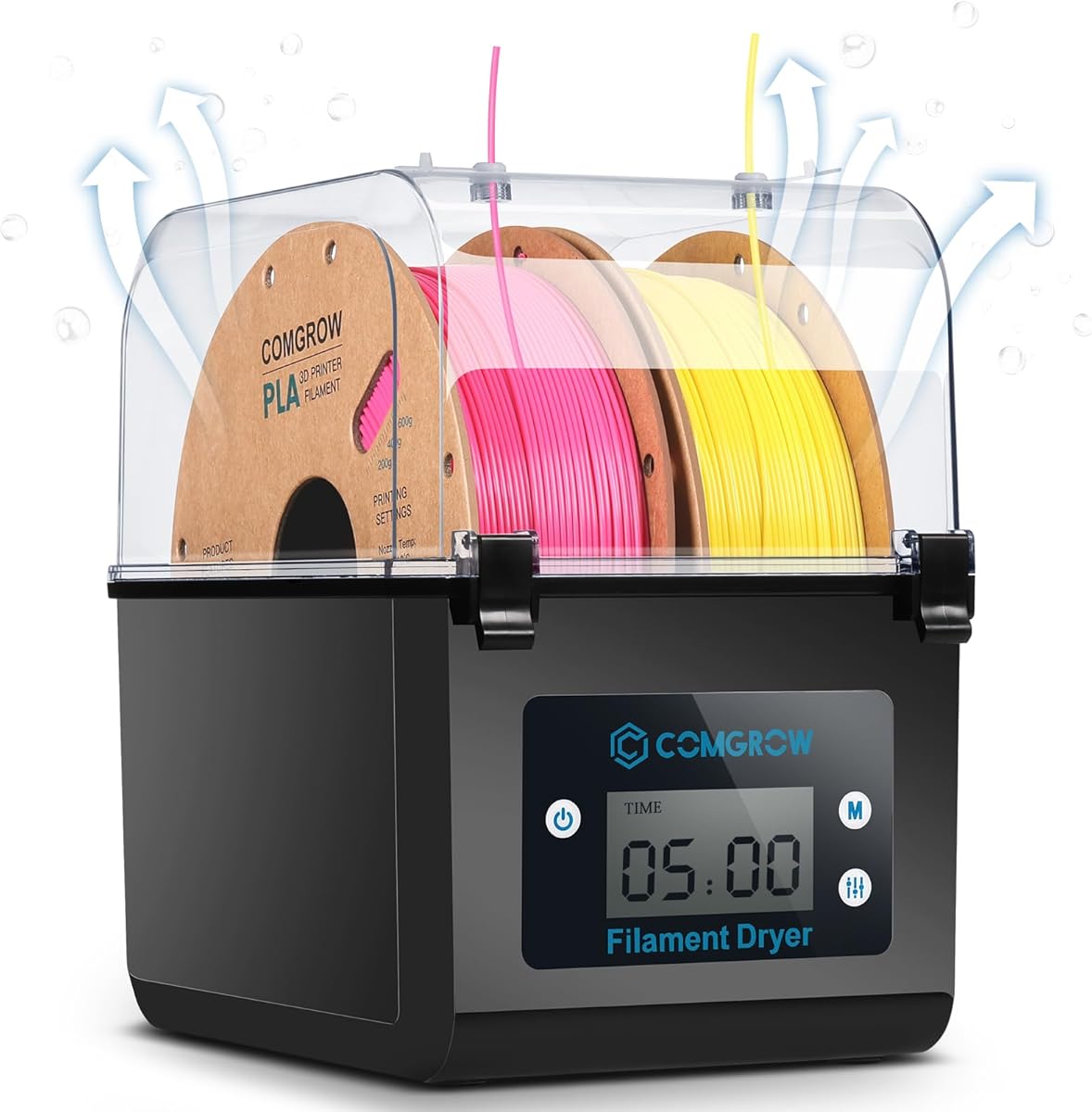



The Comgrow 3D Printer Filament Dryer Box combines enclosed drying, real-time environmental monitoring, and space for two 1kg spools. Its listed 4.4 rating reflects a broadly positive reception, while its strongest selling points are the 2-inch display, adjustable heat, and ability to maintain a dry environment while filament feeds directly into a printer.
We may earn a commission when you buy through this link, at no additional cost to you.
Its inner dimensions of 9.29 by 6.49 by 9.13 inches allow the box to hold two rolls of 1kg filament. The operating range of 40°C to 50°C is deliberately limited, but it covers common drying needs for materials such as PLA, ABS, and SILK according to the product information. A six-to-12-hour timer gives users two starting points rather than fine-grained scheduling.
The sealed upper cover, silicone cable sheath, Teflon tube, and closable outlet hole all support moisture control. The outlet must remain open during operation so moisture can escape, then closed when the unit is not being used. This design is more involved than a passive container, but it offers more active protection when setup is handled correctly.
This is a practical choice for makers with two frequently used spools who want temperature and humidity readings without moving to a large multi-chamber system. It is less suitable for advanced materials requiring a higher drying temperature or for users who need extended, independently adjustable timers. For ordinary two-spool workflows, however, it offers a useful balance of capacity, control, and protection.
The dual-spool chamber gives users more flexibility than a single-roll enclosure without reaching the footprint of a four-spool system. It is especially useful for keeping two materials ready or drying separate filament types at different times.
The LCD reports temperature and humidity while touch buttons and the function control allow users to set drying conditions. Seeing the internal readings can make it easier to confirm that the enclosure is functioning as intended.
We may earn a commission when you buy through this link, at no additional cost to you.
The Creality Space Pi X4 is the most feature-rich option in this guide, combining four-spool capacity with two independently heated chambers. Its 4.6 rating and broad material support make it a strong choice for users who regularly print with multiple filament types or maintain several printers.
We may earn a commission when you buy through this link, at no additional cost to you.
Each chamber uses 200W PTC heating and can reach as high as 85°C. The product information describes independent chamber control, with suggested settings around 50–60°C for common materials and 80–85°C for advanced options such as ABS, PET, PC, ASA, PA, and PAHT. The enclosure can hold four 1kg spools or two 2kg spools.
The box is designed to do more than remove moisture. It can actively maintain humidity while a print is paused, while the silicone-sealed structure limits reabsorption. An illuminated window lets users check spool status without breaking the humidity-controlled environment, although a larger enclosure naturally occupies more workspace than compact alternatives.
Choose the X4 when capacity, higher drying temperatures, and active storage control matter more than simplicity. It is especially relevant to advanced users who switch between common and high-performance polymers. Buyers should measure available space and verify the filaments and printer workflow they intend to use, but for a premium multi-spool setup, the stated features are unusually comprehensive.
Two separately controlled heating sections make it possible to approach different filament requirements within one enclosure. That flexibility is valuable for users with multiple material types or spools that do not benefit from identical drying conditions.
An 85°C maximum gives the X4 considerably more headroom than compact units limited to 50–55°C. The product information specifically identifies advanced polymers for the higher range, making the enclosure relevant to demanding filament workflows.
We may earn a commission when you buy through this link, at no additional cost to you.
The Creality Space Pi SE is a compact dryer that pairs PTC heating with a built-in fan, thermal insulation, and a precision sensor. It holds one 1kg spool, supports both 1.75mm and 2.85mm diameters, and has a listed 4.4 rating.
We may earn a commission when you buy through this link, at no additional cost to you.
The chamber can reach 65°C within 15 minutes, according to the product information, while the 360-degree airflow helps distribute heat throughout the enclosure. Users can set temperatures from 45°C to 65°C and drying times from zero to 24 hours. The screen and knob provide access to real-time humidity monitoring and a drying-hours countdown.
Its compatibility list includes PLA, PLA+, PETG, TPU, ABS, ASA, PP, PC, and PA nylon, with Teflon tubes included or referenced for smoother filament feeding. The unit is also designed to print while drying. One important operating note is that the manufacturer recommends storing the filament in a vacuum bag after drying to preserve the dry condition.
This dryer makes sense for a single-spool user who wants active temperature and humidity controls in a compact package. It is not the best option for keeping many materials ready at once, but the broad 24-hour timer and 65°C ceiling offer useful flexibility at a more modest tier. It is especially attractive for PLA, PETG, and other common filaments requiring moderate drying.
The stated 15-minute heat-up to 65°C offers a convenient starting point for users who do not want to leave a dryer running for a long period before every print. A built-in fan supports more even heat distribution inside the chamber.
Real-time humidity monitoring and the countdown display let users track the drying process rather than relying only on a fixed program. The sensor-equipped design is particularly useful in humid environments where moisture pickup can be rapid.
We may earn a commission when you buy through this link, at no additional cost to you.
The Creality Space Pi focuses on a feature-rich single-spool enclosure with a 3.7-inch touchscreen, twelve filament presets, and a 110W PTC heater. Its listed 4.4 rating reflects a well-received design that offers more interface flexibility than many compact dryers.
We may earn a commission when you buy through this link, at no additional cost to you.
The built-in fan circulates hot air through the chamber for 360-degree heating. Users can choose among one-key settings for up to 12 filament types, including PLA-CF, PA-CF, and ASA, or adjust the temperature manually across a 45–70°C range. The timer can run from zero to 48 hours.
A power-off memory function restores the previous material and temperature settings after an interruption, reducing the need to repeat configuration. The display can switch between Celsius and Fahrenheit, while the enclosure supports 1.75mm and 2.85mm filament. As with many single-roll boxes, however, it cannot manage several spools simultaneously.
The Space Pi is a good match for one dedicated spool and users who value detailed controls over high capacity. The generous timer and wide temperature range are useful for experimenting with different materials, and the large screen makes settings easier to navigate. It may be less suitable for a shared workshop with many filament types, but as a single-material dryer it is well equipped.
Twelve one-key programs cover common filaments and selected composite materials. Users can begin with a suitable preset and then make manual adjustments when ambient conditions or a particular spool require a different schedule.
The 48-hour timer extends beyond the shorter programs found on many compact dryers. This provides useful flexibility for owners who want to condition a spool gradually or maintain a dedicated material over an extended period.
We may earn a commission when you buy through this link, at no additional cost to you.
The SUNLU S1 Plus Black is a compact single-spool dryer designed for users who want a simple way to reduce moisture-related print problems. It has a 4.3 rating and combines a fan, a 2-inch LCD, and temperature and time controls in a small enclosure.
We may earn a commission when you buy through this link, at no additional cost to you.
The adjustable range is 35–55°C, making the unit suitable for many common filament types while offering less high-temperature capability than premium multi-chamber systems. The display reports temperature, time, and humidity. Holding the left button changes the drying time, while the right button changes the temperature, providing a straightforward physical interface.
The internal capacity is listed as 210 by 89 millimeters in height, and the product supports 1.75mm, 2.85mm, and 3.00mm filament diameters. The stated material compatibility includes PLA, PETG, ABS, TPU, nylon, and PA. Its small footprint is convenient, although users must confirm that their spool dimensions fit.
This model is well suited to a single frequently used material, a small workspace, or a beginner who needs drying without a complicated setup. The fan is intended to speed moisture discharge, and the clear screen makes conditions easy to monitor. The limited 55°C ceiling and compact capacity are the main constraints for users working with advanced polymers or multiple spools.
The single-spool format keeps the enclosure focused and manageable in size. It is a practical solution when one material is used consistently and replacing a large multi-spool system would add unnecessary space and complexity.
The LCD displays temperature, time, and humidity, giving users immediate feedback about the drying environment. The two-button control scheme keeps adjustments straightforward without requiring a touchscreen.
We may earn a commission when you buy through this link, at no additional cost to you.
The Polymaker PolyDryer takes a different approach from heated dryers by emphasizing sealed storage, desiccant protection, and humidity monitoring. It holds one spool up to 1kg and has a 4.4 rating, making it appealing to users who want dependable storage between prints.
We may earn a commission when you buy through this link, at no additional cost to you.
Its airtight enclosure helps limit exposure to humid air, while the built-in hygrometer provides a visible reading of the internal environment. A desiccant-supported design helps manage residual moisture without requiring a powered heating cycle. The box allows filament feeding while the spool remains inside, so users can continue printing without breaking the sealed setup.
Compatibility includes PLA, PETG, ABS, ASA, TPU, PVB, and PA or nylon across 1.75mm, 2.85mm, and 3.00mm diameters, up to a 1kg spool. Unlike the heated models in this guide, its product information does not specify an adjustable temperature range or powered drying cycle. The package also contains the storage box only, so accessories would need to be considered separately.
Choose the PolyDryer when controlled, passive storage and clear humidity feedback matter more than actively heating a wet spool. It is particularly useful during long pauses, overnight jobs, or periods when filament will sit unused. Users seeking moisture removal through heat should choose a heated model, while storage-focused users will appreciate the sealed feeding design.
The sealed enclosure and desiccant support work together to reduce the spool's exposure to ambient moisture. This makes the PolyDryer a practical storage companion for material that has already been dried.
The spool can remain inside while filament feeds to the printer. That design helps maintain a more consistent storage environment during long prints, overnight operations, and other extended pauses.
We may earn a commission when you buy through this link, at no additional cost to you.
The SUNLU SP2 combines active drying with a substantial sealed storage base and support for spools up to 3kg. Its 4.4 rating reflects a versatile design for users who need to prepare large amounts of filament and then keep it protected.
We may earn a commission when you buy through this link, at no additional cost to you.
The dryer uses a 250W PTC element and can reach 70°C in approximately 15 minutes. Air circulation provides 360-degree surround heating, while the detachable upper dryer and base allow the storage function to be used independently after drying. Six silicone holes and two PTFE tubes offer flexible routing for multiple filaments.
The storage base uses two sliding latches on the lid and gaskets at the bottom to support a strong seal. Rollers accommodate different spool sizes, and a bar holder supports 250g, 500g, and paper spools. Standard 1.75mm and 2.85mm diameters are supported, alongside materials such as PLA, PETG, TPU, ABS, PA, and PC.
The SP2 is a strong choice for owners with large-format spool inventory or a need to dry and store several filament feeds. Its 3kg compatibility and detachable base distinguish it from compact boxes, but the enclosure is bulkier and the controls and sealed routing demand more attention. Users with one small spool and limited space may find a simpler dryer more appropriate.
Support for spools up to 3kg is the SP2's defining feature. The roller platform and adjustable holder make it relevant to users buying bulk filament who want a single system to manage larger packages.
Removing the dryer section from its base allows the enclosure to become a storage box. Users can dry a spool, close and seal the base, and later print directly from the protected container.
We may earn a commission when you buy through this link, at no additional cost to you.
The Sovol SH02 is a dual-spool dryer built around fast PTC heating, two PTFE feed paths, and improved sealing. It has a 4.3 rating and accommodates two rolls of 1kg filament, making it a balanced option for users who regularly alternate materials.
We may earn a commission when you buy through this link, at no additional cost to you.
Its 150W heater can reach 50°C within seven minutes and 70°C within 25 minutes, with an adjustable range of 40–70°C. A built-in fan circulates air around the chamber. One-key settings cover nine filament types, including PLA, TPU, PETG, ABS, ASA, PVA, PC, PA, and PP.
Thicker sealing materials improve the enclosure compared with the earlier SH01 design. The unit can also provide passive protection when switched off, and the chamber may hold four bags of desiccant to assist moisture control, although desiccants are not included. The redesigned filament-hole positions are intended to accommodate different extruder arrangements.
The SH02 offers a good balance between rapid heating, capacity, and programmable material support. Its safety system cuts heating if the PTC temperature exceeds 130°C and resumes below 90°C, while an alarm sounds if the fan stops rotating. It is a practical two-spool choice, though users wanting richer displays or automatic humidity management may prefer the SUNLU S4.
The 150W PTC system reaches useful drying temperatures quickly while the chamber holds two 1kg spools. This combination suits users who want more capacity than a compact dryer without moving to a four-spool enclosure.
Automatic temperature cutoffs and a fan-stop alarm add protection against overheating. These safeguards are particularly relevant in a heated enclosure that may run unattended during a drying cycle.
We may earn a commission when you buy through this link, at no additional cost to you.
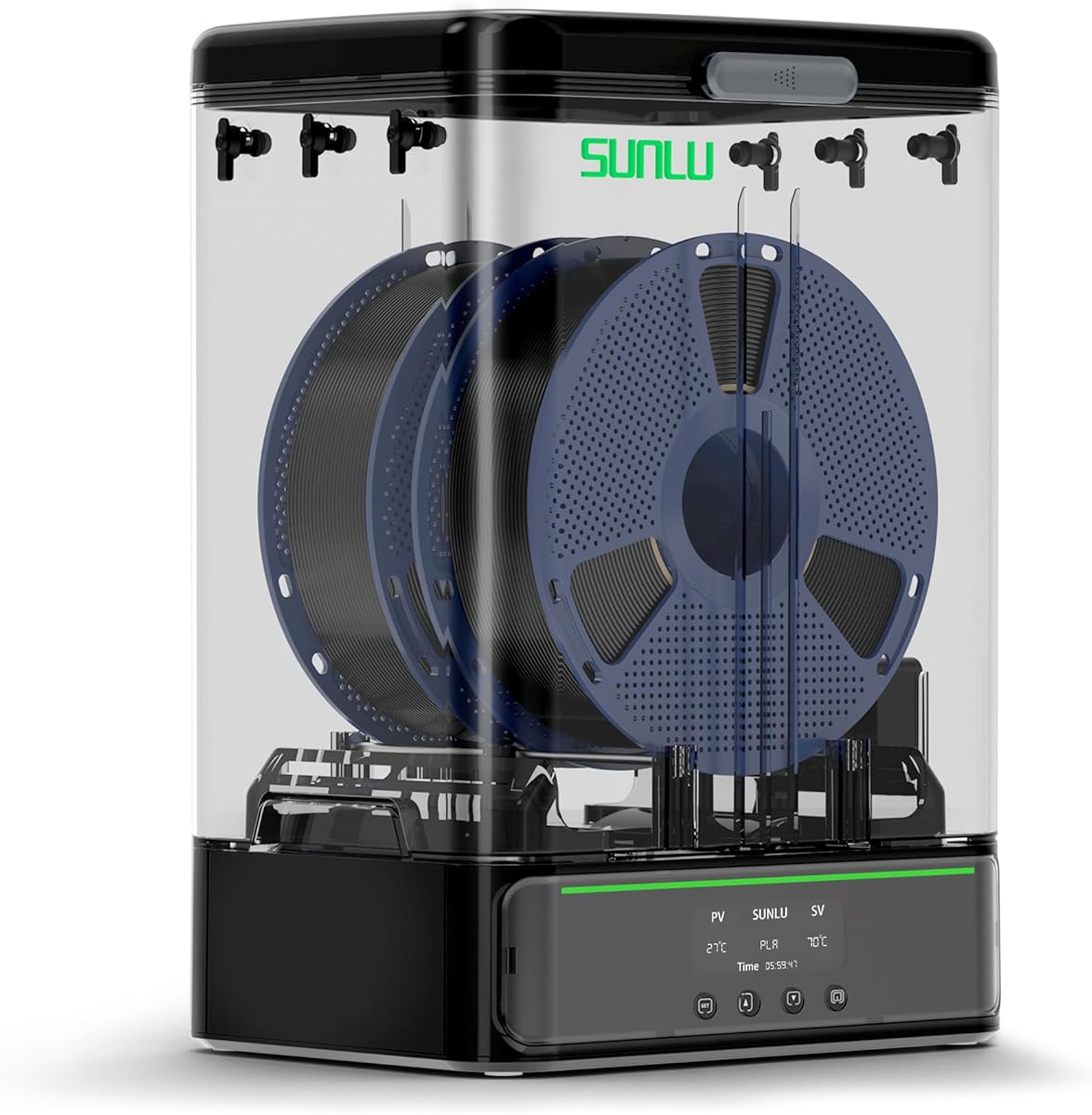
The SUNLU S4 Filadryer is a large, four-spool enclosure with automatic humidity control, three internal fans, and a 350W PTC heater. Its 4.7 rating is the highest among the products listed, and its design is aimed at high-volume or multi-machine users.
We may earn a commission when you buy through this link, at no additional cost to you.
The S4 can heat from 25°C to 50°C in 30 minutes. Two side fans and one bottom fan circulate air to maintain a stated internal temperature balance within plus or minus 3°C. It can hold four 1kg spools simultaneously and supports connection to four printers, making it suitable for multicolor workflows or several machines operating at once.
Automatic humidity control is its defining advantage. In one mode, users can select a target range of 30–50%, and the unit begins drying when humidity reaches that range. It stops when humidity falls below 25%, according to the product information, helping avoid excessive drying. PTC, a temperature switch, and software protection provide layered safety.
The S4 is the strongest recommendation for users who want automatic climate management across several spools. It reduces the need to manually monitor and restart a basic drying cycle, which is valuable during long jobs. Its size and sophistication make it less appropriate for a single-spool desktop setup, but for busy multi-printer environments, the capacity and automatic control justify the larger design.
The S4 can begin and stop its drying process according to a selected humidity range. This automation is more convenient than relying entirely on fixed timers when room conditions change throughout the day.
Four spool positions and support for connecting four printers align the enclosure with multi-color and multi-machine setups. The design reduces the need to move filament between separate dryers and storage containers.
We may earn a commission when you buy through this link, at no additional cost to you.
The white SUNLU S1 Plus is a compact dryer focused on quiet operation, straightforward controls, and the ability to print while the filament remains inside. It carries a 4.7 rating and is a strong fit for home offices, studios, and shared spaces where noise matters.
We may earn a commission when you buy through this link, at no additional cost to you.
Its temperature range is 35–55°C, and the drying time can be set from one to 99 hours. The default continuous drying period is six hours, while the product information notes that many commonly used filaments only need approximately three to six hours under normal conditions. A two-inch LCD displays temperature and time clearly.
Two internal rollers guide the spool so filament can feed directly to the printer during drying. The operating noise is listed below 10dB, making the unit notably discreet. The enclosure accepts 1.75mm, 2.85mm, and 3mm filament and accommodates spools up to 210 by 85 millimeters in height.
The S1 Plus is recommended for one standard spool and owners who value low noise over high capacity or maximum temperature. It provides more scheduling flexibility than many compact competitors through its broad timer range, but advanced materials that need stronger heat may be better served by a larger dryer. For everyday PLA, PETG, ABS, and similar materials, it offers an appealing combination of convenience and discretion.
The listed operating noise below 10dB makes this dryer suitable for close workspaces. It can maintain a drying environment without creating the distraction that a louder fan or heating system might cause.
The two-roller interior supports printing while drying, while the one-to-99-hour timer gives users broad control over the session. The large display keeps temperature and time easy to check at a glance.
We may earn a commission when you buy through this link, at no additional cost to you.
The right filament dryer depends on the number and size of your spools, the materials you print, your available space, and how much automation you need. Temperature range, airflow, sealing, controls, and filament routing are the most important factors to compare before buying.
Start with the number of spools you expect to dry at once and the dimensions of the packaging you currently use. Compact units generally hold one standard spool, while dual-spool designs accommodate two 1kg rolls and larger models may hold four 1kg spools, two 2kg spools, or even a single 3kg spool. Capacity should be based on actual spool dimensions rather than filament weight alone, because hub diameter, outer width, and cardboard or plastic flanges vary between brands.
Choose capacity based on your normal workflow, not the largest amount you could theoretically store. A single-spool box is easier to place near a printer, while a four-spool system is more useful for users who change colors or materials frequently.
A useful dryer needs enough heat for the filament you use, with controls that let you select a suitable program and make manual adjustments. Compact boxes commonly reach 50–55°C, which is relevant for many everyday materials. Larger systems may reach 65–85°C, providing more headroom for ABS, ASA, PC, PA, PET, and other demanding polymers. A long timer, humidity readings, and automatic cycles can be even more valuable than a higher maximum temperature if you only use common PLA or PETG.
Match the temperature range to your filament rather than assuming the highest number is always best. Excessive or inappropriate heat can damage some materials, so using the correct material preset and the manufacturer's recommended drying conditions is essential.
Heating the chamber quickly is only part of the job; hot air needs to circulate around the spool so moisture removal is reasonably even. PTC heating systems combined with one or more fans are common in the products reviewed. Models with multiple fans claim tighter temperature balance, while single-fan designs may take longer to distribute heat through a large chamber. Look for descriptions that specifically address circulation, enclosure size, and uniformity rather than simply quoting wattage.
Faster warmup is convenient, but consistent exposure matters more during the full drying period. A unit that reaches temperature quickly and circulates it steadily is usually more useful than one that heats quickly at the heater itself but leaves the spool in a cooler corner.
A dryer must remove moisture while also limiting new moisture from entering. Look for a close-fitting lid, effective gaskets or seals, and a filament outlet that can be closed when the unit is idle. Some models include desiccant support for passive storage, while heated models rely on controlled heat and airflow. A built-in hygrometer is valuable because it lets you confirm whether the internal environment is actually changing rather than merely assuming the programmed cycle worked.
Pay particular attention to how the filament exits the box. A sealed or closable outlet is helpful between prints, but it must be configured correctly during active drying so that moisture can escape.
A broad material list is useful only if the unit's heat, time, and airflow are appropriate for each material. PLA, PETG, TPU, ABS, ASA, nylon, PC, and composites have different moisture sensitivities and drying requirements. The products in this guide support common 1.75mm and 2.85mm filament, and several also state support for 3.00mm material. Always check the spool dimensions, filament diameter, and the manufacturer's recommended drying conditions.
Prefer presets tied to recognized filament types when available, but retain manual temperature and timer adjustments for differences in climate and spool condition. Compatibility should describe both the material and the physical format.
Many users prefer to keep filament inside the dryer while it feeds directly to the printer. This approach is especially valuable during long prints, humid weather, and extended pauses because the spool remains in a controlled environment. It requires reliable rollers, a correctly aligned feed path, and either a fixed PTFE tube or a compatible removable tube. The outlet and its seals must be configured so that filament can move freely without compromising the rest of the enclosure.
If direct printing is important, verify that the box supports your printer's extruder position and routing needs. Models designed for multiple feed paths or adjustable filament holes are more flexible in busy multi-printer setups.
The best interface is one that makes it easy to understand the current temperature, remaining time, and humidity. A simple LCD with physical buttons works well for a single-spool dryer, while a larger touchscreen suits users who select among numerous material presets. Automatic humidity control is the most advanced option in this group, while parameter memory after a power interruption is a convenient middle ground. Consider whether you need constant visibility or simply a reliable preset that can run without frequent adjustment.
Automation should support the drying process rather than create a new learning curve. If you will regularly change materials or check on multiple spools, a clearer display and faster controls may deliver more value than a small reduction in enclosure size.
Heated equipment should be used on a stable surface with adequate ventilation around the intake and outlet. Safety features such as automatic heat cutoffs, software temperature protection, and fan-failure alarms provide useful safeguards. Noise is another practical consideration: the white SUNLU S1 Plus is specifically listed below 10dB, while other fan-equipped models may be more audible. Larger enclosures consume more countertop space, and sealed doors and routed tubes require room to open and operate.
Before buying, compare the complete footprint, including clearance needed for the lid, cables, and filament tubes. A quieter, compact unit may suit a home office better than a feature-heavy enclosure that cannot be positioned conveniently.
Begin by identifying the filament type, checking that the spool fits inside the chamber, and consulting the filament manufacturer's recommended drying temperature and duration. Remove dust or loose debris from the spool, center the filament on the rollers, and make sure it unwinds in the correct direction. Route the filament through the outlet and PTFE tube without sharp bends before connecting it to the printer.
Set the appropriate temperature and time rather than selecting the highest available values. If the dryer has material presets, use one as a starting point and adjust it for local humidity, the condition of the spool, and the manufacturer's guidance. Open or configure the moisture outlet as required for the chosen model, close the enclosure, and confirm that the displayed temperature, timer, and humidity readings respond normally.
During use, inspect the filament path for tangles, binding, or contact with a hot surface. Let the chamber cool before opening a heated unit, and follow the product's cleaning guidance for removable rollers, tubes, and containers. Keep desiccant dry when the model uses it, replace it according to the manufacturer's instructions, and close the feed outlet when the dryer is not actively serving filament.
The correct temperature depends on the filament manufacturer and material. PLA, PETG, ABS, ASA, TPU, nylon, and composites each have different requirements, so use the dryer's matching preset when one is available. If the manufacturer provides a drying range, select a setting within that range and avoid using a higher temperature simply because the dryer supports it.
The appropriate duration depends on the material, the spool's condition, and the surrounding humidity. Many common filaments may benefit from several hours of drying, while specialized or severely damp material may need a longer cycle. Start with the material preset and the filament manufacturer's guidance, then inspect the result by checking for reduced bubbling, stringing, and improved adhesion.
Many of the listed dryers are designed to feed filament to a printer while the spool remains enclosed. The filament should pass through the outlet smoothly, without kinks or excessive tension, and the rollers must support the spool correctly. Follow the product-specific instructions because the moisture vent and outlet may need different positions during drying and storage.
PLA is not usually as moisture-sensitive as nylon or some other polymers, but it can still absorb enough moisture to cause stringing, bubbles, or rough surfaces. A dryer is most useful in humid conditions, after a spool has been exposed to open air, or when a fresh or previously damp spool produces inconsistent results.
A heated dryer uses controlled temperature and airflow to remove moisture from filament. A storage box primarily limits new moisture exposure through sealing and desiccant, although some products combine both functions. The Polymaker PolyDryer is storage-focused, while models such as the SUNLU SP2 and Creality Space Pi X4 explicitly combine active drying with enclosed storage.
No. A larger enclosure can dry more spools at once and may offer higher temperatures or multiple chambers, but it also requires more space, power, and attention. For one standard spool, a compact unit with accurate controls may be more convenient. Larger systems make the most sense for multiple materials, large spools, or busy multi-printer workflows.
Common signs include excessive stringing, bubbles during extrusion, poor bed adhesion, rough surfaces, inconsistent diameter, and visible popping. Checking the dryer's humidity reading can help assess the environment, but the printer remains the final test. If symptoms continue after an appropriate drying cycle, inspect the feeder and nozzle for unrelated issues.
In most cases, yes. A closed outlet helps prevent humid air from entering and reaching the spool. The Comgrow model specifically requires the sealing hole to be closed when not in use, while other enclosed models may use a sliding seal or routed tube. Follow the instructions for your particular dryer and ensure the filament path does not damage the seal.
The Creality Space Pi X4 stands out for advanced users who need four-spool capacity, dual chambers, and temperatures reaching 85°C. The SUNLU S4 Filadryer offers another strong premium option with automatic humidity control, three fans, and support for four printers, while the SUNLU S1 Plus delivers a quieter, more compact way to dry one spool while printing.
Prioritize the features your material and workflow genuinely require. A single-spool user may need little more than accurate temperature control and clear monitoring, while owners of advanced filaments should look for adequate heat and longer scheduling. Multi-material users should consider chamber count, feed-path flexibility, sealing, and the number of spools that can remain ready at once.
Before making a final selection, confirm the current product listing, electrical requirements, dimensions, filament guidance, and included accessories. Product details and pricing can change, so the latest listing is the best source for final compatibility and availability information.