
Midea 5,000 BTU EasyCool Window Air Conditioner
4.4Editor score
Compact 5,000 BTU capacity
Suitable for rooms up to 150 square feet
Simple mechanical controls
Our Low Profile Air Conditioner guide compares 10 compact cooling options by capacity, noise, efficiency, smart controls, installation, and room fit for home
A low profile air conditioner is designed to deliver useful cooling without taking over the room or window. The best model balances capacity, noise, energy efficiency, controls, installation requirements, and the amount of space it occupies. The right choice depends heavily on room size, window dimensions, and whether appearance or smart-home integration matters most.
This guide compares ten room and vehicle options based on their documented cooling capacity, footprint, operating features, control methods, installation approach, and intended use. It covers slim window units, U-shaped models that preserve window access, a built-in room system, and a low-profile vehicle air conditioner. Ratings are included where available, but no hands-on testing claims are made.
Each review explains who the product is best suited for and where its trade-offs may matter. The top selections highlight strong overall versatility, a practical smaller-room option, and a premium built-in design. Product availability, promotions, and prices can change, so shoppers should confirm current details and fit before purchasing.
4.4Editor score

4.8Editor score

The comparison below organizes all ten products by cooling capacity, physical design, control options, and intended installation, making it easier to identify the narrowest and most capable option for your space.




The Hisense 8,000 BTU Smart Inverter combines an ultra-slim housing with 4-way air direction, three fan speeds, and several operating modes. Its documented 4.0 rating reflects a capable middle ground for rooms of different sizes. The 8,000 BTU capacity is listed for spaces up to 350 square feet, making it more versatile than a compact unit designed for one small bedroom.
We may earn a commission when you buy through this link, at no additional cost to you.
The model uses inverter technology and provides cooling, fan, dry, eco, and sleep modes. Its 235 CFM airflow rating promises meaningful circulation, while the four-way direction lets you redirect air vertically and horizontally. Smart control comes through the ConnectLife app, and the washable filter has a clean-filter alert to help simplify upkeep. A 700-watt power rating adds another useful efficiency comparison point.
Its ultra-slim profile is the main reason it fits naturally into this category. The unit measures 20.5 inches long by 20.3 inches wide and 14.6 inches high, and it is designed for windows 25 to 38.6 inches wide with at least 15.2 inches of opening height. Because this is a renewed model, some buyers may prefer a brand-new unit despite the attractive combination of capacity, dimensions, and features.
This Hisense is a strong fit for apartments, bedrooms, offices, and living spaces where a conventional window unit feels visually bulky. Choose it when balanced cooling, app-based control, and a narrow profile matter more than pristine renewed condition. It is our best balanced slim option because it delivers more flexibility than the smallest model without approaching the footprint of a 10,000 BTU system.
The 8,000 BTU inverter output targets rooms up to 350 square feet, while cooling, fan, and dry modes give it useful year-round versatility. The sleep and eco settings can also make long operating periods more comfortable and efficient.
ConnectLife compatibility allows settings to be changed through a smartphone, while the reusable filter and clean-filter alert help owners stay on top of basic maintenance. The installation bracket is also included for a more secure setup.
We may earn a commission when you buy through this link, at no additional cost to you.
The Midea 6,000 BTU U-Shaped is a particularly thoughtful low-profile window design because its deeper chassis reduces the portion of the window occupied by the unit. It has a 4.3 rating and is rated for rooms up to 250 square feet. That makes it suited to bedrooms, offices, and smaller living areas where quiet operation and natural light are priorities.
We may earn a commission when you buy through this link, at no additional cost to you.
Midea lists sound levels as low as 32 dBA, describing the model as up to nine times quieter than traditional window air conditioners. Inverter technology adjusts output as room conditions change, and the product is ENERGY STAR certified. Its smart features include the Midea SmartHome app, smartphone and smartwatch control, Amazon Alexa, Google Assistant, Matter compatibility, and a physical remote control.
The U-shaped form also introduces a distinctive appearance. This Jet Black edition is intended to blend into darker frames, reduce visible side-panel light, and allow the window to remain partly open. That flexibility is balanced by specific installation requirements: single- or double-hung windows must be 24 to 36 inches wide, with a minimum opening height of 14.5 inches. The included flat sill adapter and built-in gradienter help with leveling.
Shoppers should choose this model when the window must remain usable or when bedrooms, calls, and other quiet activities make noise a major concern. It is less appropriate for rooms larger than its documented coverage or for homes without compatible windows. For a compact 6,000 BTU system, its combination of low sound, smart-home support, and open-window flexibility is unusually complete.
The U-shaped chassis leaves more of the window available than a conventional box-style unit. Depending on the window configuration, this can preserve a view, allow outside air in, and reduce the sense that the entire window has been blocked.
Matter support, voice-assistant compatibility, smartwatch control, and a smartphone app make this one of the most connected choices in the guide. A remote is also included for households that prefer immediate physical access to settings.
We may earn a commission when you buy through this link, at no additional cost to you.
The Hisense 8,000 BTU Inverter Window Air Conditioner pairs a slim profile with smartphone control and a 4.3 rating. It is designed for shoppers who want modern convenience without giving up the familiar window-unit format. The UltraSlim design focuses on reducing visual bulk while retaining the cooling capacity expected from an 8,000 BTU class appliance.
We may earn a commission when you buy through this link, at no additional cost to you.
Its central technical advantage is continuously adjusting inverter output. Rather than cycling between full power and complete shutdown, the compressor can vary output to maintain the selected temperature with less noise and improved energy use. Through the ConnectLife app, users can adjust settings, switch operating modes, and manage the unit remotely, which is useful during sleep or while the room is unoccupied.
The included installation bracket is intended to hold the unit securely, while the washable filter makes recurring maintenance straightforward. Compared with the renewed Hisense in the first position, this model offers the same core combination of inverter cooling, app control, a slim housing, and a washable filter in a new condition. The supplied information does not state a maximum room size or exact dimensions, so fit and cooling suitability should be confirmed before purchase.
This is a sensible selection for a bedroom, home office, apartment, or modest living room where appearance and remote operation are important. It may be less suitable for very large rooms because the 8,000 BTU output is more modest than the 10,000, 10,300, and 12,000 BTU options in the guide. Overall, it is a polished smart-home choice with a particularly slim visual footprint.
Continuously variable output is intended to reduce sharp on-off cycles, temperature swings, and operating noise. The result is a steadier room temperature and potentially better energy use than a conventional fixed-cycle unit.
ConnectLife app control lets users change modes and settings from their smartphones rather than relying solely on a wall panel or remote. The washable filter reduces the complexity of routine seasonal maintenance.
We may earn a commission when you buy through this link, at no additional cost to you.
The Midea 10,000 BTU U-Shaped Smart Inverter is a strong option for a larger bedroom, apartment, or living room where substantial cooling must coexist with a relatively restrained design. It carries a 4.3 rating and is documented to cool spaces up to 450 square feet. Its U-shaped chassis preserves more window access than a conventional rectangular unit.
We may earn a commission when you buy through this link, at no additional cost to you.
Sound levels are listed as low as 32 dBA, with the window helping block outside and compressor noise. The DC inverter system is advertised as delivering more than 35% energy savings compared with traditional units, and Midea identifies the product as the first window air conditioner to obtain ENERGY STAR certification. Other documented specifications include 890 watts of cooling power, 9.97 rated cooling amps, electronic controls, and R32 refrigerant.
Smart control is comprehensive. Users can manage the unit through the SmartHome app on iOS or Android and issue voice commands through Alexa or Google Assistant. The open-window design makes it appealing for rooms where daylight and ventilation matter, while an anti-theft mechanism can lock a closed window for added security. Installation uses an included quick-snap bracket and sidearms for single- or double-hung windows 22 to 36 inches wide with at least 13.75 inches of height.
This model fits best when the room is large enough to benefit from 10,000 BTU output and the window can accommodate the required opening. It is a compelling option for noise-sensitive homes, remote workers, and families combining cooling with voice control. Compared with the smaller Midea U, it provides significantly greater coverage while retaining the same low-noise design philosophy.
The 10,000 BTU output is designed for spaces up to 450 square feet, but the U-shaped chassis keeps the appliance visually distinct from a standard full-width window unit. This makes it useful where both cooling capacity and appearance matter.
The DC inverter system is stated to save more than 35% compared with traditional units, and ENERGY STAR certification adds another point in favor of long-term operating efficiency. The low listed sound level also supports use in bedrooms and home offices.
We may earn a commission when you buy through this link, at no additional cost to you.
The GE AJCQ10ACH is the most architecturally integrated model in the guide, offering a true built-in alternative to a window appliance. Its sleek room front, integrated sleeve and chassis, soft gray finish, and metallic silver accent are intended to blend into a finished wall. That makes it a premium choice for homeowners who prioritize appearance and permanent placement.
We may earn a commission when you buy through this link, at no additional cost to you.
The controls are designed to feel integrated rather than utilitarian. Electronic cap-touch controls sit alongside a large white LCD display that automatically dims for nighttime use. A slim remote control is included, and the front is structured to preserve more usable room space than a projecting cabinet-style unit. Eco mode cycles the fan off during cooling intervals, while dry mode offers dehumidification for humid rooms.
The product is identified as cool-only, so buyers focused on winter heating should not assume year-round heating capability. A stated auto mode can automatically select cooling and fan speed to maintain the setpoint, while remote access makes changing settings convenient from elsewhere in the room. The supplied listing also references ENERGY STAR-certified options, but no specific rating is provided for this exact model.
This GE is most appropriate for a planned renovation, new construction, or a room where the owner is willing to create a built-in opening. It is less practical as a portable or renter-friendly solution because the integration described in the product data is central to its appeal. For buyers seeking a permanent, visually quiet centerpiece, it represents the premium end of the low-profile category.
Unlike a window unit that remains visibly separate from the architecture, this model integrates its sleeve and chassis into the wall. The slim front minimizes projection and helps the finished room retain a clean, deliberate appearance.
The large auto-dimming LCD remains easy to read during the day without becoming overly bright at night. Cap-touch controls, an included remote, eco mode, and dry mode create a polished control experience.
We may earn a commission when you buy through this link, at no additional cost to you.
The Hisense 10,000 BTU Inverter stands out with a 4.8 rating, the highest numerical rating among the products with published customer feedback. It delivers stable 10,000 BTU cooling for rooms up to 450 square feet. That balance of strong capacity, a compact window format, and remote control makes it an attractive general-purpose choice.
We may earn a commission when you buy through this link, at no additional cost to you.
Inverter technology is the feature behind the model's more consistent performance. By varying output according to demand, it aims to reduce abrupt cycling, improve temperature stability, and lower noise compared with traditional fixed-speed systems. The product data also highlights the structural design as a contributor to quieter operation, an important consideration for bedrooms, offices, and living spaces used during working hours.
The ConnectLife app allows users to adjust settings, switch modes, and manage the unit from a smartphone. A washable filter simplifies upkeep, while the included installation bracket is designed to keep the appliance secure. The main limitation in the supplied information is the lack of exact dimensions and window-size requirements, making it important to verify physical fit before buying.
This Hisense is best suited to a larger room where 8,000 BTU might feel marginal but 12,000 BTU would be unnecessary. Its favorable rating, smart control, and documented coverage make it our leading rated large-room pick. Buyers should confirm their window can safely support the unit and then benefit from the combination of strong output, inverter behavior, and straightforward maintenance.
The 10,000 BTU model raises the cooling ceiling while retaining the visual advantages of a slim window design. It is a practical middle point for medium and large rooms that need more output than a compact unit offers.
Variable output can keep a room closer to its selected setting without the repeated hard starts associated with conventional units. The result is a steadier cooling experience that is also better suited to quiet rooms.
We may earn a commission when you buy through this link, at no additional cost to you.
The renewed Midea 12,000 BTU U-Shaped is the highest-capacity window model in the guide, with documented cooling for rooms up to 550 square feet. Its 4.3 rating and quiet U-shaped design make it suitable for larger rooms that still benefit from keeping a window partly open. It is a distinctive alternative to installing a more involved permanent system.
We may earn a commission when you buy through this link, at no additional cost to you.
The appliance operates as quietly as 32 dBA according to the product data, using both its inverter system and the window to reduce noise and vibration. Listed cooling power is 1,140 watts, with rated cooling amps of 12.17. DC inverter technology is advertised as producing more than 35% energy savings compared with traditional window units, giving the model a useful efficiency story despite its higher cooling output.
Owners can control the unit through the MSmartHome app on iOS or Android or use Alexa and Google Assistant. Its U-shaped design keeps the window openable, and a closed-window anti-theft mechanism provides added security. The electronic control type and clean-filter indicator light make routine operation and maintenance clearer, while the quick-snap bracket and sidearms support installation in single- or double-hung windows from 22 to 36 inches wide with at least 13.75 inches of height.
This Midea is appropriate for larger bedrooms, living rooms, or apartments that need serious cooling and value smart-home functions. Because it is renewed, shoppers should examine the condition and available warranty details carefully. Its 12,000 BTU output is compelling for larger spaces, but the higher electrical demand and window requirements should be considered alongside those benefits.
With 12,000 BTU of output and coverage listed up to 550 square feet, this is the most capable window unit here. It offers a practical route to cooling a larger room without moving directly into a permanently installed system.
A listed low sound level of 32 dBA makes the model appealing for bedrooms and offices, while app and voice control improve daily usability. The clean-filter indicator helps prevent basic maintenance from being overlooked.
We may earn a commission when you buy through this link, at no additional cost to you.
The GE Profile ClearView Inverter is built around a distinctive promise: preserve a full window view after installation. Its 10,300 BTU cooling output is rated for rooms up to 450 square feet, while the chassis is engineered to sit deeper inside the window opening. It carries a 3.5 rating, so it is worth comparing the unique design closely with higher-rated alternatives.
We may earn a commission when you buy through this link, at no additional cost to you.
Its flex-depth construction can adjust to accommodate walls between 4.5 and 13.75 inches thick. That range gives it an installation advantage when the window recess is unusually deep. The stated dimensions are 12.75 inches high by 19.625 inches wide by 28 inches deep, and the unit fits windows 20 to 40 inches wide with a minimum opening height of 13 inches and a minimum 10 inches above the floor.
GE describes the inverter system as operating at smooth, varying levels and states that it is 34% more efficient. Sound levels are listed as low as 40 dB, which remains quiet but is not as low as the 32 dBA advertised by several Midea U models. The ENERGY STAR-certified unit supports the SmartHQ app, Amazon Alexa, and Google Assistant, while the included remote provides a non-network option.
This model is best for someone who prioritizes an unobstructed window and has an unusual recess that requires adjustable depth. It may be less attractive when the lowest possible noise, highest customer rating, or smallest front projection is the priority. Its specialized installation geometry makes it a compelling choice for the right window rather than a universal replacement for a slim unit.
The deep chassis moves much of the appliance into the window recess, allowing the window to continue opening and closing. That preserves daylight, ventilation, and sightlines while retaining 10,300 BTU of cooling capacity.
The flex-depth design adjusts between 4.5 and 13.75 inches, a useful feature for homes with unusually thick walls. Installation still requires checking width, height, sill depth, and clearance above the floor.
We may earn a commission when you buy through this link, at no additional cost to you.
The Dometic 15K BTU Low-Profile Mechanical Air Conditioner serves a different environment from the room-focused products in this guide. Its 10.5-inch height is designed to reduce the clearance required inside tall vehicles, making it relevant for travelers, tradespeople, or mobile users who need cooling in a confined cabin.
We may earn a commission when you buy through this link, at no additional cost to you.
The mechanical controls and fixed-speed single-motor design are simpler than the inverter and smart-home systems found in most residential choices. At the same time, the 15,000 BTU output is the highest cooling capacity listed in the guide. The product description points to an upgraded motor and optimized blower system for noise reduction, suggesting that the design prioritizes usable cooling in a vehicle environment.
Durability is another major strength. A steel-reinforced base supports the unit, while a UV-resistant shroud is intended to withstand prolonged outdoor exposure. A built-in hard-start kit is included to support reliable startup. These vehicle-oriented construction details distinguish it from window and built-in room systems that are designed around household interiors.
Choose this Dometic only when the intended installation is a suitable tall vehicle rather than a bedroom or living space. Its low height and 15,000 BTU capacity are the central benefits, while the absence of inverter operation, remote controls, and smart functions means it offers fewer options for convenient residential use. Confirm roof or enclosure dimensions and manufacturer guidance before installation.
A 10.5-inch profile helps preserve headroom and interior space where a taller rooftop or vertical housing would be inconvenient. It is particularly relevant to tall vehicles and mobile applications.
The steel-reinforced base, UV-resistant shroud, upgraded motor, and hard-start kit focus on durability and dependable operation. A mechanical interface also reduces complexity in environments where residential smart controls are unnecessary.
We may earn a commission when you buy through this link, at no additional cost to you.
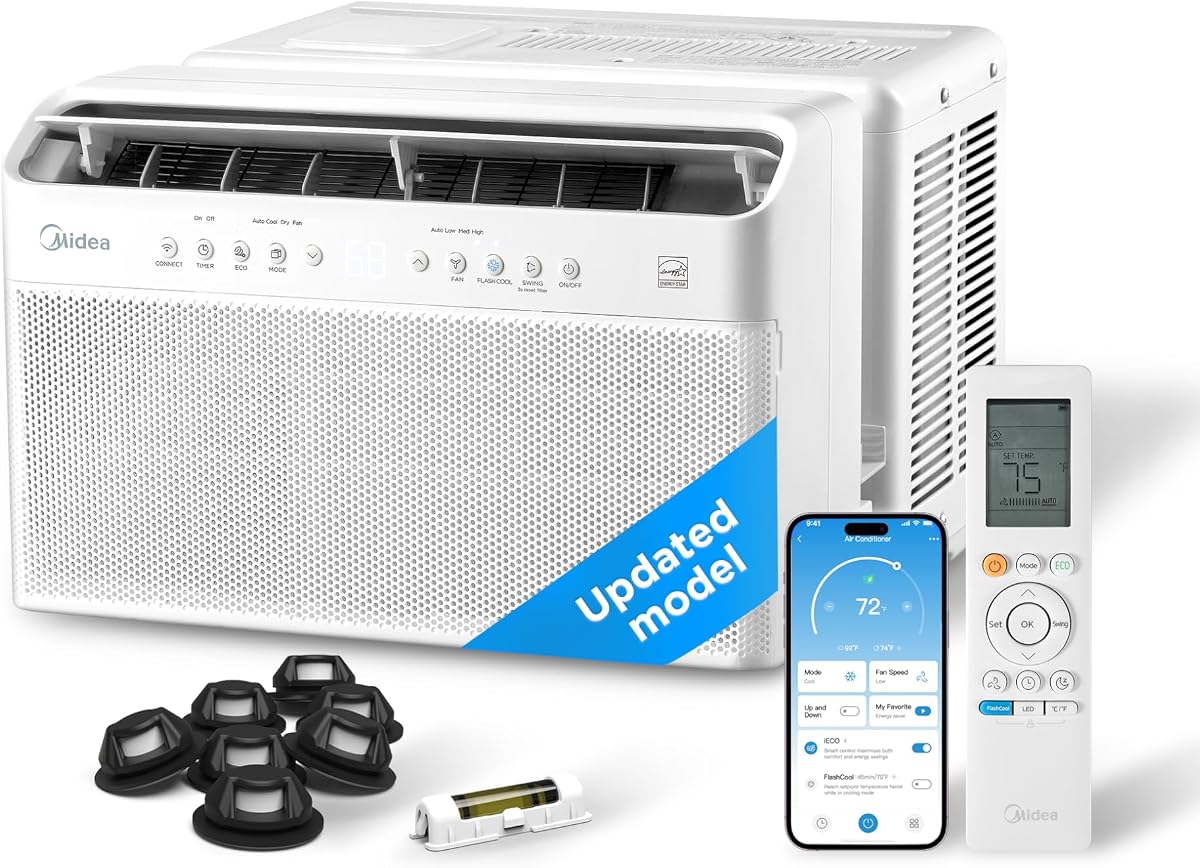
The Midea 5,000 BTU EasyCool is the most straightforward choice for a small bedroom, compact office, or modest living room. Its 4.4 rating is favorable among the products with published feedback, while the 5,000 BTU capacity is documented for areas up to 150 square feet. It focuses on practical cooling without unnecessary connected features.
We may earn a commission when you buy through this link, at no additional cost to you.
Mechanical controls make operation direct and approachable. Seven temperature settings, two cooling speeds, two fan-only speeds, and two-way air direction provide enough control for a compact room. The unit is described as quieter than a household refrigerator, a useful comparison for shoppers worried about constant operating noise in a bedroom or office.
Its Combined Energy Efficiency Rate is listed at 11.0, supporting more efficient operation compared with many conventional window units. The removable and reusable filter can be cleaned rather than replaced on a recurring schedule. Installation is intended for existing window frames 23 to 36 inches wide with a minimum height of 13 inches, and mounting accessories are included, although a screwdriver is required.
This Midea is best for small, consistently sized spaces where simple controls and a compact appliance are preferable to voice assistants or app-based operation. It is not the right choice for a large living room or poorly insulated space. Within its intended range, it delivers a clear capacity, solid efficiency specification, and simple maintenance routine at a practical entry level.
At 5,000 BTU, the EasyCool is sized for rooms up to 150 square feet. Using it in a substantially larger area can lead to continuous operation without satisfying the desired temperature.
The mechanical interface includes multiple temperature and fan settings without requiring an app or network connection. A removable reusable filter makes periodic cleaning straightforward.
We may earn a commission when you buy through this link, at no additional cost to you.
A useful low-profile air conditioner must fit the available opening, provide enough cooling for the room, and remain comfortable to operate. Capacity, depth, noise, efficiency, controls, maintenance, and installation requirements should be compared before choosing.
Cooling capacity should be matched to the room rather than chosen solely from the largest number available. The models here range from 5,000 BTU for rooms up to 150 square feet to 15,000 BTU for a vehicle-focused installation. Among room units, documented coverage ranges from 150 square feet for the Midea EasyCool to 550 square feet for the renewed Midea 12,000 BTU model. Sun exposure, insulation, window area, heat-producing electronics, and the number of occupants can all affect how well a unit maintains its setpoint.
Low profile can mean a narrow front, a deep chassis, or a fully integrated installation, so shoppers should examine dimensions rather than rely on the label alone. Window units require adequate width, opening height, sill support, and outlet access. The Hisense 8,000 BTU renewed model requires a window 25 to 38.6 inches wide and 15.2 inches high, while the Midea 6,000 BTU U accepts 24- to 36-inch windows with at least 14.5 inches of height. The GE ClearView handles particularly deep recesses through an adjustable 4.5- to 13.75-inch flex-depth design.
Sound level matters most in bedrooms, home offices, nurseries, and rooms where remote work requires clear calls. The Midea U models list operation as low as 32 dBA, while the GE Profile ClearView lists 40 dB. Numbers can vary with mode, fan setting, compressor demand, window position, and installation quality, so the advertised figure is best treated as a comparative specification rather than a guaranteed room-noise reading.
Efficiency is especially important for window units that may run for extended periods. Inverter compressors adjust output instead of operating only at full capacity, which can improve comfort and reduce energy use. Midea states that its 10,000 and 12,000 BTU U models achieve more than 35% savings versus traditional units, while the 6,000 BTU version cites up to 37% savings. The small Midea EasyCool lists a CEER of 11.0, and several products carry ENERGY STAR certification or certified options.
App control can be valuable when the room is already comfortable, when the unit operates overnight, or when a homeowner wants to change settings without returning to the window. Hisense models use the ConnectLife app, Midea models use SmartHome or MSmartHome, and the GE Profile ClearView uses SmartHQ. Voice-assistant support appears on the Midea U models and the GE Profile unit. The Midea EasyCool takes the opposite approach with mechanical controls, offering fewer dependencies and a simpler experience.
Routine maintenance has a direct effect on airflow and operating performance. The Hisense window models use washable filters, and the renewed 8,000 BTU version adds a clean-filter alert. The 12,000 BTU Midea U includes a clean-filter indicator light, while the 5,000 BTU EasyCool has a removable reusable filter. Air direction also influences perceived performance: the Hisense offers four-way direction, the small Midea provides two-way adjustment, and the Midea U models are designed to support more flexible window use.
Some installations are straightforward while others demand planning. Window units generally need compatible openings, nearby electrical outlets, support hardware, and enough clearance for airflow. The Midea 6,000 BTU includes a flat sill adapter, built-in gradienter, and anti-theft lock, while the 10,000 BTU U includes a quick-snap bracket and sidearms. The GE AJCQ10ACH is a true built-in room product requiring the wall or enclosure to be prepared around an integrated sleeve and chassis.
Most low-profile air conditioners on the market are designed for residential windows, but the Dometic 15K BTU model is built for tall vehicles. Its 10.5-inch height, reinforced base, UV-resistant shroud, hard-start kit, and fixed-speed motor address a mobile environment rather than a bedroom or living room. Choosing the wrong category can mean incompatible hardware, controls, power expectations, and installation requirements.
Begin by confirming that the window or built-in opening meets the manufacturer's width, height, depth, support, and clearance requirements. Position the unit securely, retain access to the electrical outlet, and avoid blocking the intake, discharge, or controls. For connected models, complete app and smart-home setup before the first cooling cycle, and set a comfortable starting temperature rather than automatically using the coldest setting.
Use the appropriate mode for the situation. Cooling lowers room temperature, fan mode circulates air without actively cooling, and dry mode focuses on dehumidification. Variable-capacity inverter systems generally regulate output automatically, while mechanical units work best with a stable setpoint and sensible fan speed. Allow a few minutes for the room to respond, avoid opening the window repeatedly in a way that defeats the cooling process, and use sleep or eco modes when appropriate.
Inspect the filter at regular intervals and clean it according to the manual. Keep the vents unobstructed, wipe accessible surfaces gently, and check that brackets, sidearms, locks, or built-in trim remain secure. Before storage, dry the unit as directed, disconnect power when appropriate, and cover it from dust. For vehicle units, inspect seals and mounting points and confirm that the enclosure provides the required airflow.
The Midea 5,000 BTU EasyCool is the most compact choice in this guide by stated cooling capacity. It is designed for rooms up to 150 square feet and offers mechanical controls, a reusable filter, and two-way air direction. Its actual exterior dimensions should be checked before purchase because room capacity alone does not establish window fit.
The Midea 6,000 BTU U-Shaped and renewed Midea 12,000 BTU U-Shaped both list operation as low as 32 dBA, making them especially relevant to bedrooms. The smaller model suits rooms up to 250 square feet, while the larger is documented for up to 550 square feet. Sleep, smart-control, and window-access needs will help determine which capacity is appropriate.
Yes. The Midea U-shaped models are specifically designed to preserve a greater degree of window opening while the appliance is installed. The 6,000 BTU version is described as allowing window flexibility, and the 10,000 and 12,000 BTU versions likewise allow the window to open for fresh air and a clearer view.
Inverter models can regulate cooling output more gradually, which often results in steadier temperatures, less frequent hard cycling, and lower noise than a conventional on-off design. They may also use less energy, although actual results depend on room size, insulation, maintenance, selected settings, and local conditions. The Midea EasyCool is a practical conventional alternative for a small space.
Measure the window's usable width and height, the sill or recess depth, and the clearance above the opening. Compare those measurements with the manufacturer's stated limits, including the required minimum height and wall depth. Also verify the weight can be supported and that the outlet and bracket will remain accessible.
A built-in model is usually better for permanent installations and finished-room aesthetics because it integrates into the wall and preserves more usable space. A window unit is generally easier to install, move, replace, and rent, making it more flexible. The GE AJCQ10ACH provides the premium built-in experience, while the window models offer simpler installation paths.
Yes, provided the unit's capacity and room coverage align with the space. The 5,000 BTU Midea is suited to an office up to 150 square feet, while 6,000, 8,000, 10,000, and 12,000 BTU options support progressively larger rooms. Noise, control style, window fit, and whether the office contains substantial heat-producing equipment should also influence the choice.
The Dometic model is primarily designed as a low-profile vehicle air conditioner, not as a residential bedroom unit. Its 10.5-inch height, reinforced base, UV-resistant shroud, and hard-start kit are tailored to mobile use. Homeowners should choose one of the window or built-in room products instead.
The Hisense 10,000 BTU Inverter is the strongest all-around pick, combining a 4.8 rating, room coverage up to 450 square feet, app control, inverter operation, and a washable filter. The Midea 5,000 BTU EasyCool is the practical budget selection for small rooms, while the GE AJCQ10ACH offers the most premium result through its fully integrated built-in design.
Prioritize the constraints that cannot be changed after delivery. Match BTU capacity to the room, measure the window or built-in opening, confirm electrical requirements, and consider whether low noise or smart controls matter. For larger rooms, the Midea U models preserve window access, while the Hisense 10,000 BTU model offers a straightforward mix of capacity, slim design, and connected operation.
Finally, check the current listing details before ordering because model configurations, availability, promotions, and prices can change. Review the supplied dimensions, window limits, included mounting hardware, warranty information, and installation instructions. Confirm that your room, opening, and control preferences align with the chosen model.