
UGREEN NAS DXP4800 GT
4.6Editor score
Ryzen R2514 processor
Dual 10GbE networking
Docker and virtual machines
144TB maximum raw capacity
Our expert guide compares the best NAS for 4K transcoding across performance, storage capacity, networking, media apps, expandability, and ease of use.
A NAS built for 4K transcoding must do more than store large files. It needs a capable processor, enough memory, fast networking, responsive storage, and media software that can handle demanding conversions while other services remain available. The right model also needs enough drive bays and expansion options for libraries that continue to grow.
We compared all ten models using their documented processor, memory, networking, storage, software, and expansion capabilities. Particular attention was paid to features that affect transcoding, including virtual machine support, Docker compatibility, 4K display output, SSD caching, and multi-gigabit networking. The guide covers compact home models as well as higher-capacity systems for creators and small teams.
Each recommendation highlights who should consider the model, where it offers an advantage, and where its limitations matter. Hardware transcoding capabilities are not specified for every product, so the guide emphasizes confirmed information while explaining what buyers should verify before purchasing. Prices and configurations change frequently, so confirm the current listing and NAS specifications before ordering.
4.6Editor score

4.6Editor score

4.2Editor score
This side-by-side comparison evaluates each NAS by processor class, memory, networking, expansion, and media-oriented features. The list includes diskless systems and bundles, so drive inclusion should always be checked on the current listing.
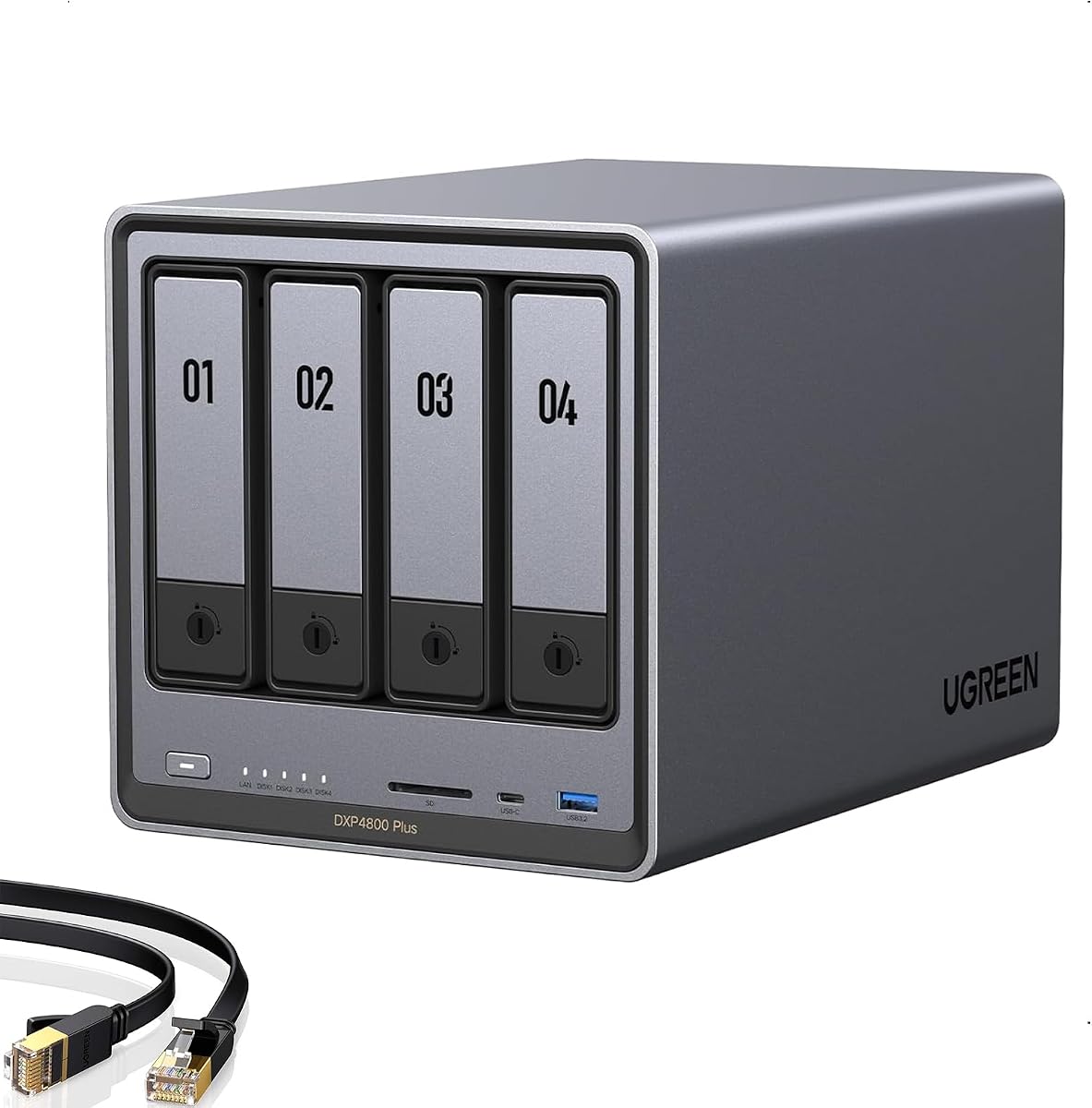


The UGREEN DXP4800 Plus is a four-bay NAS positioned for families, creators, and small teams that need a substantial combination of storage, throughput, and application flexibility. Its 4.6 rating reflects a well-rounded platform with a 10GbE port, 10Gbps USB connectivity, centralized backup features, and support for Docker and virtual machines. Those characteristics make it particularly relevant when the NAS must do more than serve static files.
We may earn a commission when you buy through this link, at no additional cost to you.
Its most important transcoding advantage is the combination of a 10GbE connection and support for virtualized workloads. A modern transcoding stack can consume substantial CPU, memory, storage bandwidth, and network capacity. While the supplied details do not state the processor model or confirm a hardware-accelerated transcoding engine, the DXP4800 Plus gives buyers room to deploy the applications and environments they need rather than relying on one preinstalled media-server interface. Its four drive bays and advertised capacity of up to 144TB also make it practical for large source libraries and completed transcodes.
There are important trade-offs. Storage drives are not included, and advertised capacity is based on RAID 0, which does not provide the redundancy sought by buyers concerned about recovery. The listing also notes that real transfer speeds can be lower depending on the router, CPU, drives, and file size. Plex can run through Docker rather than being documented as a native feature, and the system supports wired Ethernet only. These are meaningful constraints for anyone expecting effortless installation or guaranteed throughput.
Despite those limitations, the DXP4800 Plus is an excellent match for a creative household that wants fast networking, ample bays, private storage, and room for advanced services. It is particularly suitable for users willing to configure media software through Docker and comfortable selecting compatible drives. For buyers prioritizing the DXP4800 GT's Ryzen processor and dual 10GbE ports, the more premium model is the stronger choice; for those prioritizing value and simplicity, this model is more balanced.
The 10GbE port gives the NAS enough theoretical bandwidth to move large 4K source files quickly when the client, switch, storage configuration, and network equipment support it. It is a meaningful advantage over 1GbE systems, although real-world results depend on drive and file sizes.
Docker and virtual machine support gives transcoding workflows room to evolve. Users can run compatible media services, containers, and isolated environments, although Plex setup requires manual Docker configuration.
We may earn a commission when you buy through this link, at no additional cost to you.
The UGREEN DH4300 Plus targets beginners, home users, and remote workers who want a traditional four-bay NAS without the complexity of a higher-end platform. Its 4.2 rating reflects a practical combination of 2.5GbE networking, 8GB of LPDDR4X memory, four storage bays, and a user-friendly setup process. For a household library that includes 4K movies and camera footage, it is a sensible starting point.
We may earn a commission when you buy through this link, at no additional cost to you.
The system can transfer a 1GB file in approximately three seconds under the conditions described by the manufacturer, and its 2.5GbE port offers more headroom than conventional 1GbE equipment. Docker support expands the media options available, while 4K HDMI video output allows the enclosure to serve as a direct display source. These details make it attractive to users who want a straightforward media hub and do not need to manage virtual machines.
The compromises are equally clear. Unlike the DXP models, the DH4300 Plus does not support virtual machines. Plex is available through Docker rather than as a confirmed native application, and the listing specifies wired Ethernet only. The stated capacity of up to 128TB relies on RAID 0 with compatible drives, which sacrifices redundancy in favor of usable space. Its exact processor is also not identified in the supplied information, so buyers who require a specific hardware transcoding engine should confirm compatibility first.
Choose this NAS if straightforward setup, a four-bay design, and 2.5GbE performance matter more than advanced virtualization. It is well suited to family media, private cloud storage, phone backups, and users beginning their transition from external drives or cloud storage. For heavier virtualized transcoding environments, the DXP2800 or DXP4800 Plus offers a more expandable platform.
The quick setup process, mobile-oriented applications, and cross-platform access reduce the learning curve for first-time NAS owners. It is easier to begin organizing 4K media, photos, and backups without managing a complex enterprise interface.
HDMI output adds a useful path for playing locally stored media on a television. Buyers should still verify display resolution, audio formats, and application compatibility for their particular collection.
We may earn a commission when you buy through this link, at no additional cost to you.
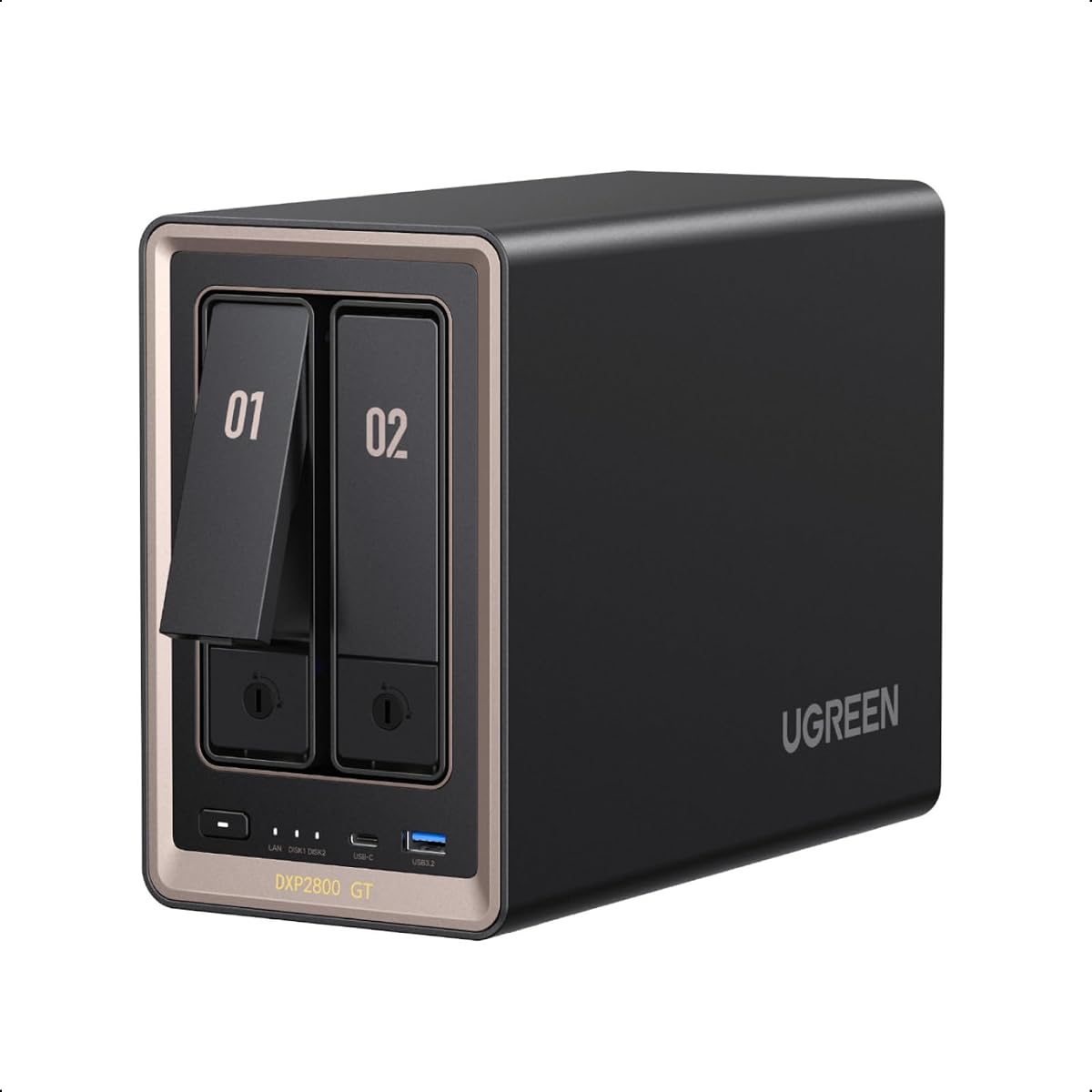
The UGREEN DXP2800 combines a compact two-bay enclosure with the processing power and expandability expected by advanced home users and creators. It has a 4.6 rating and uses an Intel N100 quad-core processor, 8GB of DDR5 memory, 2.5GbE networking, and two M.2 NVMe slots. This is one of the more interesting combinations in the guide for buyers who want transcoding flexibility without a large four-bay chassis.
We may earn a commission when you buy through this link, at no additional cost to you.
The Intel processor provides a clear foundation for compute-heavy media tasks, while 8GB of DDR5 memory gives containerized services and virtualized applications room to operate. The two NVMe slots can provide fast scratch space or caching when configured appropriately, which can help keep the active workload separate from archival drives. Support for Docker, virtual machines, and Plex-compatible media server applications makes the DXP2800 more versatile than a simple file server.
Its main limitation is physical capacity. With only two SATA bays, the system offers up to 80TB of advertised raw storage when populated with large drives. Users must choose carefully between storage density, RAID redundancy, and performance. HDDs and SSDs are not included, and the supplied details do not specify a native hardware transcoding engine, so buyers should verify their preferred codec and acceleration requirements. RAID options should also be considered for protecting irreplaceable source files.
The DXP2800 is a strong recommendation for a creator with a focused media library, a technical user who values Docker and virtualization, or anyone seeking a compact two-bay system with modern SSD expansion. It may be less suitable for a household that expects to retain multiple generations of high-resolution footage. In that scenario, the four-bay DXP4800 Plus or DXP4800 GT provides more room to grow.
The Intel N100 quad-core processor and DDR5 memory provide a modern foundation for containers, media services, and virtualized tools. Actual transcode speed still depends on codec, source resolution, software configuration, and whether hardware acceleration is supported.
Two M.2 NVMe slots allow active data to be separated from archival capacity. They can serve as fast cache or scratch space, but the intended configuration should be checked against the NAS software and available adapters.
We may earn a commission when you buy through this link, at no additional cost to you.
The UGREEN DXP4800 GT is the strongest premium choice in this guide for creators, technical enthusiasts, and office teams that want to combine compute performance, fast networking, and large storage capacity. It carries a 4.6 rating and uses an AMD Ryzen Embedded R2514 processor with four cores, eight threads, and speeds up to 3.70GHz. Its 8GB of DDR4 RAM is expandable to 64GB, making it one of the most adaptable systems in the lineup.
We may earn a commission when you buy through this link, at no additional cost to you.
For 4K workflows, the combination of processor power, dual 10GbE ports, and high-speed SSD expansion is compelling. The listing describes local-like 4K and 8K editing directly from the NAS and theoretical aggregate throughput of approximately 2.5GB/s when Link Aggregation is configured on compatible equipment. Those figures are not guaranteed application speeds, but they show the network architecture available for large media transfers, multi-user access, and parallel processing.
The DXP4800 GT also supports Docker, virtual machines, SAN Manager, and several media platforms including Plex, Emby, and Jellyfin. Four SATA bays can hold drives up to 32TB each, with additional U.2 NVMe and M.2 SSD expansion options contributing to an advertised maximum of 144TB. A built-in SD card slot, 10Gbps USB-A and USB-C ports, and 4K HDMI connectivity simplify media ingestion. Plex requires manual Docker setup, and the supplied information does not explicitly confirm native hardware transcoding, so codec support should still be verified.
This NAS is best for users who need several demanding services to coexist, expect to transfer large files between clients, or want room to scale both compute and storage. Buyers who only need a two-bay unit for a modest collection can find similar Ryzen-based performance in the DXP2800 GT. Those who prioritize simplicity over advanced networking and virtualized applications may find the standard DXP4800 Plus more approachable.
Two independent 10GbE ports provide a substantial upgrade over single-port 1GbE and 2.5GbE designs. With compatible switches and storage, they can support faster transfers, balanced multi-user access, and link aggregation.
The Ryzen platform, expandable memory, virtual machines, and several forms of SSD expansion create a broad upgrade path. This makes the model more future-oriented than a basic NAS intended mainly for file storage and backup.
We may earn a commission when you buy through this link, at no additional cost to you.
The UGREEN DXP2800 GT brings a Ryzen Embedded R2514 processor and 10GbE networking to a compact two-bay form factor. Its 4.3 rating makes it a compelling option for freelancers, creators, and smart-home enthusiasts who want a high-performance computing platform without a four-bay chassis. The CPU offers four cores, eight threads, and speeds up to 3.70GHz, while 8GB of DDR4 memory can be expanded to 64GB.
We may earn a commission when you buy through this link, at no additional cost to you.
That hardware is well suited to parallel applications, local media processing, and containerized services. UGOS Pro supports Docker, virtual machines, and SAN Manager, with compatibility for Plex, Emby, Jellyfin, Home Assistant, and other self-hosted tools. A 10GbE port offers more than twice the nominal bandwidth of 5GbE, helping when large camera files or high-bitrate media move between a workstation and the NAS.
Capacity is the principal constraint. Two SATA bays support drives up to 32TB each, and additional NVMe expansion contributes to an advertised maximum of 80TB. RAID 1 is available for redundancy, but a two-drive mirror leaves no spare bay for straightforward expansion. As with the larger GT model, Plex runs through Docker and requires manual setup, and the included memory is non-ECC even though ECC upgrades are supported.
The DXP2800 GT is well suited to a working professional who needs fast networking and expandable compute but does not need four hot-swappable SATA bays. It also appeals to smart-home users who want local camera recordings and centralized app storage. Buyers whose priority is simple family media serving should consider the DH4300 Plus, while those with a larger archive should move up to the DXP4800 GT.
The 10GbE connection is a major advantage for transferring large project files and streaming high-bitrate media. A single port keeps the design simpler than dual-port models, although it offers less flexibility for link aggregation.
Built-in support for ONVIF and RTSP cameras keeps surveillance footage within the local system. The same platform can coordinate media libraries, smart-home applications, and personal backups.
We may earn a commission when you buy through this link, at no additional cost to you.
The Synology DS425+ is a polished four-bay private-cloud and media server for offices and homes. Its 4.7 rating is the highest among the products with a numerical score in this guide. The supplied information highlights media streaming at up to 278 MB/s, concurrent access for more than ten users, centralized storage with granular permissions, and layered protection through RAID redundancy, automated backups, and snapshots.
We may earn a commission when you buy through this link, at no additional cost to you.
Its media role is stronger than that of a basic file server. The ability to serve large files and stream media across an office makes it relevant to teams working with high-resolution assets, while the stated throughput should suit many multi-user environments. Synology's established DSM platform provides file management, photo management, data protection, virtualization, and surveillance functions, allowing the same enclosure to serve multiple purposes.
The supplied product data does not identify the processor, installed memory, networking speed, expansion details, or maximum drive capacity. As a result, it is not possible to compare this model confidently with the more explicitly specified Ryzen, N100, or dual-network designs on raw processing specifications. Confirm the exact configuration and current compatibility list, especially if hardware transcoding or container-based media applications are priorities. The diskless nature of the listing also means drives will need to be sourced separately unless the package changes.
This DS425+ is a strong pick for buyers who value a mature, unified platform and team collaboration more than maximum specification transparency in a shopping listing. It also supports up to 30 IP cameras and includes a three-year warranty, making it attractive for mixed office and surveillance roles. Media enthusiasts needing very high networking throughput should examine a 10GbE alternative, while Synology users prioritizing straightforward management may find this model compelling.
Support for more than ten concurrent users and a stated 278 MB/s streaming rate makes the DS425+ relevant to shared creative environments. Network infrastructure and storage configuration will influence the result achieved in practice.
RAID redundancy, automated backup, snapshots, audit logs, and granular access controls provide several ways to protect and govern shared data. A sound backup strategy should still include an independent copy of irreplaceable media.
We may earn a commission when you buy through this link, at no additional cost to you.
The Synology DS925+ is a diskless four-bay DiskStation aimed at users who need high transfer performance and a broad collection of data services. Its 4.3 rating reflects a mature platform with sequential read/write throughput listed at 522/565 MB/s, dual 2.5GbE ports, and integrated file management, photo management, data protection, virtualization, and surveillance tools.
We may earn a commission when you buy through this link, at no additional cost to you.
For 4K media workflows, the documented sequential performance is a major point of interest. High source-file throughput helps when several clients read large files, when backups are underway, or when a transcoding system needs sustained access to storage. Dual 2.5GbE networking adds redundancy and can support Link Aggregation on compatible equipment, giving buyers more flexibility than a single 1GbE port.
The information provided does not specify the processor, memory capacity, supported codecs, or hardware-acceleration compatibility. Those details matter when the NAS will perform continuous transcoding rather than simply store and serve files. The enclosure is diskless, so compatible drives must be purchased separately, and the official compatibility list should be consulted. While virtualization and surveillance features are confirmed, detailed transcode acceleration remains unverified in the supplied facts.
The DS925+ is well suited to Synology users, media professionals, and small teams that want established management software with strong sequential performance. It may appeal more than the DS224+ when network flexibility and throughput are priorities. Buyers seeking 10GbE, explicit hardware transcoding, or a more detailed high-end processor specification should compare the DXP4800 GT or the QNAP TS-264.
The stated 522/565 MB/s sequential rates offer useful headroom for 4K assets. Sustained transcode performance also depends on drive type, RAID configuration, file layout, and the number of simultaneous jobs.
Two 2.5GbE ports can provide link aggregation, failover, or separation for different network roles. Proper switches and configuration are required to realize the intended benefits.
We may earn a commission when you buy through this link, at no additional cost to you.
The QNAP TS-264 is a compact two-bay NAS that pairs eight gigabytes of installed memory with several options for accelerated and multimedia use. Its 4.7 rating ties the Synology DS425+ for the highest numerical score among products with ratings. The model supports an optional M.2 2280 NVMe PCIe SSD or Edge TPU, which can improve NAS performance depending on the chosen software and workload.
We may earn a commission when you buy through this link, at no additional cost to you.
Its networking feature is especially relevant to media users. Port trunking can deliver up to 5Gbps using existing CAT5e cables when paired with compatible network equipment. That aggregate capability is useful for moving large 4K files, balancing multi-client access, and reducing network bottlenecks. Two screen extensions are also available for monitoring or 4K high-definition playback, giving the system a more direct role as a local media display hub.
The main constraint is the number of primary bays. Two drives offer less archival flexibility than the four-bay alternatives, while the optional NVMe SSD can use some of the enclosure's limited expansion space. The supplied data does not identify the processor, hardware transcoding engine, or supported codecs, so buyers should verify those details before assuming compatibility with their preferred media server. Likewise, the role of the Edge TPU depends on the exact application being used.
The TS-264 is a compelling choice for a home media enthusiast who values RAM, fast networking, and direct display support but does not need a large archive. It also suits technical users who understand M.2 caching and port aggregation. For a four-bay system with stronger documented storage performance, the Synology DS925+ is an alternative; for explicit modern compute specifications, the UGREEN DXP2800 offers a clearer processor and memory profile.
Combining compatible network ports can create a faster aggregate link for large media transfers. The benefit requires appropriate switch support and configuration, and it should not be confused with transcoding speed.
Eight gigabytes of RAM helps with multitasking, while the optional NVMe module can accelerate suitable workloads. Buyers should determine whether they need caching, an application target, or dedicated storage expansion.
We may earn a commission when you buy through this link, at no additional cost to you.
The 36TB Synology DS224+ configuration is aimed at buyers who want a ready-made private cloud rather than a diskless enclosure that must be populated. It includes two 18TB SATA hard drives, a Celeron J4125 four-core processor running at 2.0GHz with turbo up to 2.7GHz, and 6GB of non-ECC DDR4 memory. The supplied listing does not include a numerical customer rating.
We may earn a commission when you buy through this link, at no additional cost to you.
Having two large drives included makes the package attractive for immediate centralization of family media, photos, documents, and backups. The DS224+ supports the management of files, photos, and surveillance videos through DSM, while its indexing improvements are designed to make Synology Drive and Synology Photos more responsive. Low operational power of as little as 15 watts also suits a unit intended to remain online continuously.
This is not the strongest choice for intensive 4K transcoding. Dual 1GbE networking can become a bottleneck when moving very large source files or serving multiple users, and the supplied information does not confirm a hardware transcoding engine or codec support. The included drives are designed primarily for capacity rather than the low-latency response of SSDs. Buyers should avoid treating storage capacity and NAS processing capability as interchangeable.
Choose this version if the priority is a complete high-capacity foundation for private storage and you do not need high-bandwidth 4K editing workflows. It is also a straightforward choice for family media libraries where many users access files without demanding constant high-resolution transcodes. For faster networking or a more compute-focused system, consider the Synology DS425+, QNAP TS-264, or UGREEN DXP models instead.
The included 18TB drives remove the initial drive-purchasing and installation steps. This makes the package convenient for users establishing a large private library with straightforward NAS deployment.
An operating power use as low as 15 watts helps limit energy consumption for a device intended to remain available. Drive sleep behavior and workload intensity will influence actual consumption.
We may earn a commission when you buy through this link, at no additional cost to you.
The 20TB version of the Synology DS224+ provides a smaller ready-made private cloud than the 36TB bundle. It includes two 10TB 3.5-inch SATA hard drives, a Celeron J4125 quad-core processor with 2.0GHz base and up to 2.7GHz turbo speed, and 6GB of non-ECC DDR4 memory. No numerical customer rating is provided in the supplied data.
We may earn a commission when you buy through this link, at no additional cost to you.
For families or individuals organizing a substantial collection of photos, documents, and compressed media, the included capacity provides a convenient starting point. DSM supports centralized access, file and photo management, and surveillance video storage. The listing also notes improved indexing performance within Synology Drive and Synology Photos, which helps make large libraries easier to navigate. A listed operational power use as low as 15 watts supports efficient continuous operation.
As a transcoding platform, the DS224+ has clear limits. Its dual 1GbE ports offer only one gigabit per second per connection and may restrict transfer speed for large 4K files. The supplied details do not confirm hardware video transcoding or supported codecs, so buyers with intensive conversion requirements should verify those specifications. Capacity-focused hard drives can also respond more slowly than SSD or mixed storage configurations during active media processing.
This bundle is best for general private-cloud storage and modest local media access rather than demanding 4K editing pipelines. Its included drives, familiar DSM interface, and energy-conscious design make it approachable. If transcoding is the primary goal, choose a model with faster networking, more memory, and explicitly documented media-processing features, such as the UGREEN DXP2800 or UGREEN DXP4800 GT.
Two 10TB drives provide a usable starting library without requiring separate disk purchases. Users should still create an appropriate RAID configuration and maintain a separate backup for critical files.
Improved indexing is intended to speed searches and organization within Synology Drive and Synology Photos. These features remain most useful when metadata is processed efficiently across the installed library.
We may earn a commission when you buy through this link, at no additional cost to you.
The best NAS for 4K transcoding balances processing, memory, storage, networking, and software. Start with the codecs and workflows you actually use, then match the hardware capacity to your library and the number of simultaneous clients.
A modern multi-core processor gives media applications room to transcode without making every unrelated NAS function feel sluggish. The UGREEN DXP2800 uses an Intel N100 quad-core chip, while the DXP4800 GT and DXP2800 GT use the AMD Ryzen Embedded R2514 with four cores and eight threads. These details are more informative than drive capacity alone because transcoding is a compute-intensive operation, especially when software transcoding is used.
Choose a processor with enough headroom for concurrent jobs and background services. If your workflow depends on hardware acceleration, verify the exact codec support instead of assuming every modern NAS includes it.
Hardware transcoding can shift compatible video conversion tasks away from the CPU, improving efficiency and reducing the impact of simultaneous transfers. However, the supplied product details do not consistently identify each NAS's video engine or supported codecs. Buyers should inspect the manufacturer's compatibility list for H.264, HEVC, AV1, or other formats used by their source files.
A model may support media playback without offering the exact acceleration, bit depth, profile, or container combination you need. Confirm codec-level compatibility before purchasing, especially for HDR, high-bitrate, or professional camera footage.
Memory matters when the NAS runs databases, containers, virtual machines, indexing services, and media servers at once. The DXP4800 GT and DXP2800 GT provide 8GB of DDR4 that can be expanded to 64GB, and both support virtual machines. The DXP2800 also supports virtual machines with 8GB of DDR5, while the DH4300 Plus supports Docker but not virtual machines.
If transcoding runs in a container or virtual machine, allocate memory carefully and avoid overcommitting the NAS. For a simple media server with occasional conversions, 6GB or 8GB may be sufficient, but advanced users benefit from more headroom.
4K source files can be large, and the NAS network becomes the bridge between storage, transcoding, and playback clients. The DXP4800 GT offers dual 10GbE ports, the DXP4800 Plus offers one 10GbE port, the DXP2800 and DS925+ provide dual 2.5GbE, and the TS-264 supports port trunking up to 5Gbps. Dual 1GbE systems are less suited to sustained high-bandwidth editing.
Match the NAS to the switch, workstation, and client adapters. A faster NAS port cannot deliver full theoretical speed when the rest of the path is limited to 1GbE or when hard-drive mechanics become the limiting factor.
High-resolution media creates sustained demand for capacity, but active transcoding also benefits from responsive storage. Large-capacity HDDs are economical for archives, while NVMe SSDs can provide fast scratch space or caching. The DXP2800 includes two M.2 NVMe slots, and both GT models support additional NVMe expansion options. The DS224+ bundles use conventional SATA hard drives for bulk storage.
Separate hot working files from the archival library when possible. Also decide whether the priority is raw capacity or redundancy; RAID 0 maximizes space, while mirrored or parity configurations help protect against drive failure but may require additional bays.
Four-bay systems provide more flexibility than two-bay units because they can combine mirrored drives with expansion drives or use mixed capacities. The DXP4800 Plus, DXP4800 GT, DS425+, and DS925+ use four bays, with the first two also advertising capacities up to 144TB. The DXP2800 and DXP2800 GT offer up to 80TB, while the DS224+ bundles provide a simpler two-drive foundation.
More bays do not automatically mean faster transcoding, but they do improve capacity planning and redundancy options. Choose based on expected library growth, the number of drives you actually want to operate, and the complexity of the RAID layout you are comfortable maintaining.
The software environment determines how easily a NAS becomes a media hub. UGREEN models support Docker, and the GT systems explicitly mention Plex, Emby, Jellyfin, and Home Assistant. Plex can run via Docker on the DXP4800 Plus, DXP4800 GT, DXP2800, and DH4300 Plus, but it may require manual setup. Synology's DSM offers integrated file, photo, protection, virtualization, and surveillance features.
Consider maintenance effort as well as feature availability. A polished native interface may be easier for beginners, while Docker and virtual machines provide broader choice for technical users who accept more configuration and troubleshooting.
A NAS centralizes data, but centralization alone is not a backup. RAID can reduce the impact of a drive failure, while snapshots and automated backups help protect against accidental changes. Synology models emphasize layered data protection, audit logs, and backup capabilities. UGREEN models provide automated backups, RAID options, and security features such as encryption and permission management.
Maintain at least one independent copy of irreplaceable source footage and critical documents. A sensible setup combines RAID for availability with versioned backups for recovery, ideally including an off-site or disconnected copy.
Begin by checking NAS compatibility lists for every hard drive, SSD, network adapter, and memory module. Install the selected storage according to the manufacturer's guidance, configure the desired RAID layout, and update the NAS system before migrating media. For transcoding, choose the correct output codec, resolution, quality target, and hardware-acceleration settings for your devices rather than converting every file with identical parameters.
Place the enclosure in a cool, ventilated, vibration-free area with unobstructed access to its drive bays and ports. Monitor temperatures and storage health, schedule firmware and application updates, and keep at least one disk bay available if future expansion is important. Do not move the NAS while disks are operating, and ensure the file system is properly shut down before relocation or power interruption.
Treat the NAS as an active storage and compute appliance rather than an indestructible archive. Schedule recurring backup jobs, verify that snapshots and versions can be restored, and monitor transcoding queues for heat, network saturation, and failed jobs. If playback stutters, first test the network path and drive configuration, then determine whether the bottleneck is source throughput, codec support, client decoding, or the media application.
Hardware transcoding is useful when the NAS must convert 4K media efficiently while handling other tasks. It can reduce CPU load and energy use for compatible codecs, but it may produce slightly different output quality than software transcoding. Confirm the exact codec, profile, bit depth, HDR behavior, and resolution supported by the NAS before purchasing.
For local streaming and ordinary playback, 2.5GbE can be sufficient. Large source files, multiple simultaneous viewers, and active editing workflows may benefit from 10GbE. The network switch, client adapters, drives, RAID configuration, and file sizes also determine the actual speed, so a faster NAS port alone does not guarantee faster transcoding.
HDDs are well suited to large archival libraries, while SSDs offer lower latency and better performance for active media, containers, and databases. A mixed setup can keep source archives on hard drives while placing active projects or a transcoding queue on NVMe storage. Ensure the chosen NVMe slot is intended for the cache or application role you need.
The required memory depends on the number of concurrent jobs and whether you run virtual machines, databases, and multiple containers. Six or eight gigabytes can support a straightforward media-server setup, while the DXP2800 GT and DXP4800 GT can be expanded to 64GB. More memory helps with multitasking but does not replace a capable processor.
RAID is designed to maintain availability in some drive-failure scenarios, but it is not a complete backup. Accidental deletion, malware, NAS failure, and corrupted applications can still affect every drive in an array. Use snapshots, versioned backups, and an off-site or disconnected copy for important material.
The UGREEN product details specifically state that Plex can run through Docker on several models, including the DH4300 Plus, DXP2800, DXP4800 Plus, and DXP4800 GT, with manual setup required. The Synology and QNAP platforms also offer established media ecosystems, but buyers should confirm the current application, codec, and hardware-acceleration compatibility lists.
Four bays offer greater flexibility because they can support mirrored drives and still leave room for expansion. Two-bay models are suitable for focused libraries, but adding capacity can require replacing drives, changing the RAID layout, or adding an expansion unit. Consider your current library size, desired redundancy, and expected annual growth before choosing.
No. Streaming speed measures how quickly the NAS delivers a file or encoded stream to a client, while transcoding performance measures how quickly software converts one format into another. A fast network can move media efficiently, but actual conversion speed depends primarily on the processor, codec, source complexity, storage response, and available acceleration.
The UGREEN DXP4800 GT is the premium recommendation for buyers who want the strongest combination of Ryzen processing, dual 10GbE networking, virtual machines, and large expansion capacity. The DXP2800 is the most balanced compact choice for creators because it combines an Intel N100, 8GB of DDR5 memory, NVMe slots, and Docker and virtual machine support in only two SATA bays. For straightforward home media, the DH4300 Plus offers four bays, 2.5GbE, and direct 4K HDMI output.
Prioritize confirmed codec and hardware-acceleration support, followed by processor performance, memory, and network speed. Drive capacity should be chosen around your retention and redundancy requirements rather than the largest advertised number. If advanced containers or virtual machines are central to the workflow, consider a GT or DXP model; if native simplicity matters more, a Synology or entry-level UGREEN system may be easier to manage.
Finally, confirm the current listing because prices, included drives, software versions, and bundle configurations change. Verify the NAS's official drive and memory compatibility lists, read current documentation for the exact transcoding engine, and review your backup plan before importing the entire library. A modest amount of preparation will produce a more reliable 4K media workflow.