
Hromee AC Refrigerant Hose
4.2Editor score
800 PSI working pressure
60-inch flexible charging hose
One-quarter-inch SAE flare
Brass fittings with seals
45-degree service-port connector
Refrigerant charging hoses connect a service port, manifold, recovery machine, or vacuum pump to an air-conditioning system. A dependable set should provide secure seals, adequate pressure ratings, flexible routing, and fittings that match both the equipment and refrigerant in use.
This guide compares ten refrigerant charging hose sets and individual hoses based on working and burst pressure, length, SAE connection size, color coding, valve control, refrigerant compatibility, and stated construction materials. It covers single hoses, three-color sets, and bundles that include a manifold gauge set.
Each review explains where the product is most useful, along with any limitations visible in its specifications. The leading options include a flexible single hose, an R410A-compatible manifold hose kit, and a premium moisture-barrier set. Prices and availability can change, so verify current listings before purchasing.
4.2Editor score
4.3Editor score

4.5Editor score
As an Amazon Associate we earn from qualifying purchases.
The comparison below highlights the key differences in hose length, pressure capability, connection standard, valve control, refrigerant coverage, and included components to help you identify the right set for residential, automotive, or commercial service work.


The Hromee AC Refrigerant Hose is a single 60-inch charging hose with a 4.2 rating and an 800 PSI working-pressure specification. It is designed for adding refrigerant during installation or maintenance and is described as suitable for common refrigerants in both automotive and room air-conditioning systems. Its strongest appeal is the combination of useful length, a service-port-friendly angle, and conventional SAE sizing.
We may earn a commission when you buy through this link, at no additional cost to you.
Construction details distinguish this hose from the simplest alternatives. The listing identifies a durable rubber compound selected for pressure resistance and resistance to embrittlement, while the connectors use corrosion-resistant brass. Neoprene seals support leak resistance at the fitting interfaces, and the six-sided crimp is intended to maintain a secure connection between the hose and barb even at maximum working pressure.
The 45-degree connector is a particularly useful detail because service ports are often mounted close to a wall, cabinet, or other equipment. A straight fitting can be awkward to attach in a confined installation area, while an angled connector provides more room for the wrench and hose to move. The tradeoff is that this package contains only one hose, so buyers who routinely work with both sides of a system will need additional color-coded hoses.
This is a sensible budget-oriented option for a technician who needs a flexible replacement hose or a DIY owner servicing a compatible air conditioner. It is particularly attractive when 800 PSI working pressure, brass fittings, and a generous 60-inch length are priorities. It does not include a manifold, ball valve, or additional accessories, so it works best as a component of a broader service setup.
The 60-inch length provides enough slack to route the hose around equipment without forcing the connection into an unnatural bend. Combined with the 45-degree connector, this makes the hose easier to position in residential installations where the service port has limited clearance.
Brass connectors, neoprene seals, and the six-sided crimp create a well-defined connection system. Buyers should still inspect the seals and fittings before each use and confirm that the hose matches the equipment and refrigerant being serviced.
We may earn a commission when you buy through this link, at no additional cost to you.
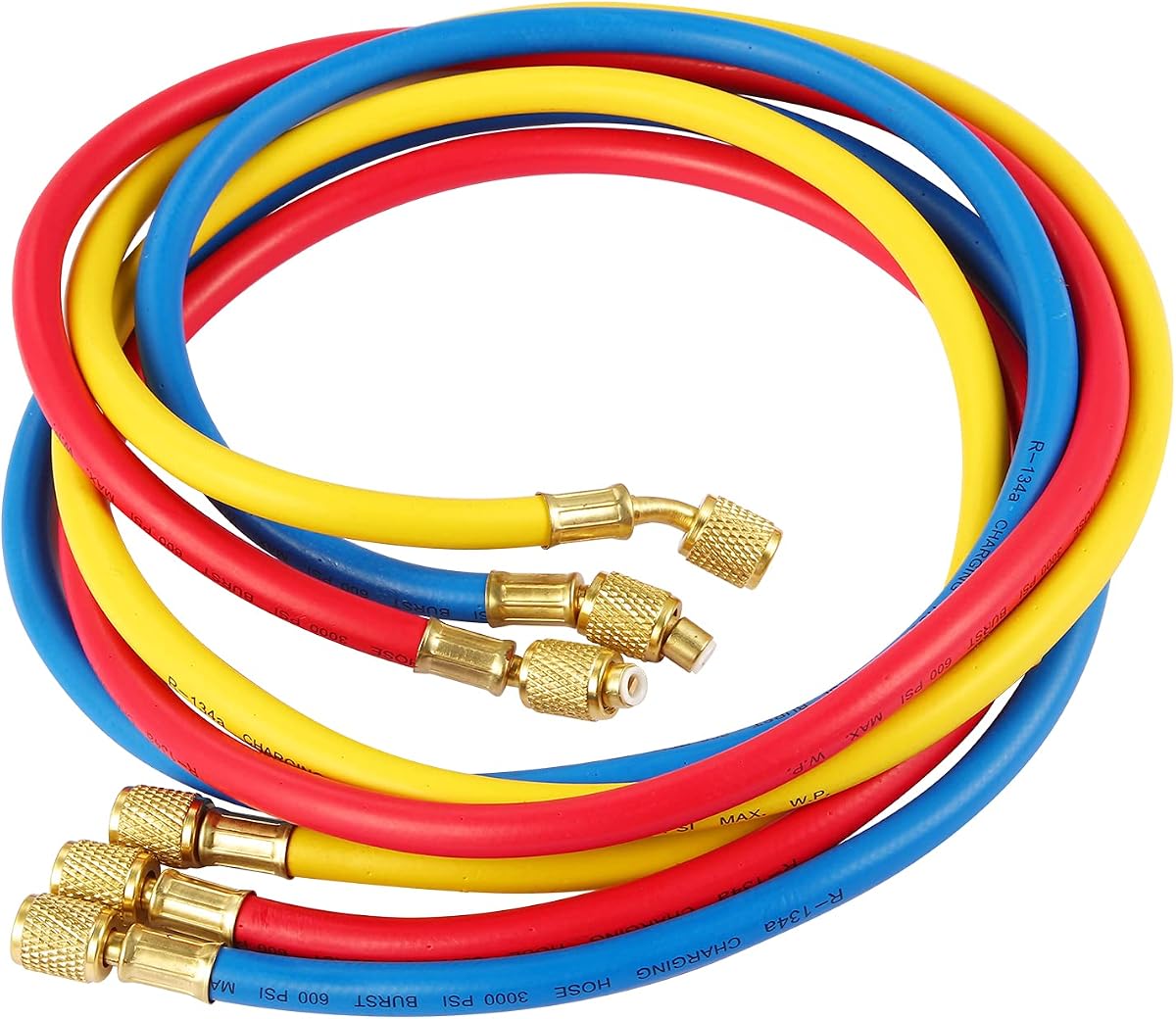
This three-piece AC Manifold Gauge Hose Kit carries a 4.4 rating and provides red, blue, and yellow 60-inch hoses for high-side, low-side, and charging or vacuum applications. It is intended for R22, R12, and R502 systems, with the listing also identifying suitability for R404A. The set is a straightforward choice for technicians who want a color-coded replacement hose group for common air-conditioning service.
We may earn a commission when you buy through this link, at no additional cost to you.
The hoses use one-quarter-inch SAE female flare connections and 45-degree service-port ends to improve access. Their stated maximum working pressure is 500 PSI, while the listed burst pressure is 2500 PSI. This distinction matters: working pressure is the relevant limit for routine service, and a hose intended for R410A should carry a suitably higher working-pressure rating than the R134A service commonly associated with 600 PSI hoses.
A potential ambiguity appears in the product information, which also references a 2500 PSI limit for the hose. The comparison here uses the more detailed kit specification stating 500 PSI working pressure and 2500 PSI burst pressure. Because R410A operates at higher pressure than many legacy refrigerants, this set is not the strongest choice for those systems unless the system manufacturer and the equipment manufacturer otherwise approve it.
The set is useful for pressure testing a line set, pulling a vacuum before charging, and replacing a manifold hose group. It does not include individual ball valves, so flow control depends on the connected manifold or equipment. Buyers who need R410A service, higher working pressure, or precise hose-level shutoff should choose a more specialized set.
Red, blue, and yellow coding follows familiar manifold conventions, making it easier to connect the hoses correctly under time pressure. Color coding is a workflow aid rather than a substitute for checking the manifold labels and service-port markings.
The listed R22, R12, R502, and R404A coverage makes this kit relevant to many automotive and older air-conditioning applications. Confirm the refrigerant, operating pressure, and SAE connection requirements before connecting the hoses to a system.
We may earn a commission when you buy through this link, at no additional cost to you.
The R410A Manifold Gauge Hose Kit is a three-hose set with a 4.3 rating, an 800 PSI working-pressure specification, and a 4000 PSI burst-pressure rating. It is explicitly designed around R410A while also listing R134A, R404A, R22, R12, and R502 compatibility. That combination gives it broad relevance for modern residential systems, automotive air conditioning, maintenance, charging, evacuation, and pressure testing.
We may earn a commission when you buy through this link, at no additional cost to you.
Each of the three 60-inch, or five-foot, hoses is color coded. Red is assigned to the high-pressure side, blue to the low-pressure side, and yellow to charging or vacuum-pump work. The long, flexible design improves reach around residential condensers, indoor equipment, and service areas while retaining enough slack to keep the connections from being strained.
The standard one-quarter-inch SAE female flare fittings are compatible with common manifold gauge sets and refrigeration service equipment. The listed working and burst ratings are especially relevant for R410A, but buyers should still verify that the entire connected system—including gauges, manifold, service equipment, and connectors—is approved for the pressure and refrigerant involved.
This is a strong general-purpose choice for technicians or advanced DIY users who want a high-pressure-rated three-hose group without paying for a complete manifold assembly. It lacks integrated ball valves and does not include gauges, so it is not a self-contained diagnostic kit. For many users, however, the balance of pressure rating, reach, color coding, and refrigerant breadth makes it one of the most adaptable options in this roundup.
The 800 PSI working rating and 4000 PSI burst rating provide a clear specification for high-pressure service work. That makes the set more appropriate for R410A than hoses whose listed working pressure is limited to 500 or 600 PSI.
The three-color arrangement supports charging, evacuation, pressure testing, and routine maintenance. It also works with a broad refrigerant list, reducing the need to keep multiple hose groups on hand for common automotive and residential systems.
We may earn a commission when you buy through this link, at no additional cost to you.
This bundle includes three 60-inch red, yellow, and blue charging hoses along with a diagnostic manifold gauge set and two quick couplers. Its 4.2 rating reflects a package aimed at users who want more than replacement hoses. The manifold can make pressure readings and charging procedures more accessible, while the hoses provide 800 PSI working pressure and a listed 4000 PSI burst pressure.
We may earn a commission when you buy through this link, at no additional cost to you.
The hose ends use one-quarter-inch SAE female flare fittings with valve-core depressors, and one end of the set features a 45-degree bend for service-port access. The manifold body is described as aluminum alloy with a durable metal casing and a built-in sight glass. Two R410A connector pieces are also included, with the listing describing them as five-sixteenth-inch SAE fittings.
Because the package includes a manifold and several connector types, careful setup is important. The listed hose thread, manifold connectors, and included R410A couplers should be matched with the actual equipment rather than assumed to be interchangeable. Verifying valve-core operation, thread size, and refrigerant approval before use helps prevent leaks or connection errors.
This set is best for a new service setup, a replacement manifold bundle, or a technician who wants hoses and gauges together. It offers more functionality than a hose-only set, though the additional components increase the amount that must be checked and maintained. Those details make it particularly practical for users performing diagnostics, not merely transferring refrigerant.
Including a manifold gauge set makes the bundle more useful for pressure-related tasks than a group of loose hoses. The built-in sight glass adds a visual way to monitor the state of the system during service.
Two quick couplers broaden the practical utility of the package, but their size and refrigerant compatibility should be checked against the system. The mix of one-quarter-inch hose fittings and five-sixteenth-inch connector descriptions calls for a deliberate connection check.
We may earn a commission when you buy through this link, at no additional cost to you.
The R410A 59-Inch Charging Hose is a single-hose package with a 4.4 rating. It combines a 59-inch length, an 800 PSI working-pressure specification, a 4000 PSI burst-pressure rating, and one-quarter-inch SAE female flare fittings. These characteristics make it a direct replacement option for many R410A service arrangements where a longer or more complex hose set is unnecessary.
We may earn a commission when you buy through this link, at no additional cost to you.
The product is listed for R410A as well as R22, R134A, R12, and R502. Its brass and rubber construction is described as durable and easy to operate, while the 45-degree service-port angle is intended to make the hose easier to reach. The use of low-loss fittings can also help reduce refrigerant release during connection and disconnection when the fittings are operated as intended.
A 59-inch hose is slightly shorter than the common 60-inch options in this list, but that difference is unlikely to matter unless the service layout is unusually tight. More significant is the absence of a ball valve and other hoses. This package does not provide a complete high-side, low-side, and charging arrangement, so it is best viewed as a targeted replacement component.
This hose is well suited to a technician or capable DIY user who already owns compatible manifold equipment and wants an additional R410A-capable line. Its high rating, straightforward fitting, and angled connection offer good utility without adding unnecessary components. As with any single hose, compatibility with the connected manifold, valve, and service port remains the buyer's responsibility to verify.
If an existing service setup already has color-coded hoses, a single 59-inch line can fill a gap without duplicating the entire set. It is particularly relevant for R410A work where the pressure rating is clearly stated.
The low-loss fitting design supports cleaner service procedures by helping control refrigerant escape at the connection. Proper technique, clean fittings, and undamaged seals remain necessary to achieve that result.
We may earn a commission when you buy through this link, at no additional cost to you.
This three-hose ball-valve set carries a 4.0 rating and is built around 60-inch red, blue, and yellow charging lines. Each hose has a compact shut-off ball valve with a metal handle, allowing flow to be stopped directly at the hose rather than relying entirely on a separate manifold control. That feature is useful during charging, evacuation, recovery, and system isolation.
We may earn a commission when you buy through this link, at no additional cost to you.
The stated working pressure is 800 PSI with a 4000 PSI burst rating, making the set suitable in principle for R410A as well as the listed R134A, R12, R22, R502, and R404 refrigerants. The product description specifically warns against using a 600 PSI hose for R410A, which is an important distinction for modern high-pressure systems.
Brass alloy fittings, rubber hoses, and deeply knurled coupler nuts form the main construction package. The included accessories consist of one valve-core remover, two thimbles, and six rubber gaskets. These extras are practical for routine service, although the number of small parts means they should be accounted for and kept from being lost in a toolbox.
The set is a strong choice for users who want individual hose-level control. It may be particularly useful for automotive work, where quick isolation of a line is convenient, or for technicians who move between a manifold, recovery unit, and vacuum pump. The lower 4.0 rating suggests mixed customer experiences, so buyers should assess the included hardware and overall condition carefully when it arrives.
Individual ball valves let the user stop or isolate flow at each hose. That control can simplify changes between charging, recovery, and evacuation connections while reducing accidental release when a line is disconnected.
The valve-core remover, thimbles, and replacement gaskets support common maintenance tasks. Keeping the seals clean and replacing worn gaskets is important for maintaining the leak resistance of the valve-equipped connections.
We may earn a commission when you buy through this link, at no additional cost to you.
The Yellow Jacket 21985 Plus II has the highest customer rating in this roundup at 4.5. It is a set of three 60-inch hoses in red, yellow, and blue with standard one-quarter-inch flare fittings. Its principal technical distinction is the improved moisture barrier, designed to resist moisture migration that can contaminate refrigerant and degrade system performance.
We may earn a commission when you buy through this link, at no additional cost to you.
The hoses are rated for an 800 PSI maximum working pressure and a 4000 PSI minimum burst pressure. Their stated operating temperature range extends from negative 20 to 180 degrees Fahrenheit, covering the environmental conditions commonly encountered in HVAC installation and service. The package also has a compact stated weight of two pounds, helping explain why it remains manageable despite including three full-length lines.
The moisture-barrier emphasis makes this set especially relevant to technicians who repeatedly open systems, evacuate them, and then recharge them. A conventional rubber hose can eventually admit moisture through its permeation characteristics, while a specialized barrier construction is intended to slow that process. The color coding follows the familiar high-side, low-side, and center or service arrangement, supporting quick identification.
This is the premium choice for a professional, serious enthusiast, or technician who places repeatability, moisture resistance, and a long service life above initial purchase cost. It does not include individual ball valves or a manifold gauge set, so it is a premium hose group rather than a complete diagnostic package. The higher rating, documented pressure capability, and specific barrier construction justify its place at the top of the list.
The improved moisture barrier is the feature that separates this set from ordinary charging hoses. Limiting moisture ingress helps protect refrigerant quality and supports more reliable system operation after the lines have been opened for service.
An 800 PSI working rating, 4000 PSI minimum burst rating, and stated negative-20-to-180-degree range provide useful limits for service planning. These figures should still be considered alongside the requirements of the connected manifold and equipment.
We may earn a commission when you buy through this link, at no additional cost to you.
This set provides three color-coded seven-inch charging hoses with individual solid-brass manual shutoff ball valves. It has a 4.0 rating and is listed for R410A, R22, R134A, and R12. The quarter-turn valve handles can be operated with one hand, which makes the set convenient for vehicle air-conditioning work and other compact service arrangements where a long hose would be cumbersome.
We may earn a commission when you buy through this link, at no additional cost to you.
The stated pressure specification is 600 PSI maximum working pressure and 3000 PSI burst pressure. Although R410A is included in the listed applications, buyers should note that R410A generally requires a higher working-pressure rating than the 600 PSI commonly associated with R134A service. The 600 PSI maximum should be treated as the controlling limit and checked against the system, equipment, and applicable instructions.
The one-quarter-inch SAE connection and short length create a portable package that is easy to organize in a small toolbox. The solid-metal valve construction and color-coded knobs support repeated use and quick identification. However, seven inches is not enough reach for many residential condenser installations, and it offers very little slack if a manifold or recovery machine is positioned away from the service port.
This set is best for automotive AC, mobile repair kits, or technicians seeking compact valved adapters. It is less appropriate for residential HVAC work where maneuverability and distance from the service port matter. The valves add control that a basic short hose would lack, but the compact size and 600 PSI working rating are meaningful constraints.
Seven-inch lines fit easily into a compact kit and avoid the loose loops created by full-length hoses. That makes them convenient for vehicle interiors and other confined working areas.
Quarter-turn ball valves with solid-brass bodies allow quick flow control. Their position and operating direction should always be confirmed before charging, recovery, or evacuation to avoid unintended pressure movement.
We may earn a commission when you buy through this link, at no additional cost to you.
The 72-Inch Low-Loss Hose Kit is a three-pack with an 800 PSI working-pressure rating, a 4000 PSI burst rating, and individual ball valves. At 72 inches, it provides the longest hose length in the comparison. That additional reach is useful when the service port and connected gauge set, recovery machine, or vacuum pump cannot be positioned immediately beside the system.
We may earn a commission when you buy through this link, at no additional cost to you.
The product lists compatibility with R134A, R410A, R12, R22, R502, R1234yf, and A2L refrigerants, while the one-quarter-inch SAE flare fittings are intended to fit most service ports. PTFE gaskets are used with brass fittings, and the stated operating range extends from negative 20 to 180 degrees Fahrenheit. Red, yellow, and blue markings align the hoses with common manifold layouts.
The central concern is the 3.1 rating, which is notably lower than every other option in the roundup. The listing presents substantial technical specifications, but those specifications alone do not establish long-term reliability or customer satisfaction. A buyer may reasonably appreciate the features while taking extra care to inspect the valves, seals, fittings, and hose condition on arrival.
This kit is worth considering for users who need extended reach, especially in residential or commercial installations where routing around an outdoor unit is difficult. It also provides the most direct flow control among the long-hose options. Because of its lower rating, it is not the leading recommendation for all users, but it may still fill a specific need that shorter, higher-rated alternatives cannot.
At six feet, each hose offers more freedom to position connected equipment than a standard five-foot set. This is especially helpful when the service port faces a wall or the manifold must rest on a clean, stable surface away from the unit.
Integrated ball valves support immediate flow control, while PTFE gaskets provide a specified sealing material at the connections. Both components should be checked regularly, especially after repeated thermal cycling or heavy use.
We may earn a commission when you buy through this link, at no additional cost to you.
The Three-Color Ball Valve Set is a three-hose package with a 4.2 rating. It includes red, blue, and yellow 60-inch hoses, each equipped with a compact ball valve and metal handle. The set is designed for R410A, R134A, R12, R22, R502, and R404 service, using one-quarter-inch SAE connections for compatibility with common charging equipment.
We may earn a commission when you buy through this link, at no additional cost to you.
The 800 PSI working-pressure specification and 4000 PSI burst rating make the set suitable for higher-pressure work than hoses limited to 500 or 600 PSI. Brass-alloy fittings and rubber hoses form the stated construction, while deeply knurled coupler nuts are intended to provide quick finger-tightening during setup and disconnection.
Integrated valves distinguish this product from simple color-coded hose groups. They let a technician stop flow on an individual line during a charging or evacuation sequence and reduce the need to depend exclusively on controls mounted on a separate manifold. The handles make the valves easy to identify, while the color coding helps maintain consistent high-side, low-side, and charging connections.
This is a practical choice for workshops and mobile service kits that already have a gauge set but need flexible valved lines. It is more specialized than a basic replacement hose and less comprehensive than a full manifold bundle. Users should inspect the valve seals and gaskets, confirm the refrigerant requirements, and ensure that the connected equipment is rated for the same pressures.
Each of the three hoses can be isolated with its own ball valve. This makes it easier to sequence connections and reduces the need to repeatedly reach the manifold controls during a service procedure.
The 60-inch length provides useful reach without the storage bulk of a 72-inch set. Three matching colors and a common 800 PSI rating make the package convenient for routine high- and low-side service.
We may earn a commission when you buy through this link, at no additional cost to you.
The right charging hose set depends on refrigerant type, system pressure, equipment connections, service environment, and the amount of flow control you need. These factors matter more than color alone because a visually organized hose can still be unsafe or ineffective if its pressure rating or fitting size is wrong.
Working pressure is the maximum pressure the hose is designed to handle during normal service, while burst pressure describes the pressure at which the hose may fail catastrophically. A high burst figure does not make a hose suitable for a higher-pressure refrigerant system if its working rating is too low. R410A service calls for a hose with an 800 PSI working-pressure specification, while many R134A applications use hoses rated to 600 PSI. Compare the hose with the refrigerant, manifold, recovery equipment, vacuum pump, and service-port requirements rather than looking at burst pressure alone.
Refrigerants differ in operating pressure, chemical characteristics, and service requirements. The product data in this guide covers commonly encountered refrigerants including R410A, R134A, R404A, R22, R12, R502, R1234yf, and A2L. A listing's compatibility claim is a useful starting point, but it should be confirmed against the equipment label and service documentation. Some hoses are presented as broadly compatible while also carrying a lower working limit, so the refrigerant and pressure specifications must be read together.
Most equipment in this category uses one-quarter-inch SAE flare connections, which explains why that measurement appears throughout the list. A hose can still be unusable if its connector threads do not match the manifold, coupler, or adapter. Some bundles include additional connector sizes, so it is important to identify which part is the one-quarter-inch hose end and which accessory may be five-sixteenth-inch. Inspect threads for damage, confirm the flare and valve-core arrangement, and avoid using adapters to bridge incompatible systems unless they are specifically approved.
Length determines how easily connected equipment can be placed away from the service area. Five-foot hoses are common for residential and automotive work, while the 72-inch option provides extra reach for difficult layouts. Short seven-inch hoses are compact and portable but offer little routing flexibility. Flexible rubber construction is also important because a hose that cannot bend without kinking can place stress on the fitting. The best length is the shortest one that comfortably connects the service port to the manifold or service equipment without pulling or sharply bending the line.
Red, blue, and yellow hoses conventionally correspond to the high-pressure side, low-pressure side, and center or charging connection on many manifold sets. This makes connections faster and helps reduce operator error, especially when gauges are not labeled clearly. Color coding should still be verified against the actual manifold because layouts can vary. Single-color hoses are useful for replacing one damaged line, while a complete three-color group is more convenient for users who move equipment between systems or perform regular charging and evacuation work.
Ball valves provide quick shutoff at the hose itself. This is valuable during charging, recovery, evacuation, and system isolation because it allows a line to be stopped without relying only on a distant manifold valve. Valve operation should be smooth, and the handle should clearly indicate the open or closed position. Quality varies among generic sets, so inspect the seals and threads carefully. A ball-valve hose is most useful when paired with a correctly rated manifold, recovery machine, or vacuum pump.
Charging hoses are opened to the atmosphere during service, making moisture control important. A dedicated moisture-barrier construction can slow the migration of moisture into the hose, while durable gaskets help maintain a secure seal at threaded and flare connections. PTFE gaskets, neoprene seals, and rubber gaskets are among the materials identified in the product data. Inspect gaskets for cracking, flattening, or contamination, and replace them when necessary. Even a premium hose cannot preserve system integrity if its seals are worn or its fittings are dirty.
Useful accessories can include quick couplers, a valve-core remover, thimbles, replacement gaskets, and a manifold gauge set. These additions improve convenience, but they also create more items to inspect and organize. Metal handles and deeply knurled nuts help with handling, while brass fittings offer corrosion resistance. Store hoses loosely after use, away from sharp edges and excessive heat, and remove moisture before closing the case. Proper storage helps prevent kinks, abrasion, and seal damage that can shorten service life.
Before connecting a hose, identify the system refrigerant and required pressure, then verify that the hose working-pressure rating, SAE connection size, manifold, valves, and attached equipment are all appropriate. Inspect the entire hose for cuts, bulges, cracks, chafing, or hardened rubber. Clean the service-port fitting and replace any dirty or damaged seal. Confirm that the valve is in the correct position before attaching the hose, and follow the equipment and system manufacturer's instructions throughout the procedure.
Connect the correct color to the corresponding manifold side and make sure all threads engage smoothly without forcing them. Hand-tighten the knurled coupler until secure, then use the appropriate wrench to reach the specified torque. Open the valve slowly and watch for leaks at both the hose connection and service port. Never use a wrench on a valve body that the manufacturer says is not intended to be torqued. Keep the hose free of twists, sharp bends, tension, and contact with hot or moving equipment.
After completing charging, recovery, or evacuation, close the appropriate valves and disconnect the hose carefully to minimize refrigerant release. Cap or protect open service ports immediately. Wipe fittings clean, inspect the seals, and check that the hose has drained and dried before storage. Coil the hose without tight kinks, store it away from chemicals, sharp tools, and excessive heat, and periodically verify the hose and fittings remain suitable for the next service.
Choose a hose with an 800 PSI maximum working-pressure rating for R410A service. A higher burst rating does not replace an adequate working-pressure rating, and the entire connected chain—including the manifold, recovery unit, couplers, and service equipment—must also be approved for the application. Verify that the hose specifically states R410A compatibility and uses the correct SAE connection size.
No. Hoses can differ in working pressure, burst rating, fitting size, refrigerant approval, hose length, and valve design. A hose may physically screw onto a connection yet still be inappropriate for the refrigerant or operating pressure. Compare the hose label with the system nameplate and the specifications of every connected device before use.
A single hose is useful for replacing one damaged line or supplementing an existing manifold set. A three-color set provides the high-side, low-side, and charging or vacuum connections in one coordinated package. Three-color kits are generally more convenient for complete charging, recovery, evacuation, and diagnostic tasks.
A ball valve lets the operator stop refrigerant or vacuum flow directly at that hose. This makes it easier to isolate a line, sequence connections, and reduce release during disconnection. The valve must be in the correct position before a connection is opened or closed, and its seals should be checked routinely for leakage.
For many residential systems, 60-inch hoses provide enough reach to position a manifold comfortably near the outdoor unit. Wall placement, line routing, and the location of connected equipment can still make more length useful. A 72-inch set may be preferable when a standard hose cannot be routed without tension, while short hoses are more convenient for vehicle applications.
Moisture can enter a hose through permeation, dirty fittings, or an imperfect connection. A moisture barrier is designed to slow migration through the hose itself, which is especially useful for technicians who repeatedly evacuate and recharge systems. It should be combined with clean fittings, sound gaskets, and correct handling practices for the best protection.
Store them loosely coiled, without tight bends, and keep them away from sharp edges, hot vehicles, excessive heat, and chemical contamination. Clean and dry the hoses before storage, and inspect the rubber, gaskets, and threads periodically. A dedicated case or divider can keep color-coded hoses organized and prevent fittings from being knocked against hard surfaces.
Many charging hose sets are also suitable for vacuum evacuation, but the hose and attached equipment must be rated for that use and compatible with the refrigerant system. Check the working pressure, connection size, seals, and manufacturer instructions. For a complete kit, a manifold, vacuum pump, and appropriate service-port connection are needed in addition to the hoses.
The Hromee 60-inch hose is the best-oriented value option for a targeted replacement, offering 800 PSI working pressure, brass fittings, and a useful 45-degree connection. The R410A Manifold Gauge Hose Kit is the most versatile general-purpose set, combining three color-coded five-foot hoses with 800 PSI working and 4000 PSI burst specifications. For premium construction, the Yellow Jacket 21985 Plus II stands out with its documented moisture barrier, strong customer rating, and broad pressure and temperature specifications.
Prioritize the system refrigerant, working pressure, SAE connection size, and required hose length before considering extra features. Ball valves are valuable when regular charging, recovery, or evacuation is expected, while a single hose or shorter set may better suit mobile vehicle work. Moisture-barrier construction and dependable seals become increasingly valuable for a service hose that will be used repeatedly.
Ratings, product configurations, and availability can change, so check the current listing and confirm the included components before ordering. Also inspect the latest details for connection size, pressure rating, and included manifold equipment, since those specifications determine whether a hose set can safely and effectively serve the intended system.