
RC Battery Charger 150W
4.7Editor score
150W charging capacity
AC and DC inputs
Twenty memory profiles
Our Rc Battery Pack Charger Station guide compares chargers for battery compatibility, power, channels, balance features, connectors, safety, and portability.
An RC battery pack charger station is more than a convenient way to top up a battery between runs. The right charger must match your battery chemistry, cell count, connector, and charging method while providing dependable protection against common charging errors. That becomes especially important when one garage contains cars, drones, aircraft, boats, and legacy NiMH packs.
This guide compares ten battery chargers according to supported chemistries, maximum charge and discharge power, dual-channel capability, balance charging, memory profiles, safety protections, included leads, display design, and portability. It covers compact single-purpose chargers, sophisticated B6-style units, high-power dual-channel stations, and a dedicated two-bank LiPo charger for smaller packs.
Each recommendation highlights a different reason to buy: broad chemistry support, simultaneous charging, balanced cell maintenance, strong output, or a simple setup for specific battery types. The award labels identify three standout choices from the group, while product details reflect the supplied manufacturer information. Prices and availability can change, so confirm current listings before purchasing.
4.7Editor score

4.6Editor score

4.7Editor score
The comparison below highlights the major differences in supported battery types, channel count, power, charging functions, and connector coverage, helping readers identify the most suitable charger for their RC collection.




The Venom Power Pro Duo is a feature-rich dual-channel charger with a 4.6 rating and two independent 80W charging circuits. Its combination of 160W total power, broad chemistry support, an LCD screen, and eight supplied leads makes it unusually well equipped for a mixed RC collection. It is particularly convincing as an all-around station for drivers, pilots, and drone users.
We may earn a commission when you buy through this link, at no additional cost to you.
Two batteries can be charged at the same time without sharing a channel, while the lead selection covers alligator, Deans, EC3, EC5, JST, receiver, Tamiya, and XT60 connections. The charger supports LiPo, LiHV, Li-ion, LiFe, NiMH, NiCd, and lead-acid batteries. Balance, fast, discharge, cycling, storage, and battery-meter modes give owners useful options beyond basic charging, while five profile slots reduce repeated configuration.
Internal temperature monitoring is a meaningful safety advantage because charging can stop when the selected temperature threshold is reached. The integrated handle and lightweight two-pound frame also help separate it from desk-only power supplies. The principal trade-off is that its menu-driven feature set and larger footprint may feel excessive for someone with only one small battery and a basic connector.
It is the strongest recommendation for someone who wants one station to handle several RC disciplines and charge two packs at once. The included connector ecosystem reduces the need to hunt for adapters, while independent channels offer more scheduling flexibility than a basic single-bank charger. For users who routinely fly, race, or drive with multiple battery types, that combination is difficult to overlook.
Charging two batteries concurrently can shorten downtime between RC sessions. Independent 80W circuits also prevent one pack from reducing the operating power available to the other, although the exact charging time still depends on battery chemistry, capacity, and selected current.
Eight included leads make the charger useful with common RC battery formats without a separate adapter collection. The range includes mainstream bullet connectors, smaller RC plugs, receiver connections, and alligator clips for setups that do not use a standard molded plug.
We may earn a commission when you buy through this link, at no additional cost to you.
This 150W, 10A charger earns a 4.7 rating and stands out by combining extensive compatibility with a wide collection of operating features. It supports 1-6S lithium packs, 1-15S NiMH and NiCd packs, and 2-20V lead-acid batteries. For an enthusiast who wants sophisticated capabilities without paying for a two-bank power station, it is a compelling choice.
We may earn a commission when you buy through this link, at no additional cost to you.
The charger accepts household AC from 100-240V and 11-20V DC input, giving hobbyists flexibility over where charging occurs. A cooling fan supports fast charging, while the fireproof shell adds a practical layer of protection. Users can choose balance, fast, discharge, storage, or cyclic charging and store 20 battery profiles for quick recall.
Its internal resistance check, battery meter, digital DC power mode, and automatic lithium cell detection are useful additions for regular maintenance. The package includes AC and DC cords, a balance board, and an octopus harness with several popular connectors. Compared with the Venom Pro Duo, however, it cannot charge two separate batteries concurrently, which is the central concession for buyers with several packs.
This model is best recommended for a broad collection of RC cars, drones, boats, and aircraft operated by one person. The extensive safety protections make it attractive for users who charge different chemistries and want the charger to identify lithium cell counts automatically. It remains a single-channel unit, so runners with two vehicles needing simultaneous turnaround should examine the dual-channel alternatives.
Support for lithium, nickel, and lead-acid families means the charger can remain useful as an RC collection changes. Automatic lithium cell detection reduces one common source of setup error, while the manual still calls for choosing the correct chemistry before charging.
Twenty memory profiles are useful for regular users who repeatedly charge a small set of known packs. Saved settings reduce the need to reselect voltage and current each time, provided the correct profile is always matched to the physical battery.
We may earn a commission when you buy through this link, at no additional cost to you.
The Universal NiMH NiCd Battery Charger is designed for hobbyists who still rely on nickel-based RC packs. It has a 4.4 rating and supports 2-10S NiMH and NiCd configurations from 2.4V through 12V. Its prewired plugs cover several popular RC formats, making it a practical one-unit solution for cars, helicopters, airsoft equipment, and remote-control toys.
We may earn a commission when you buy through this link, at no additional cost to you.
Charging current adjusts automatically: packs from 2-6S receive 800mA, while 7-10S packs receive 500mA. Negative-delta V and zero-delta V auto-stop methods help recognize a completed charge, while negative-pulse cooling is intended to limit heat during charging. The charger also includes zero-voltage activation and protection against short circuits, reverse polarity, and excessive current.
Its connector collection includes Standard Tamiya, mini Tamiya, JST, SM 2P, XH, Huanqi, T-Plug, and Futaba/JR receiver connections. That breadth is a major advantage for owners of older vehicles whose batteries do not use a modern XT60 or EC-style connector. The compact 77 by 44 by 28mm housing and 100-240V AC input also make it easy to store and use across regions.
The limitation is fundamental: this is not a LiPo, Li-ion, or LiFePO4 charger, and it does not perform lithium cell balancing. It is best for someone building or maintaining a fleet around older NiMH and NiCd packs. If the collection includes any lithium batteries, a multi-chemistry balance charger will be a safer and more versatile long-term purchase.
Restricting operation to NiMH and NiCd simplifies the charging process and removes the risk of accidentally selecting an unsuitable lithium mode. It also makes this charger a focused solution for legacy packs that many universal B6-style units can technically handle but do not primarily target.
The charger reduces current for packs with more cells, which is a sensible response to the greater heat and power demands of higher-voltage nickel packs. Users should still confirm the connector polarity and battery condition before every session.
We may earn a commission when you buy through this link, at no additional cost to you.
This dual 10A balance charger combines two channels with a broad range of supported chemistries. Its 4.3 rating reflects a capable unit aimed at RC competitors, model-aircraft pilots, and hobbyists who need to prepare multiple packs. Both channels can operate at the same time, with a combined AC limit of 150W and a combined DC limit of 240W.
We may earn a commission when you buy through this link, at no additional cost to you.
The charger handles 1-6S LiPo, LiHV, Li-ion, and LiFe batteries, 1-15S NiCD and NiMH packs, 2-20V lead-acid batteries, and three smart-battery types. Charge, balance, discharge, and storage modes are available, and individual cells can be monitored and balanced while discharging. Twenty memory slots let regular users recall battery configurations without rebuilding them each session.
A large display provides access to voltage, current, and mode controls. Automatic cell-count identification is particularly useful in balance mode, although users must still select the correct chemistry. The supplied accessory package is extensive, with AC power, XT60 and Tamiya leads, Deans adapters, crocodile clips, balance extensions, and a manual.
This is a good fit for owners who regularly cycle through different pack types and want simultaneous charging at a moderate output level. Its trade-offs are a less streamlined interface and the requirement to use either AC or DC power at one time. Users who need the highest charging current available in this guide may prefer the 16A-per-channel model, while the Venom offers a simpler dual-channel concept.
Individual cell monitoring and balancing help keep multi-cell lithium packs more even. This is valuable for regular fliers and racers because a balanced pack can deliver more consistent performance and helps identify cells that are beginning to diverge.
The included XT60, Tamiya, Deans, crocodile, and balance connections support a broad range of RC equipment. This makes the package more adaptable than a minimal charger sold with only one main lead and a small set of adapters.
We may earn a commission when you buy through this link, at no additional cost to you.
The Prettyia 19-Group Charger specializes in NiMH and NiCd packs from two through ten cells. Its 3.8 rating is the lowest in the group, but the extensive connector list gives it a distinct purpose for owners of varied legacy equipment. The unit can serve RC helicopters, Tamiya-based vehicles, airsoft accessories, cars, and other compatible remote-control toys.
We may earn a commission when you buy through this link, at no additional cost to you.
Its intelligent system automatically detects pack voltage and matches the charging current, then shuts off when the pack is full. Protection against overcharging, overcurrent, short circuits, and reverse polarity adds safeguards for routine use. The advertised connector selection spans Tamiya, mini Tamiya, JST, SM, Futaba/JR, XH, Traxxas, Molex, PH, EL-2P, S557, EC3, and 4mm banana connections.
Compared with the Universal NiMH NiCd Charger, this model offers a more extensive advertised selection of molded connector formats. It also includes a 12-month warranty and a compact design with universal 100-240V AC input. However, it lacks the cell balancing, discharge functions, memory profiles, and dual-channel flexibility found in more advanced chargers.
This charger is most appropriate for someone focused almost entirely on nickel-based batteries and values connector availability over sophisticated battery diagnostics. It is not suitable for LiPo or Li-ion packs, and its lower rating suggests buyers should consider the product warranty and expected support. For mixed-chemistry charging, one of the B6-style or dual-channel options is the more coherent long-term choice.
Nineteen connector groups can simplify ownership of an older collection that includes several less standardized battery interfaces. This is more meaningful for nickel-pack users than for modern LiPo owners, who often standardize around XT60, EC3, or EC5.
Automatic voltage detection and current matching reduce the number of manual choices. Users must still confirm that the pack is rechargeable NiMH or NiCd and that the attached connector has the correct polarity.
We may earn a commission when you buy through this link, at no additional cost to you.
The 150W 10A Balance Charger is a capable single-channel unit with a 4.5 rating. It supports LiPo, Li-ion, LiHV, LiFePO4, NiMH, NiCd, lead-acid, and smart batteries, making it suitable for drivers and pilots who need several chemistries without moving to a dual-channel station. A clear LCD, cooling fan, and 5V 2.1A USB output round out the practical features.
We may earn a commission when you buy through this link, at no additional cost to you.
The charger accepts 100-240V AC or 11-18V DC input and provides up to 150W of output, 0.1-10A charging current, and 0.1-2A discharge current. Its most distinctive capability is adjustable end voltage: lithium charging endpoints can range from 3.85V to 4.3V per cell. That flexibility is useful for experienced users, though the product description explicitly identifies the function as an expert-only setting.
Additional maintenance tools include a battery meter, internal-resistance checking, cell balancing, and digital DC power. Automatic identification helps with lithium cell counts, and the charger stops when the battery reaches full charge. Compared with the similar 150W model in second place, this unit stands out for its adjustable endpoint control and integrated USB output rather than its 20 memory slots.
It is a strong recommendation for technically confident hobbyists who may fine-tune charging behavior and want one charger to serve several battery families. Beginners should avoid experimenting with unfamiliar voltage settings and should follow the product instructions carefully. Those who regularly need two packs charged at once should instead prioritize one of the dual-bank models.
Adjustable charge and discharge end voltages offer more control than a basic fixed-endpoint charger. Because incorrect settings can affect a pack, the feature is best used only by users who understand the battery chemistry and intended application.
Internal-resistance checks, cell balancing, and a battery meter provide useful ways to inspect pack condition. These functions make the charger more than a power supply and help users notice uneven cells or declining performance.
We may earn a commission when you buy through this link, at no additional cost to you.
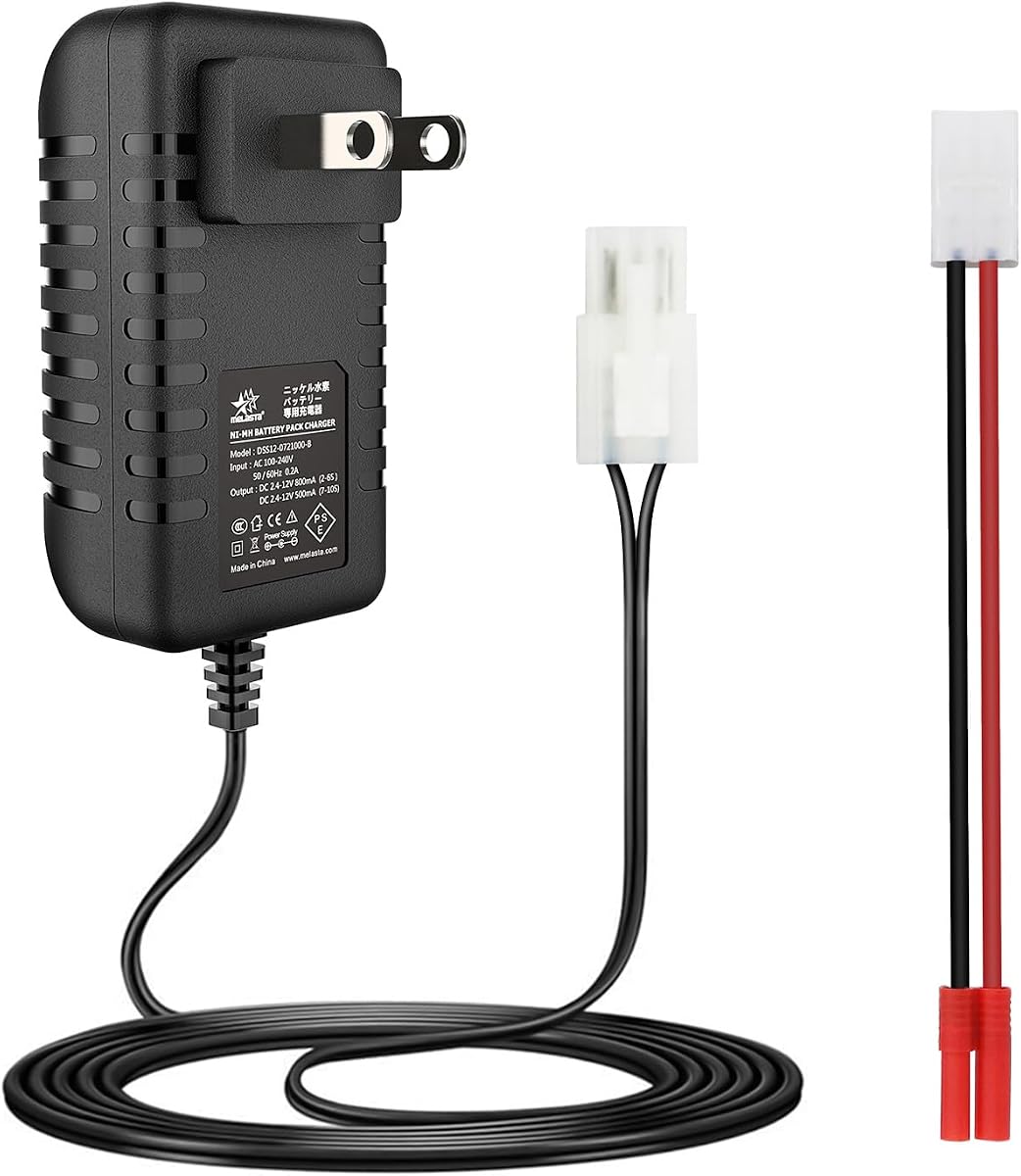
The Melasta RC Battery Charger is a straightforward option for common NiMH and NiCd car packs, with a 4.6 rating. It supports 2.4V through 12V configurations and includes a standard Tamiya connector plus an HXT 4mm banana-plug option for compatible Redcat and Hexfly packs. Its appeal lies in uncomplicated operation rather than advanced battery management.
We may earn a commission when you buy through this link, at no additional cost to you.
The unit automatically detects pack voltage and shuts off when charging is complete. It supplies 800mA for 2.4V-7.2V packs and 500mA for 8.4V-9.6V packs, with a typical charging time of six to ten hours depending on capacity. A red LED remains on during charging, turns green when finished, and flashes when it detects a bad connection.
Protection against overcharging, overcurrent, short circuits, and reverse polarity provides basic safeguards. The charger is limited to nickel chemistries and explicitly should not be used with Li-ion batteries. It also lacks balance charging, discharge testing, adjustable current, and profile storage, so it is not a suitable general station for modern lithium packs.
This is a good match for an RC car hobbyist with a small collection of Tamiya-style NiMH batteries who wants a charger that works without menus or complex setup. It may also suit users who value a visible status indicator and a compact dedicated charger. Owners of mixed fleets should look toward a multi-chemistry model, while high-volume users may need faster current.
Automatic voltage detection and current selection keep the process straightforward. Once the correct connector is attached, the LED gives a clear indication of charging, completion, or a connection problem without requiring an LCD menu.
Standard Tamiya support covers many classic RC cars, while the included banana cable expands compatibility with selected HXT-equipped packs. Buyers should check the physical connector and polarity before charging an unfamiliar battery.
We may earn a commission when you buy through this link, at no additional cost to you.
The LiPo Charger Dual 300W is the most powerful option in this comparison, pairing a 4.7 rating with 16A of charging current per channel. It accepts up to 300W combined AC input and 400W combined DC input. That capacity makes it a premium station for serious RC users who want rapid turnaround and the flexibility to charge two different packs at once.
We may earn a commission when you buy through this link, at no additional cost to you.
It supports 1-6S lithium chemistries, including LiPo, LiHV, Li-ion, LTO, and LiFe, as well as 2-20V lead-acid and 1-15S NiCD and NiMH batteries. Charge, balance, discharge, storage, and balance-only modes are available, and individual cells can be monitored and balanced while discharging. A battery meter, cycling function, and automatic cell-count detection round out the toolkit.
Operation is designed around only two buttons, while a large display presents the selected settings. In balance mode, automatic identification can determine lithium cell count. The package includes an AC cable, XT60-to-EC3/EC5/T-plug leads, balance extension cords, a screen protector, and a manual, providing a complete setup for a mixed collection.
Its premium status is justified by output rather than decorative extras, making it best suited to users charging high-capacity packs or maintaining multiple vehicles. Users must select an appropriate current rather than assuming 16A is safe for every battery, and only one input type should be used at a time. Despite its capability, it remains less convenient than a dedicated compact charger for a single small pack.
Up to 16A per channel provides considerable headroom for high-capacity batteries. Actual charging time still depends on pack size and internal limits, so the selected current should remain within the battery manufacturer's recommendations.
A dedicated balance-only mode focuses on bringing individual cells to a matched state without performing a full standard charge cycle. This can be useful for maintenance and pack preparation, provided the balance connector is attached correctly.
We may earn a commission when you buy through this link, at no additional cost to you.
The B6 80W Mini Charger combines a familiar multi-mode design with a portable footprint and a 4.6 rating. It supports 1-6S LiPo, LiHV, Li-ion, and LiFe batteries, 1-15S NiCD and NiMH packs, and 2-20V lead-acid batteries. This makes it a practical general-purpose charger for a single pack at a time.
We may earn a commission when you buy through this link, at no additional cost to you.
Charging, smart balance, discharge, and storage modes cover the core tasks of preparing and maintaining a battery. The balance mode automatically identifies cell quantity, voltage, and current parameters. The large LCD makes mode selection and parameter adjustment visible, while the 0.1-6A charge range and 2A discharge current offer enough flexibility for common hobby packs.
It can measure voltage and capacity, check reference internal resistance for lithium batteries, and balance individual cells without a separate meter. An alarm sounds when parameters exceed the set range or a configuration error is detected. The accessory kit includes a DC power cable and EC3, Futaba servo, DC, XT60, JST, crocodile, Tamiya, and T-plug connections.
This is an excellent fit for users who want many maintenance functions in a smaller package and do not need to charge two batteries simultaneously. It also works well for competitions and field use where carrying a large dual-channel station would be inconvenient. The included 80W supply and 6A maximum current limit heavy-duty charging compared with the higher-output models.
The small, portable design makes the charger easier to carry to races or flying sessions than a large dual-bank station. Its feature set still includes balance, discharge, storage, testing, and profile-oriented functions found in much larger devices.
Voltage, capacity, internal-resistance, and cell-balance information makes it easier to check pack condition. These tools are most useful when a consistent charging and inspection routine is established rather than when batteries are only topped up occasionally.
We may earn a commission when you buy through this link, at no additional cost to you.
The OVONIC D15 is a dedicated dual charger for 1S, 2S, and 3S LiPo batteries, with a 4.3 rating. Its two independent 15W channels each support up to 1.2A, allowing two small RC packs to charge together. The narrow battery focus makes it a specialist option rather than an all-purpose station.
We may earn a commission when you buy through this link, at no additional cost to you.
The advertised 5-per-mille balancing accuracy is finer than the typical 10-per-mille cited in the product information, helping maintain closer cell matching. An abnormal-battery detection feature keeps the red light on when a faulty pack is detected, prompting the user to stop charging. GaN technology is used to create a compact design with lower heat and energy loss, while synchronous rectification is credited with up to 98% conversion efficiency.
Overvoltage, overtemperature, overcharge, overcurrent, and short-circuit protection provide a broad safety layer. The package includes the D15 balance charger, AC input cable, manual, and box. It is limited to 1S-3S LiPo formats, so it cannot serve 4S and larger packs, nickel batteries, lead-acid batteries, or other chemistries.
This model is a strong recommendation for drone pilots, small RC boat users, or other hobbyists who routinely use small 1S-3S LiPo packs and want two-channel convenience. It is less appropriate for users with large high-cell-count packs or a broad mixed collection. The 1.2A limit and 15W per channel also mean charging speed is modest compared with the larger B6-style and dual-channel stations.
Two 15W channels let users prepare a pair of small LiPo batteries without buying a second charger. This is useful for drone and boat setups where matched small packs are used regularly.
The GaN-based design is intended to reduce heat and energy loss compared with conventional implementations. Its compact form and dual channels make it convenient for a travel kit, although the charging current remains below that of full-size hobby chargers.
We may earn a commission when you buy through this link, at no additional cost to you.
The best charger is the one that safely matches every battery in your collection. Begin with chemistry and cell count, then consider balance charging, channel count, output power, connector coverage, safety features, and where the unit will be used.
Start by identifying every chemistry you intend to charge. Lithium-based options generally include LiPo, LiHV, Li-ion, and LiFe, while multi-chemistry units may also support NiMH, NiCd, and lead-acid. A charger that only handles NiMH or NiCd cannot safely serve a LiPo pack, and a unit limited to 1S-3S LiPo will not cover larger packs. Cell count also matters because a pack's cell arrangement must remain within the charger's supported range.
Multi-cell lithium packs benefit from balance charging because the charger measures and adjusts individual cells toward a common voltage. Look for a balance port, compatible balance lead, and clear cell-voltage display. Some advanced chargers can also balance during discharge, while a balance-only mode may be included for maintenance. Balance support is especially valuable for packs used in aircraft and drones, where consistent cell performance is important.
A single-channel charger handles one pack at a time, while a dual-channel unit can prepare two batteries simultaneously. Independent channels provide more flexibility than simply splitting power across one bank. They also let owners maintain separate settings for different battery types. Verify that the listed channel power is shared only as stated and never place two incompatible batteries on the same channel.
Maximum wattage and amperage determine how quickly a charger can replenish a pack. A 150W, 10A unit is suitable for many common hobby batteries, while the premium 300W AC and 400W DC station offers more headroom for large packs. Higher output is not automatically better: battery manufacturers specify safe charge rates, and excessive current can create heat or stress cells. Always set a conservative current appropriate to the pack's size and design.
The correct battery chemistry is not enough if the charger cannot physically connect to the pack. Common RC formats include XT60, XT30, EC3, EC5, Tamiya, Deans, JST, T-Plug, and receiver connectors. A balance lead must also match the cell count and connector layout. Check the shape, gender, polarity, and pin arrangement rather than assuming visually similar plugs are interchangeable.
Useful protections include short-circuit, overcharge, overcurrent, overheat, reverse-polarity, and low-voltage limits. A temperature sensor is especially valuable because charging creates heat. Battery meters, internal-resistance checks, and cell-voltage displays help identify weak or mismatched cells. These features are more useful when paired with a consistent routine of inspecting packs before charging and removing any pack that is swollen, damaged, or unusually hot.
A large LCD makes it easier to verify chemistry, cell count, voltage, current, and operating mode. Memory profiles save time by recalling recurring battery settings; the most capable units in this guide store 20 profiles. Beginners may benefit from automatic cell detection and straightforward menus, while advanced users often value adjustable endpoints and cycling. Whatever the interface, incorrect settings remain the user's responsibility.
A charger used beside a workbench may prioritize power and connector coverage, while one taken to competitions benefits from a compact frame and manageable weight. AC input is convenient at home, and DC input can make field charging more flexible when paired with a suitable power source. Some advanced units support both but should never use the AC and DC cords simultaneously. Consider cooling, storage space, and the location of the display before finalizing a purchase.
Begin by identifying the battery chemistry, nominal voltage, cell count, connector, and manufacturer-specified charge current. Inspect the pack for swelling, cracks, corrosion, loose cells, or damaged wires, and never attempt to charge a damaged or visibly overheated battery. Select the corresponding chemistry on the charger rather than relying on automatic detection alone, and confirm that the main connector and any balance lead are oriented correctly.
Connect the charger to the appropriate power source first, then attach the battery. When using balance mode, verify that the balance connector's cell count matches the pack and that the numbered positions line up with the battery's balance board. Set a safe voltage and current, select the appropriate mode, and begin charging. Do not use both AC and DC inputs at once on models that prohibit that combination.
During charging, keep the charger and battery on a nonflammable surface with ventilation around the unit. Watch for unusual heat, odor, swelling, or repeated connection errors, and stop immediately if any of these occur. After charging, disconnect the battery according to the charger's instructions, inspect it again, and store lithium packs in an appropriate storage mode. Clean connectors with suitable contact cleaner, keep the charger dry, and use the memory profiles consistently so saved settings always match the attached pack.
Only if its specifications explicitly include those chemistries. Many budget NiMH and NiCd chargers cannot charge LiPo, Li-ion, or LiFePO4, while compact LiPo chargers may not support nickel or lead-acid packs. Never assume that a connector fitting means the charger chemistry is compatible. Check the battery label, the charger's supported battery menu, and the required cell configuration before every first charge.
A normal charge mode treats the battery pack as one combined voltage, while balance charging measures the individual cell voltages through a balance connector. Balance mode then adjusts cells toward a common level, which is useful for multi-cell lithium packs. It does not replace correct charger settings, and the balance connector must match the pack's cell count and pin arrangement.
No. A charger's maximum current is a capability, not a recommended setting for every battery. Safe current depends on battery capacity, chemistry, cell design, and the manufacturer's guidance. Charging a small pack at a high current can create excess heat and stress. Begin with a conservative current and increase only when the battery specification supports it.
A dual-channel charger is convenient when you regularly use two vehicles or need several packs ready at once. It can charge two compatible batteries simultaneously, often with independent settings. A single-channel unit costs less and takes less space, which may be sufficient if you only need one pack at a time. Do not connect two different batteries to the same channel unless the manufacturer explicitly permits it.
The balance connector may have the wrong cell count, reversed orientation, incompatible pin spacing, or a different voltage-specific design. Check the charger display for the detected cell count and inspect the connector for bent pins. Also confirm that the main charging plug and balance plug belong to the same battery, because a standard main connector may fit while the balance connection does not.
No. Several chargers in this guide explicitly warn against using the AC cable and DC cord simultaneously. Choose one power source for the charging session and use the port designed for that source. Combining inputs can create unsafe conditions or damage the charger even when the unit offers both options.
Storage mode is intended to bring a lithium battery to an appropriate storage voltage rather than fully charging or deeply discharging it. This is useful when a pack will sit unused for a period, but the target depends on the chemistry and the manufacturer's instructions. NiMH and NiCd packs do not use the same storage logic as lithium packs, so select the mode only for the supported battery type.
Place the charger on a stable, nonflammable, ventilated surface and keep dust, moisture, and loose metal away from its ports. Inspect plugs and balance leads for damaged contacts, and clean oxidized connectors with a product appropriate for electrical contacts. Store the unit in a dry location, and have any unusual heat, smell, error indication, or damaged lead inspected before further use.
The Venom Power Pro Duo is the strongest all-around recommendation because it combines two independent 80W channels, broad chemistry support, eight supplied leads, useful balance and storage functions, and temperature monitoring. The RC Battery Charger 150W is the value-oriented alternative for users who want extensive modes and 20 memory profiles from a single-channel unit, while the LiPo Charger Dual 300W leads the group in high-power dual-channel performance.
Prioritize exact compatibility before considering convenience. Identify every battery chemistry and cell count, confirm the main and balance connectors, and select a charger whose current can be set conservatively. Then choose one or two channels according to how many packs you need ready, and favor clear protections, temperature monitoring, and diagnostic readouts for regular long-term use.
Remember that product specifications, promotions, and availability can change. Check the current listing and included accessories before buying, especially when a battery uses an unusual connector or requires a specific balance lead. The right station should make charging predictable while matching the equipment you already own rather than forcing your collection into an unsuitable battery format.