Speed Gates Pro
3.7Editor score
Radio frequency sprint sensors
Visible LED timing display
Stores 50 recent times
Rechargeable batteries included
Portable carry bag included
Our electronic sprint timing system guide compares ten options for accuracy, setup, displays, power, portability, and training needs in 2026 for coaches.
An electronic sprint timing system replaces manual stopwatch judgment with automated starts, finishes, recorded results, or both. A useful setup should suit the training space, provide a clear display, align predictably, and operate reliably through repeated sprints. The right choice depends on whether the priority is a portable team kit, professional race accuracy, or a flexible laser system.
The products in this guide were compared using their stated timing methods, display capabilities, power options, range, included accessories, portability, and training applications. The list includes gate-based radio frequency systems, wireless laser timers, and a professional redundant-transmission setup. It covers options for short dashes, field drills, track work, cycling, skating, and more specialized coaching environments.
Each review explains the product's strongest benefits, practical limitations, and likely buyer. Ratings reflect the supplied product information, while feature descriptions come from the listed specifications. Availability, package contents, and pricing can change, so readers should confirm the current listing and accessories before ordering for a particular training program.
3.7Editor score

5.0Editor score

4.7Editor score
This side-by-side comparison highlights each system's timing method, display, power source, range, and intended training environment. It helps distinguish simple gate kits from wireless laser systems, professional redundant systems, and compact options designed for portable use.




Dashr 2.0 Timing Systems provides a focused three-gate package for coaches who want automated sprint evaluation without assembling each optical component separately. Its principal strength is the configuration itself: three gates, lasers, reflectors, and tripods are included, making the package more cohesive than a bare timer with separately positioned accessories.
We may earn a commission when you buy through this link, at no additional cost to you.
The three-gate arrangement can support a more structured measurement workflow than a simple two-point timer. A coach can use separate gate positions to define acceleration phases, while the included reflectors and stands help maintain the required line-of-sight relationships. This makes the system especially relevant to football speed training, acceleration programs, and field testing where consistency in gate placement is important.
The main trade-off is the commitment required by a multi-gate system. It takes more equipment and more setup attention than a single timer or a compact two-cone kit. The supplied product information is concise and does not detail display resolution, memory capacity, battery configuration, operating modes, or communication range, so buyers needing those specifications should verify them before purchase.
This is the strongest option in the list for a coach or facility seeking a dedicated sprint timing system rather than a general stopwatch. It is particularly suitable for repeatable acceleration testing where multiple measurement points matter. Buyers should confirm the full contents and operating requirements on the current listing, but the integrated three-gate approach makes Dashr 2.0 the most focused professional pick.
Three timing gates provide a framework for examining acceleration across multiple points instead of relying on a single start-to-finish result. That structure is useful for coaches comparing short splits and tracking how athletes build speed.
The inclusion of lasers, reflectors, and tripods simplifies assembly because the core positioning elements are supplied together. Correct alignment remains essential, but a bundled system reduces the need to source each component independently.
We may earn a commission when you buy through this link, at no additional cost to you.
The 40/60 Yard Sprint Timer combines a compact smaller tripod with a five-digit display and stated accuracy to 0.001 seconds. It is aimed at athletes and coaches who want precise numerical timing for 40-yard, 60-yard, and other sprint activities while retaining a wireless layout that avoids cables across the lane.
We may earn a commission when you buy through this link, at no additional cost to you.
Its wireless communication range is listed as 0 to 400 meters, while the effective laser distance is less than 13 meters. This distinction matters: the wireless signal can connect the timer and remote components across a broad area, but the actual optical timing beam has a much shorter working distance. The timer can also sit beside a coach for convenient recording during track and field training.
The display is described as bright, clear, and flicker-free, with resistance to visible-light interference for stable operation in direct sunlight. Its built-in battery charges in five hours and is stated to run for eight hours. A smaller tripod is included, although the product information notes that higher brackets may be purchased separately for elevated placement.
This timer is a good choice for a track coach who values numerical detail, wireless flexibility, and daylight readability. It can also support motorcycle timing, kart lap timing, balance-car and skating work, pet training, and field competitions. Those considering elevated laser placement should account for the separately sold high brackets and confirm which equipment is needed for their particular setup.
The five-digit display and millisecond-level resolution are useful for coaches who want results shown in a familiar race-clock format. The stated resistance to visible-light interference also supports outdoor use in difficult lighting.
With communication stated across 400 meters, the display can remain with a coach while the laser and receiving components occupy the start and finish positions. The shorter effective laser range still requires careful placement of the optical path.
We may earn a commission when you buy through this link, at no additional cost to you.
The Powered Wireless Laser Timer is a versatile sprint and workout timer built around four adjustable tripods, a high-definition display, and multiple operating modes. It is designed for coaches who want one timing system to serve running, cycling, soccer, roller skating, running-back drills, and circle work rather than a single-purpose sprint device.
We may earn a commission when you buy through this link, at no additional cost to you.
Tripod height is adjustable to as much as 5.25 feet, allowing the timer and laser components to be placed at a height that suits the athlete, camera position, or training environment. A high-performance chipset and wear-resistant alloy frame support the system's performance positioning, while the HD display is intended to remain easy to read in bright sunlight.
The built-in lithium battery is stated to provide up to eight hours of continuous use, and plug-in mode is supported for extended sessions. Intuitive body buttons handle start, stop, and reset functions without a separate remote, reducing the chance of losing a small control component. A rugged carrying case protects the equipment during transport.
This is a particularly useful option for a multi-sport coach or a facility that switches between sprint, cycling, and field activities. The included stand height and mode flexibility make it more adaptable than a fixed-purpose kit, although buyers who require a particular protocol should verify the exact mode functions before ordering. It stands out for broad training versatility and simple controls.
The stated modes cover sprints, cycling, soccer drills, roller skating, running-back work, circles, and multi-timer setups. This flexibility makes the system more useful across a varied athletic calendar.
Start, stop, and reset functions are accessible through body buttons. For coaches working at speed, direct controls reduce setup time and avoid dependence on a small separate remote.
We may earn a commission when you buy through this link, at no additional cost to you.
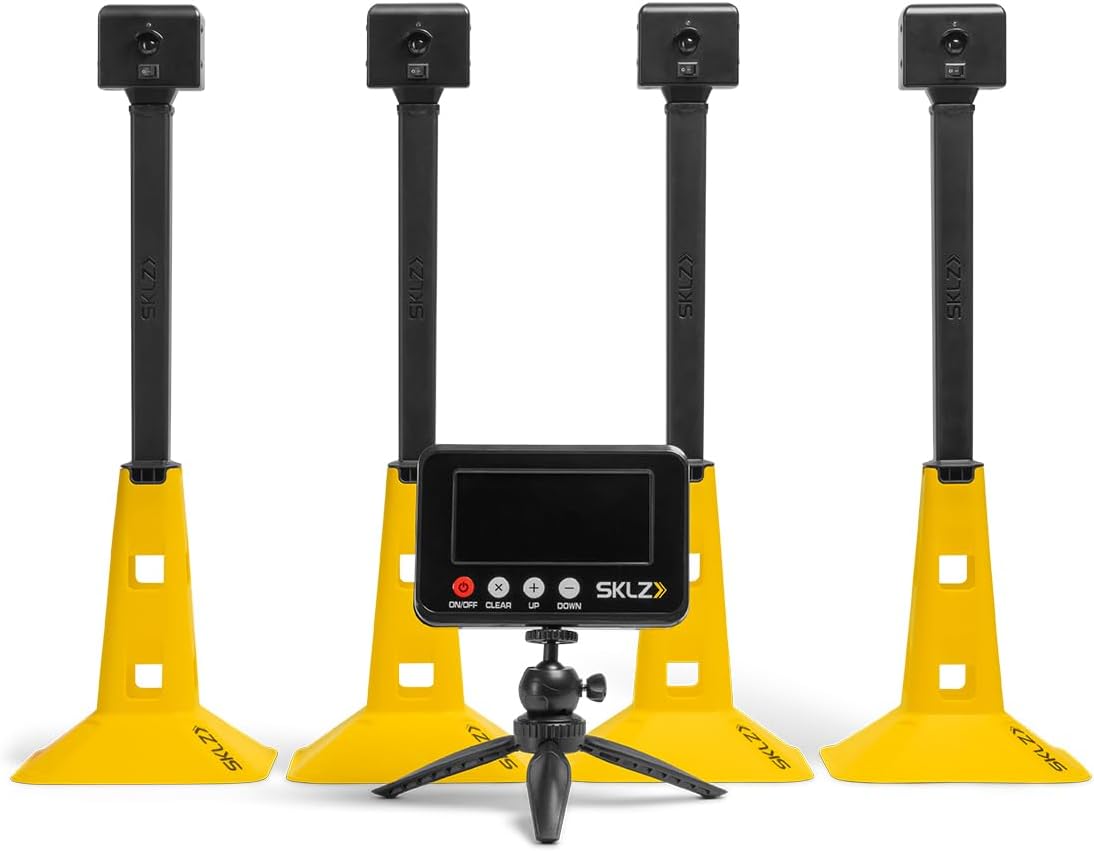
SKLZ Speed Gates uses a start gate and finish gate to automate straight-line timing up to 20 yards. The format is well suited to the 20-yard dash, 20-yard shuttle, base-to-base sprints, and similar acceleration tests used in football, baseball, soccer, and track training.
We may earn a commission when you buy through this link, at no additional cost to you.
Indicator lights on the sensors help confirm alignment and connection. The specified setup places the two start-line cones within four feet of one another and requires the same proximity at the finish, simplifying the process compared with a complex laser arrangement. The LED timer is designed to remain visible both inside a gym and outdoors in direct sunlight.
The included memory stores the 50 most recent results, allowing coaches to compare athletes and review progress without relying entirely on a separate stopwatch or handwritten record. The package contains four sensor cones, four sensors, one timer, and a carry bag. It runs on ten AA batteries, using two per device, which means replacement batteries should be part of the field kit.
The system is most appropriate for coaches working with shorter acceleration distances who value portability and quick gate setup more than long-range laser coverage. The 20-yard limit makes it less suitable for full sprint-distance measurement, and battery management requires planning. Within that narrower use case, it offers a complete, approachable kit for team tryouts and school fitness work.
The sensor lights provide an immediate indication that the gate positions are communicating correctly. This gives new users a practical cue before beginning a timed session.
Keeping the 50 most recent results on the timer makes quick athlete comparisons easier. Coaches can review changes over a session or across training days without transferring every result manually.
We may earn a commission when you buy through this link, at no additional cost to you.
YZ Laser Timer provides a five-digit display, stated accuracy to 0.001 seconds, and a rechargeable battery designed for training sessions that can extend across a full workout. Its stated one-hour timing error of less than 0.001 seconds makes the numerical specification appealing for coaches focused on detailed sprint results.
We may earn a commission when you buy through this link, at no additional cost to you.
The system is built for timing starting and ending points positioned in different locations. The package includes one timer, one laser, two reflectors, four stands, two cables, and a user manual, all organized in toolbox-style packaging. This assortment gives a coach the principal optical and positioning components needed to assemble a working course.
Battery charging takes four hours, while stated operating time is up to ten hours. That balance is convenient for facilities without a nearby outlet, though the charger needs to be scheduled around the training calendar. The product information does not state a maximum laser working distance, so users should confirm that the intended sprint length falls within the system's operating range.
YZ Laser Timer is a strong fit for running, football, barrel racing, track and field, and general speed training. It suits a coach who wants a compact reusable timer with multiple stands and reflectors but does not need an expansive accessory ecosystem. The organized package and long stated runtime make it a practical mid-range option for regular use.
The five-digit screen provides a familiar numerical format, while the stated accuracy supports coaches who want more detail than a basic manually operated stopwatch.
A dedicated toolbox-style package keeps the timer, optical components, stands, cables, and manual together. This organization can reduce missing pieces when moving between a track, field, or training hall.
We may earn a commission when you buy through this link, at no additional cost to you.
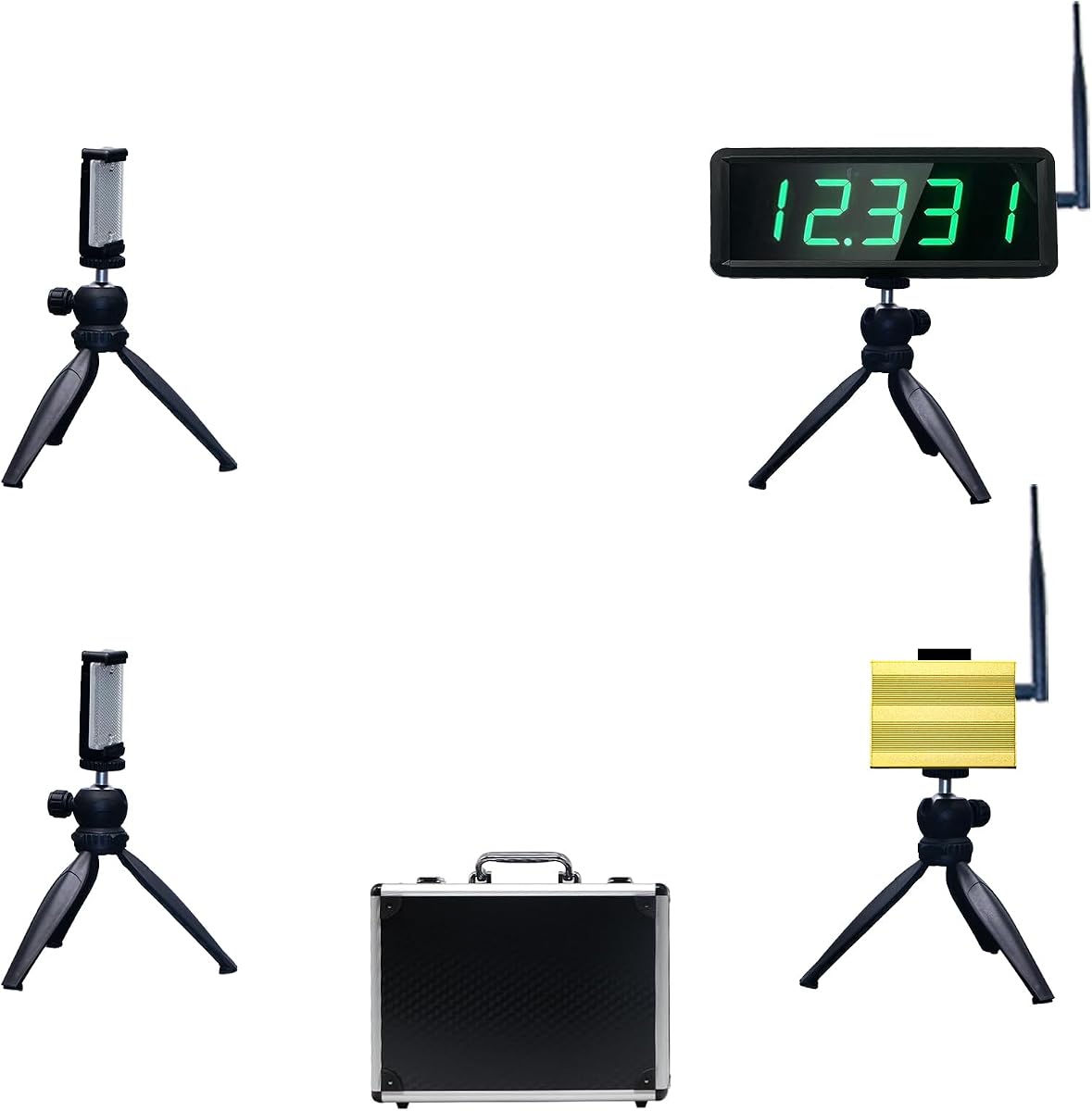
Wireless Laser Timer with Tripod is designed for athletes and coaches who want several timing behaviors from one system. It includes three single-timer modes for lap time, trigger, and interval work, plus three combined timer-and-receiver modes for monitoring, recording, and sprint use.
We may earn a commission when you buy through this link, at no additional cost to you.
The five-digit display is stated as accurate to milliseconds with a 0.001-second reaction time. Events can be timed for as long as 99 minutes, covering 40-yard, 60-meter, 100-meter, and cycling lap applications. A rechargeable battery provides up to seven hours of continuous operation after a three-hour charge.
The product requires connection to the wireless antenna for use, and the specifications note that a nonfunctional receiver box may need to be reconfigured. This is an important setup consideration because the system is not simply a standalone display. Its package includes a timer, receiver, four brackets, two reflectors, two antennas, two chargers, and a flight case for transport.
The six-mode design is the most attractive feature for a coach who alternates between interval work, lap timing, and straight-line sprints. The included case also supports organized transport to different venues. Buyers should account for the antenna and receiver requirements and confirm that the available modes align with their training plan before choosing this option.
Lap, trigger, interval, monitoring, recording, and sprint modes let the system move beyond a single race-clock function. That makes it useful for practices built around multiple training formats.
The flight case keeps the timer, receiver, brackets, reflectors, antennas, and chargers together. Coaches can move the complete setup between a track, gym, and field without loose components.
We may earn a commission when you buy through this link, at no additional cost to you.
TimeRider Laser Timing System combines a precision laser sensor, bright LED display, and cord-free design for sprint training. Its stated timing accuracy reaches 0.001 seconds, positioning it for athlete speed work, agility drills, and track tests where a clear numerical result is important.
We may earn a commission when you buy through this link, at no additional cost to you.
The wireless design reduces cable-related trip hazards around the running area. An adjustable-height stand allows the equipment to fit different training scenes, while the bright LED is designed to remain visible under direct outdoor sunlight. Its solid body and portable storage case support repeated transport between facilities.
Power can come from a rechargeable battery or a plugged-in supply, with runtime stated at up to 10 hours. That flexibility is useful for longer sessions or facilities that prefer a continuously powered installation. The product information does not specify the maximum laser distance, compatible accessories, or the available timing modes, so those details should be confirmed for demanding use cases.
This system is a logical choice for a field coach who prioritizes a readable display, adjustable positioning, and freedom from cables. It also suits an indoor facility that wants a rechargeable system with the option to keep it powered during a busy training day. Its core design fits common sprint and agility applications, although buyers should verify range and operating details before deployment.
A bright LED display is especially valuable for outdoor practices, where smaller screens can become difficult to read. The display supports quick result checks without moving the timer away from the course.
Rechargeable battery and plug-in power give the coach two ways to manage operating time. The stated ten-hour runtime also supports full-day training when charging is planned in advance.
We may earn a commission when you buy through this link, at no additional cost to you.
Speed Tech Single Timer is built to time one person moving from a starting point to an endpoint. It is positioned for running, skating, track and field, biking, motorcycle racing, and infrared induction timing, making it relevant to coaches who need a focused one-person timing system rather than a full gate array.
We may earn a commission when you buy through this link, at no additional cost to you.
The effective laser distance is listed as 0 to 8 meters, while wireless communication extends up to 500 meters. This separation allows the display to be placed away from the optical start and finish components. The compact system also has a straightforward operating sequence: connect the power cord to a qualified power bank, hold the side reset button for one second, and begin using it.
The system requires a 5-volt, 2-amp power source and the product details specify that it needs three power banks. That requirement adds preparation and carrying considerations. The instructions also advise keeping the laser sensor and display screen at least two meters apart during close-range testing to reduce the chance of antenna co-channel crosstalk and communication errors.
This timer best suits a coach with a short but precisely defined course and a willingness to organize its three-power-bank setup. It can be especially useful for individual skating, cycling, motorcycle, and sprint testing. The short optical range and external power requirements are acceptable for planned mobile sessions but may make it less convenient for spontaneous sessions with fewer accessories.
The 500-meter communication range allows the display to be separated from the laser sensor. Coaches can place the readout where results are easier to view while retaining a compact start-and-finish arrangement.
Keeping the sensor and screen at least two meters apart during close-range testing helps limit crosstalk. Following that separation rule supports more dependable communication and cleaner results.
We may earn a commission when you buy through this link, at no additional cost to you.
Speed Gates Pro is a portable radio frequency sprint timing kit designed for 40-yard dashes, agility work, and general speed training. Unlike a laser system that depends on a visible optical path, its radio frequency sensors are intended to record speed and time across distances up to 50 yards.
We may earn a commission when you buy through this link, at no additional cost to you.
The system includes a visible LED timer, rechargeable lithium batteries, a charging cable, and a carry bag. A built-in memory stores up to 50 recent times, giving coaches a convenient way to review successive attempts without writing down every result during the session.
Its greatest practical advantage is portability. The bag supports transport to a gym, outdoor field, or track, while rechargeable batteries remove the need to prepare a large supply of disposable cells. The main limitation is that the supplied information does not explain the exact sensor spacing, controls, operating modes, or whether speed values are displayed alongside elapsed time.
Speed Gates Pro is well matched to coaches who need a convenient 40-yard measurement system without committing to a more complex laser package. It also covers longer straight-line runs up to 50 yards and can support agility sessions. For a buyer focused on an affordable, self-contained training kit, its range, memory, rechargeable power, and carrying case create a balanced package.
A stated range of up to 50 yards covers 40-yard dashes and provides room for shorter acceleration tests. The radio frequency approach also avoids the need to keep a visible laser path unobstructed.
Included lithium batteries and a charging cable simplify recurring use, while the carry bag keeps the components together. This makes the kit convenient for coaches who move between practice sites.
We may earn a commission when you buy through this link, at no additional cost to you.
Power Systems Brower TCi is the most specialized and technically oriented system in this guide. It uses redundant radio transmissions, button-based wireless synchronization, signal strength analysis, and multiple independent channels to support dependable sprint timing in demanding environments.
We may earn a commission when you buy through this link, at no additional cost to you.
Each start and finish signal can be transmitted up to 12 times, reducing the chance that a result is lost. The system synchronizes without cables through a button press, which makes installation cleaner around a track or field. The timer can also display the radio signal strength associated with each start and finish, giving operators useful diagnostic information.
Thirty-two independent channels allow multiple systems to operate near one another without interference from other compatible systems and radio devices. This is a meaningful advantage for large meets, training centers, or events that require multiple timing lines close together. The handsfree timer configuration also helps the operator avoid repeatedly interacting with a handheld control.
Brower TCi is aimed at coaches, facilities, and event operators who prioritize redundancy and multi-system control rather than a lightweight portable kit. The supplied information does not describe the display resolution, battery life, range, or included hardware in detail, so a professional buyer should request complete technical specifications. If those details align with the venue's requirements, its transmission architecture offers the most robust option here.
Sending each start and finish as many as 12 times reduces dependence on a single radio transmission. That repetition is valuable when reliable data capture matters more than minimal hardware.
Thirty-two independent channels help separate compatible timing systems operating in close proximity. The feature is especially useful for large facilities or events requiring several timing lines at once.
We may earn a commission when you buy through this link, at no additional cost to you.
Selecting an electronic sprint timing system means balancing timing method, distance, display, power, and mobility. Start with the athletes, venue, and training formats you actually need, then narrow the options by the features that make repeat sessions faster and results easier to trust.
Radio frequency gate systems, laser systems, and redundant radio systems each use a different method to identify movement. Radio frequency gate systems are intuitive for straight-line acceleration drills and may be easier to position between two cones. Laser systems require a clear optical path and correctly positioned reflectors, but can provide detailed numerical timing across sprint and lap activities. Redundant radio systems are more complex and target professional operations where minimizing missed signals is the priority.
The maximum measurement distance determines which system fits your program. SKLZ Speed Gates are listed for runs up to 20 yards, while Speed Gates Pro supports up to 50 yards. Several laser products are marketed for 40-yard, 60-yard, and 100-meter sprint work, but buyers should confirm the effective range of the specific laser and receiver. A system that appears to cover a longer sprint in its title may still have a shorter optical working distance.
A clear display is essential because a result that cannot be read promptly is less useful during a fast-paced practice. LED screens and bright digital displays are specified for both indoor and outdoor visibility in several products. A five-digit display with millisecond-level resolution can help coaches read race-style results quickly. Review whether the display shows elapsed time, stored results, signal information, or a combination of these functions.
Power options determine whether a system is ready for spontaneous practices or requires routine preparation. Rechargeable models are convenient over a season, while plug-in operation can suit facilities that keep equipment at a fixed station. Battery runtime ranges from stated seven-hour figures to ten-hour figures in this group. SKLZ Speed Gates uses ten AA batteries, and Speed Tech specifies three qualified power banks, so consumable and accessory requirements deserve careful attention.
Wireless range describes communication between components, while laser range describes the optical measurement path. These are not interchangeable. One product lists 500-meter wireless communication with an eight-meter effective laser distance, and another offers 400-meter wireless communication with less than 13 meters of effective laser distance. Systems with many channels, such as Brower TCi, can also reduce interference when multiple compatible systems operate nearby.
A system intended for field use should arrive with the stands, reflectors, sensors, cables, chargers, and storage needed for its intended workflow. Speed Gates Pro, SKLZ Speed Gates, YZ Laser Timer, and TimeRider include carrying solutions, while several laser packages supply multiple stands. Compare the included components with the accessories a venue already owns, since optional high brackets, reflectors, receivers, or antennas can be necessary to complete a setup.
Some systems are optimized for straight sprint measurement, while others include lap, trigger, interval, monitoring, recording, sprint, cycling, soccer, and skating modes. A versatile system can serve more of a team's calendar, but the extra modes do not add value if the required protocol is absent or behaves differently from the one used by your organization. Confirm that the named modes match the drills you intend to run.
Large facilities and formal racing environments may need more resilience than a single radio message or visible optical beam. Brower TCi sends each start and finish up to 12 times and offers 32 independent channels, making it relevant to multi-system operations. These features are advantageous when several timing lines or compatible radio devices share a venue, although the complexity and cost commitment justify a careful review of the complete professional specification.
Begin by choosing a clear, level measurement area and removing obstacles that could affect an athlete's path or the operation of the system. Unpack every component, install or charge the batteries, and confirm that the display powers on before athletes approach. For a gate system, position the two cones according to the manufacturer's specified spacing. For a laser system, place the laser and reflectors along a straight line, keep the optical path unobstructed, and maintain the recommended separation between the sensor and display to reduce communication errors.
Run a short test before the group session. Move through the start and finish points as an athlete would, verify that the timer records one result rather than an accidental multiple trigger, and confirm that the displayed number matches a manual reference. Use the same positioning for every attempt because moving a reflector or stand by even a modest amount can alter the measurement course. Familiarize athletes with the start procedure and keep them focused on the finish rather than the equipment.
After training, disconnect power when appropriate, clean the sensor faces and reflectors with a dry or lightly damp cloth, and inspect cones, stands, cables, and connectors for damage. Store rechargeable systems in their supplied cases and avoid prolonged storage with depleted batteries. Keep spare batteries or power banks with portable kits, and periodically verify the timer, sensor connection, wireless signal, and stored results. Follow the current manufacturer instructions for charging, storage temperature, calibration, and replacement parts.
Laser timing uses an optical beam and reflector to detect when an athlete crosses the finish line, while radio frequency timing uses coordinated sensors or gates. Laser systems can offer detailed numerical timing and broader activity support, but they require a clear optical path. Radio frequency gate kits are often straightforward for straight-line acceleration drills and avoid the need to maintain a visible beam.
Several systems in this guide specifically target 40-yard work, including Speed Gates Pro, SKLZ Speed Gates, the Powered Wireless Laser Timer, and the 40/60 Yard Sprint Timer. The best choice depends on whether the coach prioritizes simple gates, detailed numerical display, portability, or professional laser positioning. Confirm the stated measurement range and required accessories before ordering.
Many of the listed products are designed for both indoor and outdoor use. Bright LED displays, weather-conscious components, and wireless layouts support field training, although sunlight, moisture, and power management can affect the experience. Outdoor users should check the manufacturer's environmental guidance, protect the system during storage, and ensure that the display remains readable in direct sun.
Timer memory is valuable when a coach wants to compare consecutive attempts without relying on handwritten notes. Speed Gates Pro and SKLZ Speed Gates each store up to 50 recent times. A display with stored results can support immediate athlete feedback and later progress reviews, but the system should not be treated as a complete database unless additional software or export capability is confirmed.
Some models are explicitly designed for more than running. The Powered Wireless Laser Timer supports sprints, cycling, soccer drills, and roller skating, while Speed Tech is positioned for skating, biking, motorcycle racing, and track use. Multi-sport capability still depends on correct sensor placement and the system's available modes, so coaches should check those details for their specific activity.
Rechargeable systems are often the most convenient for regular practice because they eliminate repeated disposable battery purchases. Options such as TimeRider, Speed Gates Pro, and several laser timers support rechargeable or plugged-in power. Battery-powered gate systems can also be practical, but coaches should carry enough replacement cells and account for the extra weight in a mobile kit.
Usually, a single training lane can be managed with one system, so extensive channel control may not be necessary. Multiple independent channels become more valuable at a large facility, competition, or training center running several compatible timing systems near one another. In that setting, channel separation can reduce interference and make parallel operation more dependable.
Start with a short test and compare the result with a reliable manual reference, recognizing that reaction handling and timing methods can differ. Test the intended start and finish positions, watch for duplicate triggers, and confirm that the display is readable. For multi-gate or laser systems, also check optical alignment, wireless communication, sensor separation, and stored results before the full session begins.
Dashr 2.0 Timing Systems stands out for a focused three-gate professional configuration, while the 40/60 Yard Sprint Timer offers detailed laser timing, a clear five-digit display, and broad wireless communication. The Powered Wireless Laser Timer is the strongest choice for coaches who need multiple modes across several sports, and SKLZ Speed Gates provide a straightforward, portable option for short acceleration drills.
The right priorities depend on the training program. For short team sprints, simple gate setup and stored results may matter most. For track, cycling, or multi-sport work, laser range, readable displays, and multiple modes become more important. Large venues should consider redundant transmissions and independent channels, while mobile coaches should examine battery requirements, included stands, reflectors, receivers, and carrying cases before buying.
Product specifications and package contents can change over time, so check the current listing for range, battery requirements, accessories, and warranty information before ordering. Availability and pricing also change, and the right system is ultimately the one that matches the required distance, venue, athlete workflow, and level of diagnostic detail your coaching program needs.