
NTAG Ultralight EV1 NFC Cards
4.1Editor score
48-byte rewritable user memory
Advanced EV1 security controls
Supports thermal sublimation printing
Discover the best Blank Rewritable Rfid Cards by comparing frequency, chip type, memory, printability, security, reader compatibility, and ideal uses in detail.
Blank Rewritable Rfid Cards are versatile credentials for access control, identification, attendance, inventory tracking, event admission, and personal NFC projects. A useful card must match your reader’s frequency, support the required data format, and have enough memory, security, and durability for its intended role.
We compared all ten products by examining operating frequency, chip type, rewriteability, memory, UID behavior, print compatibility, physical construction, intended applications, and important limitations. The list includes 13.56 MHz high-frequency cards and 125 kHz low-frequency cards, each suited to different systems and programming environments.
Each review explains what distinguishes the card, who should consider it, and where it may fall short. Ratings and availability can change, and prices fluctuate over time, so check the current listing and verify reader compatibility before ordering.
4.1Editor score

4.2Editor score

4.5Editor score
The comparison below highlights each card’s operating frequency, chip family, rewrite behavior, physical format, and strongest application. Because 13.56 MHz and 125 kHz cards use different technologies, compatibility with your reader and writer is the most important point of comparison.
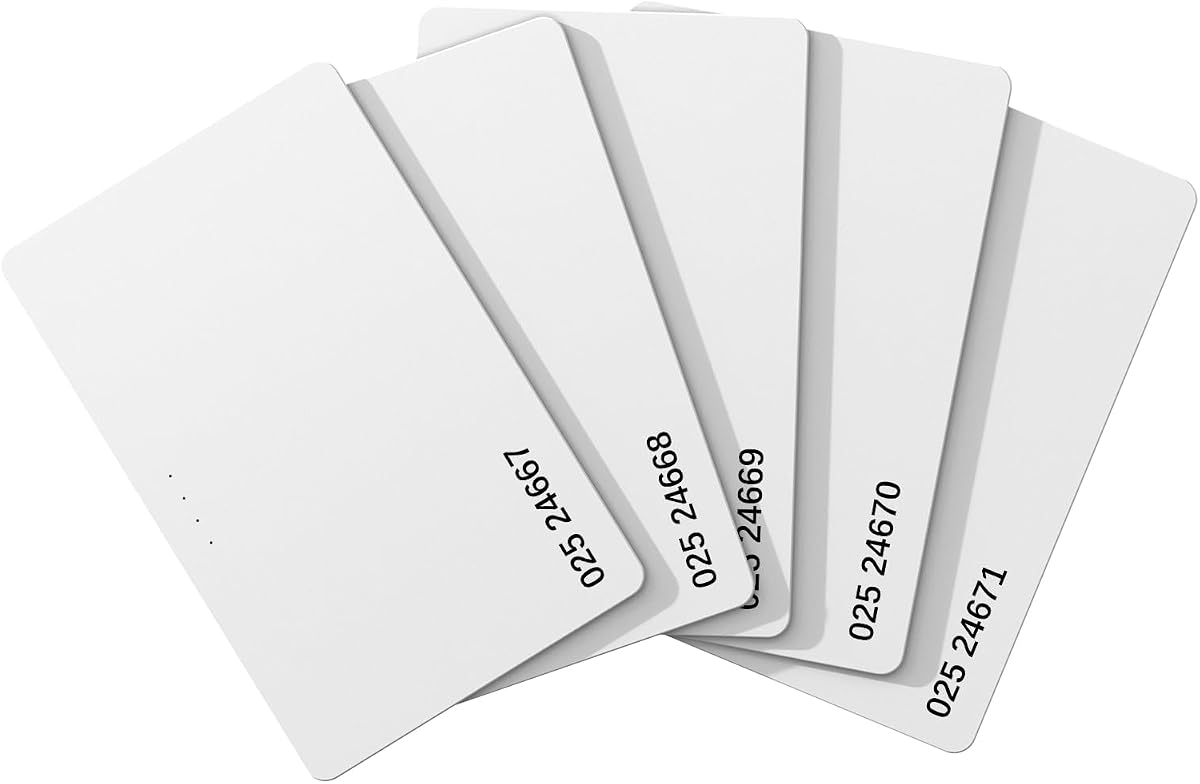


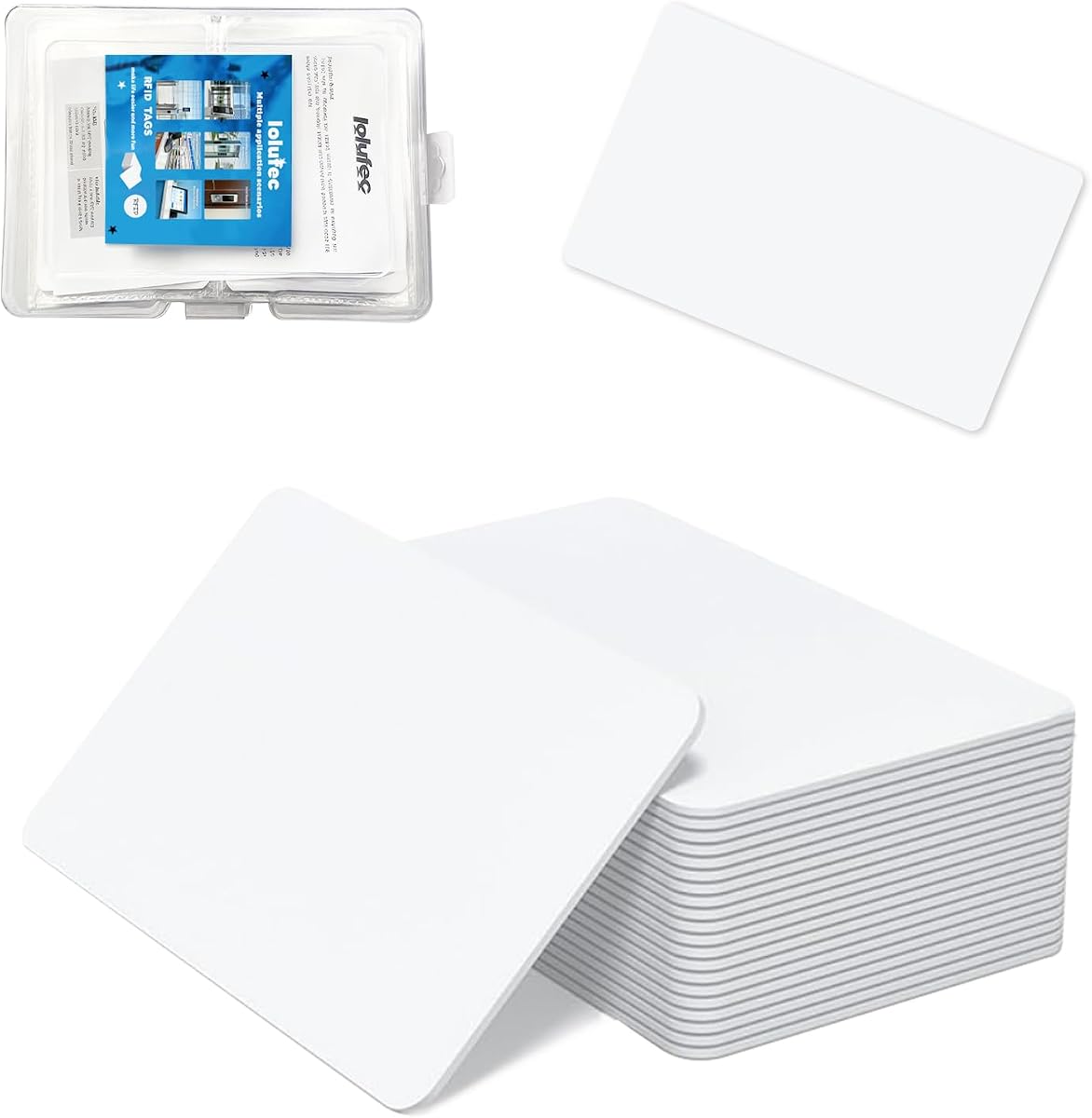


The LEXI Rewritable UID Smart Card is a 13.56 MHz PVC card built around a changeable Mi-Fare Classic 1K-compatible chip. It carries a 4.2 rating and stands out for supporting read, write, copy, and reprogramming operations. Each card is assigned a unique encrypted ID, making it useful when a project needs writable high-frequency credentials rather than a fixed, unprogrammable tag.
We may earn a commission when you buy through this link, at no additional cost to you.
The card supports more than 100,000 rewrite cycles and is organized into 16 sectors of four blocks. Its stated reading distance of 0–10 cm is suitable for standard desktop readers, door-access hardware, and close-range NFC workflows. The writable UID focus also gives it more flexibility for testing or repeatedly recreating credentials in a controlled environment.
Compatibility is the main consideration. It is intended for 13.56 MHz readers operating with Mi-Fare Classic 1K, 4-byte UID cards and ISO/IEC 14443A-compatible systems. It will not satisfy a 125 kHz installation, and changing a UID does not automatically guarantee compatibility with every proprietary access platform, hotel lock, or encrypted reader.
Choose this card when you need a moderate pack of writable 13.56 MHz PVC credentials for a compatible access-control, testing, or development system. Confirm the reader protocol, authentication requirements, and expected data layout first. For those needs, it offers a practical balance of programmability, recognizable chip compatibility, and physical card convenience.
The programmable encrypted UID is the defining feature, allowing a card to be rewritten as project requirements change. This makes the card more useful than a fixed UID tag when developing or refreshing credentials.
A stated read range of up to 10 cm and support for more than 100,000 rewrites suit repeated operational use with compatible 13.56 MHz readers.
We may earn a commission when you buy through this link, at no additional cost to you.
The 30 Pack NTAG Ultralight EV1 NFC Cards provide 48 bytes of user-rewritable memory, a 7-byte manufacturer-programmed UID, and a 4.1 rating. Their strongest appeal is the combination of modern NFC functionality and layered EV1 protections, including password controls, an OTP area, tamper counters, lock bits, and an originality signature.
We may earn a commission when you buy through this link, at no additional cost to you.
These cards support up to 100,000 write cycles and are advertised with 10-year long-term data retention. A maximum reading distance of 100 mm is possible with matched readers, while anti-collision technology helps identify multiple cards simultaneously. The uncoated white PVC surface supports thermal sublimation and professional UV, retransfer, direct-to-card thermal, and all-in-one lamination printers.
The cards arrive factory-locked, so users must follow the supplied NFC Tools Advanced Write sequence before treating them like standard writable NTAG215 cards. This setup requirement is manageable for smartphone-based projects but may discourage buyers who want immediate use. They also cannot be printed directly on ordinary household inkjet printers.
This is a strong choice for temporary visitor credentials, event tickets, campus access, loyalty cards, personalized NFC links, and other compact programmable uses. It is particularly compelling when security features and professional print compatibility matter more than Mi-Fare-style sector memory. Confirm your reader and software support before purchase.
Password protection, configurable access limits, tamper counters, lock bits, and an ECC originality signature provide a more robust security toolkit than a simple memory tag.
The matte PVC stock supports thermal sublimation and professional card-printing processes, while the stated waterproof, bend-proof, and scratch-resistant construction suits frequent reuse.
We may earn a commission when you buy through this link, at no additional cost to you.
YARONGTECH’s 20-card pack is a straightforward choice for 125 kHz installations, with a 4.5 rating and original T5577 chips. The cards support rewritable programming in 125 kHz ID, H-ID WG, and customizable 26-bit proximity formats, giving integrators more freedom than a card restricted to one identifier style.
We may earn a commission when you buy through this link, at no additional cost to you.
These plastic cards are compatible with Zebra, Fargo, and Evolis card printers, which makes them suitable for organizations that want to combine a printed credential design with a programmable proximity chip. The blank white face also provides a straightforward background for identifying information, logos, or other authorized personalization.
A blank T5577 has no pre-programmed ID and cannot be read until an identifier has been written with a compatible 125 kHz writer or copier. This is normal for the product category, but it adds a setup requirement. It also means the card is not a ready-to-use key for a reader simply because it resembles a standard hotel card.
This pack is best for a user who owns a compatible 125 kHz system and needs a manageable number of rewritable cards for hotel access, attendance, identification, or testing. It combines a favorable rating with broad format support and useful printer compatibility. Verify the reader and programming software before placing an order.
Support for 125 kHz ID, H-ID WG, and customizable 26-bit formats makes these cards adaptable to several established proximity-card conventions.
Combining a printable white surface with an erasable T5577 chip lets administrators refresh identifiers while maintaining a professional printed credential.
We may earn a commission when you buy through this link, at no additional cost to you.
The 12 Pack T5577 CR80 Proximity Cards use a credit-card-shaped 0.8 mm PVC format and carry a 4.5 rating. They are designed for 125 kHz T5577 systems where a familiar CR80 body is more useful than a bulky or unconventional credential format. Their applications include hotel keys, access control, attendance, ticketing, and packing cards.
We may earn a commission when you buy through this link, at no additional cost to you.
The original T5577 chips have no pre-programmed identifier. Once written, they can operate in common 125 kHz ID, H-ID WG, and customized 26-bit formats. They may also duplicate compatible EM4100 or TK4100 ID-card keychain tags, although copying must only be performed on credentials the user owns or is authorized to reproduce.
Punch-hole marks appear on the short and long sides, giving integrators options for lanyards or other mounting arrangements. The main limitation is unavoidable: these are blank low-frequency cards, so a compatible 125 kHz writer must be available. They also offer no NFC smartphone operation and no 13.56 MHz reader compatibility.
This smaller pack works well for testing, a modest office rollout, or replacing a limited group of programmed credentials. Its thin CR80 construction is especially attractive for wallets, badge sleeves, and existing card-management workflows. Confirm that the target reader accepts T5577 cards before purchasing.
The standard credit-card size and 0.8 mm thickness make these cards easy to integrate with badge sleeves, lanyards, wallets, and conventional credential-printing systems.
T5577 chips can be erased and rewritten in several low-frequency formats, allowing administrators to match established ID conventions.
We may earn a commission when you buy through this link, at no additional cost to you.
The 10-piece T5577 White PVC Card pack has a 5.0 rating, the highest numerical rating in this roundup. It targets 125 kHz readers and writers that support T5577 writable chips and common low-frequency proximity formats, including readers associated with 1386, 1326, and H10301 formats.
We may earn a commission when you buy through this link, at no additional cost to you.
Each card arrives without a pre-programmed ID and must be written with compatible equipment before it can be read. Once configured, the chip can be erased and rewritten repeatedly. The roughly 1.8 mm-thick PVC body is described as waterproof and wear-resistant, making it suitable for employee cards, school cards, membership cards, parking systems, smart locks, and hotel applications.
The product description correctly emphasizes checking device compatibility before purchase. A T5577 card cannot simply be tapped by a phone, and reader branding alone may not reveal the required chip or protocol. Direct use on metal is also not recommended because metal can interfere with proximity-card performance.
Choose this option for a small but capable deployment with recognized reader families. Its 5.0 rating is encouraging, although ratings should not be treated as a substitute for technical verification. Confirm the reader, writer, target ID format, and physical environment, then use the cards for authorized access-control or identification programs.
Explicit references to 1386, 1326, and H10301 format readers make the intended equipment clearer for integrators familiar with these low-frequency systems.
The waterproof, wear-resistant PVC construction and repeatable programming support make the cards practical for recurring access, attendance, and membership use.
We may earn a commission when you buy through this link, at no additional cost to you.
The 100 Pack T5577 Rewritable Plastic RFID Proximity Card set is designed for organizations that need a larger inventory of 125 kHz credentials. It has a 4.5 rating and uses original T5577 chips in a standard CR80, 0.8 mm PVC format. That makes it practical for schools, hotels, attendance programs, ticketing, and access-control deployments.
We may earn a commission when you buy through this link, at no additional cost to you.
The cards support several common low-frequency ID structures, including 125 kHz ID, H-ID WG, customizable 26-bit, and compatible EM4100 or TK4100 duplication workflows. The chip is rewritable, allowing identifiers to be programmed and subsequently changed as the system evolves. Punch-hole markings are included for mounting options.
As with other T5577 products, the cards have no pre-programmed ID and cannot be read until programmed. Buyers also need a compatible 125 kHz writer. The large quantity can be valuable for controlled rollouts, but unprogrammed credentials should be stored securely because their future identifiers and permissions depend on proper administration.
This is the appropriate choice for high-volume users who have already established a 125 kHz T5577 workflow. It offers the same practical chip and physical format as smaller packs but with enough inventory for institutional use. Validate the format and programming process with a small test before deploying the complete batch.
The 100-card quantity supports consistent provisioning across many employees, students, rooms, or assets while preserving the same T5577 programming model.
At 0.8 mm, the CR80 body closely follows a conventional payment-card thickness and remains easier to use with sleeves, clips, and badge holders.
We may earn a commission when you buy through this link, at no additional cost to you.
The JASAG UID5050 pack combines a substantial quantity of blank 13.56 MHz cards with a 4.6 rating. Each card has a unique encrypted ID that can be reprogrammed, and the chip is compatible with Mi-Fare Classic 1K, ISO/IEC 14443A, 4-byte UID, and 1,024 bytes of memory organized across 16 sectors.
We may earn a commission when you buy through this link, at no additional cost to you.
The cards support reading, writing, and reprogramming for more than 100,000 rewrite cycles. A listed read distance of 0–10 cm makes them suitable for common close-range access-control readers. The 100-card quantity is useful for offices, campuses, hotels, clubs, and organizations that need writable high-frequency credentials at scale.
There is an important frequency distinction: these cards can clone compatible 13.56 MHz IC cards but cannot copy 125 kHz cards. As with other programmable access media, the card’s technical ability does not mean it is automatically accepted by proprietary locks or that every existing credential may lawfully or technically be duplicated.
This is a compelling pick for a compatible 13.56 MHz environment where large quantities and high rewrite capacity are priorities. Its 4.6 rating and detailed sector specification provide useful confidence, but the buyer should still confirm ISO type, authentication behavior, and reader support. It is not the right choice for a 125 kHz hotel-lock replacement without verification.
A 100-card pack and more than 100,000 rewrite cycles support recurring credential changes across a large group of users or assets.
The 1,024-byte, 16-sector organization matches a widely recognized 13.56 MHz card structure, helping simplify integration with compatible systems.
We may earn a commission when you buy through this link, at no additional cost to you.
The 80-piece MIFARE Classic 1K set has a 4.7 rating and uses original Fudan FM11RF08 chips operating at 13.56 MHz. Its key distinction is a factory-locked, unique four-byte UID in Sector 0 Block 0. Unlike genuinely UID-rewritable cards, this product preserves the manufacturer identifier while allowing supported data sectors to be managed through authentication.
We may earn a commission when you buy through this link, at no additional cost to you.
The cards contain 1,024 bytes across 16 independent sectors and support dual A/B access keys for granular permissions. The default factory key is listed as FF FF FF FF FF FF, while Sector 0 Block 0 remains hardware locked. They support up to 100,000 read-write cycles and work with common devices such as ACR122U, PN532, and RC522.
Although data can be written after successful authentication, the UID is not rewritable, and custom UID modification is unsupported. The listing also excludes HID, Salto, Assa Abloy, Verkada AC33, Amiibo, Yoto, Skylanders, 125 kHz, and ISO 14443 Type B compatibility. This is a narrower but more secure choice than a card intended for UID cloning.
Choose this set for professional 13.56 MHz access, attendance, hotel, gym, and parking programs that value a permanent UID, sector permissions, and printable credentials. The included storage box is useful for managing a large inventory. Always verify proprietary lock compatibility, because broad protocol compatibility does not guarantee acceptance by every access platform.
A factory-locked UID maintains a stable card identity while sector data can still be changed by authorized users who possess the appropriate access keys.
The uncoated CR80 cards support UV, retransfer, direct-to-card thermal, and lamination printer workflows, making them suitable for customized organizational cards.
We may earn a commission when you buy through this link, at no additional cost to you.
The five-pack of T5577 cards is a practical choice for testing a 125 kHz setup before committing to a larger deployment. It uses standard blank white proximity cards with writable, erasable T5577 chips. A customer rating is not currently listed, so the available product details and compatibility checks should guide the decision.
We may earn a commission when you buy through this link, at no additional cost to you.
These cards are intended to work with common 125 kHz reader-writer combinations and can receive custom information, ID numbers, or access credentials for systems the user owns or is authorized to manage. Potential uses include access control, asset tracking, inventory labeling, personal identification, attendance, and other DIY RFID projects.
The legal and administrative point is important. Rewritable blank media can be used to create legitimate credentials, but using it to duplicate third-party access cards without permission may violate laws, contracts, or workplace policies. Likewise, a card is not operational until it has been programmed with compatible equipment.
This five-card package is best for technicians, installers, developers, and small organizations that need samples or a handful of replacement credentials. Its small size reduces waste during compatibility testing. Buy a larger pack only after confirming that your reader, writer, software, and intended identifier format work with the card.
Five cards are enough to verify programming, read range, formatting, and physical handling before deploying a larger credential set.
Programmable identifiers support asset labels, inventory records, personal identification, attendance, and access credentials within appropriately authorized environments.
We may earn a commission when you buy through this link, at no additional cost to you.
The 12 T5577 Thick Smart Cards provide a durable 1.8 mm version of the common 125 kHz proximity card. They have a 4.7 rating and use original T5577 chips that can be written, erased, and rewritten up to 100,000 times. Their thickness distinguishes them from the thinner 0.8 mm CR80 options in this roundup.
We may earn a commission when you buy through this link, at no additional cost to you.
The cards target 1386, 1326, and H10301 format readers and can be programmed in 125 kHz ID, H-ID WG, and customizable 26-bit formats. Compatible T5567, T5577, and EM4305 references indicate that they may fit several established low-frequency workflows, subject to reader and writer verification.
These are not NFC cards, so they will not work with NFC-enabled phones. The listing also specifically warns against use with ONITY systems and Proxmark3 RDV4, and states that the cards must be written before use. These restrictions reduce the risk of buying the wrong product if they are considered before deployment.
Choose the thick format when a more substantial card is desired for hotel keys, access control, time attendance, ticketing, or packing cards. The twelve-card pack gives enough material for a moderate rollout, while the physical construction may better suit environments where a thin card would be less convenient. Confirm the reader model, writer compatibility, and prohibited systems first.
The 1.8 mm PVC body offers a sturdier alternative to standard thin proximity cards and may be easier for users to handle in frequent-entry environments.
The chip can be erased and written repeatedly, supporting established 125 kHz ID, H-ID WG, and custom 26-bit structures where the equipment permits.
We may earn a commission when you buy through this link, at no additional cost to you.
The right blank RFID card depends less on a single feature than on compatibility with your complete system. Start with frequency and protocol, then assess memory, UID behavior, programming requirements, printing method, security, and physical format.
In short, match the exact frequency, chip, and protocol expected by the reader rather than relying only on the RFID label.
Choose a changeable UID only when your system expects one, and consider permanently locked identifiers when uniqueness and resistance to UID alteration are more important.
Match memory to the data volume: use sectored Mi-Fare storage for structured records and compact NTAG memory for short programmable payloads.
Treat the card, reader, writer, and software as one system, and test one card end to end before purchasing or programming in bulk.
Verify printer type, ink or ribbon method, card thickness, lamination, and any punch requirements before ordering personalized stock.
Check the reader’s card slot, badge hardware, and printer specifications because a thicker card may fit some workflows but not others.
Choose the application first, then confirm that the chip, format, memory, and physical design support the workflow you actually need.
Program only authorized systems, track every issued card, and remove or cancel identifiers when personnel, assets, or access rights change.
Begin by identifying the card’s frequency, chip type, required identifier format, and compatible reader or writer. For a T5577 card, program the intended ID with a supported 125 kHz writer before testing it. For NTAG Ultralight EV1 cards, follow the supplied NFC Tools setup and unlock commands before writing links or other data. For Mi-Fare-compatible cards, use suitable reader-writer software and authenticate with the correct key before attempting writes.
After programming, test the card on the intended reader before printing, cutting, punching, or issuing it. Confirm that the expected identifier appears in the system, access permissions are correct, and repeat reads work as expected. A successful read on one reader does not prove compatibility with a different proprietary lock. Keep unprogrammed stock away from readers and label organized packages so cards are not accidentally assigned twice.
Handle cards gently and keep them away from excessive heat, bending, strong chemicals, and direct metal contact. Store them in a protective sleeve or box, especially before final issuance. Periodically audit active credentials, erase or retire cards when appropriate, and update the administrative record whenever a card is reassigned. For cards with permanent UIDs, replacement is usually cleaner than attempting to alter the identifier.
Generally, no. The 125 kHz T5577 cards in this guide require compatible low-frequency readers and writers and are not NFC cards. NFC phones operate primarily with 13.56 MHz technologies, although phone support varies by device and card type. A 13.56 MHz card can still require a specific app, unlocked memory, or authentication, so confirm phone compatibility separately from reader compatibility.
A blank card is a programmable component rather than a ready-made credential. T5577 cards require an identifier to be written with a compatible 125 kHz writer, while NTAG EV1 cards require the documented unlocking setup. Mi-Fare cards may require successful authentication before data can be written. This is expected behavior and not necessarily a defective product.
No. Compatibility depends on frequency, chip, protocol, identifier format, authentication method, and sometimes proprietary lock requirements. Some listed cards work with common MIFARE or 125 kHz readers but are explicitly excluded from ONITY, HID, Salto, Assa Abloy, Verkada AC33, and other systems. Provide the exact lock and reader model to a qualified installer or supplier before purchasing.
A rewritable UID can be changed by an authorized writer, which is useful for controlled testing or credential creation. A locked UID is permanently assigned by the manufacturer and cannot be altered. The MIFARE Classic 1K cards in this guide use a factory-locked four-byte UID, while the LEXI and JASAG products advertise reprogrammable unique IDs. The right choice depends on the system’s security model.
Most products in this guide are intended for professional card-printing equipment rather than ordinary household inkjet printers. Several list compatibility with Zebra, Fargo, or Evolis printers, while the NTAG EV1 and MIFARE products also support UV, retransfer, thermal, and lamination workflows. Printers designed for thinner stock may also have difficulty feeding thicker 1.8 mm cards.
Not without authorization. Rewritable cards can be used legitimately to issue credentials, replace lost cards, test equipment, and label assets, but duplicating a third-party credential may violate workplace rules, contracts, or local law. Use blank media only with systems you own or have written permission to administer, and follow the policies of the relevant property or organization.
The stated limits vary by product. The LEXI, JASAG, NTAG EV1, and MIFARE Classic options support at least 100,000 read-write cycles, while the T5577 options also advertise repeat erase-and-write capability, including a stated 100,000-cycle figure for the thick card. Real-world longevity also depends on chip quality, reader behavior, storage conditions, and whether writes are performed within the chip’s intended life.
The NTAG Ultralight EV1 cards are the most directly aligned with compact 13.56 MHz NFC projects because they provide 48 bytes of user-rewritable memory and support programmable links through NFC Tools. They require initial unlocking and do not work with ordinary household inkjet printers, but they are a better fit than low-frequency T5577 cards for smartphone-based personal programming.
The strongest all-around choice is the LEXI Rewritable UID Smart Card for compatible 13.56 MHz Mi-Fare Classic 1K systems, while the NTAG Ultralight EV1 pack stands out for advanced security, compact rewritable memory, and professional personalization. Among 125 kHz options, the YARONGTECH pack is an accessible multi-format choice, and the JASAG and 100-pack T5577 products address larger organizational requirements.
Prioritize exact system compatibility over any single advertised feature. Confirm frequency, chip, reader, writer, identifier format, authentication, and proprietary lock exclusions before purchasing. Choose a locked UID for stable identity and stronger resistance to identifier alteration, a rewritable UID for controlled testing and credential recreation, and enough memory and print compatibility for the data and presentation your organization needs.
Ratings can change and product availability fluctuates, while current prices may also vary. Review the latest listing, manufacturer details, and device requirements at the time of purchase, and test a small quantity before deploying a large batch. A successful end-to-end test is the most reliable way to avoid an otherwise capable card failing at the reader.