
Upgraded Version Bed Sensor Alarm
4.5Editor score
Floor and doorway placement
Up to 918-foot open-area range
Five adjustable volume levels
A bed alarm for elderly and dementia patients can help caregivers respond sooner when someone leaves a bed, approaches a doorway, or moves toward the floor. The right device should balance dependable detection, understandable alerts, comfortable placement, and dependable operation throughout the night.
The products in this guide use several monitoring approaches, including pressure-sensitive bed pads, under-bed motion sensors, and weight-sensing floor mats. We compared their alert methods, wireless range, sound and vibration options, installation needs, caregiver support, and suitability for home, hospital, or facility care.
Each review explains the product's strongest use case, practical limitations, and ideal placement. The list includes three standout picks for different priorities, while the comparison table makes sensor type and coverage easier to review. Prices and availability can change.
4.5Editor score
4.7Editor score
4.6Editor score
As an Amazon Associate we earn from qualifying purchases.
The comparison covers ten systems based on sensor design, monitoring distance, alert options, included equipment, and intended placement. Pressure pads suit bed-exit monitoring, motion sensors can cover the floor or doorway, and floor mats provide a wider warning zone.



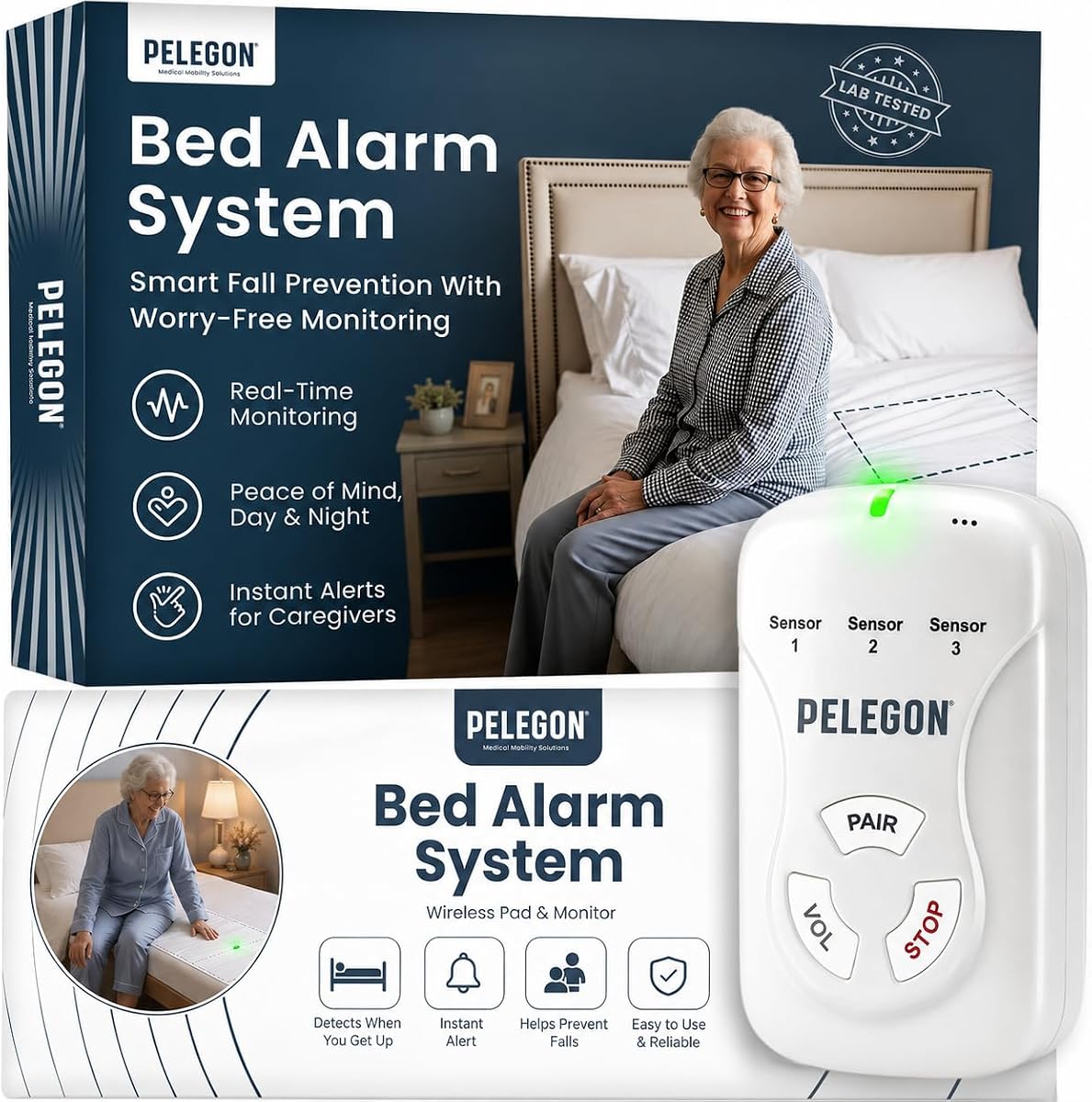
The PELEGON Bed Alarms for Elderly Dementia Patients combines an under-sheet sensor pad with a wireless caregiver pager to create a practical early-warning system. It holds a 4.7 rating, and its strongest qualities are the 328-foot operating range, customizable alert modes, and straightforward setup. The product is specifically oriented toward fall-risk reduction, wandering awareness, and overnight dementia support.
We may earn a commission when you buy through this link, at no additional cost to you.
The sensor is placed beneath the sheet and is designed to detect movement as the person begins to rise, potentially giving a caregiver time to respond before a fall. Its wireless pager can be clipped to a belt or carried in a pocket, allowing the caregiver to remain in another room. Sound, adjustable volume, and vibration-only operation make it possible to tailor alerts to daytime noise levels, shared sleeping spaces, and nighttime monitoring.
There are trade-offs. The 328-foot range is ample for many homes but shorter than the 918-foot open-area specification claimed by two of the motion-sensor systems in this guide. The product also depends on correct sensor placement and on a caregiver being able to respond promptly. As with any monitoring device, it should support—not replace—direct supervision, regular check-ins, and other appropriate fall-prevention measures.
This is a strong choice for families seeking a wireless under-bed system that combines a pad sensor, portable paging, and quiet alert options without a complex installation. It is particularly well suited to home dementia care, especially when nighttime vibration is preferable to an audible alarm. For those needs, the PELEGON system offers the most balanced feature set in this roundup.
Movement detection is intended to provide notice as someone starts rising rather than waiting until a fall occurs. Vibration-only paging offers a discreet alternative when an audible alert could disturb the patient or another household member.
The pad goes beneath the sheet, and the system connects without complicated installation. Caregivers should still test the placement and alert path before relying on the device for overnight monitoring.
We may earn a commission when you buy through this link, at no additional cost to you.
The Smart Caregiver Bed Alarm for Elderly Adults is a traditional pressure-pad monitoring system with a 4.2 rating. The sensor pad fits under the lower fitted sheet, and an alarm sounds when pressure is removed. Its appeal lies in its familiar design, durable sealed vinyl construction, clear reset control, and two selectable volume levels rather than advanced wireless features.
We may earn a commission when you buy through this link, at no additional cost to you.
The included 10-by-30-inch pad has a soft foam interior and a sealed surface that is easy to wipe clean. Caregivers can position it around the shoulder blades or hips, depending on the patient's movement patterns. The monitor can be mounted on the bed, wall, or another nearby surface, and a low-battery indicator plus sensor-status light help with routine checks.
The main limitation is the wired connection between the pad and monitor. Unlike several wireless products in this guide, it cannot send its standard alert directly to a portable caregiver pager without an optional add-on kit. It also produces an in-room alert, which may be less suitable when the patient could be startled by a sudden sound.
This system is best for caregivers who want an uncomplicated pressure sensor, simple local controls, and a monitor that can remain near the bed. It may fit a traditional home-care setup better than a facility requiring remote paging. Buyers should consider the optional wireless pathway if they need to monitor from another room.
The sealed vinyl pad is designed to withstand regular cleaning and resist moisture from incontinence. Its foam interior provides cushioning beneath the sheet, while the low-profile dimensions fit discreetly into a standard bed setup.
Two volume levels, a front reset button, and visible battery and sensor lights keep routine operation understandable. These basic controls are useful in homes where complex menus or frequent configuration changes would be undesirable.
We may earn a commission when you buy through this link, at no additional cost to you.
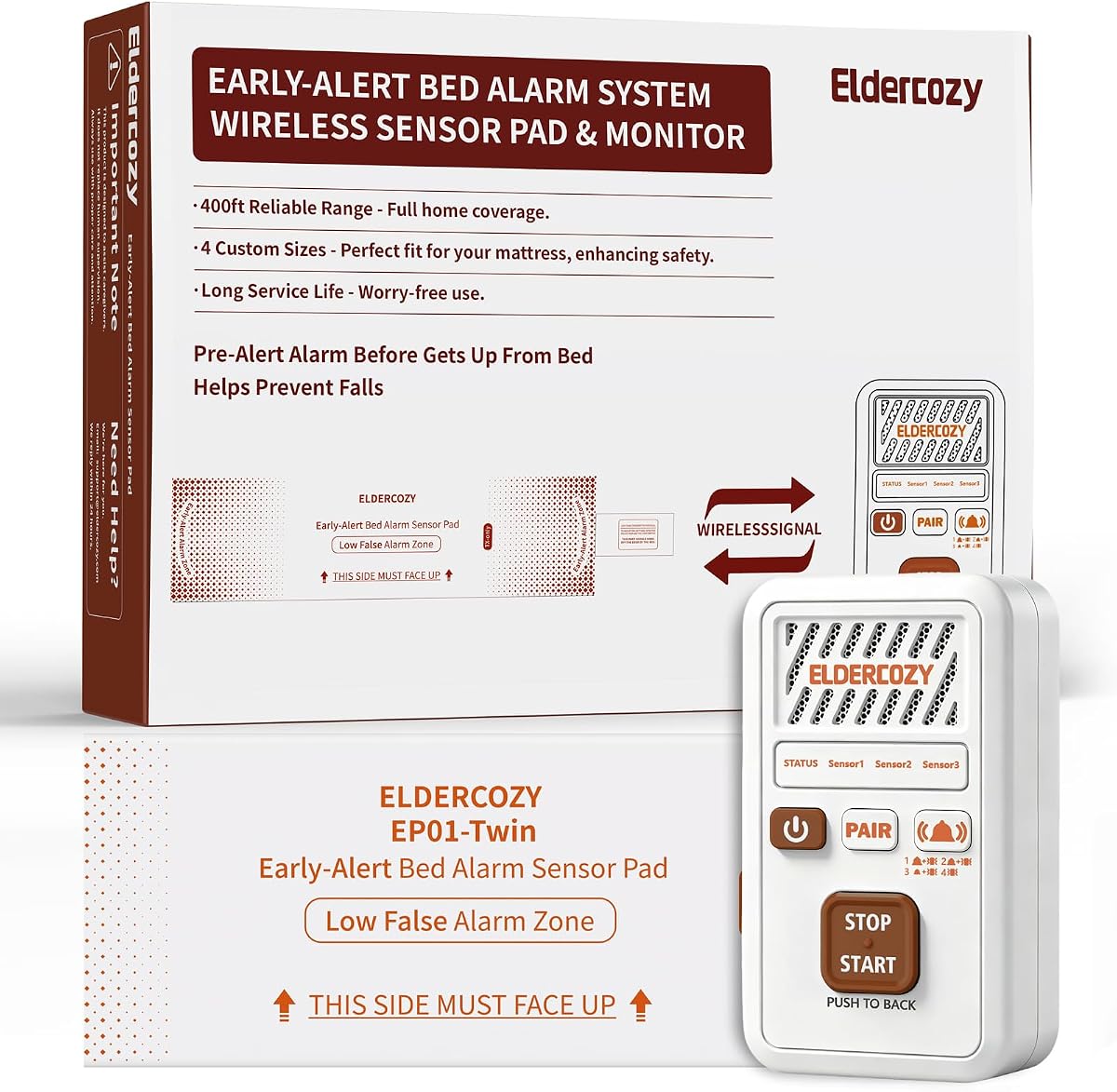
The Eldercozy Twin Size Wireless Bed Alarms for Elderly Dementia Patients has the highest rating in this list at 4.8. Its defining feature is a soft TPU-composite sensor pad designed to avoid the crinkly noise associated with PVC. The system also provides 400-foot wireless coverage, four alert modes, and replaceable batteries in both the transmitter and receiver.
We may earn a commission when you buy through this link, at no additional cost to you.
Unlike a shoulder-placed pad that may respond to ordinary turning, this product is intended to be positioned at hip level so it can alert when the person sits at the edge of the bed. The pager supports adjustable volume and vibration-only operation, along with dim status lights for nighttime use. A long press activates a 20-minute caregiver mode, allowing direct assistance without an immediate bed-exit interruption.
The most obvious compromise is the supplied Twin size, even though the product information lists other available sizes. Caregivers must confirm that the selected version matches the mattress. Another consideration is that caregiver mode temporarily pauses the exit alarm, so it should be used only when a caregiver is actively present and monitoring the patient.
This system is a compelling option for anyone who places a high value on quiet materials, flexible paging, and an alert intended to occur before the patient fully stands. It is well suited to overnight dementia monitoring and homes where a caregiver wants a portable receiver without relying on an app.
The TPU-composite pad is designed to remain quiet during movement and feel softer against the sleeper than crinkly PVC. Its waterproof surface also makes routine cleaning easier after spills or incontinence events.
Vibration-only paging, adjustable volume, and dim status lights offer quieter overnight operation. Caregiver mode can then support hands-on assistance while the patient is being helped.
We may earn a commission when you buy through this link, at no additional cost to you.
The Upgraded Version Bed Sensor Alarm uses a wireless motion sensor rather than a pressure pad and earns a 4.5 rating. It can be placed on the floor beneath the bed to detect a foot approaching the ground or positioned at a doorway to monitor a patient leaving a room. The included caregiver pager supports five volume levels.
We may earn a commission when you buy through this link, at no additional cost to you.
Because the sensor is not compressed by body weight, it avoids one common concern with bed pads: displacement and the possibility that incontinence will affect the pad. The alarm is also designed so the patient's room does not have to sound loudly, potentially reducing the risk that a sudden noise causes confusion or a fall. Both the sensor and receiver support alkaline-battery and Micro-USB power options.
The stated 918-foot range applies in an open area, so walls, floors, furniture, and room layout may reduce actual reception. Placement also requires care because the product's self-test uses a flashing indicator and caregivers are instructed to verify sensing direction. The system may not provide the same early, in-bed indication as a pressure-sensitive pad.
This is a practical budget choice for families seeking flexible placement and avoiding a wired bed pad. It works especially well when the priority is detecting a foot reaching the floor or a person crossing a monitored doorway. Caregivers should test the sensor from realistic positions before depending on it for overnight support.
The under-bed sensor detects lower-body movement before a patient is fully upright. It can also be moved to a doorway, making the same system useful for wandering awareness in addition to bed-exit monitoring.
The receiver combines LED and sound reminders with five volume levels. A visual-only reminder can be useful at night or in a shared room where an audible alarm would be disruptive.
We may earn a commission when you buy through this link, at no additional cost to you.
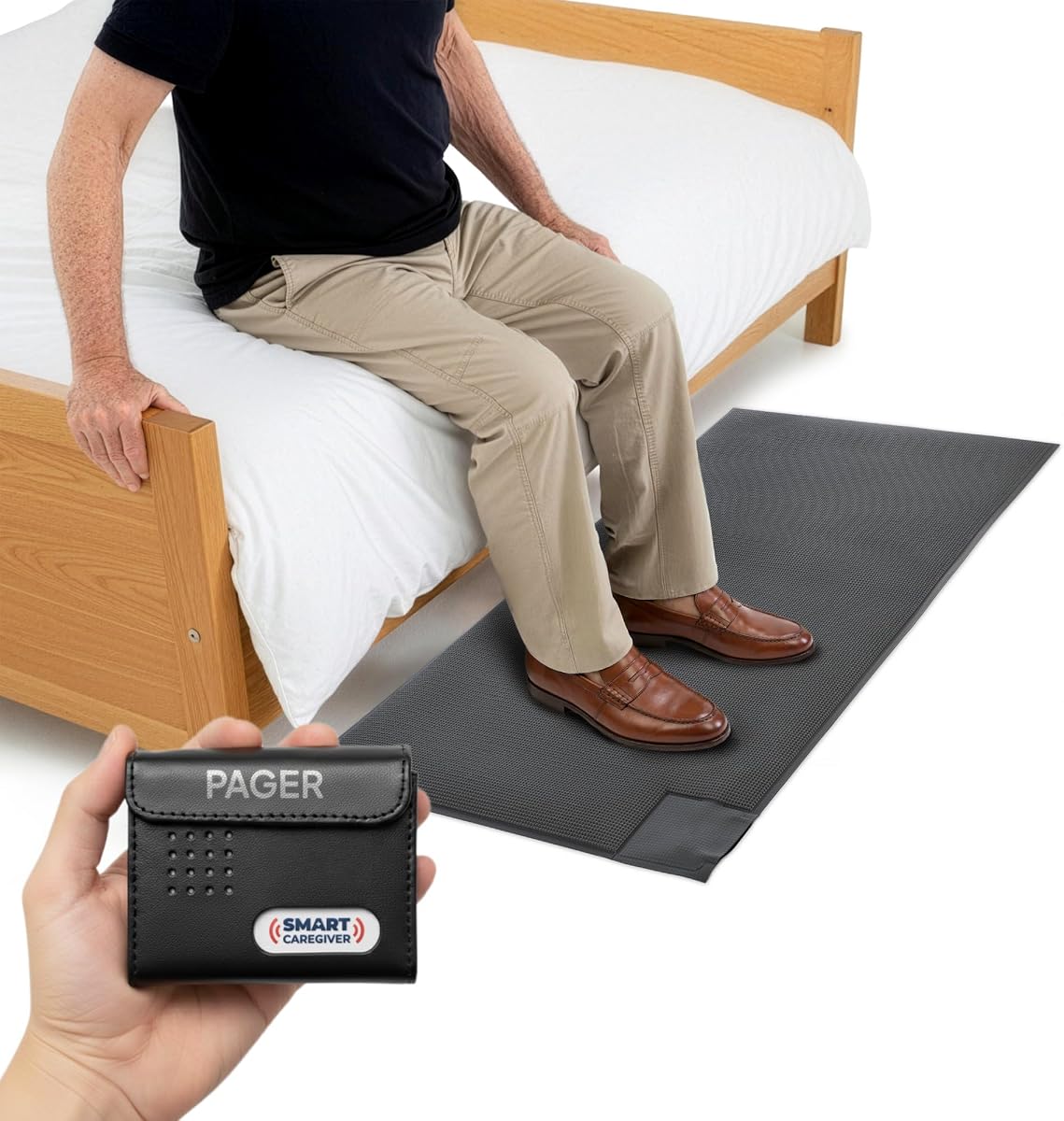
The Smart Caregiver Floor Mat Alarm and Pager System provides a wider detection area than a narrow pressure pad or single motion sensor. Its 4.6 rating reflects a well-defined purpose: notifying a caregiver when someone steps onto a 24-by-48-inch weight-sensing mat. The mat can be positioned beside a bed or near an exit door, and the wireless pager offers audible and vibration alerts.
We may earn a commission when you buy through this link, at no additional cost to you.
The larger monitored footprint makes this system useful when a person may approach a bed from different directions or wander near an exit. Up to 300 feet of caregiver-pager range supports monitoring within a home or many care settings. The included pager can be carried or placed conveniently, while its vibration mode avoids adding a loud alarm in the patient's room.
The main practical limitation is floor space. A 24-by-48-inch mat needs a clear, stable location, and a bedside installation must not create a trip hazard. The pager requires two AA batteries that are not included. It also monitors contact with the mat rather than predicting movement while the person is still in bed.
This is a strong choice for caregivers who want one floor-based system for both bedside and doorway monitoring. It can also be combined with separately sold Smart Caregiver call buttons, motion sensors, bed pads, and chair pads. Buyers who value a broad detection zone and discreet pager alerts will find this option especially flexible.
The broad mat can detect foot contact across a larger section of floor than a compact bedside sensor. That makes it suitable for people whose approach to the bed varies or whose paths require a wider warning zone.
Place the mat beside the bed for fall-risk monitoring or move it near a door for wandering awareness. The wireless pager keeps the caregiver informed without requiring a loud sound in the patient's room.
We may earn a commission when you buy through this link, at no additional cost to you.
The Smart Caregiver Bed Exit Alarm with Wireless Pager provides a conventional 10-by-30-inch weight-sensing pad with wireless caregiver notification. It has a 4.4 rating and is designed to alert when pressure is removed and the patient leaves the bed. The included pager supports both sound and vibration, allowing caregivers to choose a less disruptive notification when needed.
We may earn a commission when you buy through this link, at no additional cost to you.
One of its strongest features is expandability. The pager can support up to six different Smart Caregiver sensors, allowing coverage across beds, chairs, and doorways rather than limiting the system to one bed. The pad is intended to sit under the shoulders for an early response as the person starts to get up.
A potential drawback is that the product information does not state a wireless transmission distance, so buyers cannot compare its range numerically with the systems that specify 300, 328, 400, or 918 feet. The standard pad size also means placement should be checked carefully for a patient who shifts position during sleep. Sensor movement can affect both reliability and nuisance alerts.
This alarm is best for caregivers who want a single pager to manage several fall-risk and wandering points. It is particularly appealing in homes or care facilities that already use Smart Caregiver accessories. Confirm the pager's coverage in the intended rooms and perform placement tests before overnight use.
Six-sensor support lets a caregiver monitor different beds, chairs, and doorways with one receiver. This is useful in larger homes and facilities where isolated alarms could otherwise become difficult to manage.
Vibration mode delivers the alert without a conspicuous sound in the room. This can be advantageous for shared bedrooms, while audible mode remains available for situations where a stronger prompt is desired.
We may earn a commission when you buy through this link, at no additional cost to you.
The CallToU Bed Alarms for Elderly and Dementia Patients who Wander pairs a portable infrared sensor with a rechargeable receiver. Its 4.1 rating is supported by flexible alert settings, including five volume levels, 18 ringtones, and vibration-only operation. The floor sensor detects feet touching the ground from a stated range of three to 10 feet.
We may earn a commission when you buy through this link, at no additional cost to you.
The device is intended to provide notice before the patient is fully standing and does not need to touch the person. The sensor can rotate through 360 degrees, allowing caregivers to orient its detection field toward the likely exit path. The receiver's Type-C charging port and portable form make it easy to move around a home or carry between rooms.
The short detection distance means placement is critical. The sensor must be close enough to detect the expected movement without being positioned where normal activity creates unwanted alerts. Although the 360-degree rotation is designed to reduce false alerts from incontinence or restless sleep, the system does not offer a specified long-distance wireless transmission range.
This is a good match for caregivers who want extensive control over sound and vibration and who prefer a rechargeable portable pager. It can be useful in home, hospital, and room-monitoring contexts, provided the sensor is positioned according to the patient's actual movement pattern. Test the detection angle before relying on it overnight.
Eighteen ringtones and five volume levels make it easier to select a sound that is noticeable to the caregiver without being harsh. Silent or vibration modes support discreet monitoring in shared spaces.
The 360-degree sensor rotation helps focus detection toward a bedside exit route. Because the stated range is relatively short, the unit should be tested from every position the patient commonly uses when getting out of bed.
We may earn a commission when you buy through this link, at no additional cost to you.
The Upgrade Professional Bed Sensor Alarm offers a long-range wireless motion system with a 4.5 rating. The sensor can be placed under a bed or in a doorway, while the factory-paired receiver provides four operating modes. These include sound with flashing light, light flashing, LED-only indication, and a 113-decibel alarm.
We may earn a commission when you buy through this link, at no additional cost to you.
Its main attraction is the claimed 918-foot transmission distance in an open area. That makes it potentially useful in large homes, facilities, or other environments where the caregiver may be well away from the monitored room. The sensor and receiver can run from batteries or a Micro-USB connection, reducing the need to occupy a wall outlet continuously.
As with any long-range wireless product, actual indoor performance will depend on walls and obstructions. The receiver's controls are also relatively basic, requiring a continuous press of the side button to change modes and another press to adjust volume or brightness. Caregivers should complete the self-test and verify both range and sensing direction in the actual location.
This is a useful option for a caregiver who wants to move freely around a large home or care setting and needs visual as well as audible reminders. Its four modes offer more choice than a basic sound-only alarm. It is best suited to users comfortable with button-based configuration and willing to test the installation carefully.
The stated 918-foot open-area transmission range offers considerable flexibility for larger environments. Interior walls and obstacles may shorten the practical distance, so testing in the intended rooms remains important.
Four modes let a caregiver rely on an LED, flashing light, combined light and sound, or the highest-volume alert. This makes the receiver adaptable to both shared rooms and situations where a stronger audible prompt is needed.
We may earn a commission when you buy through this link, at no additional cost to you.
The Smart Caregiver Bed and Chair Exit Alarm System includes both a 10-by-30-inch bed pad and a 10-by-15-inch chair pad. With a 4.2 rating, it stands out for monitoring two common fall-risk locations with one monitor. Pressure-sensitive pads alert when the person attempts to rise from either the bed or chair.
We may earn a commission when you buy through this link, at no additional cost to you.
Both pads use soft vinyl with a foam interior and sealed surfaces designed for easy cleaning and moisture resistance. The bed pad fits under the fitted sheet, with a cord running along the mattress to the monitor. For chair monitoring, the monitor can clip to the back of the chair. Placement can also be adjusted to balance early notification against sensitivity for restless sleepers.
The wired pad connection is the main constraint, and only one monitor is included for both pads. A family monitoring a bed and chair simultaneously may need to move the monitor or purchase another one. As with all pressure pads, incorrect placement, shifting, or sensitivity differences can affect how quickly the alarm sounds.
This product is an excellent choice for a single patient who moves between a bed and chair and spends time in both. The included two-pad set offers more flexibility than a bed-only system without requiring a separate app. Caregivers should test both pad positions and ensure the connecting cords cannot create a snag or trip hazard.
Including both bed and chair pads makes the system useful for a patient whose routine involves transfers from a chair as well as nighttime bed exits. A phone-style clip allows the monitor to move with the chair when needed.
The bed pad can be aligned with the shoulder blades for earlier alerts or moved beneath the hips for a restless sleeper. Careful testing helps balance timely notification with fewer unnecessary alarms.
We may earn a commission when you buy through this link, at no additional cost to you.
The Bed Sensor Pad and Pager for Elderly Dementia Patients uses a comparatively large 32-by-13-inch motion-sensing pad and a portable wireless pager. Its 3.7 rating is the lowest among the ten products, but the system offers several useful features: 300-foot range, adjustable volume, music, vibration alerts, and a water-resistant, latex-free pad that can be wiped clean.
We may earn a commission when you buy through this link, at no additional cost to you.
The larger pad provides a broader area beneath the fitted sheet than the 10-by-30-inch pads used by several competitors. Secure clips help keep it in position, while the portable receiver gives caregivers freedom to move around the home. Intended applications include homes, hospitals, nursing homes, and rehabilitation centers.
The product information provides less detail about pager configuration, sensor placement, and false-alert management than some competing descriptions. That makes independent setup testing especially important. The 300-foot range also falls below the wireless range of several other systems, and the lower rating may reflect less favorable customer feedback without revealing the specific cause.
This system is worth considering when a large bed pad and simple portable paging are the main priorities. It may appeal to caregivers who want a broader pad than conventional 10-by-30-inch models and need a wipe-clean surface. Before adoption, verify that the pad's position provides the desired response and that the receiver is audible or noticeable in the intended monitoring area.
The 32-by-13-inch pad offers more surface area than the standard compact sensor pads in this roundup. Its dimensions may improve coverage when a patient moves around the lower portion of the mattress.
The latex-free, tear- and water-resistant material supports routine cleaning in shared-care environments. Music, adjustable volume, and vibration give the caregiver several ways to recognize a bed-exit event.
We may earn a commission when you buy through this link, at no additional cost to you.
Choosing a bed alarm requires balancing detection method, alert delivery, room layout, nighttime needs, and the patient's movement patterns. The best device is the one that is placed correctly, tested consistently, and integrated into a broader caregiving plan.
Pressure-sensitive pads detect a change in weight and can provide an early warning while the patient is still shifting toward the edge of the bed. Motion sensors placed under the bed can detect a foot approaching the floor or movement in a doorway, while weight-sensing floor mats cover a larger area where the patient steps. A pressure pad is usually more appropriate when the priority is an in-bed warning; a floor sensor or mat is often easier to reposition and can serve both bedside and wandering applications.
The most useful system provides a warning before the person has fully stood or reached a doorway. Look for sensors designed to detect the start of rising, sit-up movement, or feet touching the floor. Placement is just as important as the claimed technology: shoulder- or hip-positioned pads may behave differently, and under-bed sensors must face the likely path of movement. No alarm should be considered reliable until it has been tested under realistic sleeping and waking conditions.
Wireless range can determine whether a caregiver can remain in another room, move around a large home, or monitor a patient from a nearby work area. Stated figures range from 300 feet to 918 feet, but the largest number is an open-area specification. Walls, doors, floors, and furniture can reduce actual reception. Compare the system's range with the distance between the bed and the most distant location where the caregiver will spend time, then perform an in-home test before relying on it overnight.
Sound, LED indicators, and vibration each serve different caregiving situations. A loud alarm may be necessary in a large facility, while vibration-only paging is preferable in a shared bedroom or when noise could confuse the patient. Several products offer multiple volume levels or selectable tones. Caregivers should choose an alert that is noticeable to them but not excessively startling to the patient, and confirm that the pager can be carried comfortably.
Overnight monitoring calls for dim status lights, quiet sensor materials, and the ability to use vibration without waking a household. Caregiver mode, as offered by the Eldercozy system, can temporarily pause an alarm during hands-on assistance, but it should only be activated when someone is present. Review battery life, charging options, and power-backup arrangements so a depleted device does not create a false sense of security.
A home caregiver may need one bed, while a larger household or facility may monitor bedrooms, bathrooms, chairs, and exits. Pagers that support multiple transmitters or sensors can simplify a broader deployment. A floor mat can be moved between the bedside and a doorway, while a bed-and-chair set covers two transfer points without separate sensor purchases. Consider the available space, the number of patients, and whether equipment must be portable between rooms.
A sensor remains under the fitted sheet, so comfort and hygiene are essential. Quiet TPU material may be preferable to crinkly PVC, while sealed, wipe-clean surfaces are useful for incontinence care. Tool-free setup is helpful for family caregivers, but every installation should still be checked for secure placement, unobtrusive cords, and trip hazards. For motion systems, verify the sensing direction and use the included mounting materials as intended.
Check what arrives in the box before purchase, especially batteries, wall adapters, charging cables, mounting hardware, and additional sensors. Some systems include all required power sources, while others list batteries or adapters as not included. A manufacturer warranty and accessible customer support can be valuable when troubleshooting placement, pairing, or replacement parts. Read the specifications carefully and keep the instruction manual for testing and maintenance reference.
Begin by reading the manufacturer's instructions and identifying the sensor, transmitter, receiver, power sources, and any mounting accessories. Charge or install the batteries as directed, pair the components where required, and run the self-test before positioning the device. For a pad system, place the sensor under the fitted sheet in the specified area; for a motion sensor, position it on the floor beneath the bed or at a doorway; for a floor mat, secure it in a clear, level location.
Test the system with a family member or caregiver while no patient is relying on it for safety. Simulate normal turning, sitting, and getting up, then confirm that the correct alert reaches the receiver. Check the sensing direction, communication distance, volume, vibration setting, and reset behavior. Repeat the test after moving furniture, changing the patient's routine, replacing bedding, or repositioning the sensor. Cords and mats should never create a snag or trip hazard.
Care for the equipment according to its materials. Wipe sealed pads and mats with a damp cloth as directed, avoid immersing electrical components, and allow surfaces to dry before reinstalling them. Replace batteries on a schedule and keep spare power sources available. Clean the receiver and sensor openings gently, inspect clips and mounting points, and arrange manufacturer support or replacement parts if performance becomes inconsistent.
No. A bed alarm is a monitoring aid that can notify a caregiver of movement or a bed exit, but it cannot prevent every fall or replace attentive supervision. It should be used as part of a broader care plan that includes appropriate supervision, fall-hazard reduction, mobility support, and regular check-ins. Caregivers should test each device under real conditions and follow any professional guidance for the patient's care.
The best nighttime system depends on the patient's movement and the caregiver's location. A soft wireless pad can provide an early in-bed warning, while an under-bed motion sensor may be easier to reposition and can alert when feet approach the floor. Vibration paging and dim status lights are useful for shared bedrooms. Compare noise comfort, alert type, placement, and wireless coverage rather than relying on one feature.
False alerts can occur when a pressure pad is poorly positioned, a person moves heavily in sleep, a sensor is installed beyond its useful direction, or a floor mat is disturbed. Correct placement, careful self-testing, and regular inspection help reduce unwanted triggers. Product designs differ in how they handle incontinence, restless sleep, and bed movement, so caregivers should test during the patient's usual sleep pattern before full reliance.
A bed pad detects changes in pressure and may alert while the person is shifting or sitting up, potentially providing earlier notice. An under-bed motion sensor detects lower-body movement and is intended to alert when a foot approaches the floor. Pads can be more sensitive to body position, while motion sensors depend heavily on correct direction and can be moved between bedside and doorway monitoring.
Some systems support multiple transmitters or sensors. The Smart Caregiver Bed Exit Alarm states that its pager supports up to six sensors, and the floor-mat system can be paired with separately sold accessories. Other systems are designed around a single sensor and receiver. Confirm pairing limits, alert differentiation, and wireless coverage before using one pager for multiple people.
The listed products specify wireless distances from 300 feet to 918 feet, with the largest figure applying in an open area. Walls, doors, floors, and other obstructions can reduce the practical range. A closer, more reliable signal in the rooms where caregiving occurs is preferable to relying on a maximum figure. Test the complete path between sensor and pager before relying on it overnight.
Placement depends on the product and the patient's behavior. Several bed-pad systems specify placement under the shoulder blades for earlier alerts, while a hip-level position may reduce sensitivity to ordinary turning. The Eldercozy system is designed around hip-level early warning. Follow the included instructions and test both areas during normal movement, then keep whichever placement provides the best balance of early notice and reliable alerts.
Wipe cleanable pads and mats with a damp cloth, keep electrical parts dry, and inspect clips, cords, sensors, and receivers regularly. Replace batteries on a consistent schedule and keep spares available. Re-test the system after any equipment move, change in the patient's routine, or unusual alert. Contact the manufacturer if sensing becomes inconsistent rather than attempting to alter protected electronics.
The PELEGON system stands out as the best overall balance of early movement detection, wireless paging, sound and vibration choices, and tool-free setup. The Upgraded Version Bed Sensor Alarm is the best budget option for flexible under-bed or doorway monitoring, while the Smart Caregiver Floor Mat Alarm offers a broad premium detection zone for bedside and exit use. Each suits a different household layout and caregiving routine.
Prioritize the sensing method that matches the patient's actual behavior, then verify indoor wireless reception, nighttime noise, cleaning requirements, and power needs. A device with more features is not automatically better than a simpler system. Reliable placement, routine testing, prompt response, and integration with direct supervision matter more than any specification on its own.
Before ordering, confirm the current product details, included accessories, battery requirements, warranty terms, and availability. Prices and promotions can change over time, so compare the final cost only after verifying that the chosen model provides the sensor placement, alert style, and range needed for the intended care environment.