
SANDISK 1TB Extreme PRO SDXC UHS-II Memory Card
4.9Editor score
UHS-II professional performance
Up to 280MB/s reads
V60 6K video support
Our 1TB SD Cards guide compares ten high-capacity cards for 4K video, burst photography, app use, fast transfers, durability, and device compatibility in 2026.
A 1TB SD card offers enough room for extensive photo libraries, high-resolution video, mobile applications, and portable storage, but capacity alone does not guarantee dependable performance. The right card must also match your device, recording format, transfer workflow, and tolerance for different physical formats.
We compared ten 1TB cards across their stated performance classes, read and write speeds, video capabilities, app ratings, durability claims, warranty coverage, and compatibility. The list includes full-size SDXC cards and microSDXC options with adapters, giving buyers useful choices for cameras, drones, action cameras, and mobile devices.
Each review highlights the product best suited to a particular workflow rather than treating a headline speed as the only measure of quality. Ratings and specifications can change by revision, and current availability varies, so confirm the exact model and your device requirements before ordering.
4.9Editor score

4.8Editor score
4.3Editor score
This side-by-side comparison covers all ten cards, with particular attention to card format, speed ratings, stated transfer performance, video use, and device compatibility. It also distinguishes full-size SDXC cards from microSDXC models that include an SD adapter.


The SanDisk Extreme PRO 1TB SDXC UHS-I card combines a 4.8 rating with a balanced set of professional specifications, making it our strongest general recommendation. Its headline capabilities are up to 200MB/s read speed and up to 140MB/s write speed, while U3 and V30 ratings support demanding 4K UHD recording workflows.
We may earn a commission when you buy through this link, at no additional cost to you.
The card is particularly well suited to photographers who alternate between burst-mode stills and video. SanDisk describes it as ideal for 4K UHD video and sequential burst photography, with sustained video capture supported by its V30 rating. QuickFlow technology can accelerate offloads when paired with a compatible host, although the card cannot deliver its maximum stated speed to every reader.
There is a meaningful distinction between peak laboratory figures and everyday performance. SanDisk notes that results depend on the host device, interface, file attributes, and usage conditions. The compatible Professional PRO-READER is also sold separately, which means buyers should budget for a reader if fast imports are a central part of their workflow.
This is the most practical choice for users who want substantial capacity and high performance without moving to the more specialized UHS-II card. It suits a broad range of cameras and creative systems, particularly those that benefit from faster writes than basic V30 cards provide. Choose it when dependable 4K capture, burst photography, and efficient offloading matter more than the extreme throughput available from the premium UHS-II model.
Up to 200MB/s read performance can shorten card-to-computer transfers when the camera, reader, interface, and files support those speeds. This advantage is especially useful for creators moving large RAW libraries or reviewing high-resolution footage without prolonged waiting.
The combination of U3, V30, and up to 140MB/s write speed gives the card more headroom for 4K recording and sequential burst shooting. It is a well-rounded option for creators who do not need the V60 rate or UHS-II interface of a professional cinema-oriented card.
We may earn a commission when you buy through this link, at no additional cost to you.
This SanDisk Extreme microSD card is a versatile 1TB option for devices that rely on the smaller format. It carries a 4.8 rating and states read speeds up to 190MB/s and write speeds up to 130MB/s, placing it firmly among the faster UHS-I microSD choices in this guide.
We may earn a commission when you buy through this link, at no additional cost to you.
Its U3 and V30 ratings support 4K and 5K UHD capture when the host device and recorded files are compatible. The A2 rating also makes it suitable for smartphones and tablets that support running applications from the card, with specified performance of 4,000 read IOPS and 2,000 write IOPS.
The included adapter allows use in full-size SD devices, while the microSD card itself suits compatible action cameras, drones, and mobile hardware. Compatibility with Nintendo Switch is stated, but the product information specifically excludes Nintendo Switch 2. As with the other high-speed cards, actual performance depends on the reader, interface, host device, and workload.
This is an attractive pick for creators who need one high-capacity card across several kinds of equipment. It is particularly compelling for a workflow involving 4K or 5K footage, camera transfers, and mobile storage. It falls short of the full-size UHS-II card for maximum professional throughput, but its flexibility makes it easier to deploy across a broader device mix.
The included SD adapter expands compatibility with full-size hosts, while microSD support brings the card to compatible compact cameras, drones, and mobile devices. That versatility makes it a practical travel and production companion.
The A2 rating is designed for improved app loading and in-app responsiveness on compatible Android devices. It is more relevant to active mobile workflows than to a camera used only for recording finished video files.
We may earn a commission when you buy through this link, at no additional cost to you.
The SanDisk Extreme PRO 1TB SDXC UHS-II card stands apart with a 4.9 rating, a V60 video class, and the highest stated read speed in the group. It is designed specifically for prosumers and professionals using MIL or cinema cameras that can benefit from the UHS-II interface.
We may earn a commission when you buy through this link, at no additional cost to you.
Its stated performance reaches up to 280MB/s for offloads and up to 150MB/s for writes. V60 denotes a sustained video capture rate of 60MB/s, while the card supports 6K and 4K UHD recording when the host device, file attributes, and other conditions align. It is also positioned for continuous burst photography and time-lapse image capture.
UHS-II creates an important compatibility consideration. A device or reader that only supports UHS-I will use the card, but it will not unlock the full UHS-II throughput. Actual transfer and write results also depend on the host. This means the card's specifications are most meaningful in a professional camera, card reader, and computer setup built around UHS-II.
For a studio, documentary team, or advanced enthusiast shooting high-resolution continuous video, this is the premium choice. It offers the strongest combination of sustained recording class, burst capability, and transfer speed in the guide. The trade-off is unnecessary complexity for users who only need general storage, 4K capture, or a card for an older UHS-I camera.
The V60 rating is the key differentiator for professional video workflows because it represents a sustained 60MB/s capture rate. It offers more headroom for demanding high-resolution recording than the V30 options in the guide.
Up to 280MB/s read performance can materially accelerate offloads when the entire chain supports UHS-II. Professional photographers and videographers can spend less time waiting for large batches of high-resolution files to reach a workstation.
We may earn a commission when you buy through this link, at no additional cost to you.
The Lexar Silver 1TB SD card is a strong full-size option for creators who value fast transfers, substantial capacity, and broad device support. Its 4.6 rating is supported by specifications of up to 205MB/s read speed and up to 140MB/s write speed.
We may earn a commission when you buy through this link, at no additional cost to you.
The V30 rating is designed for up to 4K 60FPS video recording, making the card suitable for high-resolution video and burst-oriented camera workflows. Lexar lists compatibility with a variety of cameras and devices, including Canon, Sony, and Nikon systems, though users should still confirm support for 1TB capacity and the intended recording format.
Durability is another strength. The card is described as wearproof, drop-proof, temperature-proof, x-ray-proof, shockproof, magnetic-proof, and vibration-resistant. A lifetime limited warranty and access to Lexar Recovery Tool add value for buyers concerned about long-term ownership and recovering accidentally deleted files.
The Silver's read figure is among the strongest for a UHS-I full-size card, but it does not change the interface's underlying limits. It is a compelling choice for 4K shooters and photographers seeking fast offloading without moving to UHS-II. Choose it when strong write speed, familiar SDXC format, and broad camera compatibility are the priorities.
The stated 205MB/s read speed can benefit large imports when a compatible reader and host device are used. It gives the card an attractive transfer profile for photographers and videographers who regularly move multi-gigabyte collections.
Multiple environmental protections make the card a sensible option for mobile production. The included recovery software and limited lifetime warranty are useful additions for a device expected to remain in service for a long time.
We may earn a commission when you buy through this link, at no additional cost to you.
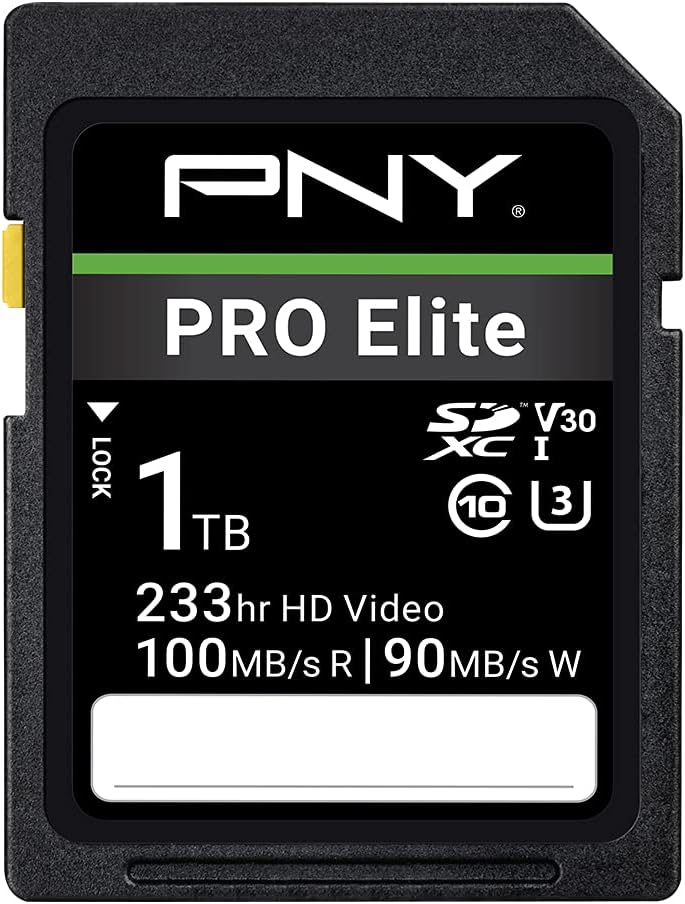
The PNY PRO Elite 1TB SDXC card provides the essentials of a modern high-capacity camera card at a more modest performance level than the premium selections. It carries a 4.3 rating, with up to 100MB/s read speed and up to 90MB/s write speed.
We may earn a commission when you buy through this link, at no additional cost to you.
Its Class 10, U3, and V30 ratings cover burst-mode HD photography and 4K Ultra HD videography. The card is listed as compatible with point-and-shoot cameras, DSLRs, standard HD-enabled video cameras, and advanced HD video cameras. This makes it a practical starting point for photographers and videographers who need 1TB of storage without requiring UHS-II.
The product information describes it as magnet-proof, shockproof, temperatureproof, and waterproof. Those protections support use across mobile and outdoor workflows, although buyers should understand that marketing terms alone do not indicate suitability for every extreme condition. The card's principal limitation is its lower throughput compared with the faster models in the guide.
Our budget designation reflects the balance between a complete feature set and more conservative performance figures, not a claim that it lacks useful speed. Choose this card for standard 4K capture, large photo libraries, and everyday transfers in UHS-I equipment. Upgrade to a higher-speed model if your workflow is dominated by continuous high-bit-depth recording or very large burst sequences.
The V30 rating provides a sustained 30MB/s video class, making the card suitable for 4K UHD workflows that meet the card's stated format and device requirements. It offers enough specification for common enthusiast and professional camera use.
A full-size SDXC card with UHS-I support fits a wide range of modern cameras. The stated compatibility with point-and-shoot, DSLR, and HD-enabled video cameras makes it a versatile one-card solution for mixed equipment.
We may earn a commission when you buy through this link, at no additional cost to you.
The Lexar Blue 1TB microSD card offers a balanced combination of mobile responsiveness, video support, and physical protection. Its 4.7 rating and stated read speed of up to 160MB/s place it among the stronger performers in the microSD group, even though it does not lead the category in raw transfer speed.
We may earn a commission when you buy through this link, at no additional cost to you.
Its U3 and V30 ratings support 4K video, while A2 performance is intended to improve application launch and responsiveness on compatible smartphones and tablets. The product information also identifies the card as useful for Full HD and 4K UHD media transfers, creating a natural fit for a phone-centered content workflow.
Durability is a major selling point. Lexar lists testing against eight proof points, including temperature, IPX7 water resistance, X-ray protection, vibration, magnetism, shock, drops up to 1.5 meters, and wear. A 10-year limited warranty and lifetime access to Lexar Recovery Tool add long-term reassurance.
This is a strong recommendation for mobile creators, Android users, and compatible compact or action cameras that need 1TB and A2 performance. The stated 160MB/s read rate benefits from a compatible reader, such as a select Lexar USB 3.1 model, and actual results vary. If your equipment requires a full-size card, verify that an appropriate adapter is available before purchase.
A2 performance, 4K support, and high read speed make this card useful beyond simple file storage. It can keep media and compatible applications in a compact mobile setup without moving to a faster but less broadly compatible model.
The card's protection against water, temperature, impact, magnetic fields, vibration, X-rays, wear, and drops reflects a strong emphasis on mobile durability. Those claims make it particularly appropriate for frequently carried equipment.
We may earn a commission when you buy through this link, at no additional cost to you.
The Amazon Basics 1TB microSDXC card is a practical general-purpose option that includes a full-size adapter. Its 4.6 rating, A2 rating, and up to 100MB/s read speed make it relevant to both cameras and compatible mobile devices.
We may earn a commission when you buy through this link, at no additional cost to you.
The product information is unusually transparent about usable capacity, listing the 1TB card at at least 908GB after operating-system formatting and the difference between decimal and binary calculations. It is optimized for high-bitrate video, burst photography, RAW files, time-lapse sequences, and 4K UHD playback, subject to device support.
Its UHS-I U3, V30, and A2 certification provides a useful baseline for modern storage. The microSD form factor supports compatible Android devices, cameras, and other hosts, while the adapter broadens the range of full-size equipment. Nintendo Switch compatibility is stated, but Nintendo Switch 2 is expressly excluded, and the maximum supported capacity of any device should be checked.
This card is well suited to buyers who want a straightforward 1TB card without paying for the highest headline transfer rate. It is especially useful for travel, dashcams, mobile file storage, and mixed camera work. Its listed shock, IPX6 water, extreme-temperature, X-ray, and magnetic resistance further improve its suitability for mobile use.
The stated usable capacity of at least 908GB helps set realistic expectations for a nominally 1TB card. This transparency is useful when comparing cards that display capacity using different decimal and binary conventions.
A2 performance supports compatible Android application use, while V30 and U3 ratings support modern high-resolution recording. The included adapter extends the card to full-size compatible hosts without requiring a separate purchase.
We may earn a commission when you buy through this link, at no additional cost to you.
The SanDisk Ultra 1TB microSD card is a well-rounded mobile and general-purpose card with a 4.7 rating. It provides up to 150MB/s read speed, 1TB of capacity, and an included adapter, making it suitable for devices that cannot use the more specialized high-end models in the guide.
We may earn a commission when you buy through this link, at no additional cost to you.
It is positioned primarily for Android smartphones and tablets, with storage for hours of Full HD video and the ability to move large batches of photographs. The read-speed claim is based on an internal test using an average file size of 3.55MB and a USB 3.0 reader, while actual results vary with the host, interface, files, and usage conditions.
A1 performance supports faster application loading than the baseline class, with stated performance of 1,500 read IOPS and 500 write IOPS. That remains useful for compatible Android workflows, although it is below the A2 rating offered by several other microSD cards here. The operating range is listed as minus 13 to 185 degrees Fahrenheit.
Choose this card when you want a recognizable high-capacity mobile solution with a full-size adapter, ample space for photos and Full HD video, and a strong read figure. It is less oriented toward demanding 4K camera workflows than the U3 and V30 models, and it is not intended for Nintendo Switch 2.
With capacity for extensive media and a read speed of up to 150MB/s, the card helps reduce transfer waits in compatible devices. It is particularly useful for moving personal photos and Full HD video between a phone and computer.
A1 performance remains appropriate for compatible Android app use. Models rated A2 may offer more headroom, but this card provides a simpler and established option for users whose priority is media storage rather than intensive app performance.
We may earn a commission when you buy through this link, at no additional cost to you.
The GIGASTONE 1TB SDXC Pro Series card combines a 4.6 rating with up to 150MB/s transfer speed and the ratings needed for modern high-resolution use. It is a full-size card designed for digital cameras, HD camcorders, DSLRs, and PCs.
We may earn a commission when you buy through this link, at no additional cost to you.
Its UHS-I, A1, V30, and Class 10 positioning supports 4K UHD video and provides a baseline for application access in compatible devices. The included specifications emphasize transfer speed without listing a specific maximum write rate, so buyers creating long or continuous recordings should pay close attention to the device's format requirements.
Physical protection is a meaningful part of the design. The card is described as waterproof, temperatureproof, X-ray-proof, shockproof, and magnetic proof, and it includes a mini case. The product listing also promotes five years of free data recovery and a five-year limited warranty from the manufacturer or supplier.
This is a practical choice for photographers and videographers who want 1TB of storage, 4K capability, and a full-size SDXC format. It is especially compelling for users who value the stated data-recovery offer and included protective case. For workflows where maximum write speed is the deciding factor, a card with an explicit write figure may offer a clearer specification.
The V30 and U3 ratings position the card for 4K UHD recording, while its 1TB capacity reduces the need to move media frequently. The full-size format suits compatible DSLRs, camcorders, and computers.
The advertised recovery service, limited warranty, mini case, and multiple environmental protections add practical value. These benefits can make the card appealing for long-term archives and frequently transported camera equipment.
We may earn a commission when you buy through this link, at no additional cost to you.
The PNY PRO Elite Prime 1TB microSDXC card pairs a 4.6 rating with ambitious stated performance of up to 200MB/s read and up to 150MB/s write. It is one of the fastest microSD options here on paper and targets recording, editing, and mobile workflows that need more than basic UHS-I performance.
We may earn a commission when you buy through this link, at no additional cost to you.
The U3, V30, and A2 ratings cover sustained 4K-oriented video capture and improved app performance, with A2 defined as at least 4,000 read IOPS and 2,000 write IOPS. The product is listed for Android phones and tablets, action and surveillance cameras, drones, computers, and other compatible microSD hosts.
Maximum stated speeds are reached when used with the PNY Performance Prime card reader, which is a separate consideration for the complete workflow. Compatibility is broad, but the product information specifically states that the card is not compatible with Nintendo Switch 2. Included is an SD adapter for compatible full-size hosts.
This card is a compelling option for creators who want a small, high-capacity card with a high stated read figure. It fits drones, compact cameras, and mobile production systems as long as those devices support 1TB and the card's required ratings. For readers working with unusually large files, the combination of 200MB/s reads and 150MB/s writes offers an attractive foundation.
Up to 200MB/s reads can shorten the movement of large photo and video collections when paired with the specified Performance Prime reader. Actual performance remains dependent on the host and interface.
The card is intended for action cameras, surveillance devices, drones, mobile hardware, and computers. Its included SD adapter adds compatibility with compatible DSLRs, camcorders, desktops, and laptops.
We may earn a commission when you buy through this link, at no additional cost to you.
Choosing a 1TB card means balancing physical format, sustained performance, device support, and the type of files you plan to store. The most important step is to identify your equipment's requirements before comparing advertised peak speeds.
A full-size SD card is physically larger and fits cameras, professional media readers, and other devices with a standard SD slot. A microSD card is much smaller and is designed for drones, action cameras, many smartphones, and other compact devices. Several microSD products include an SD adapter, allowing the same card to work in full-size hosts, but the adapter is only a physical format converter and does not make an incompatible device support microSD.
The physical choice should follow the device that will use the card most often. A camera with only a microSD slot cannot accept a full-size card, while a full-size camera cannot use a microSD card without an adapter and a slot that accepts it. Confirm the slot shape and maximum capacity before purchasing.
Headline read and write speeds describe the best conditions, while a video speed class describes a minimum sustained write rate. V30 guarantees a sustained 30MB/s for real-time video recording, while V60 guarantees 60MB/s. The higher V60 class on the SanDisk Extreme PRO UHS-II card is particularly relevant to professional 4K and 6K workflows. A V30 card is suitable for many 4K applications, but the camera's bitrate, codec, resolution, and frame rate must also be supported.
Match the rating to the recording format rather than relying on resolution alone. Full HD, 4K, high frame rates, high bitrates, and data-rich camera formats can place different demands on a card. If the manufacturer publishes a card requirement, treat that as the governing specification.
Read speed controls how quickly files can be transferred from a card, while write speed affects recording and burst capture. The 1TB cards in this guide state maximum figures ranging from 100MB/s to 280MB/s for reads. For writing, several cards list speeds from 90MB/s to 150MB/s, while others do not provide a specific maximum. Faster transfer is useful for photographers with large libraries, but it only matters when the camera, reader, cable, interface, and computer can sustain the same level of performance.
Treat peak figures as an upper boundary rather than a guaranteed real-world result. Host device speed, file attributes, interface bandwidth, usage conditions, and card readers can all affect the outcome. For the best chance at reaching stated performance, use equipment specifically listed as compatible.
UHS-I is the most common interface in this group and provides broad compatibility, but the physical host device controls how much of a card's potential performance can be reached. UHS-II adds a second row of contacts and can deliver substantially greater throughput with compatible cameras, readers, and computers. The SanDisk Extreme PRO UHS-II card, with up to 280MB/s reads and a V60 rating, is the clear choice when the entire workflow supports that interface.
If your equipment is limited to UHS-I, a high-performing UHS-I card is more practical than paying for UHS-II capability that cannot be used. The difference can be obvious in professional offloads, but it may have little effect on a user who transfers a small number of files occasionally.
A1 and A2 ratings indicate minimum random read and write input/output operations per second. These ratings matter when an Android device runs applications directly from a memory card. A2 provides a higher performance level than A1, making it more relevant for responsive app launches, multitasking, and active use of mobile storage. Cards without an A rating can still store media, but they are less attractive for applications that expect faster random access.
The host device must support the application and card standards for these benefits to appear. An A2 card will not speed up every phone, and a high sequential read figure does not replace the random-access requirements represented by an A rating.
A nominal 1TB card does not provide exactly 1TB of usable space to every user. Storage systems use binary measurements, while card capacities are commonly labeled using decimal measurements, and formatting also reserves some space. The Amazon Basics listing gives a useful example by identifying the 1TB card at at least 908GB usable. Actual capacity can vary by operating system, file system, and device formatting. Buyers should also consider whether the intended host supports 1TB cards at all.
Capacity helps reduce how often media must be moved or deleted, but it should not compensate for an insufficient speed class. A card that is too slow for the recording format can interrupt capture regardless of how much room it contains.
Cards used in cameras, drones, action cameras, and vehicles face vibration, impact, temperature changes, moisture, and magnetic fields. Several products list combinations of waterproof, shockproof, temperatureproof, X-ray-proof, magnetic-proof, vibration-resistant, drop-resistant, or wear-resistant construction. These claims are useful differentiators for mobile storage, but buyers should still protect the card from bending, impact, moisture, and extreme heat and should follow the manufacturer's operating guidance.
Recovery tools and limited warranties can also matter for valuable files. The Lexar cards include access to Lexar Recovery Tool, while the GIGASTONE listing promotes a five-year data-recovery offer. These services help with certain accidental deletion or formatting issues, but they are not substitutes for regular backups or a disciplined offloading routine.
Compatibility involves more than the shape of the card. Check the device's maximum supported capacity, physical format, required speed class, application support, and operating system. Nintendo Switch compatibility is listed for the SanDisk Extreme microSD and Amazon Basics microSD, but both explicitly exclude Nintendo Switch 2. The PNY PRO Elite Prime also states that it is not compatible with Nintendo Switch 2. Cameras may additionally limit supported resolutions, frame rates, codecs, or file sizes.
Use the device maker's current documentation rather than assuming every 1TB card will behave identically. A card that works for storage may not support direct video recording, and a camera that accepts 1TB may format it using a file system that differs from a computer's.
Before inserting a new card, confirm that the device supports 1TB capacity, the correct physical format, and the required speed class. Format the card in the device that will use it most often, using that device's recommended file system. This establishes a clean structure and helps the host identify the card correctly before you begin recording or copying important files.
Handle the card by its edges, keep the contacts clean and dry, and avoid forcing it into a slot. Do not use the card in a device that is not compatible with its format or maximum capacity. When transferring media, use a reader and interface appropriate for the card's stated speed, and avoid interrupting a write operation by removing the card or shutting down the host prematurely.
Treat SD cards as active storage rather than permanent archives. Copy important footage and photographs to a computer or separate drive, verify that the copies open correctly, and maintain more than one backup. Eject the card cleanly, keep it in its case when it is not in use, and avoid exposing it to bending, severe impact, excessive heat, water, or strong magnetic fields.
No. A device must support both the card's physical format and its maximum capacity. Check the camera manual or manufacturer support page for 1TB compatibility before buying. A full-size SD card and a microSD card are not interchangeable without a suitable adapter, and some devices also require particular speed classes or application ratings.
No, although it can improve transfers and recording headroom. A faster card cannot make an unsupported camera record a higher resolution or frame rate. The most important requirements are device compatibility, an appropriate sustained video class, and enough write speed for the selected recording format. Faster reads are most valuable when moving large files regularly.
Both are minimum sustained write-speed classes for video recording. V30 represents a sustained rate of 30MB/s, while V60 represents 60MB/s. V60 provides more headroom for demanding high-resolution and professional video workflows, but your camera and recording settings must actually need that level of performance. Otherwise, a reliable V30 card can be sufficient.
No. The stated figures are maximum performance under specified test conditions. The camera, card reader, interface, file size, device, and operating conditions can affect the result. To approach the stated read speed, use compatible hardware throughout the transfer chain, and for recording, verify that the card's sustained class meets the camera manufacturer's requirements.
A1 and A2 are application performance classes based on minimum random read and write operations per second. A2 is the faster class, while A1 provides a lower baseline. These ratings matter when compatible Android devices run applications directly from a card. They do not determine video recording quality and cannot accelerate unsupported devices.
Sometimes, but only if the slot accepts a microSD card through a compatible adapter and the device supports the card's format, capacity, and performance requirements. The adapter is a physical converter, not a speed or capacity upgrade. Always confirm the maximum supported card size and use an adapter that fits securely without forcing the card.
Card makers generally label storage using decimal units, while operating systems may report capacity using binary units, which makes the displayed number appear smaller. Devices also reserve some space for formatting, system functions, and metadata. The Amazon Basics product information, for example, lists at least 908GB usable for its 1TB card under its stated conditions.
Maintain at least one verified backup and preferably two copies in different locations. Copy footage and images to a computer, laptop, or dedicated drive, then confirm that the files open correctly before formatting the card. Recovery tools and warranties can help in some accidental deletion or formatting situations, but they are not a replacement for regular backups.
The SanDisk Extreme PRO UHS-I is the most balanced overall choice, combining up to 200MB/s reads, up to 140MB/s writes, and U3 and V30 ratings for 4K and burst workflows. The SanDisk Extreme PRO UHS-II is the premium specialist, adding up to 280MB/s reads and a V60 rating for professional high-resolution recording, while the PNY PRO Elite SD is the value-oriented full-size option.
Prioritize device compatibility and sustained video requirements before transfer speed. Choose V60 or UHS-II only when the camera, reader, and computer support the relevant standards. For mobile workflows, A2 performance can be useful, while compact equipment calls for a microSDXC card. For full-size camera slots, an SDXC card with adequate write speed is usually the more natural fit.
Finally, verify the exact product listing, supported capacity, format, and speed requirements at the time of purchase. Ratings, firmware, device support, and availability can change, and accessories such as high-speed readers may be needed to reach the stated transfer performance. A careful compatibility check is the most reliable way to avoid an expensive mismatch.