
Cassida C300 Professional
4.4Editor score
Processes 300 coins per minute
Quick-load rolling tubes
Supports receipt printing
Discover the best Coin Counter and Sorter Machine options, comparing speed, hopper capacity, denomination support, wrapping features, and ease of use today.
A coin counter and sorter machine turns a large pile of mixed change into organized, countable, and easier-to-store money. The most useful models combine accurate denomination recognition with a generous hopper, clear reporting, and convenient collection trays or tubes. Features such as batch stopping, automatic wrapping, and readable displays can also reduce repetitive work.
This guide compares ten machines for handling common U.S. coins, including pennies, nickels, dimes, quarters, and dollar coins. The evaluation considers the published specifications for processing speed, hopper capacity, denomination channels, displays, controls, wrapping accessories, and intended business uses. The list includes compact options for occasional cash handling and higher-capacity models for demanding routines.
Each review explains what stands out, where practical trade-offs may arise, and which type of user is most likely to benefit. The top picks highlight specialized strengths without treating every machine as suitable for every setting. Product details and availability can change, so readers should verify current specifications and purchase terms before selecting a model.
4.4Editor score

4.8Editor score

4.3Editor score
The comparison below highlights the major differences among ten coin-counting and sorting machines, including supported denominations, stated processing rates, hopper size, display type, and available collection methods. Specifications are based on the supplied product information and should be checked against the current listing before purchase.




The Cassida C300 Professional combines counting, denomination sorting, and coin wrapping in a package aimed at users who regularly process substantial amounts of cash. Its stated 300-coin-per-minute rate and 2,000-coin hopper place it among the most capable machines in this guide. The 4.4 rating also reflects a generally favorable balance of speed, capacity, and convenience.
We may earn a commission when you buy through this link, at no additional cost to you.
Its most distinctive feature is the quick-load rolling system. Instead of removing a full tube to replace the wrapper, users can swap a new wrapper into position from the bottom of the tube. That design makes continuous rolling more convenient and reduces interruption between completed rolls. The machine can also pair with a separately sold Cassida thermal printer, allowing detailed daily receipts for deposit records and accounting purposes.
There are practical considerations. The optional printer means the C300 does not provide a complete printed-reporting system by itself, and the quick-load mechanism may require a short learning period compared with a basic tray-only counter. Its stated package weight is eight pounds, so buyers should also plan for a stable surface and enough room around the hopper, collection area, and removable tubes.
The C300 is a strong recommendation for a business, office, or cash-handling operation that wants more than a basic counter. It is especially attractive for users who roll coins frequently and value a faster wrapper replacement process. Those who need a minimal machine for occasional small batches may find its specialized rolling system less important than simplicity and a lower-complexity workflow.
The quick-load tubes are the C300's clearest advantage over conventional rollers. A user can keep a completed roll in place while fitting the next wrapper, which is particularly useful during long sessions. This design supports a more continuous process than repeatedly dismantling and reassembling a full tube.
Compatibility with the separate Cassida thermal printer adds a level of recordkeeping that many basic machines cannot provide. Printed reports can help users reconcile a count, prepare deposit information, and preserve a dated log of daily totals.
We may earn a commission when you buy through this link, at no additional cost to you.
The Nadex S540 Pro is a business-grade counter, sorter, and wrapper designed to handle mixed U.S. coins with minimal manual preparation. It sorts up to 300 coins per minute and accepts up to 2,000 dimes in its hopper. Its 4.4 rating places it among the top-rated products here, with particular value in its flexible batch controls.
We may earn a commission when you buy through this link, at no additional cost to you.
One of the S540 Pro's strongest distinctions is its ability to sort into trays and tubes at the same time. Users can choose separate batch settings for different denominations, allowing some coins to travel into collection trays while others fill wrappers. This is more versatile than a rigid all-denomination workflow and could suit businesses that need both loose storage and standard rolls.
The screen reports the quantity and total value for each denomination during the count. A one-touch batch setting with automatic stopping helps prevent bins or rolls from overfilling, while custom settings offer further control. The machine also includes 48 preformed wrappers, making it relatively ready for wrapping tasks after setup. Its hopper, bin, and tube capacities are clearly defined for planning around common U.S. denominations.
The S540 Pro is a good fit for small businesses and busy offices that need flexible collection methods rather than a single fixed approach. It may be less attractive for a household that only needs to count a small jar of change, since the custom batch controls add more complexity than necessary. Even so, its speed, hopper size, and dual collection method make it a versatile choice for regular use.
The ability to divide denominations between trays and wrappers is the S540 Pro's most useful workflow feature. That means a user can fill standard coin rolls for one denomination while allowing another to accumulate in a bin, reducing the need to stop and reorganize the process halfway through.
Real-time information for each denomination makes it easier to confirm that a mixed load is being recognized correctly. The displayed quantity and value provide a useful cross-check before the coins are moved to storage, deposits, or a business account.
We may earn a commission when you buy through this link, at no additional cost to you.
The VEVOR USD Coin Counter Sorter and Wrapper Machine provides a practical balance of capacity, recognition, and simple controls. It handles all five common U.S. denominations and processes up to 225 coins per minute. Its 4.3 rating and 1,500-coin hopper make it a compelling option for businesses that want capable sorting without moving to the highest-speed group.
We may earn a commission when you buy through this link, at no additional cost to you.
The upgraded recognition sensor is the headline feature. According to the supplied information, it improves identification precision by 48% over an earlier version, which can help reduce mis-sorting in mixed collections. A large hopper means fewer pauses to refill the machine, while straightforward buttons make the controls accessible for employees who may not operate the counter every day.
Its processing rate is lower than the 300-coin-per-minute figure stated by several competitors, but real results also depend on coin condition, loading habits, and how consistently the machine is maintained. The listing identifies supermarkets, convenience shops, laundromats, banks, and community centers as possible applications, reflecting the model's flexible commercial orientation.
This VEVOR is well suited to small businesses, offices, community organizations, and household users with regular mixed-change batches. It is a particularly sensible choice when five-denomination support, a large hopper, and uncomplicated operation matter more than advanced batch menus or printed reporting. Buyers who primarily need to prepare standard coin rolls should verify the available accessories and wrapper setup before ordering.
The stated 48% improvement in sorting precision focuses attention on the factor that matters most in mixed coin handling. Better denomination recognition can reduce manual corrections and make the final count easier to verify, although routine cleaning remains important.
Simple physical buttons and a familiar mixed-coin workflow reduce the training required for new users. The machine can be useful in environments such as retail counters, laundromats, and community centers where employees need a tool that does not require extensive training.
We may earn a commission when you buy through this link, at no additional cost to you.
The LLIKED Coin Counter & Sorter Machine is built around a broad package of counting, sorting, and wrapping accessories. It recognizes pennies, nickels, dimes, quarters, and dollar coins, processes up to 270 coins per minute, and holds 2,000 dimes in its hopper. Its 4.3 rating suggests solid overall value for a complete setup.
We may earn a commission when you buy through this link, at no additional cost to you.
The included configuration is unusually comprehensive. Buyers receive five denomination-specific tubes, ten preformed wrappers for each denomination, and coin storage boxes. Free-counting and batch-wrapping modes support different workflows, and custom batch settings allow the machine to pause at user-defined quantities. The large LCD displays individual denomination quantities and the overall total.
The main limitation is that its most advanced capabilities remain centered on the display and batch settings; printed documentation is not listed. Users should also follow the supplied guidance for common issues, including cleaning coins for inaccurate counts, powering off before removing obstructions, and reinstalling wrappers correctly if leakage occurs. These are normal maintenance considerations for any coin path.
This machine is a strong fit for a new user who wants a complete wrapping setup without separately sourcing tubes, wrappers, and boxes. It suits retail businesses, offices, cafés, and household users who process recurring batches. Users wanting printed receipts or an exceptionally quick wrapper exchange may prefer a model designed specifically around those features.
Five tubes, 50 wrappers, and storage boxes give the machine a practical foundation for immediate use. This is useful for first-time buyers because it reduces the need to determine which accessories are required for each denomination before the first counting session.
Switching between free counting and batch wrapping makes the machine adaptable to different amounts of loose change. Custom batch quantities further help prevent overfilled channels, while the large screen keeps the important totals visible throughout the process.
We may earn a commission when you buy through this link, at no additional cost to you.
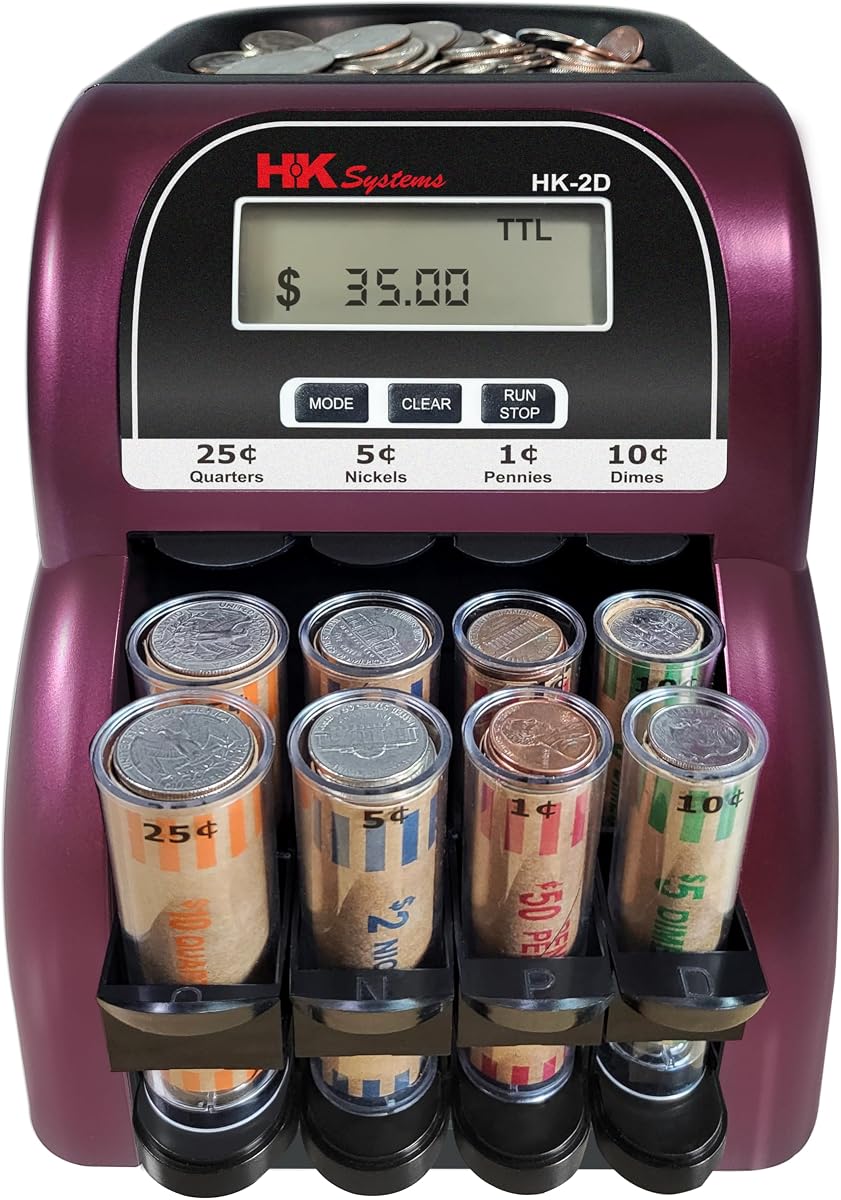
The HK Systems HK-2D is a digital U.S. coin counter and sorter with a 400-coin hopper and a stated sorting rate of up to 260 coins per minute. Its 4.0 rating places it among the solid performers in the group, and its two-row tube design gives it a distinct approach to preparing coin rolls.
We may earn a commission when you buy through this link, at no additional cost to you.
The digital display reports the value associated with each denomination as well as the total value of the coins processed. Two-row wrapper tubes support automatic rolling, and the package includes 16 wrappers split across quarters, pennies, nickels, and dimes. The machine's stated jam-free technology is intended to support consistent internal sorting during continuous operation.
Capacity is the clearest trade-off. A 400-coin hopper is much smaller than the 1,500- to 2,000-coin hoppers offered by several competitors, so large loads require more frequent refills. The accessory list also does not include dollar wrappers, even though the product is intended for U.S. coin handling. Buyers needing extensive dollar-coin rolling should verify that capability and its associated supplies.
The HK-2D is most suitable for users handling moderate batches in a space where a compact machine is valuable. It may work well behind a small counter, in a compact office, or for a business that sorts smaller amounts regularly. Those processing hundreds or thousands of coins at once will probably prefer a larger hopper and a wider set of included wrapping accessories.
The 400-coin hopper keeps the machine focused on manageable batches. While that means more frequent refills than larger models, it can be advantageous in a confined workspace where a very broad hopper or expansive collection system would be inconvenient.
The included two-row tube configuration provides a practical way to fill wrappers while the machine continues separating coins by denomination. It is a useful feature for users who want more than simple bin sorting without moving to a larger model.
We may earn a commission when you buy through this link, at no additional cost to you.
The SakerNeo Electronic Coin Counter & Sorter Machine combines a 300-coin-per-minute processing rate, a 2,000-coin hopper, and flexible collection methods. It sorts pennies, nickels, dimes, quarters, and dollar coins into individual channels. Its 4.8 rating is the highest among the products reviewed, making it a leading choice for regular commercial or organizational use.
We may earn a commission when you buy through this link, at no additional cost to you.
The LCD presents the total dollar amount, overall coin quantity, and results for each denomination. Users can review individual channels with the report function and establish batch quantities with the batch and plus/minus controls. Five removable bins support regular sorting, while included tubes offer stated capacities of 25 dollar coins, 40 quarters, 50 dimes, 40 nickels, and 50 pennies.
The machine is designed for AC 110V/60Hz power and uses 20W, so it is intended to run in a stable location with access to standard electrical service. Unrecognized coins are kept out of the five denomination results, which helps prevent false totals from unsupported pieces. Its 2,000-coin hopper and 300-per-minute rate are more substantial than the figures offered by several lower-cost alternatives.
This is a strong recommendation for retail stores, supermarkets, banks, offices, cafés, and small businesses that regularly handle loose U.S. coins. It works particularly well for users who want bins during ordinary sorting and tubes when preparing grouped rolls. Its combination of speed, capacity, reporting controls, and collection flexibility makes it one of the most complete options in the guide.
Removable bins make it easier to move a completed denomination to storage or another station. The option is valuable in a working retail environment where users may need to collect, replace, and deposit coin bins repeatedly during a shift.
Adjustable batch quantities and channel-level review make the machine more than a simple total counter. These functions can help standardize repeated processing routines, particularly where the same number of coins or denominations is collected at regular intervals.
We may earn a commission when you buy through this link, at no additional cost to you.
The Aneken Coin Counter & Sorter stands out for its 3.5-inch TFT color display and stated processing rate of up to 350 coins per minute. It supports the five most common U.S. denominations and fits up to 2,000 coins in the hopper. Its 4.1 rating reflects a capable machine with a few limitations that buyers should consider before use.
We may earn a commission when you buy through this link, at no additional cost to you.
The color screen provides an intuitive view of quantity and total value for each denomination, making it easier to read than a traditional monochrome display. Batch counts can be set from zero to 999, and the machine stops when the selected count is reached. It also powers down after 20 seconds of inactivity. An external display, wrappers, cleaning brush, replacement fuse, cord, and manual are included.
One important limitation is that the machine does not support half-dollar coins. It is specifically designed for dollar coins, quarters, dimes, nickels, and pennies. Users must also wait for the startup self-check to finish before inserting coins; adding coins too early can cause a jam. These are meaningful operating constraints for people accustomed to feeding coins immediately into a machine.
The Aneken is a good choice for a retail store, office, restaurant, vending operation, or other cash-handling environment that values a large, colorful readout and fast processing. The 350-coin rate is particularly notable, although the actual result will vary with coin condition and operating habits. It is less suitable for a business that regularly handles half-dollars.
The 3.5-inch color TFT gives users a more visually organized view of denomination quantities and totals. Color can make separate result areas easier to distinguish, which supports quick checks during busy counting sessions.
Configurable batch counts from zero to 999 can reduce the chance of a bin receiving more coins than intended. The automatic stop is useful for routine sessions where the same quantity needs to be collected repeatedly.
We may earn a commission when you buy through this link, at no additional cost to you.
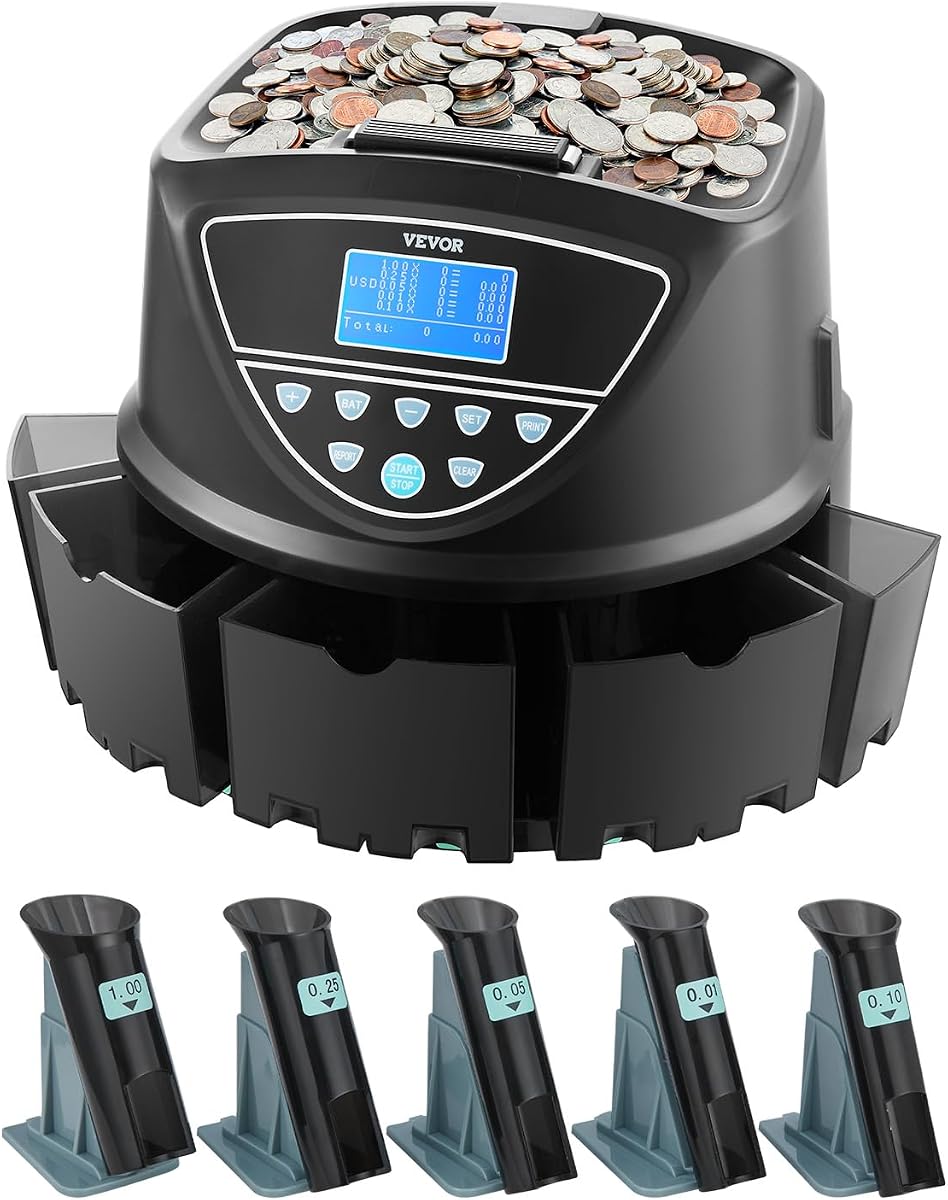
The VEVOR USD Coin Counter with LCD Display is a capable, uncomplicated machine for sorting mixed U.S. coins. It processes up to 300 coins per minute, has a 2,000-coin hopper, and separates pennies, nickels, dimes, quarters, and dollar coins. Its 4.2 rating reflects a well-rounded option for offices, retail counters, and other locations that need efficient coin handling.
We may earn a commission when you buy through this link, at no additional cost to you.
The machine comes with five coin bins and five tubes, giving users a choice between collecting loose denominations and filling wrappers. Straightforward LCD controls and physical buttons make progress easy to monitor, while the large hopper reduces the need for repeated refilling. Its stated sorting rate puts it in the same performance group as several more specialized professional models.
Coin wrappers are not included, so buyers will need to source compatible paper rolls before using the tube system. Printed reports are also absent from the listed features, although the LCD provides live count information during operation. These are sensible compromises for a design focused on speed, capacity, and uncomplicated daily use.
This VEVOR is a good match for a cash desk, office, small store, or similar setting where an easy-to-learn machine with large capacity is more important than advanced receipt functions. It can also handle users who want to begin with bins and add wrapping later. The included channels and tubes provide a flexible foundation without requiring the operator to learn a complex setup.
Five bins and five tubes offer users a simple way to switch between loose collection and wrapper filling. Having both styles available reduces the need for separate equipment when the preferred storage method changes.
The LCD and straightforward controls make the running count easy to monitor without navigating a complex menu. That simplicity is useful in environments where several employees may need to operate the machine with little instruction.
We may earn a commission when you buy through this link, at no additional cost to you.
The VEVOR Upgraded Coin Counter, Sorter, and Wrapper Machine with Handle combines a 300-coin-per-minute rate with a large 2,000-coin hopper. Its 4.0 rating reflects a capable machine whose built-in handle adds convenience for users who may need to move the equipment between work areas.
We may earn a commission when you buy through this link, at no additional cost to you.
The upgraded sorting technology is described as improving efficiency by 10%, while the LED interface and simple controls make operating status easy to check. The machine automatically fills coin packaging placed into its tube, allowing users to prepare rolls without manually loading every coin after sorting. A 2,000-coin hopper is particularly useful for larger mixed batches.
Compared with the Cassida C300, Nadex S540 Pro, and SakerNeo, the supplied information gives this VEVOR fewer details about denomination-level controls, batch settings, and specific channel capacities. It also requires compatible packaging paper for tube filling. Those omissions do not make it unsuitable, but they make it more important to review the current product instructions and verify the desired functions before buying.
The model is a sensible option for offices, cash registers, small retailers, and mobile operations that need a portable machine with a large hopper. The carrying handle makes repositioning more practical, although the machine should still be moved with care and only when powered down or otherwise safe. It is a good fit for users who prioritize capacity, speed, and straightforward packaging over advanced reporting.
The integrated handle is the defining practical feature of this model. It allows the machine to be repositioned more easily between a cash desk, storage area, office, or another workstation, provided it is handled safely and disconnected from power as required.
The combination of a 2,000-coin hopper, 300-coin-per-minute processing rate, and a readable LED interface supports a straightforward counting routine. Users can focus on loading and collecting coins without navigating extensive controls.
We may earn a commission when you buy through this link, at no additional cost to you.
The Black Three-in-One Coin Counter Sorter Wrapper Machine offers bin, tube, and DIY modes within a package designed for U.S. change. It processes 270 coins per minute, has a 500-coin hopper, and sorts pennies, nickels, dimes, quarters, and dollar coins. Its 4.9 rating is the second highest in the guide.
We may earn a commission when you buy through this link, at no additional cost to you.
The accessory package is extensive. It includes a power cord, two fuses, a user manual, 50 coin wrappers, a folding handbag, a set of tubes, and a set of bins. The report button and LCD provide denomination values and totals, while the machine pauses when a collection bin is full. The included handbag is especially notable for users who need to carry the machine or its accessories between locations.
The 500-coin hopper is smaller than those of the leading high-capacity models, which means more frequent refills during a large session. The supplied information also does not explain how unrecognized coins are handled, so buyers should check the instructions for that detail. The three-mode design is broad, but it may require more initial configuration than a single-purpose sorter.
This machine is a compelling choice for a new user who wants bins, tubes, wrappers, and carrying accessories in one package. It fits small businesses, laundromats, cafés, grocery stores, and family cash-handling routines. For a high-volume environment that will process very large loads without interruption, a 2,000-coin hopper may be more appropriate; for portability and a broad accessory bundle, this option stands out.
Bin mode, tube mode, and DIY mode let users decide how coins are collected and organized. This flexibility can make the machine more useful across different tasks, from quick daily sorting to preparing wrapped groups for storage or deposit.
Fifty wrappers, tubes, bins, spare fuses, a cord, a manual, and a folding handbag create a self-contained package. New owners can begin with the supplied components instead of immediately searching for a separate set of basic accessories.
We may earn a commission when you buy through this link, at no additional cost to you.
The right coin counter and sorter depends on how much change you process, which denominations you accept, and whether you need loose bins, standard rolls, or documented reports. Capacity, recognition features, and workflow convenience matter more than the largest stated speed number.
Most machines in this guide handle the five common U.S. denominations: pennies, nickels, dimes, quarters, and dollar coins. That coverage suits most cash-handling environments, but the Aneken explicitly does not support half-dollars. If a business regularly receives 50-cent pieces, it should verify recognition support before buying rather than assuming every machine accepts them.
Choose a model that supports every denomination found in your cash stream. Mixed-coin accuracy matters more than the number of channels if your operation rarely encounters dollar coins but frequently handles pennies.
Hopper capacity determines how many coins can be loaded before a refill is necessary. The products listed range from 400 coins in the HK Systems HK-2D to 2,000 coins in several higher-capacity models. A larger hopper reduces interruptions but requires more space and may be unnecessary for a household that only handles a small amount of change.
Match capacity to the size of typical batches. Large retail environments benefit from 1,500- to 2,000-coin hoppers, while occasional users may prefer a more compact machine with a smaller load limit.
Published processing rates range from 225 to 350 coins per minute. Faster is helpful when large mixed collections must be processed repeatedly, although the stated figure is not the only measure of real-world performance. Coin condition, consistency of denomination recognition, and operator habits can affect how smoothly a session proceeds.
Do not choose on speed alone. Accurate recognition, clear controls, and convenient collection can matter more in practice, especially for a business that handles a moderate number of coins every day.
A basic sorter sends coins into removable bins, while a wrapper machine can fill paper rolls through denomination-specific tubes. Some models support both simultaneously. The Cassida C300 emphasizes quick tube replacement, the Nadex S540 Pro allows tray and tube batching, and the LLIKED and Black Three-in-One machines arrive with broad wrapping accessory sets.
Decide whether loose collection, standard rolls, or both are central to your workflow. Check whether wrappers and tubes are included, because some machines provide compatible tubes but require the buyer to purchase coin paper separately.
An LCD screen may show denomination quantities, total value, and selected channel details. The Aneken adds a 3.5-inch color TFT display, while the Cassida C300 can connect to a separately sold thermal printer. Printed records are useful for deposit documentation, but they are not necessary for every household or small business.
Prioritize a display that is easy to read from the operator's position. Confirm whether the report function provides denomination-level detail or only an overall total, and verify the controls before committing to a more complex model.
Batch settings can stop a denomination after a selected number of coins, reducing the risk of overfilling a bin or tube. The SakerNeo offers adjustable batch quantities, the Nadex S540 Pro supports custom batch settings, and the Aneken allows settings from zero to 999. These functions are particularly useful for repeated business routines.
If your workflow involves consistent totals, batch stopping is worth prioritizing. For occasional use, free counting may be sufficient, and a more basic interface can be easier to operate.
Some coin counters are permanently positioned at a cash desk, while others need to move between a register, office, or storage area. The Black Three-in-One includes a folding handbag, and the VEVOR Upgraded Counter with Handle is designed for easier movement. Electrical requirements also matter, particularly for models that specify AC 110V/60Hz or 110V–120V operation.
Check the available counter space, outlet location, and frequency of relocation. A portable design is useful only if the machine can be carried safely and operated on a stable, level surface.
Accurate counting depends on clean recognition sensors and unobstructed coin paths. The LLIKED listing specifically recommends cleaning coins when counts are inaccurate, checking power when the machine does not start, and removing foreign objects after powering off. Users should also avoid loading coins before startup checks complete, as emphasized by the Aneken guidance.
Look for included cleaning tools, replaceable fuses, accessible instructions, and a stated support period. The Aneken includes a cleaning brush, fuse, and two-year support coverage, while the Cassida includes a one-year warranty. Routine care remains important regardless of the stated coverage.
Place the machine on a stable, level surface with adequate clearance around the hopper, display, bins, and tubes. Connect it to a suitable grounded outlet, read the startup prompts, and allow any self-check to finish before adding coins. Remove foreign objects and damaged coins from the batch, since debris or irregular pieces can reduce recognition accuracy or interrupt the sorting path.
Pour mixed coins into the hopper gradually rather than forcing a large mass into the opening. Watch the denomination totals and overall value on the display, and use the stop or pause function if something appears to be misread. When using tubes, install the correct wrapper for each denomination and set the appropriate batch quantity. Allow the machine to stop automatically before removing a filled tube.
After each session, power down and unplug the unit as directed by its manual. Use a soft, dry brush or the supplied cleaning tool to remove dust, label fragments, and residue from the sensor area and coin path. Avoid flooding openings with liquid. Store wrappers and accessories in a dry place, review the displayed total before depositing or storing the coins, and schedule periodic checks of cords, fuses, tubes, and moving parts.
Yes, the machines in this guide are designed to accept mixed common U.S. coins and sort them by denomination. Most support pennies, nickels, dimes, quarters, and dollar coins. The Aneken specifically excludes half-dollar coins, so users should confirm denomination support for any uncommon coins their business regularly handles.
A sorter separates mixed coins into labeled bins or channels so they can be counted and stored. A wrapper-capable machine also sends coins into paper rolls and can stop when a roll reaches the desired quantity. Some models support both collection methods, while others emphasize one workflow.
A larger hopper allows more coins to be processed before refilling, which is useful for high-volume batches. It does not guarantee better accuracy or better controls. A smaller machine can still be the better choice for occasional use, limited space, or a more basic sorting requirement.
It depends on the model. The Nadex S540 Pro includes 48 preformed wrappers, the LLIKED includes 50, the HK Systems includes 16, and the Black Three-in-One includes 50. The VEVOR model with five bins and five tubes does not include wrappers, so compatible coin paper must be purchased separately.
Keep the sensor and coin path free from dust, sticky residue, and foreign objects. Remove damaged or badly corroded coins before processing, and follow the machine's startup sequence before adding a batch. If totals appear incorrect, stop the count and inspect the machine rather than repeatedly feeding more coins into the hopper.
That is the primary purpose of these machines. A mixed load can be placed in the hopper, after which the machine identifies denominations and directs coins into the appropriate bins or tubes. Users should still remove obvious debris and unsupported pieces because the machine may pause or incorrectly handle an item it cannot identify.
A printed receipt can make reconciliation and deposit records easier, but it is not essential for every operation. The Cassida C300 supports a separate thermal printer, while the other featured machines rely on their displays and controls. A business should compare its recordkeeping requirements with the added convenience and accessory cost of a printing-capable model.
Models with a 2,000-coin hopper and a stated rate of 300 coins per minute are strong choices for frequent large batches. The Cassida C300, Nadex S540 Pro, SakerNeo, and two VEVOR models fall into that general performance group. The Aneken offers the highest stated rate, but its two-year support coverage and display are separate considerations from raw speed.
The Cassida C300 Professional is the strongest all-around choice for users who value fast rolling, a 2,000-coin hopper, and optional printed records. The SakerNeo stands out for its high rating, flexible bins and tubes, detailed reporting, and strong capacity, while the VEVOR Five-Denomination model offers a balanced approach for small businesses that want capable sorting at a more modest performance level.
Before buying, prioritize the features that match your actual cash-handling routine. A large hopper and high processing rate matter for heavy batches; batch controls help standardize repeated work; and included wrappers can simplify a new rolling setup. Also verify denomination support, electrical requirements, collection accessories, warranty terms, and the amount of space available at the workstation.
Product specifications, included accessories, and current purchasing terms can change over time, so readers should review the latest listing before making a final decision. Comparing the machine against the size and frequency of your coin collections is the most reliable way to avoid buying unnecessary capacity or overlooking a feature needed for wrapping, reporting, or daily operation.
This guide compares ten coin counter and sorter machines based on denomination support, processing speed, hopper capacity, display quality, wrapping functions, and ease of operation.