
SEEKONE 7.2V Cordless Mini Heat Gun
4.7Editor score
Real-time LCD temperature display
5000mAh rechargeable battery
212–932°F temperature range
Our best heat gun for 3D printing guide compares 10 models for temperature control, airflow, nozzle design, safety, and post-processing precision today.
A heat gun for 3D printing is more than a general-purpose crafting tool. It gives makers a way to smooth layer lines, soften supports, repair seams, and improve surface consistency after a model has been printed. The best results come from balancing useful airflow, adjustable heat, focused nozzles, and controls that make careful work easier.
This guide compares ten heat guns using the specifications and feature details provided for each model. It covers compact pen-style tools, full-size 1800W units, and a cordless model with a digital display. Temperature ranges, airflow modes, nozzle options, safety features, and suitability for detailed or hands-free 3D-printing tasks are the main points of comparison.
The top picks show why a digital cordless model stands out for control, why a compact 1800W heat gun offers a versatile balance, and why a focused mini tool works well for smaller budgets. Each review explains the model’s strongest features and honest limitations. Product details and availability can change, so readers should confirm current specifications and prices before buying.
4.7Editor score

4.7Editor score

4.6Editor score
The table below compares all ten heat guns by power, heat range, airflow, and practical 3D-printing features. It highlights the balance between broad full-size tools, focused mini models, and a cordless option with digital monitoring.



The SEEKONE 1800W Heat Gun Variable Temp 122℉-1202℉ for Crafts, Shrink Wrap is a versatile full-size option for makers who want meaningful control over both heat and airflow. It carries a 4.6 rating and uses a rheostat-style dial rather than a digital display, but that analog approach still provides a broad 50–650°C temperature range. Its 1800W power and dual modes make it useful beyond small 3D-printing touch-ups.
We may earn a commission when you buy through this link, at no additional cost to you.
Its strongest feature is the combination of variable temperature and separate airflow control. Mode I runs from 50–450°C with airflow of 190–210 L/min, while Mode II extends to 650°C and 250–500 L/min. That separation helps a user moderate aggressive airflow while retaining useful heat, or increase volume when working on a larger area. Four nozzles broaden the options further: a deflector creates a long narrow stream, two concentrators focus airflow, and a reflector disperses heat more evenly.
The trade-offs are modest for a full-size heat gun. There is no LCD, so the selected temperature is not displayed numerically, and the 1800W design takes more space than a pen-style tool. Some new heating elements may also produce brief smoke or odor as coatings burn off during initial use. Even so, the broad adjustment range, overload protection, and four-nozzle package give this model more flexibility than most two-setting alternatives.
This is a strong choice for a hobbyist who regularly post-processes printed parts or also uses a heat gun for shrink wrap, electronics, paint removal, and other craft projects. It is particularly useful when different prints require different levels of heat and airflow. For a maker who wants a digital display or cordless freedom, another model in this list may be more appropriate, but this option delivers an effective combination of power and analog control.
The continuous temperature dial allows gradual adjustment instead of jumping between only a few presets. This is helpful when moving from gentle surface smoothing to more intense seam repair, although the lack of a digital readout means the user must rely on experience and careful observation.
The included deflector, concentrator, and reflector nozzles let a maker change both the direction and coverage of the hot air. A concentrator suits a small seam, while the reflector is more useful when broad, even warming is needed across a printed surface.
We may earn a commission when you buy through this link, at no additional cost to you.
The SEEKONE 350W Mini Heat Gun with 2-Temp Settings 842℉ & 500℉ is a compact, approachable option for focused post-processing. Its 4.6 rating reflects a useful combination of simple dual-temperature operation, a lightweight body, and a narrow nozzle. The model is well suited to smoothing small sections, softening seams, and working around details without the size or airflow of a full-size heat gun.
We may earn a commission when you buy through this link, at no additional cost to you.
The 500°F and 842°F settings give the user a meaningful choice between gentler warming and concentrated high-temperature work. A nozzle safety shield helps protect the outlet, and built-in overheat protection is designed to interrupt power if the tool becomes too hot. The retractable stand also adds real utility: it can provide a stable resting position while the maker works with both hands or allows continuous heating without holding the tool in the air.
Its main limitation is the absence of continuously variable control. Users who need to move gradually between temperatures may find the two presets less accommodating. The 350W power level is also lower than that of the 1800W models, so it is better matched to small areas, short heating passes, and delicate 3D-printed parts than to broad surface finishing on a large model.
For beginners, occasional makers, and anyone who wants a focused tool without carrying a full-size heat gun, this is a practical selection. It is also a useful companion for repairing small printed components, particularly when the narrow nozzle makes precise application easier. Users needing broad-area heating, continuous temperature adjustment, or a digital temperature reference should look to one of the more powerful models.
The focused nozzle concentrates heat where it is needed, helping limit exposure on nearby details. That makes the tool useful for seam work and small burrs, provided the maker keeps the nozzle moving and does not hold heat on one point for too long.
The retractable stand provides a more consistent alternative to balancing the gun on an improvised support. It is especially helpful when warming a part gradually while the free hand positions, presses, or inspects the model.
We may earn a commission when you buy through this link, at no additional cost to you.
The SEEKONE 350W Mini Dual-Temp 500℉ & 842℉ for crafts is a portable pen-style heat gun aimed at detailed work. It has a 4.6 rating, a lightweight 0.83-pound body, and two airflow levels paired with 500°F and 842°F settings. The narrow format and focused reflector make it convenient for reaching confined areas or warming a small printed feature.
We may earn a commission when you buy through this link, at no additional cost to you.
At its lower setting, the tool operates at 6.5 m/s, while the higher setting raises the listed airflow speed to 11 m/s. This supports fast, concentrated work in hard-to-reach locations. The impact-resistant housing, dual-side heat-sink design, overload protection, and nozzle safety cover all contribute to its suitability as a compact workshop tool. Its four-foot-nine-inch cord also provides reasonable movement around a workbench.
The product description notes that a new coil may smoke slightly during its first use and that the nozzle can darken with heat. These are described as normal effects of the rust-resistant coating and high temperatures, but beginners should still work in a ventilated area and allow the gun to cool naturally. The two fixed settings and single reflector nozzle are less versatile than the continuous controls and four-nozzle set of the top-ranked model.
This heat gun is well matched to makers who work on small models, repair individual features, or need a lightweight secondary tool for crafts. Its quick airflow and compact shape can make repeated localized heating easier than using a full-size gun. It is less suitable for a user who needs a digital target temperature, continuous adjustment, or broad, even heating across a large printed area.
The two listed airflow speeds make it possible to choose lighter movement for careful work or stronger concentrated airflow for stubborn seams. This is particularly useful when a model has recesses or internal edges that a larger nozzle cannot reach easily.
At 0.83 pounds, the tool is light enough to maneuver with one hand. The retractable metal stand creates a stable upright position when a maker needs both hands for alignment, support removal, or surface inspection.
We may earn a commission when you buy through this link, at no additional cost to you.
The SEEKONE 1800W Compact Heat Gun 122℉-1202℉ Variable Temp for Crafting is the most balanced recommendation in this guide. Its 4.7 rating, broad 122–1202°F range, and two-speed airflow make it particularly effective for post-processing. It also uses a ceramic heating element and a body described as 20 percent smaller than traditional heat guns, combining substantial output with easier storage.
We may earn a commission when you buy through this link, at no additional cost to you.
Stepless adjustment gives the user much more freedom than a pair of fixed presets. Mode I spans 50–350°C and 300 L/min, while Mode II covers 50–650°C and 500 L/min. The higher airflow setting can move heat across a larger area, and the lower mode can be gentler on delicate surfaces. Four included nozzles allow the maker to focus, deflect, or spread the airflow according to the shape of the print.
A digital screen would make precise repeated settings easier, and 1800W is more than necessary for some delicate miniatures. The higher maximum temperature also places more responsibility on the user to keep the tool moving and monitor the material. Ceramic construction and overheat protection support durability, yet they do not replace careful handling. The compact format helps offset the size and power of a conventional full-size gun.
This is the strongest general-purpose choice for a maker who wants enough heat for seam repair and surface work without giving up detailed temperature adjustment. The four nozzles expand its usefulness for heat-shrink tubing and other craft work, while the 1800W element and two airflow modes suit larger printed models. It is our Editor’s Choice because it offers the most convincing combination of adjustment, power, accessories, and manageable size.
Separating temperature from airflow creates useful control that single-mode tools cannot provide. Lower airflow can reduce the chance of blowing a lightweight print around, while higher airflow distributes heat more effectively across a larger section.
The reduced body volume makes the 1800W model easier to store and carry than many conventional heat guns. That is valuable for a shared craft room or a mobile repair kit where every bit of bench space matters.
We may earn a commission when you buy through this link, at no additional cost to you.
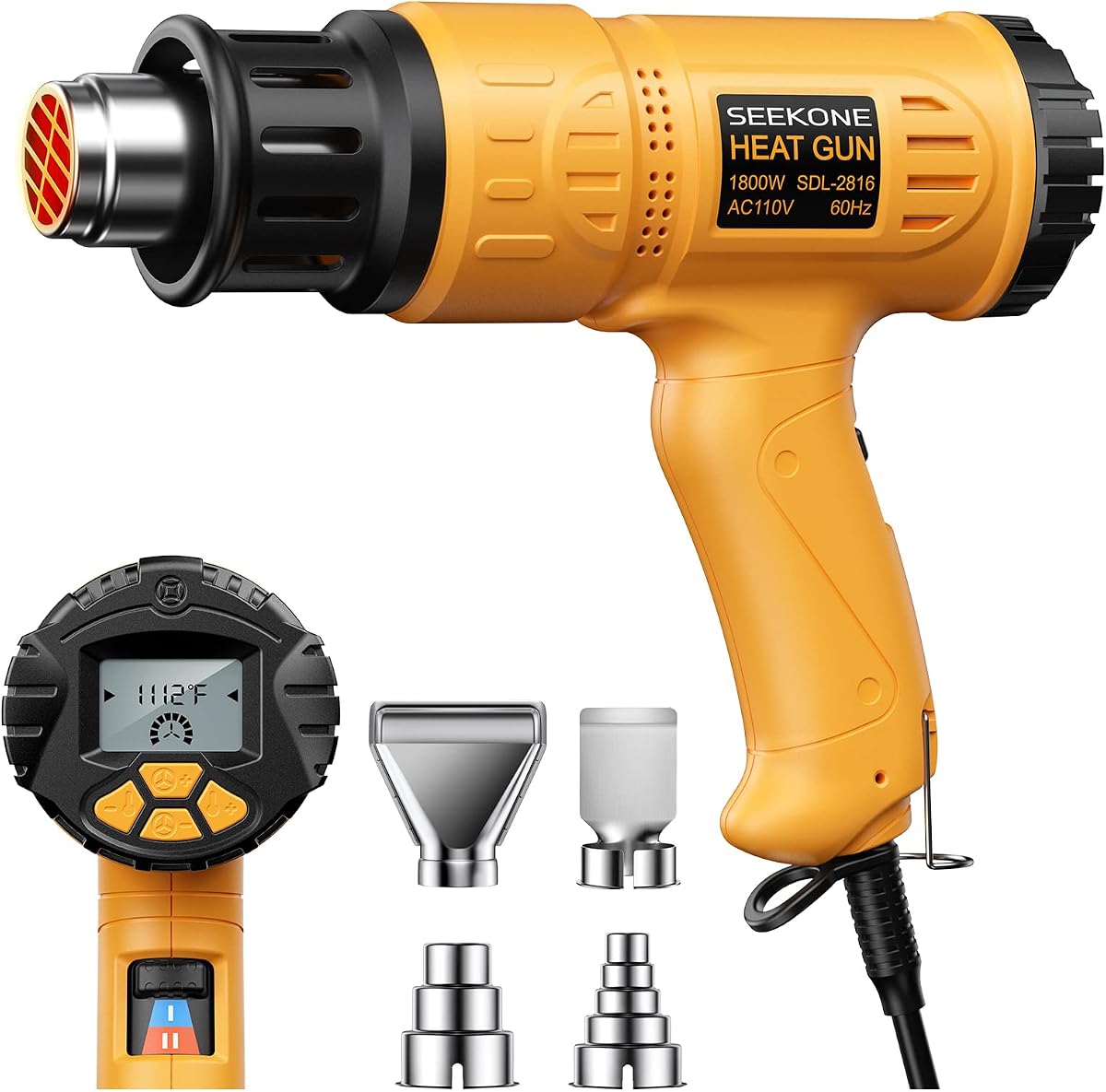
The SEEKONE Heat Gun 1800W with 1112℉&752℉ 2 Temperature Settings for Crafting is built for users who favor straightforward controls and strong airflow. It has a 4.7 rating, an 1800W rating, and two distinct settings: 752°F with 250 L/min airflow and 1112°F with 500 L/min. The separation between temperatures and air volume is simple to understand and useful for a range of craft tasks.
We may earn a commission when you buy through this link, at no additional cost to you.
Safety and handling are notable strengths. The heat gun is described as UL certified and tested for fire-resistant materials, while built-in overheat protection shuts down the heating element if necessary. Its handle has a TPE rubber exterior for grip, and the air outlet uses PA6 flame-retardant nylon composite. A built-in stand supports vertical placement, and a hanging hook simplifies storage.
Unlike continuously adjustable models, this unit provides only two temperature settings. That makes it less precise when a particular filament, adhesive, or printed feature responds differently at intermediate temperatures. There is also no digital screen. The product description warns of smoke and a burning smell during first use because the heating core has an anti-rust coating, which should be allowed to dissipate in a ventilated space.
The model is most appropriate for makers who want simple, powerful heating for seam reinforcement, general smoothing, and other craft work. Its high-output setting can handle demanding heat applications, while the lower preset gives a safer starting point. A user who needs to dial in a narrow range or monitor temperature digitally would benefit more from one of the variable-control or LCD-equipped choices.
Two operating settings reduce setup time and make the tool approachable. A maker can begin with the lower mode and move to the hotter, faster-air mode when a repair or craft job needs greater intensity.
The integrated stand lets the gun rest upright without an improvised support, while the hanging hook offers another storage option. These details are useful in a crowded workshop where a heat gun may need to be set down and retrieved frequently.
We may earn a commission when you buy through this link, at no additional cost to you.
The Mini Dual-Temp Craft Heat Gun is a general crafting solution that can also support 3D-printing post-processing. Its 4.7 rating and dual temperature-and-speed design make it appealing to users who need one tool for resin, shrink wrap, vinyl, embossing, candle making, electronics, paint drying, and other small projects. A printed model may need careful, localized heating rather than the concentrated output of a dedicated mini tool.
We may earn a commission when you buy through this link, at no additional cost to you.
The low mode is intended for delicate detail work, while the high mode supports heavy-duty or high-volume tasks. This makes the heat gun useful when the same bench is used for multiple crafts. Its compact, lightweight, insulated body is designed for comfortable handling, and the product description emphasizes quiet operation. A shield and wire stand support safer positioning and hands-free use.
The available information does not provide a numerical temperature range, wattage, or exact airflow figures. That makes it difficult to compare precise output with the other models in this guide. The physical form is also larger than a pen-style heat gun, so it may offer less access to very small or recessed areas. Makers working on tiny details should verify dimensions and nozzle clearance before committing.
This product is a good fit for a general hobbyist who wants flexible heat for many craft tasks and occasional model finishing. Its dual-mode layout, quiet operation, and included stand make it especially attractive as an all-purpose bench tool. For careful 3D-printing work that depends on an exact target temperature or a narrow nozzle, one of the models with stated temperature ranges and focused attachments may be a better fit.
The stated range of applications is unusually broad for a compact heat gun. That versatility can justify adding it to a general craft kit even when most 3D-printing tasks are handled on a separate bench.
The insulated, lightweight housing is intended to remain comfortable during extended use. Quiet operation can also make the tool more pleasant to use in a home workspace where a loud motor would be distracting.
We may earn a commission when you buy through this link, at no additional cost to you.
The SEEKONE 7.2V Cordless Mini Heat Gun 212-932℉ for Crafts, 3d printing offers the most sophisticated control arrangement in the list. It has a 4.7 rating, a 212–932°F range, and an LCD that displays the current temperature and battery status in real time. The cordless format also gives it a clear advantage when the work area is not near an outlet.
We may earn a commission when you buy through this link, at no additional cost to you.
Temperature can be set in Celsius or Fahrenheit by pressing the two buttons simultaneously, which helps users work with familiar units. The intelligent memory function restores the previous setting, reducing repetitive adjustments between tasks. A 7.2V 5000mAh battery, PD fast charging, and normal charging support repeated use. The small nozzle focuses heat on electronics, crafts, and detailed areas of printed models, while a reflector nozzle broadens the coverage.
Safety and convenience features are unusually comprehensive for a mini heat gun. A dedicated safety lock helps prevent accidental activation during storage or transport, and integrated overheat protection cuts power if internal temperatures exceed safe limits. The compact body can stand upright or lie flat, allowing hands-free heating. These features add convenience, but the 932°F maximum is lower than the 1112–1202°F reached by several 1800W models.
This is the premium selection for a maker who prioritizes visibility, cordless freedom, and repeatable settings. It is particularly useful for localized seam work, electronics-adjacent repairs, and finishing small models where a full-size gun would be cumbersome. The rechargeable battery requires planning around charging time, and highly heat-intensive jobs may still call for a higher-output corded model.
The LCD removes much of the guesswork associated with analog dials and preset-only tools. Seeing the current temperature and battery state helps a maker apply a repeatable amount of heat and recognize when the tool needs attention.
The built-in rechargeable battery allows the gun to move around a model without being restricted by a nearby outlet. This is useful on a shared workbench, at a makerspace table, or anywhere a power lead would interfere with careful finishing.
We may earn a commission when you buy through this link, at no additional cost to you.
The 380W Mini Heat Gun, 2-Temp 480°F & 850°F for DIY & Crafts is a straightforward heat gun for small jobs and 3D-printing touch-ups. Its 4.6 rating, 380W power, and two widely separated settings provide a simple way to handle both light detail work and higher-volume heating. The package includes a reflector nozzle, manual, and a bracket for hands-free placement.
We may earn a commission when you buy through this link, at no additional cost to you.
Mode I provides 480°F and 100 L/min airflow, while Mode II reaches 850°F and 500 L/min. The large airflow difference allows the low setting to be gentler around delicate details and the high setting to move more air across a broader repair. The ergonomic body is designed to reduce hand fatigue, and the four-foot-nine-inch cord gives the user some freedom to move around a work area.
The heat gun is described as UL certified and protected by an automatic overheat cutoff. Its PA6 composite shell with 30 percent glass fiber and stainless-steel outlet are intended to withstand heat, corrosion, and repeated use. As with many new heating tools, the product information warns of initial smoke and burning odor caused by the anti-rust coating on the heating core.
The model is well suited to users who want a small, uncomplicated heat gun and do not need a digital display or continuously variable temperature. It can handle resin work, embossing powders, shrink wrap, and localized 3D-print cleanup. The two fixed temperatures require more selection than a continuously adjustable gun, and the reflector nozzle favors broader heating over extremely focused streams.
The temperature and airflow changes are substantial between the two modes. This clear distinction helps a user move between careful warming and faster, broader heating without navigating a complicated control panel.
The heat-resistant composite shell and stainless-steel outlet support longevity in a frequently used workshop. These construction details complement the overload protection and make the tool suitable for regular craft and repair tasks.
We may earn a commission when you buy through this link, at no additional cost to you.
The SEEKONE 1800W Heat Gun with LCD Display 122°F-1112°F for Paint Removal is a strong choice for users who want digital confirmation of the selected temperature. It has a 4.6 rating and two digitally controlled modes. Mode I covers 120–750°F, while Mode II reaches 120–1100°F, with the display also indicating airflow and the operating temperature.
We may earn a commission when you buy through this link, at no additional cost to you.
Digital controls allow faster changes than a basic preset switch, and a long press is provided for quick adjustment. The unit can switch between Celsius and Fahrenheit by pressing the two airflow-speed buttons together. A power-on memory function restores the previous temperature and speed, which is convenient for repeated jobs using the same settings. Its 1800W power and high maximum temperature make it suitable for demanding post-processing.
The power-off delay is a thoughtful safety feature. After the switch is turned off, the fan continues running for several seconds to cool the heating element before power is cut. Overheat protection and dual heating wires support safe operation. The digital interface may feel more complex than an analog dial, and the tool’s power and broad range require careful practice around heat-sensitive materials.
This model is ideal for a serious maker who wants to repeat a temperature setting and verify it directly on the screen. It offers an effective middle ground between the fully adjustable analog tool and the cordless LCD model. The maker should still keep the nozzle moving, monitor the printed part closely, and choose the lowest effective setting to reduce the chance of softening or distorting a model.
Power-on memory is useful when a project requires multiple heating passes. Rather than resetting the tool each time, the user can return to the same temperature and airflow combination, improving repeatability between similar prints.
The delayed fan shutdown allows the internal heating element to cool before the power is disconnected. This is a thoughtful approach to component longevity and makes the shutdown process more orderly.
We may earn a commission when you buy through this link, at no additional cost to you.
The SEEKONE 1800W Heat Gun with Carry Case 122℉-1112℉ Variable Temp for Crafts is a complete kit for a maker who wants more than a basic heat gun. It has a 4.6 rating, 1800W power, and a fast stated heat-up time of 1.5 seconds. The package adds a compact carry case, five nozzles, a putty knife, and a handheld scraper.
We may earn a commission when you buy through this link, at no additional cost to you.
Two operating modes offer different levels of intensity. Mode I runs from 120–840°F with airflow of 190–210 L/min, while Mode II spans 120–1112°F and raises airflow to 250–500 L/min. Five interchangeable nozzles allow the user to redirect, focus, or broaden the hot air. For 3D printing, the putty knife and scraper also support common post-processing tasks such as removing residue, shaping edges, or lifting softened material.
The carry case is a notable advantage for portable or organized workflows. It keeps the heat gun and its many attachments together, reducing the chance of losing a small nozzle. On the other hand, buyers who only need localized smoothing may find that the accessory assortment adds more complexity than they will use. The tool also relies on analog controls and does not display the current temperature numerically.
This kit is best for a dedicated hobbyist, educator, or repair technician who expects to use a heat gun across several tasks. The broad accessory set supports shrinking, wrapping, electronics, paint removal, and print finishing, while the case makes storage straightforward. A user seeking only a lightweight, focused tool can find a simpler alternative in the guide.
The putty knife and handheld scraper extend the heat gun’s usefulness beyond heating alone. They can assist with residue removal and light shaping, making the package more relevant to a multi-stage 3D-printing workflow.
The compact case protects the main tool and keeps the five nozzle styles together. It is a practical choice for a makerspace locker, mobile repair kit, or home workshop where small accessories are easy to misplace.
We may earn a commission when you buy through this link, at no additional cost to you.
The right heat gun for 3D printing depends on the size of your models, the level of control you need, and whether you also use the tool for crafts or repairs. Consider temperature, airflow, nozzle focus, safety, and power before choosing.
For 3D printing, prioritize enough range to warm a model without pushing it beyond what the material can tolerate. Fine control matters more than simply reaching the highest possible temperature.
Choose independent airflow control when you will work on different geometries, and remember that lower airflow is often the safer starting point for delicate prints.
For detailed finishing, prioritize a concentrator; for broad surface work, a reflector is usually more useful. More included nozzles add flexibility, not automatically better performance.
Choose full-size power for larger parts and repeated jobs, and choose a mini model when precision, portability, and lower heat output are the main priorities.
A display is valuable for repeatable work and tight control, while an analog dial can provide a simpler and more tactile experience. Verify that the information shown matches the type of adjustment you prefer.
Look for a real overheat cutoff, a stable stand, and a housing that remains comfortable to hold. Never rely on automatic protection as a substitute for keeping the airflow open and the nozzle moving.
Consider the entire kit, not only the main tool. Include accessories that you will actually use, and favor a case or stand if it improves storage and setup at the bench.
A versatile kit can be worthwhile for a multi-craft workspace, but 3D-printing performance should remain the deciding factor. Select controls and accessories that support the finishes you actually make.
Begin with a clean, dry printed part on a heat-resistant surface. Remove loose debris with a suitable tool, identify the areas that need smoothing or bonding, and begin at the lowest useful setting. Keep the nozzle moving and maintain a sensible distance; concentrated heat left in one place can soften a model, soften support interfaces, or cause the part to deform.
Use a concentrator nozzle for seams and small corrections, and a reflector nozzle for broader surface work. Move the tool in steady passes rather than holding it over the same region. Test a hidden edge or an area where damage would be acceptable before treating a visible face, and allow the part to cool before checking whether the layer lines have become smoother or the joint has bonded.
After use, switch the heat gun off and let it cool according to its instructions. Models with a delayed fan-off function should remain powered during the cooling interval. Store the tool on its stand or in its case, keep the air outlet clear, and wipe away residue from the nozzle only after it has cooled. For cordless models, check the battery display and recharge the unit before the next job.
Yes. Moving hot air over a print can soften the outer layer slightly, reduce the visibility of layer lines, and help small burrs or seams settle into a smoother surface. The result depends on the material and the model’s geometry, so users should test a small area and avoid holding the heat gun in one place. A concentrated nozzle gives more localized control than a broad reflector.
It can, because many common filaments soften when exposed to sufficient heat. Warping and slumping are most likely when the heat is concentrated, the airflow is strong, or the part is thin or unsupported. Start with a lower setting, keep the nozzle moving, and watch the model continuously during the first test.
The suitable temperature depends on the filament, geometry, and task. Gentle surface work may require less heat than seam reinforcement, and broad surfaces usually need more airflow than a small joint. Start conservatively, increase the setting gradually, and use the lowest temperature that produces the desired result.
A mini heat gun is usually easier to control for small parts, seams, and recessed details because it is lighter and often produces a focused stream. A full-size 1800W model offers faster recovery, broader airflow, and more heat for larger objects. The best choice depends on the scale and frequency of the post-processing work.
A digital display is helpful but not essential. It makes the selected temperature easier to see, supports unit conversion, and helps a user repeat a successful setting. Analog controls can still work well when the maker understands the tool and watches the model closely, while dual-setting tools are most convenient for straightforward, repeatable jobs.
A concentrator nozzle is best for small seams, edges, and isolated layer lines because it limits the heated area. A reflector nozzle is more appropriate when the goal is to warm a wider surface evenly. Whichever nozzle is used, moving the heat gun continuously is important because a stationary hot-air stream can damage the print.
Several products in this guide describe an anti-rust coating on the heating core that may smoke or produce a burning odor as it is heated for the first time. The listed instructions identify this as normal, but first use should still take place in a ventilated area. Stop using the tool if smoke persists after the coating has warmed or if any other warning sign appears.
Yes. Heat guns are also commonly used for shrink wrap, vinyl, embossing powders, resin, electronics, paint removal, and thawing. A model with multiple temperatures, airflow modes, and interchangeable nozzles is generally the most adaptable, while a small focused gun may be better kept exclusively for detailed 3D-print finishing.
The SEEKONE 1800W Compact stands out as the best overall choice because it combines stepless temperature adjustment, two airflow modes, 1800W output, and four nozzles in a relatively manageable body. The SEEKONE Cordless Mini Heat Gun is the premium option for makers who value a real-time display, rechargeable freedom, and repeatable settings. The SEEKONE 350W Mini provides a focused and approachable budget solution for smaller repairs.
The right priority depends on the work. Larger prints and repeated seam work favor a high-output full-size gun, while small details and tight spaces benefit from a light mini tool. A concentrator nozzle, a stable stand, and overheat protection are particularly useful, but the maker should also pay attention to whether the control system is simple, digital, or continuously adjustable.
Before purchasing, verify the current specifications, included accessories, dimensions, and compatibility with your workflow. Product configurations, ratings, availability, and prices can change, so checking the current listing is the best way to confirm that the selected heat gun still matches your particular 3D-printing needs.