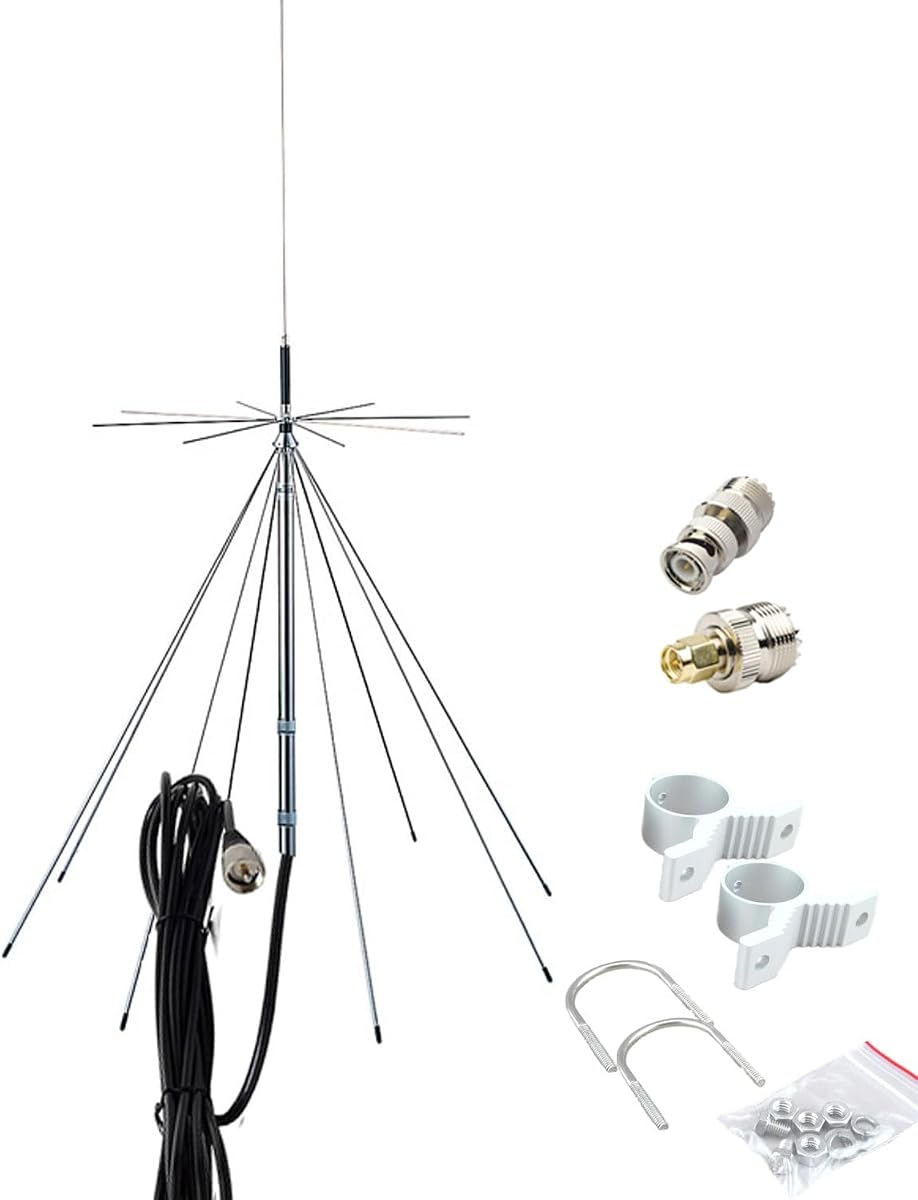
Discone Antennas D3000
4.7Editor score
Ultra-wideband 25-3000 MHz
Receive and transmit support
Multiple connector adapters
Ten-meter RG58 cable
Our Base Station Scanner Antenna guide compares ten wideband, discone, magnetic-base, and dual-band options for scanners, SDR, ham radio, two-way communication.
A base station scanner antenna determines which signals your radio can hear, how cleanly those signals arrive, and whether a new setup feels like an upgrade. A worthwhile antenna should cover the frequencies you monitor, match your radio’s connector, fit your location, and remain securely mounted without becoming unnecessarily complicated.
The products in this guide were compared using their documented frequency coverage, gain, impedance, mounting options, connector types, transmission capability, physical construction, and included accessories. The list includes permanent outdoor discone antennas, portable magnetic-base models, telescopic units, and a dedicated dual-band base antenna.
Each review explains the antenna’s strongest benefits, practical limitations, and ideal user so you can judge more than the headline specification. Ratings and specifications can change, and current prices, availability, promotions, and retailer policies should always be checked before purchasing.
4.7Editor score
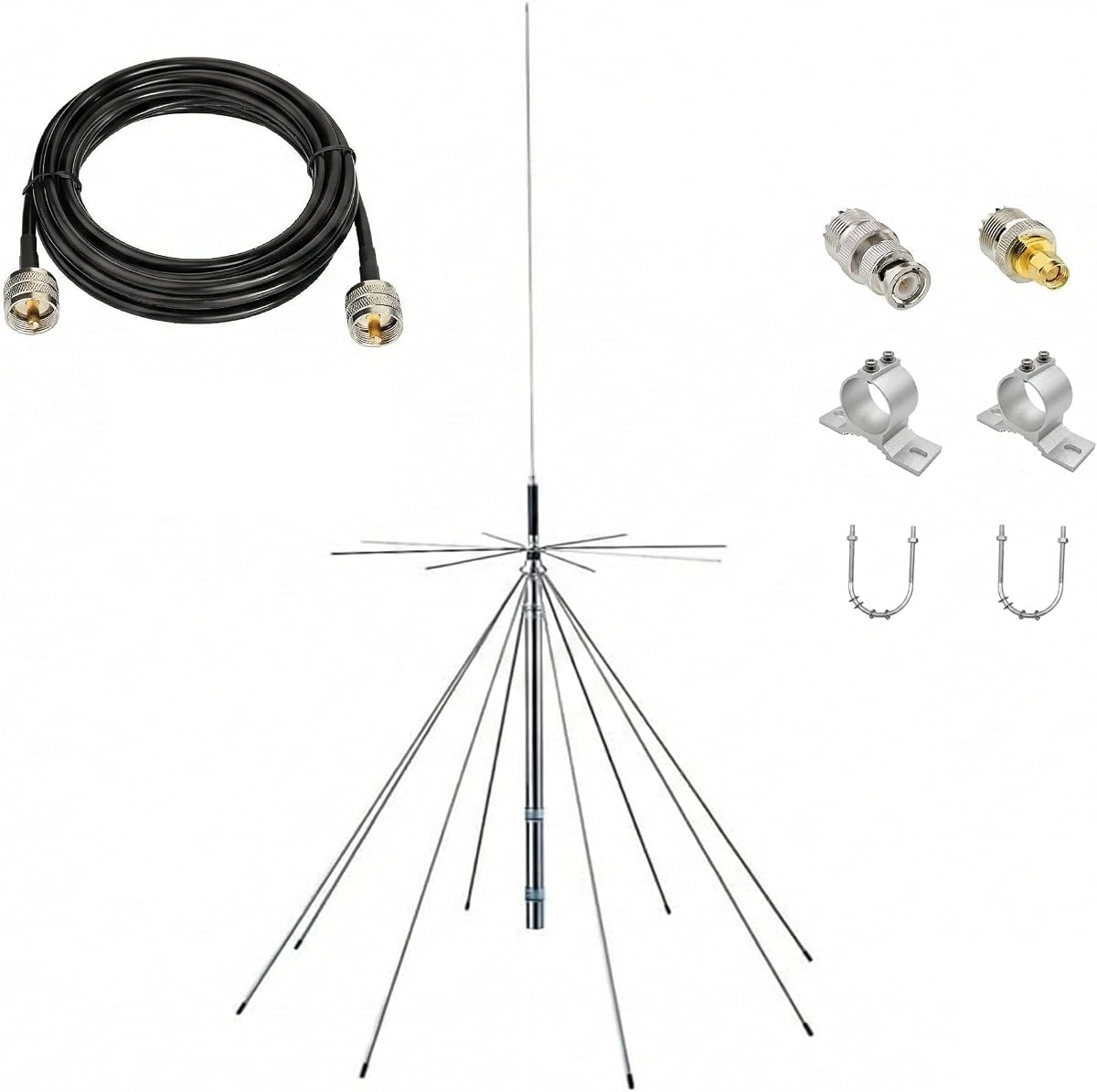
5.0Editor score

4.6Editor score
The table below highlights the principal differences in frequency range, installation style, gain, and mounting approach. It provides a quick way to separate permanent wideband systems from portable magnetic-base antennas and a dedicated dual-band base model.


The Discone Antennas D3000 is a wideband discone design intended for scanner, SDR, amateur radio, CB, air-band, and two-way-radio reception, with additional transmit support. Its 4.7 rating reflects a strong overall reception-oriented feature set, particularly the unusually broad 25-3000 MHz range. For users who monitor many unrelated services, it offers a more flexible starting point than an antenna limited to conventional VHF and UHF scanner bands.
We may earn a commission when you buy through this link, at no additional cost to you.
The supplied package includes ten meters of RG58 coaxial cable with a PL-259/SO-239 connector, along with BNC and SMA male adapters. That connector selection is useful because scanner and SDR equipment does not always use the same fitting. Installation can take place on a balcony railing, roof, or mast, and the top loading coil may be removed when reception of the 25-50 MHz portion is unnecessary, allowing a smaller and lighter configuration.
The main trade-off is complexity. A full discone assembly has more components than a compact magnetic-base antenna, so placement and weatherproofing require care. Its receive-and-transmit description should not be taken as a blanket promise of equal performance or suitability on every amateur band. Users who transmit need to verify their radio’s output, operating band, connector, and local licensing conditions before connecting the antenna.
This antenna best suits a versatile home listening station covering HF through the upper 3000 MHz range. It is particularly compelling for someone adding multiple radio interests without replacing one antenna whenever a new service is introduced. For a single narrow band or occasional portable setup, a simpler whip may be easier to justify, but for broad-spectrum monitoring this is among the most capable options in the guide.
The 25-3000 MHz range is the D3000’s defining advantage. It can cover shortwave-adjacent HF, VHF, UHF, FM, GMRS, aviation-band, and higher-frequency reception, reducing the need for separate antennas when monitoring interests span widely separated services.
The long RG58 run provides room between the antenna and radio, while the included BNC and SMA adapters make it easier to integrate with popular scanners and SDR equipment. Balcony, roof, and mast mounting options also accommodate both apartments and detached homes.
We may earn a commission when you buy through this link, at no additional cost to you.
The Tram 300-Watt Broad-Band Scanner is a traditional outdoor super-discone antenna for receiving from 25 MHz through 1300 MHz. Its 4.6 rating and well-defined construction details make it a practical all-purpose choice for scanner operators, CB users, and amateur-radio listeners. The design supports up to 300 watts in general and 200 watts for CB use, subject to appropriate equipment and operating conditions.
We may earn a commission when you buy through this link, at no additional cost to you.
The antenna lists transmit bands at 26, 27, 46, 49, 72, 144, 220, 440, 900, and 1290 MHz. For reception, the full 25-1300 MHz range is much broader than a conventional scanner antenna. A stainless steel structure helps resist corrosion, while the advertised SWR below 1.5:1 offers a strong technical foundation for both receiving and transmitting installations.
The physical layout is substantial. It uses six lower radials measuring 32 inches, two adjustable lower radials measuring 48 to 53 inches, eight 10.5-inch upper radials, and a 55-inch top whip. Buyers must provide a compatible mast with a maximum diameter of 1-3/8 inches. That requirement makes it less convenient for a temporary desktop arrangement but well suited to a rooftop or yard installation.
This is a strong recommendation for listeners who want a dependable outdoor base antenna without chasing the upper end of the 3000 MHz range. It is particularly useful for CB, VHF, UHF, and general scanner work. Those whose primary interest extends through aviation or other services near the top of the spectrum should compare its 1300 MHz limit with the wider alternatives before finalizing a purchase.
The stainless steel components and documented SWR make the Tram a sensible permanent base choice. Its adjustable radials add some installation flexibility, but the mast-mounted design is intended to be assembled and positioned rather than moved constantly.
The listed transmit bands allow the antenna to serve more than receive-only scanning. Users should still confirm the exact band, radio output, connector, and local transmission rules because broad frequency support does not guarantee identical performance everywhere.
We may earn a commission when you buy through this link, at no additional cost to you.
The Scanner Antenna with Tripod combines a 25-1300 MHz discone-style antenna with a portable stainless steel tripod, offering a practical middle ground between a desk whip and a permanent mast system. No customer rating is available, so the documented specifications are the best basis for evaluation. Its stated 3.5 dBi gain, omnidirectional pattern, and receiving or transmitting support are relevant for home base-station monitoring.
We may earn a commission when you buy through this link, at no additional cost to you.
The package includes the discone antenna, ten meters of coaxial cable, a stainless steel portable tripod, an instruction manual, and PL-259, UHF, and SMA connectors. That is a comparatively complete setup for users who want height without immediately installing a permanent roof or tower mount. The tripod also makes the antenna easier to reposition when comparing locations around a home or vehicle.
The primary limitation is that the antenna does not extend into the 1300-3000 MHz range covered by the most expansive models. Its suitability also depends on securing the tripod safely, particularly on uneven ground or exposed locations. Although the product is described as compact and lightweight, outdoor exposure can create wind load and corrosion concerns that a permanent installation must address.
This setup is ideal for a new scanner user who wants more height and a full cable without committing to a rooftop mast. It can also suit a portable or semi-permanent base station. Buyers seeking aviation-band monitoring at the extreme upper end, or a product with an established customer-rating history, should examine the wider and more reviewed alternatives.
The included tripod allows immediate elevation above furniture and nearby obstructions. It is especially useful for testing whether added height improves reception before committing to a more permanent installation.
Ten meters of RG58 provides ample distance between the antenna and radio, while several connector choices improve compatibility. The user still needs to confirm the radio’s connector and weatherproof any exposed connections appropriately.
We may earn a commission when you buy through this link, at no additional cost to you.
The D3000N Discone Scanner Antenna is a wideband outdoor system rated 5.0 by customers and designed to cover 25-3000 MHz. It combines an omnidirectional receiving pattern with support for transmission on 50-1200 MHz and up to 200 watts above 144 MHz. That combination makes it a leading option for a home scanner or SDR station that wants broad reception without abandoning occasional amateur-radio use.
We may earn a commission when you buy through this link, at no additional cost to you.
Its 1.7-meter format is relatively compact for such extensive frequency coverage, which helps when the antenna must be installed on an apartment balcony or a relatively modest roof mast. The stainless steel construction is intended to resist corrosion, while the bracket, support pipe, V-bolts, connector, cable, hex wrench, and manual create a well-rounded installation package.
Assembly requires attention because the disk-element rods must be installed after the radial rods. The upper frequency range and transmit claims also need to be interpreted carefully: usable performance depends on the band, radio, connector, installation, and regulatory limits. This is not a blanket permission to operate at any power across every listed frequency.
The D3000N is a strong overall recommendation for a permanent wideband base station. It offers especially strong value for users who want both upper-frequency reception and some transmit capability in one package. A buyer who only needs local VHF/UHF reception can find a smaller magnetic-base option, but this model is better aligned with an expanding, multi-service listening setup.
The 25-3000 MHz range covers conventional scanner bands, amateur and GMRS frequencies, aviation-band signals, and higher-frequency services. At 1.7 meters, it is easier to accommodate than a large conventional discone arrangement.
The included support pipe, bracket, V-bolts, cable, connector, and tools reduce the need for separate purchases. Buyers still need a suitable mast, secure attachment point, and thoughtful cable routing to keep connections protected.
We may earn a commission when you buy through this link, at no additional cost to you.
The Outdoor Indoor Police Scanner Antenna offers 25-3000 MHz coverage in a compact ground-plane configuration designed for desktop, window, vehicle, and temporary outdoor placement. Its 4.0 rating reflects a useful balance of broad frequency support, portability, and included accessories. The specification sheet identifies 3.5 dBi gain, VSWR below 2.0, linear vertical polarization, 50-ohm impedance, and omnidirectional coverage.
We may earn a commission when you buy through this link, at no additional cost to you.
Two whip choices help match the antenna to a priority band. The 12-centimeter short whip is intended for UHF reception around 400-470 MHz, while the 15-centimeter long whip covers VHF around 136-174 MHz. A 9-centimeter magnetic base and 16.4-foot RG58 cable make it possible to place the radio and antenna separately, while the SO-239 connection and BNC and SMA adapters broaden device compatibility.
The magnetic base is convenient but inherently less secure than a bolted mast or tripod. A vehicle roof or metal shelf may work well, but high winds, vibration, or a smooth surface can undermine the placement. The listed VSWR is also less tightly specified than the sub-1.5 figures advertised by some discone models, so users focused on transmitting should investigate their particular band carefully.
This antenna is a good fit for listeners who want one compact assembly to cover many services, especially where a permanent roof installation is impractical. It also works well for travel, provided the mounting surface is secure. Users who plan to transmit regularly or need a fixed year-round base may be better served by a sturdier mast-mounted discone.
Selecting the long or short whip allows the user to emphasize VHF or UHF reception. This makes the package practical for public safety listening, GMRS, two-way radio, and general scanner work without carrying multiple complete antennas.
The magnetic base and long cable make it easy to compare indoor and outdoor locations. For best results, use a stable metal surface, keep the cable supported, and avoid placing the antenna beside obvious sources of electrical interference.
We may earn a commission when you buy through this link, at no additional cost to you.
The 2m 70cm GMRS Antenna is a portable ground-plane antenna with a stated 25-3000 MHz reception range and transmission support on the 2-meter and 70-centimeter amateur bands. Its 4.5 rating suggests a generally well-received balance of capabilities, especially for users who want one small antenna to cover scanner, SDR, air-band, CB, GMRS, and two-way-radio applications.
We may earn a commission when you buy through this link, at no additional cost to you.
A long whip can be selected for 136-174 MHz VHF reception, while a short whip supports 400-470 MHz UHF reception. The ground-plane radials are intended to improve signal behavior, and the 9-centimeter magnetic base makes the antenna straightforward to use on a desk, shelf, vehicle, or other convenient metal surface. The five-meter RG58 cable is terminated with BNC, SMA, and SO-239 connector options.
The product information is less complete than that of some competitors. It does not provide a specific gain figure, VSWR value, or detailed environmental rating, so users cannot compare those electrical parameters from the supplied information alone. Its small whip also means the claimed upper-frequency reception should not be confused with the performance of a full-size discone.
This antenna is a compelling choice for a portable or temporary station that already has a strong preference for VHF/UHF and occasionally needs 2m or 70cm transmission. It also fits users who need a single inexpensive-format package for several radio types. A fixed base station with demanding reception requirements would benefit from a larger discone with more detailed electrical specifications.
The wide receive range covers common scanner, air-band, GMRS, and other frequencies, while documented 2m and 70cm transmit support makes the antenna more versatile than a receive-only magnetic whip.
The magnetic base and 16.4-foot cable separate the antenna from the radio, making it easy to place the radio at a desk and the antenna near a window or outside. Always confirm that the mounting surface is secure and conductive.
We may earn a commission when you buy through this link, at no additional cost to you.
The Bingfu 20-1300MHz Police Scanner Antenna is a magnetic-base antenna aimed particularly at owners of popular Uniden, Whistler, and Radio Shack scanners. Its 4.2 rating indicates a solid reception-oriented product with broad compatibility. The documented 20-1300 MHz range, 50-ohm impedance, VSWR below 2.0, 10-foot cable, and BNC male connection cover the main needs of a straightforward home listening station.
We may earn a commission when you buy through this link, at no additional cost to you.
One of its strongest practical features is the extensive compatibility list. It names scanners including the Uniden BC125AT, BCD436HP, BC75XLT, BCD996P2, BC780XLT, and numerous BC-series models, as well as Whistler WS1040, WS1088, WS1010, TRX1, and TRX2 radios. The list also covers many Radio Shack PRO-series scanners and common handheld amateur radios.
The magnetic base is convenient, and the three-meter cable gives enough separation to place the antenna near a window or on a higher surface. However, the antenna is primarily a compact whip rather than a full discone, so reception performance and potential transmit behavior will vary more noticeably across the advertised range. Users should not assume it can replace a dedicated high-gain transmitting antenna.
This is a good recommendation for a scanner owner who wants an easy-to-place upgrade and can use a BNC-equipped radio or adapter. It is less appropriate for aviation services above 1300 MHz or for users who require stronger, more uniform wideband reception. In those cases, one of the 25-3000 MHz discone systems offers a better fit.
The unusually detailed model list reduces uncertainty when buying for an established scanner. Checking the exact radio model and connector remains important, especially when using an adapter or a device not explicitly listed.
The magnetic mount allows rapid movement between indoor and outdoor positions, which is useful for finding a location with less interference. Keep the base flat, and route the coax away from power cables and metal obstructions.
We may earn a commission when you buy through this link, at no additional cost to you.
The Bingfu VHF UHF Scanner Antenna is a compact magnetic-base model for public-safety scanners, amateur radio, two-way radios, and mobile-radio use. It carries a 4.1 rating and shares the same fundamental 20-1300 MHz range, 50-ohm impedance, VSWR below 2.0, three-meter cable, and BNC male connection as the other Bingfu model in this roundup.
We may earn a commission when you buy through this link, at no additional cost to you.
Compatibility is the main attraction. The documentation lists numerous Uniden scanners, including the SR30C, BC125AT, BCD436HP, BC75XLT, BCD996P2, BC780XLT, and other BC-series units. It also identifies Whistler WS1040, WS1088, WS1010, TRX1, and TRX2 models, along with Radio Shack PRO-series scanners and many handheld transceivers from Icom, Motorola, Maxon, Vertex Standard, and Uniden.
The supplied information includes a note advising buyers to check local digital-spectrum regulations before using the full frequency range. That is an important distinction for a product whose broad bandwidth could tempt users to treat it as suitable for every possible transmission purpose. The product is better understood as a versatile receiving and general-purpose antenna than as a specialized high-power base-station system.
This antenna is best for a straightforward scanner setup, especially when a compact magnetic whip is preferred over a large discone. It can also support amateur-radio listening and compatible two-way equipment. Buyers should compare it with the nearly identical 20-1300 MHz Bingfu option based on current availability and connector needs rather than assuming there is a major technical distinction.
The small magnetic whip and three-meter lead are easy to deploy around a desk, radio room, or vehicle. Although the upper limit is 1300 MHz, the lower coverage includes widely used HF, VHF, and UHF scanner services.
Confirm that the radio uses a compatible BNC connection and that intended frequencies are legal in the area. The broad specification should not be interpreted as authorization or guaranteed performance for every transmitting service.
We may earn a commission when you buy through this link, at no additional cost to you.
The Wide Band Telescopic Antenna Set is designed for portable VHF, UHF, GMRS, two-way-radio, and RTL-SDR use. It has a 5.0 rating and provides reception from 95 to 1100 MHz, with 2.15 dBi gain from 95-300 MHz and 3.2 dBi from 300-1100 MHz. The folding and telescoping construction makes it visually and physically more adaptable than a permanently assembled discone.
We may earn a commission when you buy through this link, at no additional cost to you.
The package includes the telescopic antenna, a BNC female-to-PL-259 adapter, a BNC female-to-SMA male connector, and a magnetic base with a three-meter cable and BNC male connection. The main antenna uses a BNC male connector. It supports reception throughout the stated range and documented transmission on 144 and 430 MHz, along with GMRS and reception of 1090 and 978 MHz aviation ADS-B signals.
Maximum input power is limited to 10 watts, making this unsuitable for a high-output amateur transmitter or repeater setup. It also omits the 25-95 MHz portion covered by several discone products, so listeners focused on shortwave or lower HF will need another antenna. The 44.5-centimeter extended length and 29-gram weight are nevertheless helpful for travel and temporary installations.
This is an excellent choice for an RTL-SDR user, portable radio listener, or traveler who wants a broad receiving antenna without carrying a large mast assembly. It is less appropriate as a permanent high-power base antenna. Its top-listed rating, included adapters, and easy folding design nevertheless make it a particularly approachable option for a new scanner or SDR setup.
The antenna folds down and its tip telescopes, allowing the user to alter its physical length and pack it more easily. Those traits make it useful for testing a hotel, field location, or temporary indoor listening position.
The stated 95-1100 MHz range supports common amateur, GMRS, and SDR use, including reception of 978 and 1090 MHz ADS-B signals. The 10W input ceiling is the decisive limitation for anyone considering more powerful transmission.
We may earn a commission when you buy through this link, at no additional cost to you.
The 144/430MHz Fiberglass Omni Base Station Antenna is a dedicated dual-band vertical for 2-meter and 70-centimeter amateur radio. Unlike the wideband discone and magnetic-base products, it concentrates its design on two frequency ranges, offering 4.5 dBi gain on VHF and 7.2 dBi gain on UHF. It is therefore better viewed as a high-performance dual-band base antenna than a general scanner antenna.
We may earn a commission when you buy through this link, at no additional cost to you.
The 200-watt power rating supports higher-output transceivers, and the 50-ohm impedance, SWR below 1.5, and SO-239 connector align with common amateur-radio installations. Its fiberglass radome and copper radiating element are described as weather resistant and corrosion resistant, making it suitable for a permanent mast where the environment may be harsh, including shoreline locations.
The antenna reaches 67 inches when assembled and uses a two-section design for storage and installation. It can attach to a mast or pipe with a diameter between 30 and 62 millimeters using the included aluminum-alloy U-bolts. Since the coverage stops at 144 and 430 MHz, it cannot replace a scanner antenna for public safety, aviation, GMRS, FM, or many other frequencies outside those two bands.
This model is the right choice for an amateur-radio operator seeking reliable 2m and 70cm omnidirectional coverage from a fixed base. It is not a general answer for the keyword’s broader monitoring audience. Among the products here, it offers the clearest high-gain, higher-power alternative for users who can sacrifice wideband reception for focused dual-band operation.
By concentrating on 144 and 430 MHz, the antenna can provide stronger directional performance than a compact broadband whip. The 4.5 dBi VHF and 7.2 dBi UHF figures make it more appropriate for repeater, mobile-radio, and transceivers than receive-only scanning.
The fiberglass body and copper element are designed for outdoor exposure, while the two-section construction simplifies handling. The supplied U-bolts fit a range of mast sizes, but the installer must provide a secure mast and suitable roof or wall support.
We may earn a commission when you buy through this link, at no additional cost to you.
The right antenna depends on the services you monitor, the equipment you use, the power available at the location, and how permanent the installation should be. Compare electrical specifications and physical mounting requirements together rather than focusing on a single headline frequency number.
Begin with the lowest and highest frequencies you expect to monitor. Wideband scanner antennas in this guide range from 20 or 25 MHz to either 1100, 1300, or 3000 MHz. The 3000 MHz models can include aviation-band and other upper-frequency services, while the 1300 MHz models are sufficient for many conventional VHF and UHF listening. The dedicated 144/430 MHz antenna is only appropriate if your interest is concentrated in 2m and 70cm amateur bands.
A receive-only scanner antenna has one job, while a transmit-capable model must also handle radio output, impedance, standing-wave ratio, and frequency-specific loading. Several discone products list transmit bands, and the Bingfu telescopes set states a 10-watt maximum. The dedicated fiberglass antenna is rated for 200 watts. Do not assume that a broad receive range automatically makes an antenna efficient or legally usable as a transmitting antenna on every band.
The connector on the radio must match the antenna or require an appropriate adapter. BNC is common among the magnetic-base scanner antennas, while discone systems frequently use SO-239/PL-259, with BNC and SMA adapters included in some packages. Check the connector gender as well as the type. Cable length also matters: a longer RG58 run offers placement flexibility, but proper strain relief, supported routing, and protected connections are more important than adding unnecessary length.
A 50-ohm impedance is standard for the listed equipment, and the products described as 50-ohm systems fit that expectation. Gain figures vary by design, with the compact magnetic models commonly around 3.5 dBi, the telescopic set ranging from 2.15 to 3.2 dBi, and the dedicated dual-band fiberglass antenna offering 4.5 dBi on VHF and 7.2 dBi on UHF. VSWR below 1.5 is more precise than a figure below 2.0, but actual results also depend on mounting environment and nearby objects.
A mast, roof, tripod, or balcony arrangement is more appropriate for a fixed listening station, while a magnetic base is ideal for testing locations, vehicles, and temporary setups. Permanent installations need secure structural support, weather protection, and cable strain relief. Magnetic bases demand a clean, conductive surface and can suffer from wind or vibration. A tripod raises the antenna conveniently but must still be weighted or secured on exposed ground.
Full discone antennas require assembly and adequate clearance around their radials. The D3000N is described as 1.7 meters tall, the Tram uses a 55-inch top whip plus multiple radial elements, and the fiberglass dual-band antenna stands 67 inches when assembled. Magnetic-base whips need far less room but may not provide the same reception environment. Measure the installation area, including overhead and side clearance, before choosing a permanent model.
A balcony or indoor magnetic base can be the realistic starting point for apartment users. High placement is important because walls, floors, appliances, and furniture can attenuate or reflect radio signals. The supplied D3000 information specifically identifies balcony railing, roof, and mast locations. Users in rental housing should avoid permanent modifications without permission and should choose a removable base or a method that does not damage the structure.
Antennas with a support pipe, mast bracket, V-bolts, coax, adapters, tools, and instructions can simplify setup considerably. The D3000N and tripod model are especially complete in this respect. Magnetic-base packages often provide a cable and several radio adapters. Compare the full package rather than assuming every similarly named antenna includes the same mast, connector, or mounting hardware.
Before assembly, compare the antenna parts with the included manual, identify the radio’s connector, and plan the final cable route. For a discone system, install the lower radials and disk elements in the specified order, then attach the top section. Mount the antenna as high as practical, away from metal gutters, roof edges, chimneys, power lines, and dense trees. A magnetic-base model requires a flat, clean, conductive surface with enough room for the whip and cable.
Connect the appropriate adapter after routing the coax, and provide strain relief so the connector does not carry the cable’s weight. Keep exposed joints dry and use weather protection approved for outdoor electrical connections. For a tripod, secure it against wind. For a mast-mounted antenna, confirm that the mast, brackets, and roof attachment are mechanically sound. Do not transmit until the intended band and system have been checked with suitable test equipment.
Inspect the antenna periodically for loose elements, corrosion, damaged insulation, bent radials, and connector contamination. Tighten accessible hardware without over-stressing thin metal elements. Clean the magnetic base and mounting surface to preserve its attachment. Keep the coax away from sharp edges and avoid repeated bending at the connector. If reception changes unexpectedly, compare performance at a known location and inspect the cable and connections before adjusting the radio’s settings.
A discone uses several radial elements and a vertical whip to cover a broad frequency range, making it better suited to permanent outdoor mounting. A magnetic-base antenna is generally smaller, simpler, and intended for quick placement on a vehicle, shelf, or other metal surface. The discone generally offers more installation flexibility, while the magnetic whip is easier to move between locations.
No. A higher-gain antenna can improve reception when interference and background noise are not the limiting factors, but it may also receive more unwanted noise or reject signals arriving from certain directions. Placement, nearby structures, coax quality, and the radio’s filtering often have a major effect. Choose gain that suits the antenna design and installation rather than selecting solely by the largest number.
It depends on the antenna and radio connectors. BNC is common in the magnetic-base products, while several discone antennas use SO-239/PL-259, with BNC and SMA adapters included in some packages. Verify both connector type and gender before installation. Avoid forcing a connector or leaving a poorly supported adapter exposed to moisture.
Only if the antenna is specifically listed for transmission on the intended band, and the radio’s output stays within the antenna’s power limit. Pay attention to frequency-specific transmission, SWR, impedance, and connector requirements. Local licensing rules also apply, and a receive-capable antenna should never be operated as a transmitting antenna merely because its frequency label overlaps a ham band.
Place the antenna as high as practical, with a clear view of the surrounding area and away from metal obstructions, electrical wiring, and heavy vegetation. A roof, mast, balcony, or elevated tripod may work better than an indoor shelf. Experiment with different positions because nearby buildings and roof materials can have as much influence on reception as the antenna itself.
A strong magnetic base can be useful on a metal roof, but safety depends on secure placement, clean contact surfaces, and protection from wind. Check the vehicle manufacturer’s guidance regarding accessories and antennas, especially if the antenna is tall or could affect roof-mounted equipment. Do not operate a transmitter without verifying mounting stability and local regulations.
A 3000 MHz model is worthwhile if you need reception above 1300 MHz, including certain aviation-band services, or want fewer antenna changes as your listening interests expand. If your monitoring is limited to conventional VHF and UHF scanner traffic, a 20-1300 MHz model may meet the requirement with a smaller footprint. Consider the intended services rather than choosing the highest upper limit automatically.
Compare reception on known local channels before and after changing antennas or positions, while keeping the radio settings and coax connection consistent. Also monitor for interference, noise, and unwanted signals. SWR measurements are especially important if transmitting. If performance is inconsistent, inspect the connectors, cable, mounting stability, and nearby obstructions before changing equipment.
The D3000N Discone Scanner Antenna stands out as the most complete all-around permanent system, combining 25-3000 MHz coverage, transmission support, a compact form, and extensive mounting hardware. The Discone Antennas D3000 is an equally flexible choice with its long RG58 cable and multiple adapters, while the Tram 300-Watt model offers a proven stainless-steel foundation for conventional wideband scanning and CB use.
Prioritize the factors that match your setup: full frequency coverage, compatible connectors, transmission limits, mounting permanence, and enough physical clearance. A compact magnetic antenna is often best for a new user, travel, or location testing, whereas a discone or dedicated dual-band fiberglass antenna is more appropriate for an established base station. The highest useful specification is not always the most practical one.
Ratings, specifications, availability, promotions, and prices can change, so check the current listing and official product details before buying. Also verify your scanner model, antenna connector, intended frequencies, local spectrum rules, and mounting requirements. A careful compatibility check will help ensure that the selected base station scanner antenna works as intended.