
Bambu Lab A1 3D Printer
4.7Editor score
Automatic calibration and flow compensation
Fast 10,000 mm/s² acceleration
Optional AMS lite multicolor printing
Quiet operation and touchscreen controls
Our 3D Printer for Cosplay Props guide compares 10 leading FDM printers for large props, fine detail, multicolor work, speed, reliability, and ease of use at
A 3D printer for cosplay props should combine accurate detail, dependable layer adhesion, enough build space, and materials that can withstand handling, transport, and event-day use. The right model also depends on whether you prioritize fast prototypes, full-size armor pieces, flexible components, or multicolor details.
We compared all ten printers using the supplied specifications, focusing on build volume, speed, motion system, nozzle temperature, chamber control, multicolor capability, calibration, monitoring, material support, and ease of workflow. The list covers beginner-friendly enclosed FDM printers, high-speed models, large-format systems, and advanced multi-tool machines.
Each review reveals a different route into cosplay fabrication, from accessible single-color printing to industrial multi-material production. Ratings reflect the supplied customer feedback, while feature suitability depends on your designs, materials, workspace, and experience; prices and bundle contents can change, so verify current details before buying.
4.7Editor score
4.7Editor score

4.0Editor score
This side-by-side comparison highlights the differences in scale, speed, multicolor capability, enclosure design, and material handling that matter most when turning cosplay concepts into durable physical props.




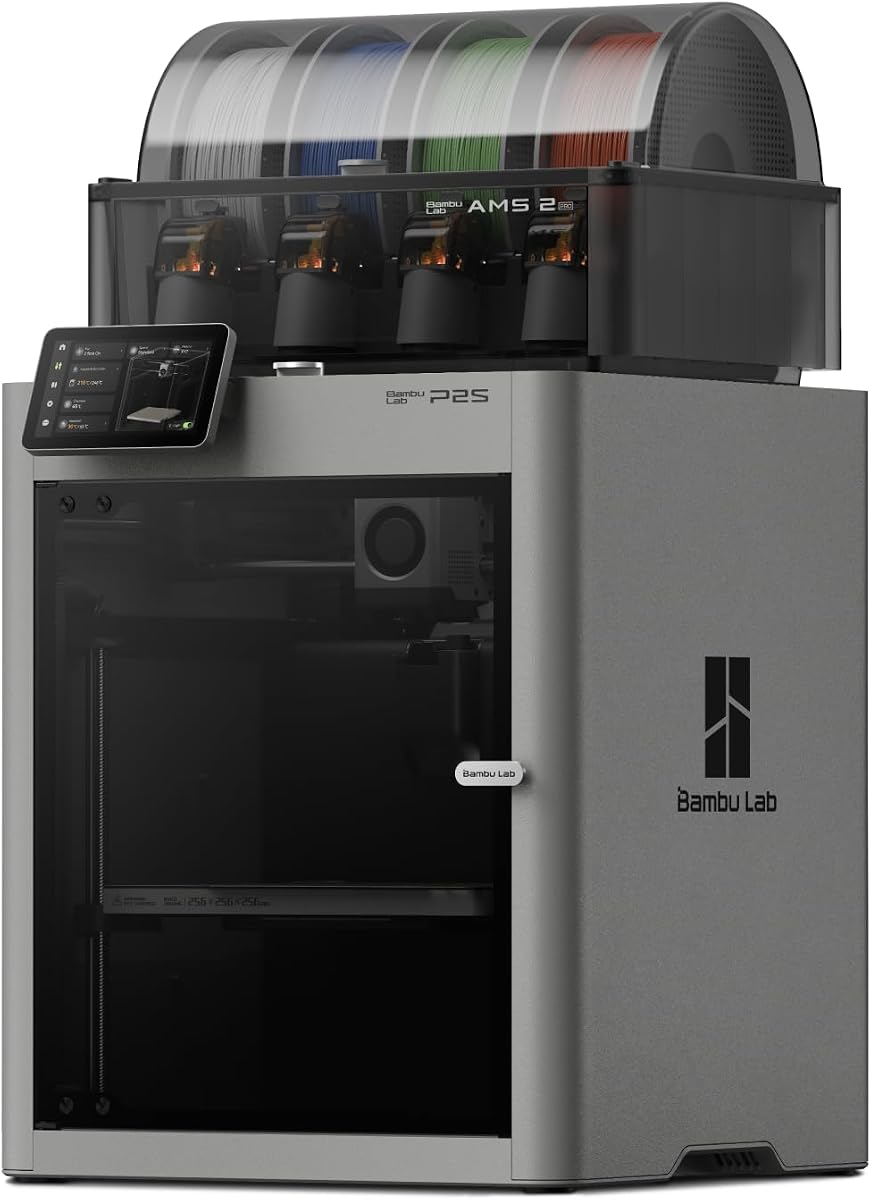
The Bambu Lab P2S Combo is the most versatile all-around choice in this guide, earning a supplied rating of 4.7. It combines up to 600 mm/s printing, active flowrate compensation, automatic calibration, and an AMS 2 Pro capable of seamless multi-color and multi-material output. That combination suits everything from detailed costume jewelry to broad costume shells.
We may earn a commission when you buy through this link, at no additional cost to you.
Its standout advantage is the balance between speed and dependable motion. The PMSM servo extruder and Active Flowrate Compensation are designed to keep layers consistent while the machine moves rapidly, which helps when producing repeated helmet details, armor segments, or batches of small accessories. The AMS 2 Pro also dries filament at up to 65°C, which is useful when consistent material flow matters across long production sessions.
The tradeoff is that the standard P2S alone does not support the multicolor features; the Combo version is necessary for that workflow. The AMS 2 Pro also occupies additional space and requires occasional attention. Nevertheless, the adaptive airflow system, carbon filter, AI failure detection, quick-swap nozzle, and ready-in-15-minutes setup reduce the usual barriers to making sophisticated props.
Choose the P2S Combo if you want one machine to cover prototypes, finished costume parts, and multicolor display pieces without assembling a complicated multi-machine workflow. It is especially attractive to cosplayers who want fast results, accessible controls, and a broad choice of downloadable models. For most makers, it offers the most complete package on this list.
The 600 mm/s maximum speed and servo-driven extruder make the P2S well suited to rapid iterations. Active Flowrate Compensation helps maintain controlled extrusion as print conditions change, supporting cleaner walls and more consistent fine features.
The included AMS 2 Pro enables multi-color output without manually changing filament throughout an entire print. Built-in drying helps protect filament condition, while dedicated material handling supports visually complex props with distinct color regions.
We may earn a commission when you buy through this link, at no additional cost to you.
The Bambu Lab A1 is an attractive budget choice for beginners, families, and cosplayers who want capable results without beginning with an advanced industrial machine. Its supplied rating is 4.7, and the feature set emphasizes speed, automatic operation, quiet movement, and straightforward controls.
We may earn a commission when you buy through this link, at no additional cost to you.
The printer reaches an acceleration of 10,000 mm/s² and uses active flowrate compensation to maintain accurate extrusion. Full-auto calibration handles tasks such as bed leveling and Z-offset, helping new users achieve a reliable first layer with less manual tuning. The 1-Clip quick-swap nozzle also simplifies routine maintenance and nozzle changes for different prop details.
Its open-frame format and quieter operation make it most comfortable for PLA, PETG, and other suitable everyday filaments. The lack of a fully controlled heated chamber can make demanding engineering materials less convenient, while AMS lite multicolor printing requires the A1 Combo or a separately purchased unit. Even so, the A1 delivers a remarkably approachable core workflow.
The A1 is best for creators who want to print costume pieces, accessories, and display props on a manageable learning curve. It can serve as an excellent first machine or a convenient secondary printer for smaller parts. Those wanting a multi-material setup or heavily engineered armor should consider an enclosed alternative.
Automatic calibration, touch controls, active flow compensation, and a quick-release nozzle simplify the daily workflow. These features help users focus on scaling and preparing their digital models rather than performing repetitive setup tasks.
Active motor noise canceling reduces distraction during long prints. That makes the A1 practical for a bedroom, office, classroom, or shared hobby space where a noisy machine would be inconvenient.
We may earn a commission when you buy through this link, at no additional cost to you.
The Sovol SV08 MAX is the premium large-format choice, with a supplied rating of 4.0 and a build volume of up to 500 × 500 × 500 mm. That scale allows full-size prototypes, broad armor sections, oversized props, and multiple smaller components to be produced without splitting the design into many sections.
We may earn a commission when you buy through this link, at no additional cost to you.
Its CoreXY architecture supports up to 700 mm/s printing and 40,000 mm/s² acceleration. The 50 mm³/s high-flow nozzle and reduced moving mass are designed to retain speed across substantial models. An eddy-current scanning system performs high-speed, contactless bed leveling, while pressure-sensing touch points assist with automatic calibration and first-layer reliability.
The main limitation is physical scale, since the printer needs more room than a desktop enclosed model. A heated chamber module is not included and must be purchased separately for future high-temperature compatibility. The 300°C hotend already handles demanding filaments including PLA, TPU, PETG, ABS, ASA, PA, PC, and reinforced variants, but chamber heating can improve results with warp-sensitive materials.
The SV08 MAX is ideal for advanced cosplay builders producing large, complex, or repeated components who value speed and build volume. Its built-in 1280 × 720 camera, remote monitoring, time-lapse recording, and Obico integration also improve oversight during lengthy prints. For serious large-scale fabrication, it offers the most compelling geometry of any pick here.
A 500 mm build width and depth allow broad chest plates, back pieces, shields, and scenery elements to fit more naturally. This can reduce visible seams and the need to redesign a concept around several disconnected panels.
The 700 mm/s maximum speed and 40,000 mm/s² acceleration help reduce waiting on large components. CoreXY motion keeps the toolhead movement efficient while maintaining a stable foundation for complex geometry.
We may earn a commission when you buy through this link, at no additional cost to you.
The FLASHFORGE Creator 5 Pro 4-Toolhead is built for creators who routinely need different colors or materials in the same prop. Its supplied rating is 4.3, while four independently prepared toolheads and a seven-second FlashSwap system distinguish it from conventional filament-changing printers.
We may earn a commission when you buy through this link, at no additional cost to you.
Because each toolhead can hold and preheat its own filament, the machine changes tools rather than repeatedly unloading and purging a single hotend. This can make multi-color masks, layered armor, contrasting trim, and mixed-material components more efficient. The enclosure supports an active 65°C chamber, and the 320°C hardened nozzle accommodates a broad filament list that includes PVA, ASA, carbon-filled variants, and other demanding materials.
Flow Dynamics Calibration models extrusion as a changing system and adjusts for effects such as nozzle wear or filament moisture. Adaptive airflow refreshes the chamber and supports clean bridges and sharp overhangs. These are sophisticated systems, so first-time users should budget time for learning the toolhead workflow, slicing setup, and material handling.
Buy this model if your cosplay project requires genuinely mixed materials or many separated color regions in one print. It is less necessary for a single-color prop that a simpler printer can handle, but for ambitious masks, wearable props, and production accessories, the four-tool architecture can dramatically simplify the process.
Preloaded and preheated toolheads reduce the downtime associated with unloading filament and purging a shared nozzle. The approach is valuable for props containing rigid shells, flexible inserts, or several contrasting color zones.
The actively heated chamber maintains a more consistent environment for ABS, ASA, PA, and reinforced materials. Combined with the hardened high-temperature nozzle, it supports stronger interlayer bonding and flatter large components.
We may earn a commission when you buy through this link, at no additional cost to you.
The Bambu Lab P1S is a strong enclosed-printer choice for cosplayers who need more material control than an open machine but do not require a four-tool system. It carries a supplied rating of 4.5 and combines a 500 mm/s maximum speed with a fully enclosed design.
We may earn a commission when you buy through this link, at no additional cost to you.
Its 20,000 mm/s² acceleration helps make rapid production of smaller costume elements practical. The enclosure creates a more stable thermal environment for ABS, ASA, PETG, TPU, and PVA, while automatic bed leveling reduces setup work. An AMS attachment can expand the machine to as many as 16 colors, although that hardware is not included with the printer.
The P1S is not recommended for carbon- or glass-fiber-reinforced polymers according to the supplied specifications. It also lacks the four independent materials and actively heated chamber found in the Creator 5 Pro. Nevertheless, its enclosed format, rapid motion, and accessible setup make it a balanced option for repeatable props that benefit from stable conditions.
Choose the P1S if you want a straightforward enclosed FDM workflow with excellent speed and optional multicolor expansion. It is a good middle ground for makers producing durable costume parts, organizers, wearable accessories, and display pieces without committing to the operating complexity of a professional multi-extruder machine.
The full enclosure helps limit abrupt environmental changes around the print. This is particularly useful when moving between PLA, PETG, ABS, and ASA while refining the same prop design.
High maximum speed and acceleration suit repeated buckles, clips, trim pieces, and other small parts. Automatic leveling helps maintain consistent first layers when many jobs are scheduled in sequence.
We may earn a commission when you buy through this link, at no additional cost to you.
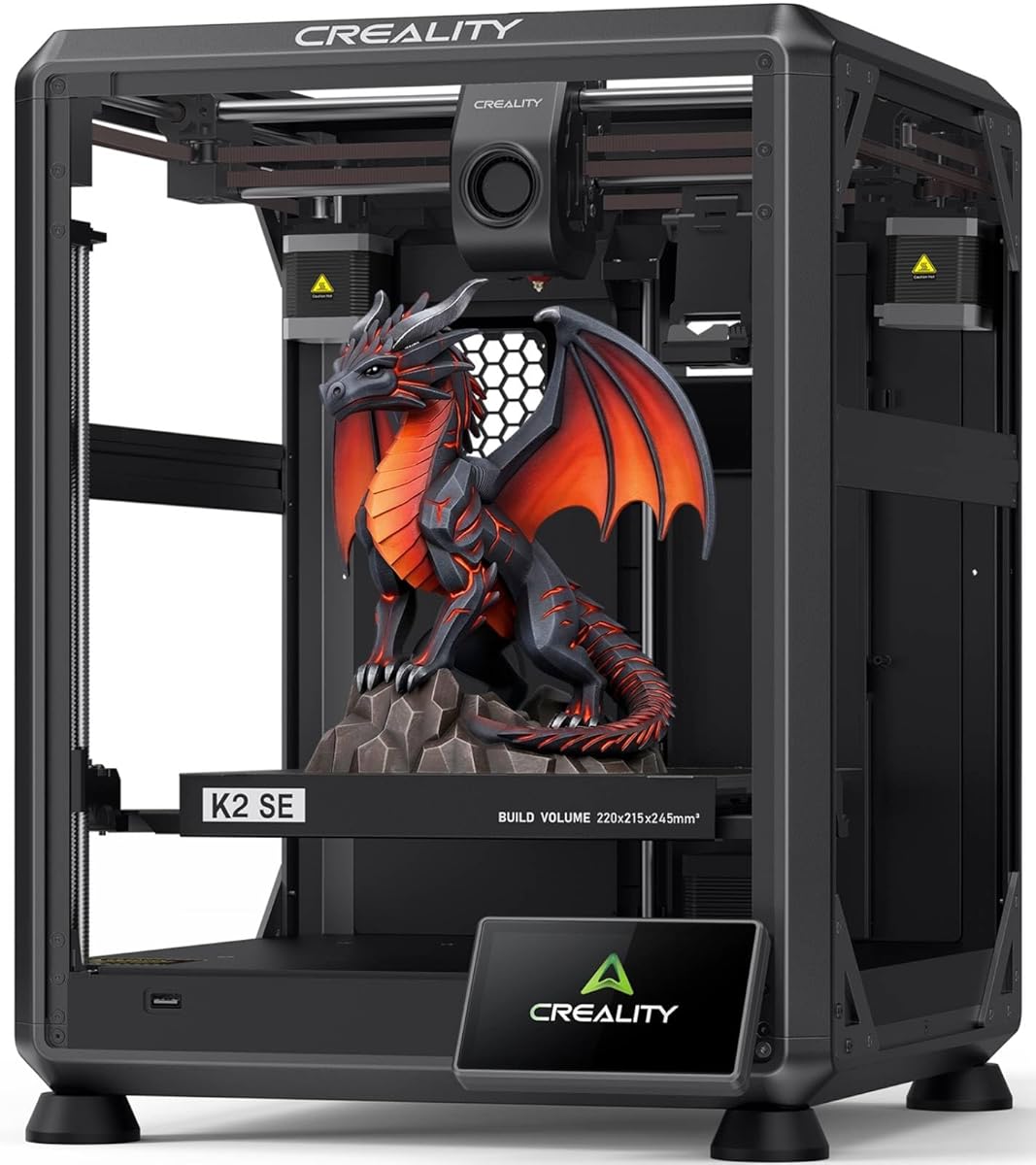
The Creality K2 SE is a compact, speed-focused option with a supplied rating of 3.8. Its 220 × 215 × 245 mm build volume is the smallest among these picks, so it is best suited to accessories, smaller armor sections, helmets, and props rather than room-sized scenery.
We may earn a commission when you buy through this link, at no additional cost to you.
A lightweight CoreXY motion system supports up to 500 mm/s printing and 20,000 mm/s² acceleration. Vibration sensing and input shaping reduce ringing, while the die-cast aluminum frame, corner gussets, and dual-side crossbeams improve rigidity. The modular direct-drive extruder includes hardened steel gears, a run-out sensor, and a quick-swap nozzle for controlled feeding and short maintenance times.
The main limitation is scale. Some cosplay pieces may need to be divided into more sections, and the separately sold CFS is required for multicolor printing. The supplied rating is also lower than those of several highly rated alternatives, so buyers should weigh feedback carefully. Even so, automatic leveling, fan calibration, and five-minute assembly simplify initial setup.
The K2 SE is a good choice for a dedicated accessory machine in a compact studio or for creators who prioritize fast small parts over large formats. Its optional CFS workflow, cloud tools, and 40-plus filament presets add flexibility. For full-size armor or oversized props, choose a model with a larger build volume.
High motion speed and acceleration are valuable when printing many buckles, straps, clips, trims, or display items. The compact geometry also limits wasted filament when a job does not require a full bed.
Compatibility with the separately sold CFS adds automatic filament identification, relay switching, run-out and tangle detection, and multicolor slicing. It remains optional, allowing users to start with a simpler single-color setup.
We may earn a commission when you buy through this link, at no additional cost to you.
The FLASHFORGE Adventurer 5M Pro is designed for makers who want fast, enclosed printing in a relatively quiet environment. It has a supplied rating of 4.0, a full enclosure, and an all-metal CoreXY frame capable of 600 mm/s printing with 20,000 mm/s² acceleration.
We may earn a commission when you buy through this link, at no additional cost to you.
The enclosure and dual filtration system help maintain thermal stability and manage fumes, while low-noise motion control keeps operation under 50dB. That combination makes the printer practical for a home studio or office where a cosplay project may run overnight. A 280°C nozzle and 110°C heated bed support ABS, ASA, PETG-CF, PLA, PETG, and other suitable materials.
Automatic one-click leveling, a tool-free nozzle mechanism, filament detection, and power-loss recovery reduce common sources of failed prints. The built-in camera supports monitoring and time-lapse capture through Flash Studio, while the 4.3-inch touchscreen offers local control. There is no integrated multicolor system, so complex color changes require a different printer or external workflow.
This is a strong all-around option for users who value quiet operation, clean hardware, fast enclosed printing, and straightforward maintenance. It is particularly well suited to masks, wrist props, armor plates, and accessories that benefit from controlled conditions without requiring four independent toolheads or a heated chamber.
The enclosed structure and dual filtration help preserve a controlled printing environment. Quiet motion control supports longer sessions in shared spaces without the distraction of a loud machine.
The tool-free quick-release nozzle can be replaced in about three seconds, and one-click leveling prepares the bed for the next job. These features are valuable when moving between detailed and faster production prints.
We may earn a commission when you buy through this link, at no additional cost to you.
This FLASHFORGE Creator 5 Pro configuration emphasizes efficient multi-color and multi-material output, earning a supplied rating of 4.0. Four independent toolheads and a seven-second FlashSwap changer reduce the need to purge a shared nozzle, making the system attractive for props that use several colors or material types.
We may earn a commission when you buy through this link, at no additional cost to you.
The fully enclosed frame includes an actively heated chamber reaching 65°C, while CoreXY motion supports up to 600 mm/s printing. Its rigid integrated architecture, precision linear rails, and high-torque timing belts are intended to control vibration and ghosting at speed. That makes the machine useful for durable armor, supports, scenery, and repeated accessories where geometry and layer consistency matter.
Dual HEPA 13 and activated-carbon filtration work with continuous airflow to capture particles and fumes. Automated toolhead offset calibration, vibration compensation, dynamic flow calibration, and an HD chamber camera further support reliable production. As with other advanced systems, the four-tool arrangement adds complexity, occupies more room, and demands familiarity with toolhead calibration and material preparation.
Choose this version when reducing purge waste is important to your workflow or when a prop contains many color boundaries. The near-zero-waste toolhead approach can be especially helpful for large designs that would otherwise require lengthy flushing. Users who only need occasional colors will get less value from the additional complexity.
Swapping prepared toolheads instead of repeatedly purging one nozzle reduces purge waste and waiting time. That advantage grows on multi-color models with numerous transitions or several physically distinct materials.
The built-in HD camera enables time-lapse and remote progress viewing. Filtration, controlled airflow, and a sealed chamber create a more suitable environment for repeated work with engineering-grade materials.
We may earn a commission when you buy through this link, at no additional cost to you.
The FLASHFORGE Creator 5 Pro Industrial combines a 4.4 supplied rating with a production-oriented 600 mm/s motion system. Its 30,000 mm/s² acceleration and rigid all-metal CoreXY architecture are designed to support fast, stable output, making it appropriate for repeated cosplay components and small production batches.
We may earn a commission when you buy through this link, at no additional cost to you.
Four completely independent extruders allow color separation without mixing or cross-contamination. The heated chamber reaches 65°C to support interlayer adhesion for ABS, ASA, PC, and Nylon. An adaptive outside-in cooling system protects prints from drafts while preventing nozzle clogging, and the sealed enclosure works with HEPA13 filtration to manage particles and odors.
Automatic platform leveling and toolhead offset calibration support repeatable first layers. A sensor suite watches for filament run-out and tangles, while a full-color touchscreen and flexible PEI magnetic plate aid operation and part removal. The sophisticated toolhead arrangement and industrial software workflow are less approachable than a simple desktop printer, and the machine demands a dedicated work area.
This model is best for cosplay studios producing a consistent stream of durable, multi-color, or mixed-material parts. Its combination of speed, chamber heat, filtration, and independent channels supports an efficient production workflow. Beginners should confirm that the advanced features justify the learning curve before committing.
Independent toolheads preserve clean color boundaries and material purity. Swapping nozzles avoids the purge delays that can interrupt high-volume work when a prop includes numerous color changes.
A stable 65°C chamber improves consistency with warp-prone engineering filaments. The enclosure, cooling strategy, and filtration system work together to support consistent parts and a cleaner workspace.
We may earn a commission when you buy through this link, at no additional cost to you.
The Creality K2 Pro Combo is a broad 300 × 300 × 300 mm enclosed printer that includes a CFS Smart Filament System. Its supplied rating is 3.9, and its most appealing cosplay feature is support for up to 16 colors within a workflow that also includes automatic filament identification and moisture-proof storage.
We may earn a commission when you buy through this link, at no additional cost to you.
The printer can reach 600 mm/s with 20,000 mm/s² acceleration, while an actively heated chamber maintains up to 60°C. That chamber temperature can improve stability with ASA, PPA, ABS, PETG, and reinforced filaments. The direct-drive extruder uses hardened steel gears, provides 40 mm³/s flow, supports abrasive filament, and includes automatic filament cutting and a quick-swap hotend.
Two AI cameras expand oversight. The chamber camera provides continuous monitoring, build-plate checks, failure detection, and time-lapse filming, while the nozzle camera performs real-time flow tuning, pressure-advance optimization, and waste-chute blockage detection. Automatic leveling probes only the model area, which can reduce setup time while targeting the areas that matter.
The K2 Pro Combo is an appealing choice for colorful masks, layered costume accessories, and prop collections requiring a large build area. The CFS system adds bulk and ties the machine into a defined multicolor workflow, while the 3.9 rating is modest relative to several competitors. Buyers should verify current package contents and current feedback before finalizing.
The included CFS enables up to 16 colors and multi-material printing. Automatic identification and intelligent feeding reduce the manual intervention normally required by a basic single-spool system.
The 300 mm cubic volume supports sizable prototypes or multiple small parts in one batch. Dual cameras allow users to inspect progress, investigate failures, and create time-lapse documentation of long production runs.
We may earn a commission when you buy through this link, at no additional cost to you.
The right cosplay printer depends on the size, geometry, material, color count, and production volume of your project. Consider the complete workflow rather than focusing only on maximum speed or the largest specification.
Choose a build volume that fits typical projects, not merely the largest possible model. Oversized machines require more desk space, stronger supports, and careful planning.
Match filament to the prop's function and expected handling. A decorative costume piece and a repeatedly used event-day prop may require very different materials.
Prioritize stable repeatable output over a headline maximum. A faster machine with reliable calibration can complete more usable props than an aggressively tuned but inconsistent one.
Choose color capability only when the design requires it. Single-color printing remains simpler, lighter on filament, and easier to maintain.
Choose active heating for demanding rigid materials and large surfaces. For PLA and most PETG projects, a reliable enclosed machine may be sufficient.
Beginners should favor guided calibration and clear controls. Experienced fabricators may value the deeper control offered by industrial platforms.
Choose monitoring for unattended jobs and filtration for frequent material variety. A camera is useful, but it is not a substitute for safe ventilation.
Choose the machine you can comfortably operate and maintain. Available space, acceptable noise, and easy access to consumable parts should influence the decision as much as peak speed.
Begin with a scaled, watertight model and print a small test section before committing to a full prop. Confirm that the design fits the build volume, orient it to minimize supports, and select the filament based on how the finished piece will be used. Clean the build plate, confirm the nozzle is clear, and run the machine's guided leveling and flow checks before starting.
Use the printer's recommended material and temperature profiles rather than copying settings between radically different machines. Monitor early layers for bed adhesion, consistent extrusion, and correct Z-height. For long jobs, enable cameras, run-out alerts, and power-loss recovery when available. Multi-material machines require confirming that every tool is loaded, heated, and correctly calibrated before the print begins.
After printing, allow rigid parts to cool before removing them, and flex the magnetic plate only when the machine's procedure permits it. Remove supports carefully, sand edges, and test-fit parts before applying paint or adhesive. Clean residue from the nozzle and bed, inspect filament paths, and replace filters or dried material when necessary. Store filament in a dry, sealed environment and record successful profiles for future cosplay designs.
The Sovol SV08 MAX has the largest stated build volume in this guide, reaching up to 500 × 500 × 500 mm. That makes it the strongest fit for oversized armor and props printed in fewer sections. The Creality K2 Pro Combo is also generous at 300 × 300 × 300 mm. Measure the finished piece and account for supports, clearance, and workspace before choosing.
An enclosure is helpful when you use ABS, ASA, PC, nylon, or reinforced filaments because it reduces environmental variation. It is also beneficial for large parts that are sensitive to warping. PLA and many PETG accessories can be produced successfully on an open machine, making the Bambu Lab A1 a practical lower-cost option for many hobby projects.
PETG is often a strong balance of toughness, layer adhesion, and moderate printing difficulty. TPU is useful for flexible trim or armor details, while PLA is easy to print and sand but is more brittle. If a prop must withstand heat, repeated handling, or impacts, test a small sample and consider ABS, ASA, or another suitable material with the printer's supported profiles.
It depends on the design. A single-color helmet or belt may not need it, while layered insignia, colorful masks, and contrasting accessories can benefit greatly. The P2S Combo, K2 Pro Combo, and four-tool Creator 5 Pro configurations support multicolor workflows. These systems also add cost, filament consumption, and maintenance compared with single-color printing.
Speed can shorten production time, especially for repeated small parts, but consistent quality matters more than the maximum headline figure. A printer may advertise 500 to 700 mm/s while producing its best results at lower practical settings. Consider acceleration, automatic calibration, motion stability, cooling, and repeatability alongside the stated maximum speed.
Four toolheads are useful when a project requires multiple materials, clean color separation, or many transitions without repeated purging. They are unnecessary for most single-color props and introduce additional setup requirements. A conventional multicolor system can handle simpler color work, while advanced toolheads are most valuable to studios producing complex pieces regularly.
Look for a sealed enclosure, effective ventilation, HEPA and carbon filtration for suitable materials, and monitoring for run-out, tangles, and failures. Cameras and remote alerts are helpful for long prints because they can reveal problems before an entire job is wasted. Always follow the filament manufacturer's ventilation and temperature recommendations.
Start with the type you expect to print most often. Enclosed desktop machines are easier to accommodate and often better for rigid materials, while large-format systems reduce sectioning for oversized props. A smaller enclosed model can also provide a more manageable learning experience before you invest in an industrial or large-format workflow.
The Bambu Lab P2S Combo is the strongest all-around recommendation because it combines rapid production, dependable automation, adaptive airflow, and integrated multicolor capability. The Bambu Lab A1 is the budget-friendly choice for accessible home printing, while the Sovol SV08 MAX stands apart for large-format armor and oversized props. Each serves a different scale of cosplay ambition.
Prioritize the constraints that actually affect your projects: build volume for large pieces, enclosure and chamber heat for rigid materials, independent toolheads for complex mixed-media designs, and simple calibration for beginners. Quiet operation and monitoring can make long production sessions more practical, while multicolor is most valuable when the artwork genuinely requires it.
Before purchasing, confirm the current package contents, filament compatibility, build dimensions, accessory requirements, and latest customer feedback. Prices, promotions, and configurations can change, so check the current listing for the exact model and bundle you intend to buy.