
UGREEN NAS DXP4800 GT
4.6Editor score
AMD Ryzen four-core processor
Eight threads up to 3.70GHz
Dual 10GbE network ports
Plex support through Docker
A NAS for Plex should do more than hold media files. It needs enough network and processing power for smooth library browsing, dependable direct playback, and enough storage for a growing collection of high-resolution movies, shows, music, and family videos.
This guide compares ten relevant storage products from the supplied range, considering enclosure capabilities, drive configuration, networking, memory, app support, and suitability for Plex. It also examines standalone NAS units and compatible hard drives so readers can distinguish between a complete system and a storage component.
Each entry explains where the product fits and where it falls short. The UGREEN DXP2800 leads for capable home use, the DXP4800 Plus offers expanded performance, and the DXP4800 GT targets demanding workloads. Ratings, availability, configurations, and prices can change, so verify current details before buying.
4.6Editor score

4.6Editor score

4.2Editor score
As an Amazon Associate we earn from qualifying purchases.
The table below places each enclosure, bundled NAS, and hard drive side by side so readers can quickly compare format, networking, expansion, and documented Plex support.



The UGREEN NAS DXP2800 combines a balanced set of media-server and storage features in a two-bay enclosure. Its 4.6 rating is among the strongest in this list, and its Intel N100 quad-core processor, 8GB of DDR5 memory, and 2.5GbE networking provide a more convincing foundation for Plex than a typical basic home NAS.
We may earn a commission when you buy through this link, at no additional cost to you.
The system is especially attractive to advanced users who want more than simple file sharing. Docker and virtual-machine support allow Plex to run alongside other self-hosted applications, while the dual M.2 NVMe slots can add fast storage for applications, caches, or selected data. The supplied details also describe support for family photos, 4K videos, movies, backups, AI photo organization, and local surveillance, giving the enclosure a broader role than media delivery alone.
Its limitations are practical rather than fundamental. HDDs and SSDs are not included, and two SATA bays may eventually feel restrictive for someone building a large archive with multiple users. The enclosure is diskless by design, so buyers must plan compatible drive purchases and installation. Those considerations make setup less convenient than buying a preloaded bundle, but they also allow storage to be matched precisely to the media library and RAID strategy.
This is the strongest all-around choice for a home Plex server because it combines efficient 2.5GbE networking, ample memory, and application flexibility without moving into the highest-cost enthusiast tier. It suits households with multiple users, a growing 4K collection, or creators who also want private backups and local applications. For someone whose primary need is reliable media storage and Plex, it offers the most balanced specification set in the guide.
The DXP2800's processor, memory, Docker support, and virtual-machine capability make it suitable for running Plex as a self-hosted application. Its 2.5GbE connection also provides more useful headroom than gigabit Ethernet when a wired network and compatible client equipment are available.
Two M.2 NVMe slots complement the two HDD bays, giving creators room to separate fast working data from archival media. This makes the system more versatile for mixed personal, backup, and media workloads.
We may earn a commission when you buy through this link, at no additional cost to you.
The UGREEN NAS DH2300 is a simple personal-storage NAS rather than a strong Plex recommendation. It carries a 4.5 rating and offers two bays, 4GB of onboard memory, gigabit Ethernet, automatic backups, and broad device support. Those qualities make it useful for keeping photos, documents, videos, and phone backups under local control.
We may earn a commission when you buy through this link, at no additional cost to you.
The product data emphasizes an intuitive experience for people moving away from cloud storage or disconnected external drives. Automatic backups work across Windows, iOS, Android, and macOS, while AI features can identify faces, places, text, and objects. RAID modes, two-factor authentication, permission controls, and encrypted transfers add a reassuring privacy and security layer for everyday storage.
The central limitation is Plex compatibility. The supplied information explicitly says that Plex cannot be run via Docker and that the DH2300 does not support Docker, virtual machines, or SAN Manager. Its 1GbE port also offers less bandwidth than several higher-ranked UGREEN models. This makes the enclosure more appropriate for backup, family file access, and personal media storage than for a dedicated Plex media server.
Those constraints keep it out of the recommended top three, even though the enclosure is attractive for simpler storage needs. Consider the DH2300 if centralized backups and private file access matter more than running Plex through Docker. If Plex is mandatory, choose a model with documented Docker support and a faster network connection instead.
Automatic device backups and cross-platform access are the DH2300's strongest themes. It can give users a convenient private destination for phone photos, personal documents, and other files that would otherwise be scattered across devices or cloud accounts.
Documented application support matters more than processor speed alone when Plex is the goal. Because this model cannot run Plex via Docker and lacks virtual-machine support, buyers should treat it as a general-purpose storage enclosure rather than a dedicated Plex platform.
We may earn a commission when you buy through this link, at no additional cost to you.
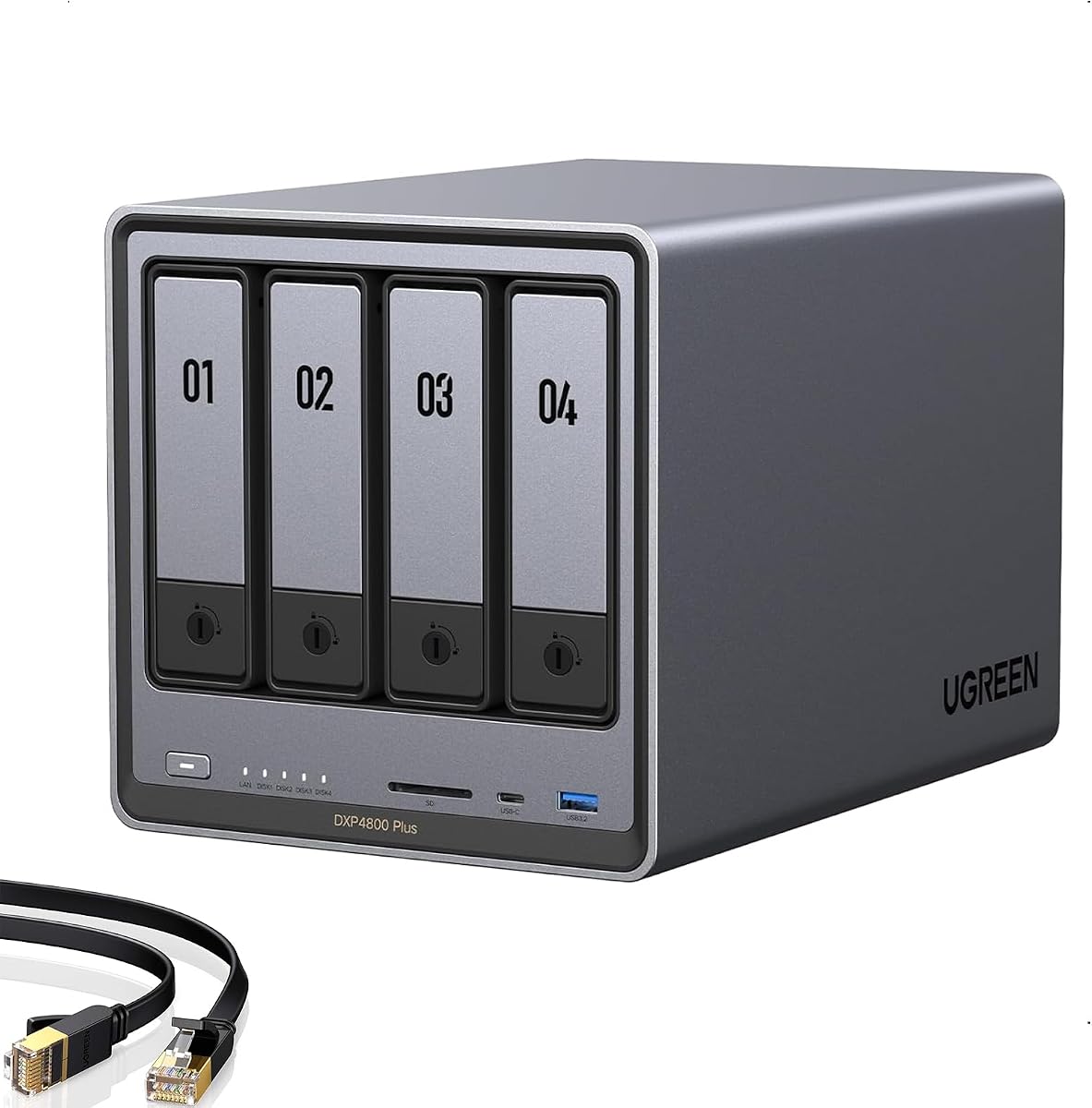
The UGREEN DXP4800 Plus is a high-performance four-bay NAS built for families, creators, and small teams. Its 4.6 rating reflects a strong overall result, while 10GbE networking, 10Gbps USB connectivity, Docker support, and virtual-machine support make it particularly well equipped for Plex and other self-hosted workloads.
We may earn a commission when you buy through this link, at no additional cost to you.
The supplied specifications indicate that users can back up a 1GB file in less than a second using either the 10GbE network port or 10Gbps USB ports. That level of throughput is useful when moving large movie files, camera assets, or backup sets between a computer and the NAS. Four drive bays add a valuable layer of expansion flexibility, and the stated maximum capacity reaches 144TB.
The enclosure is sold without hard drives, so the completed system requires additional compatible storage. It also expects more from the network than a basic gigabit setup: clients need compatible 10GbE hardware, and the switch and cabling path must support the same standard. Users without that infrastructure may gain little from the fastest port during everyday Plex streaming.
This is a strong premium recommendation for people who regularly move large media libraries, work with multiple users, or want storage and application performance in one enclosure. It is less compelling for a small collection viewed by one household on gigabit networks, but it offers the balance of capacity, speed, and flexibility that a serious Plex system needs.
A 10GbE port gives large file transfers considerably more theoretical headroom than gigabit Ethernet. The benefit is most visible during library updates, local transfers, and backups rather than ordinary remote streaming over an internet connection.
The four-bay layout allows a more gradual storage build than a two-bay system. Users can start with the capacity they need and expand as a movie, photo, or team archive grows, subject to compatible drives and the chosen RAID configuration.
We may earn a commission when you buy through this link, at no additional cost to you.
The UGREEN NAS DH4300 Plus brings four-bay expansion and 2.5GbE networking to an entry-level enclosure aimed at home users and remote workers. Its 4.2 rating is lower than the ratings of most UGREEN NAS models in the list, but the core specification supports Plex through Docker and should suit families building a private media library.
We may earn a commission when you buy through this link, at no additional cost to you.
The system includes 8GB of LPDDR4X memory, a high-performance processor, and support for 4K HDMI video output. Phone photo and video backup runs automatically, while AI photo albums use semantic search and recognition of people, objects, pets, and similar images. It also supports Docker, though not virtual machines, which narrows its flexibility compared with the DXP series.
Its gigabit-only networking note does not apply to the faster port supplied with this model; the product supports wired Ethernet and does not include Wi-Fi. Storage disks are not included, and advertised capacity depends on using compatible drives in RAID 0. Actual transfer speed can also vary with the router, CPU, drive, file size, and network path.
The DH4300 Plus is the most budget-oriented option here that combines four bays, Docker-based Plex support, 2.5GbE networking, and 8GB of memory. It makes sense for families who want easy phone backup, local media storage, and a capable Plex server without paying for the DXP4800 Plus or DXP4800 GT.
Docker support is the decisive feature because it allows Plex to run as a self-hosted application. Combined with 8GB of memory and 2.5GbE networking, it provides a practical foundation for a mainstream home media server.
Automatic phone backups, remote access, AI photo organization, and 4K HDMI output make the enclosure useful beyond media playback. The friendly setup process is particularly relevant for users who want a private storage hub without advanced administration.
We may earn a commission when you buy through this link, at no additional cost to you.
The UGREEN NAS DXP4800 GT is the most ambitious enclosure in this guide, combining an AMD Ryzen Embedded R2514 processor, dual 10GbE networking, extensive expansion, and a professional media and application ecosystem. Its 4.6 rating places it alongside the strongest models, and the specification is clearly aimed at creators, technical users, and office teams.
We may earn a commission when you buy through this link, at no additional cost to you.
The four-core, eight-thread processor can reach 3.70GHz, while 8GB of DDR4 memory is expandable to 64GB. UGOS Pro supports Docker, virtual machines, SAN Manager, and applications such as Plex, Emby, Jellyfin, and Home Assistant. Two 10GbE ports can provide aggregate throughput of up to 20Gbps with Link Aggregation and compatible network equipment, supporting large transfers, multi-user access, and demanding 4K or 8K workflows.
Plex runs through Docker and requires manual setup, so this is not the simplest route to a working media server. Storage is also sold separately, and the preinstalled memory is non-ECC even though the platform supports ECC upgrades. Local-only access, RAID support, and security tools improve privacy and resilience, but users must still plan their drives, networking, and configuration carefully.
This is the best choice when Plex is the center of a broader self-hosted environment rather than the only application. It offers ample processing power, fast networking, and room for demanding concurrent workloads. For ordinary household streaming, some of that capability may go unused, but it gives creators and small teams a platform that can evolve with their media and storage needs.
The Ryzen processor, expandable memory, and dual 10GbE interfaces are valuable for users who edit media, serve multiple users, or move large files every day. These features go well beyond what a basic streaming-only enclosure requires.
Support for Plex, Emby, Jellyfin, Home Assistant, virtual machines, and Docker creates room to consolidate services. The built-in surveillance center and local security features also make the NAS useful as a private hub for cameras and stored footage.
We may earn a commission when you buy through this link, at no additional cost to you.
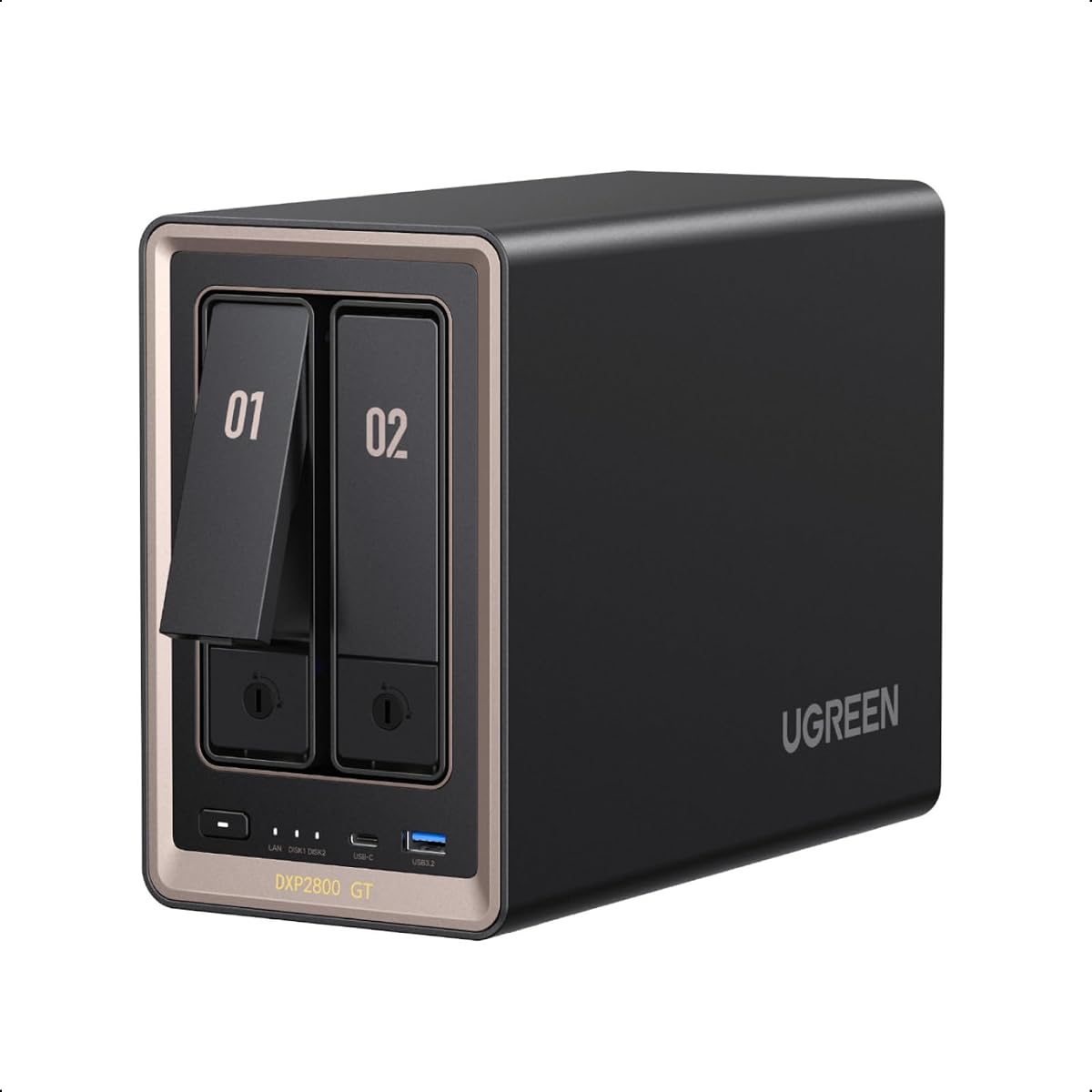
The UGREEN DXP2800 GT combines flagship-style processing and 10GbE networking in a two-bay enclosure. Its 4.3 rating is solid, and the AMD Ryzen Embedded R2514, 8GB of expandable DDR4 memory, and UGOS Pro application environment make it a capable option for Plex, smart-home control, and creator workflows.
We may earn a commission when you buy through this link, at no additional cost to you.
Docker, virtual machines, and SAN Manager support give the enclosure more flexibility than entry-level NAS units. Plex can run through Docker, while other supported services include Emby, Jellyfin, and Home Assistant. A built-in Surveillance Center works with compatible ONVIF or RTSP cameras and supports live viewing, event detection, recording, and timeline playback.
The two SATA bays can accept large hard drives, and the supplied specification lists support for U.2 NVMe SSDs in compatible bays plus additional M.2 SSD storage. Despite that expansion, the enclosure is still smaller than a four-bay system, so it is better suited to focused personal libraries than large, multi-drive archives. Plex setup through Docker is manual rather than plug-and-play.
The DXP2800 GT is a compelling high-speed option for a creator or smart-home user who values a smaller footprint and strong networking over maximum bay count. It can serve Plex comfortably, especially with a wired 10GbE path, but families planning rapid long-term expansion may prefer a four-bay model.
A single 10GbE interface gives the DXP2800 GT ample local-transfer headroom for photo libraries, video projects, and backups. Its Ryzen platform adds processing capability for media tasks and multiple self-hosted applications.
The surveillance center turns compatible cameras into a locally managed recording system. Combined with Docker, virtual machines, and Home Assistant support, the enclosure can serve as the center of a broader private digital home.
We may earn a commission when you buy through this link, at no additional cost to you.
The Seagate IronWolf Pro 24TB is not a NAS enclosure or a complete Plex server. It is a high-capacity enterprise hard drive designed for RAID network attached storage, making it relevant when a Plex builder wants to add substantial archival capacity to a compatible system.
We may earn a commission when you buy through this link, at no additional cost to you.
Its all-CMR recording method supports consistent 24/7 operation, and the listed 7200 RPM spindle speed and 512MB cache suit demanding storage workloads. A workload rating of up to 550TB per year and a 2.5-million-hour MTBF specification indicate that this drive is aimed at sustained use rather than occasional cold storage.
The AgileArray firmware, dual-plane balancing, time-limited error recovery, and rotational-vibration sensors help it perform well in multi-bay RAID environments. IronWolf Health Management provides prevention, intervention, and recovery recommendations, while complimentary three-year Rescue Data Recovery Services add another layer of support. These features matter when the drive contains irreplaceable media or backups.
Buyers must select a compatible NAS, install the drive correctly, and decide on a RAID configuration. A single large drive does not itself provide the resilience of RAID, and a Plex server with one storage device still needs a sound backup strategy. Used with a capable enclosure, the IronWolf Pro is a strong choice for a large, always-on media archive.
A 24TB drive provides substantial room for high-resolution movies, television episodes, music, and family videos. It is particularly useful when one large-volume member of a multi-bay array is preferred to several smaller capacity options.
The 24/7 performance focus, CMR recording, vibration sensors, and AgileArray features make this a more purposeful choice for an always-active Plex library than a general-purpose desktop drive. Health management can also help owners respond to warnings before a drive becomes a storage emergency.
We may earn a commission when you buy through this link, at no additional cost to you.
The Synology DS223j 8TB Bundle offers a different approach from the diskless UGREEN enclosures. It combines a two-bay Diskstation with two 4TB Seagate IronWolf drives, providing a more immediately complete package for creating a private media and file server.
We may earn a commission when you buy through this link, at no additional cost to you.
The enclosure uses a Realtek RTD1619B four-core processor operating at 1.7GHz and includes 1GB of non-ECC DDR4 memory. Its single RJ-45 port provides gigabit Ethernet, while two USB 3.2 Gen 1 ports support peripherals and transfer tasks. The supplied information describes remote file and media access, file sharing, and professional video surveillance monitoring.
The installed 1GB of memory is modest by the standards of the more expandable UGREEN systems in this roundup. The drive bundle also fixes the initial capacity and drive type rather than letting the buyer tailor each bay. As a result, the package is convenient, but it offers less flexibility for users who later want faster networking, more memory, or different storage components.
For a new Plex user who values a recognized NAS platform and would rather begin with a populated two-bay system, the bundle is straightforward and relevant. It is better suited to a modest household library than to intensive transcoding or heavy multi-user workloads. Users should verify their preferred Plex package and current device support before finalizing a purchase.
The two included 4TB IronWolf drives remove the need to select and install initial hard drives. This makes the bundle approachable for users who want a functional private file and media server with minimal assembly.
The DS223j combines straightforward file management with remote access and surveillance monitoring support. Its one-gigabit network and 1GB memory are adequate for ordinary use, but they place lower ceilings on demanding media workflows than the higher-end options here.
We may earn a commission when you buy through this link, at no additional cost to you.
The Ubiquiti Four-Bay NAS is a compact enclosure for buyers who prioritize network performance and fast local storage. The supplied information identifies 2.5/3.5-inch hard-drive bays, a 2.5GbE connection, USB-C connectivity, and two M.2 NVMe SSD cache slots. Those details fit the needs of a modern Plex server well.
We may earn a commission when you buy through this link, at no additional cost to you.
The 2.5GbE interface offers more transfer headroom than gigabit Ethernet without requiring the 10GbE infrastructure associated with some competing models. The four hard-drive bays provide room for a media library and RAID configuration, while the NVMe cache slots are designed to accelerate frequently accessed data when appropriately configured.
The available product information is limited, and no rating is listed. The data also does not explicitly identify processor specifications, installed memory, operating-system capabilities, or confirmed Plex support. As a result, it is impossible to make a complete performance or transcoding assessment from the supplied facts alone. Prospective buyers should check the current software documentation and hardware specifications before purchasing.
The enclosure is worth considering for users already invested in the Ubiquiti ecosystem or seeking a compact, network-focused four-bay system. Its headline hardware is appropriate for Plex storage, but application support must be verified. It is a potential fit rather than the most confidently documented recommendation in this roundup.
A 2.5GbE port offers a practical middle ground between basic gigabit networking and more demanding 10GbE equipment. It can improve local library updates and transfers when the client and switch also support the standard.
Two M.2 NVMe cache slots can provide a place for fast storage in a compatible configuration. The specific caching workflow and supported software should be confirmed with Ubiquiti before installation.
We may earn a commission when you buy through this link, at no additional cost to you.
The Western Digital WD Red Plus 8TB is a purpose-built hard drive for small and medium NAS systems. It is not a standalone Plex appliance, but it can provide the storage foundation for a compatible NAS, making it an important companion to the enclosures in this guide.
We may earn a commission when you buy through this link, at no additional cost to you.
Its CMR technology provides predictable write behavior, while the 5400 RPM spindle speed, SATA 6Gb/s interface, and 256MB cache suit continuous NAS storage duties. NASware firmware supports compatibility within intended small and medium business NAS environments, and the stated workload rate reaches up to 180TB per year.
The drive is rated for 24/7 use and includes a three-year limited warranty. As with every hard drive in a Plex system, it should be paired with an appropriate RAID or backup plan; redundancy within an array does not replace a separate copy of important media. Its 8TB capacity is also more modest than the 24TB option represented by the Seagate IronWolf Pro.
The WD Red Plus is a sensible choice for a balanced media library where moderate capacity, purpose-specific firmware, and CMR reliability matter more than maximum density. It suits homes and small teams that need a dependable drive for a Plex NAS but do not need the largest available capacity.
CMR recording is particularly useful in RAID and continuously active NAS environments because it avoids the write-behavior concerns associated with SMR. It is a sensible foundation for a library that receives regular additions and backups.
NASware firmware, a 24/7 operating profile, and a stated 180TB-per-year workload rate align the drive with small and medium NAS use. A three-year warranty provides standard support for a component expected to operate continuously.
We may earn a commission when you buy through this link, at no additional cost to you.
The right Plex NAS depends on library size, client equipment, transcoding demand, expansion plans, and tolerance for setup. The following factors help narrow the field before comparing enclosures and individual storage drives.
In short, choose a model with documented Plex deployment support and enough memory for the application and any companion services.
In short, prioritize multi-core processing and sufficient memory if clients need on-the-fly transcoding.
In short, choose bandwidth that matches your largest local transfers and ensure the switch, cables, and clients support it.
In short, two bays suit smaller libraries, while four bays better accommodate expansion and redundancy.
In short, buy drives that match your capacity, durability, and performance needs, and use NVMe only where it serves a clear purpose.
In short, allow headroom beyond Plex alone if you plan to run containers, backups, indexing, or surveillance tools.
In short, use RAID for resilience and maintain a separate backup strategy for irreplaceable media.
In short, balance hardware capability with your comfort level, because a simpler system you understand may serve Plex better than an advanced unit left half-configured.
Begin by planning the storage layout, RAID mode, user permissions, and backup destination before installing the operating system or media application. Install compatible drives, connect the NAS over Ethernet, complete the guided setup, and create administrator accounts with strong, unique credentials. If Plex will run through Docker, use the documentation for the exact UGREEN model and follow the required image, network, and folder-access settings.
Organize the library into durable folders, connect those folders to Plex, and test playback on the most important client devices. Keep the NAS wired for stable throughput, give it a reserved network address, and avoid exposing administration interfaces directly to the internet without a secure access method. Confirm that remote clients can reach the server while local users can stream without unnecessary buffering.
Maintain the system by checking storage health, reviewing alerts, keeping the NAS software and applications updated, and verifying that backups are actually completing. Dust and heat matter in multi-bay systems, so keep vents clear and operate the enclosure in a cool, ventilated location. Rebuild or replace a failing drive promptly, and periodically test whether a separate backup can be restored rather than assuming a successful backup job guarantees usable data.
The UGREEN NAS DXP2800 is the strongest balanced option because it combines an Intel N100 processor, 8GB of DDR5 memory, 2.5GbE networking, Docker support, and M.2 NVMe expansion. The DXP4800 Plus is the better fit for maximum transfer performance and four-bay expansion. The DXP4800 GT serves the most demanding multi-user and self-hosted workloads, while the DH4300 Plus offers the most budget-conscious four-bay option with documented Plex support.
The supplied product information explicitly says that the DH2300 cannot run Plex via Docker. It also does not support Docker, virtual machines, or SAN Manager. The enclosure remains suitable for private file storage, phone backups, photo organization, and general personal media storage, but buyers whose primary requirement is a Plex server should choose a model with documented Plex application support.
No. Gigabit Ethernet can support ordinary Plex streaming, and the exact experience depends on media bitrate, file format, client transcoding, and network conditions. A 10GbE port is most useful for rapid local transfers, large backups, and multi-user workloads. A 2.5GbE connection is a practical middle ground and may offer better value if your switch and clients support it.
Not necessarily. Hard drives are generally more economical for retaining large movie libraries, while NVMe storage is useful for faster caches, application data, metadata, or active editing files. The DXP2800, DXP4800 GT, DXP2800 GT, and Ubiquiti enclosure provide M.2 or NVMe expansion options, so buyers can add fast storage when a clear workflow justifies it.
No. RAID can keep a volume available after certain drive failures, but it does not protect against accidental deletion, malware, enclosure failure, theft, or corruption affecting every mirrored copy. Important media should also be copied to a separate drive, another NAS, or an appropriate off-site backup system. Test restoration occasionally to confirm that the backup is usable.
A bundle such as the Synology DS223j with two 4TB Seagate IronWolf drives is convenient for beginners because the initial storage is ready to install. A diskless enclosure offers more control over capacity, drive type, and timing, but the buyer must select compatible drives. The best choice depends on confidence with installation and whether a ready-made package better fits the household.
Direct play sends a compatible media file to the client with little or no conversion, reducing the load on the NAS. Transcoding converts a file into a format the client can play, which can require more processor and network resources. A NAS with a stronger multi-core processor and more memory gives greater flexibility when serving mixed formats or less capable devices.
Two bays are sufficient for many personal libraries and can be configured with appropriate redundancy or other storage arrangements. Four bays provide more room for expansion and flexible RAID layouts. The best choice depends on current library size, how quickly it is growing, the importance of the media, and the backup plan rather than bay count alone.
The UGREEN NAS DXP2800 is the most balanced overall recommendation because it brings together a capable Intel N100 processor, 8GB of DDR5 memory, 2.5GbE networking, Docker support, and dual M.2 slots in a manageable two-bay enclosure. The DXP4800 Plus is the stronger premium four-bay option for fast transfers and expansion, while the DXP4800 GT leads the range in processing, networking, and broader application capability.
For buyers seeking a more affordable route, the DH4300 Plus combines four bays, 2.5GbE networking, 8GB of memory, and Docker-based Plex support. The DH2300 is better viewed as a private backup and file-storage enclosure because its supplied information confirms that Plex cannot run through Docker. Seagate and Western Digital drives are useful storage components rather than complete NAS systems.
Before purchasing, verify the current model details, Plex deployment method, drive compatibility, RAID plan, and backup strategy. Product ratings, software capabilities, configurations, and prices can change, so confirm the latest information directly on the linked listing. Whichever system you choose, prioritize confirmed Plex support, adequate memory, reliable storage, and a network path that matches your viewing habits.