
Renogy Bifacial 800W N-Type
4.3Editor score
Two 400W bifacial modules
N-Type 16BB cell design
Dual-zone shade resilience
Our 800W solar panel guide compares ten rugged options for RVs, boats, homes, camping, and off-grid systems, highlighting output, flexibility, and setup.
An 800W solar panel can provide substantial charging capacity for an RV, boat, cabin, backup power system, or portable power station, but the best configuration depends on rigidity, efficiency, weather resistance, and installation demands. This guide examines ten products ranging from framed monocrystalline panels to lightweight flexible and foldable designs.
The comparison considers total rated output, cell technology, construction, mounting options, electrical compatibility, environmental protection, and the balance of included equipment. It also considers how each set is likely to fit practical needs such as permanent rooftop mounting, curved marine surfaces, camping portability, off-grid battery charging, and simplified low-voltage wiring.
Each review identifies the product's strongest qualities and relevant trade-offs so readers can choose confidently. Specifications and customer ratings reflect the supplied product information, while availability, promotions, and prices can change over time. Always verify the latest listing details and system requirements before purchasing.
4.3Editor score

4.5Editor score
5.0Editor score
The comparison below highlights each panel's rated configuration, construction, best-suited installation environment, and principal advantage, making it easier to identify the right 800W solar panel for a particular power system.
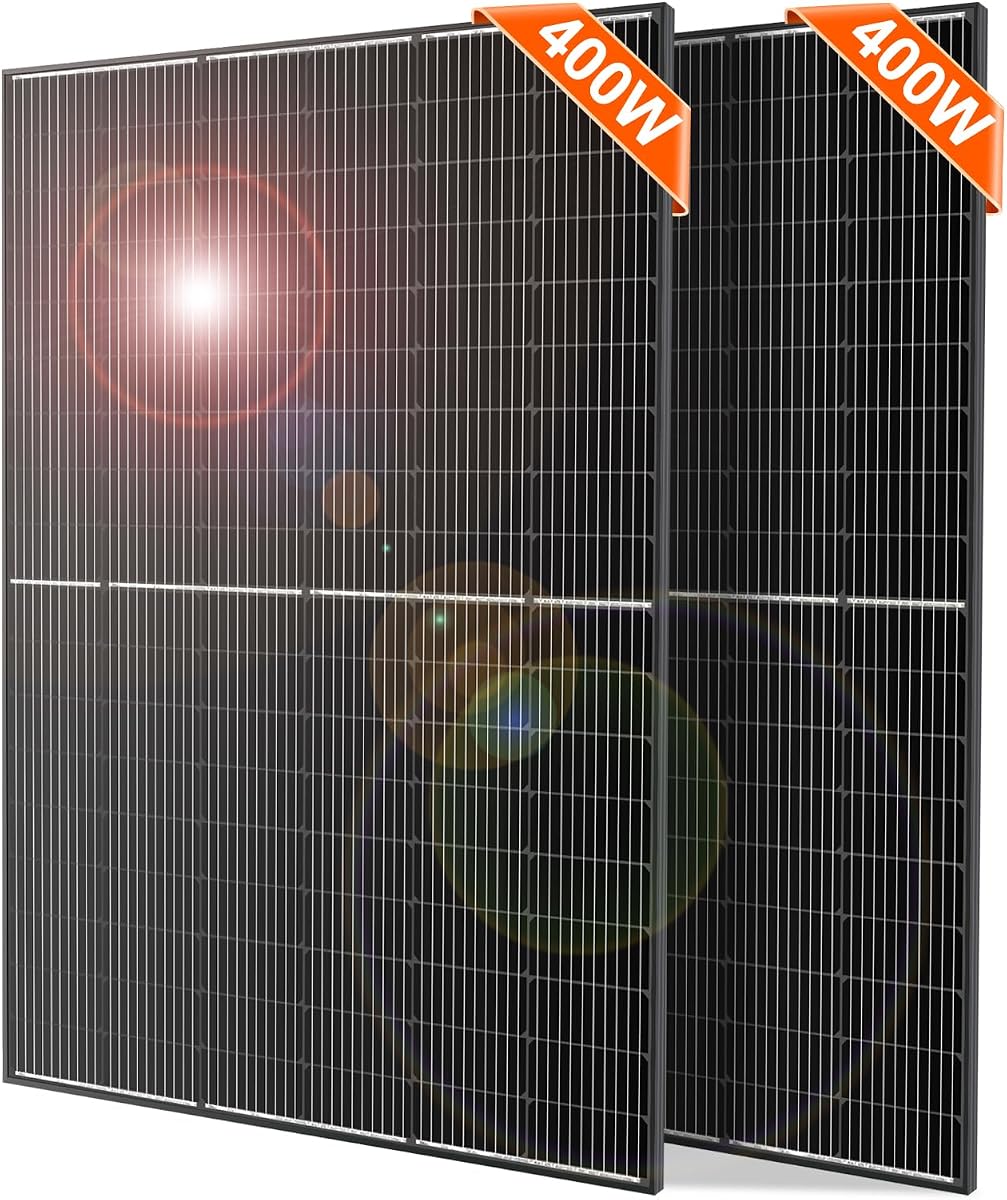


The DOKIO 800W Solar Panels set combines two 400W, 31V rigid modules and carries a 4.1 customer rating. Its clearest attraction is the reduction in hardware compared with an equivalent array made from many smaller panels. That can produce a cleaner installation with fewer branch connectors, extension joints, and potential connection points.
We may earn a commission when you buy through this link, at no additional cost to you.
Each panel has 9.84-foot MC4 leads, giving installers more reach between the modules and a combiner or charge controller. Tempered glass, an aluminum frame, and sealed junction boxes support year-round outdoor installation. Compatibility extends to AGM, gel, and LiFePO4 battery banks through suitable PWM or MPPT controllers, although the combined current must be handled by the selected controller.
The product is most attractive to installers who want substantial nominal capacity without assembling an elaborate multi-panel network. Parallel wiring is the stated starting point for a 12V battery system because it keeps panel voltage at a safer level and supports steady charging. Series configuration should only be used with equipment designed for the higher input voltage.
This set suits homeowners, cabin owners, and RV users planning a permanent or semi-permanent array where roof or ground space is available. Buyers who value fewer joints and long included leads will find it particularly practical. It is less appropriate for people who need a portable, foldable design or a low-profile panel for a curved surface.
Two high-output modules can replace a much larger group of low-wattage panels. Fewer connectors and branch points simplify wiring and may reduce installation time while limiting opportunities for wiring errors.
The pair can deliver a combined 800W under standard test conditions, so the charge controller and inverter must be sized for the total current. MPPT is advisable when its input range safely matches the intended configuration.
We may earn a commission when you buy through this link, at no additional cost to you.
The DOKIO 800W Solar Panel Set is a two-panel system aimed specifically at 24V off-grid installations. Its 4.1 rating reflects a practical design based on two 400W modules rather than a complex collection of smaller panels. The result is a simpler physical array with fewer opportunities for branch connections.
We may earn a commission when you buy through this link, at no additional cost to you.
Both modules use tempered glass and aluminum frames, while sealed junction boxes support outdoor placement in yard or garden installations. Each panel includes a three-meter MC4 lead, which can shorten the distance between the array and its controller without requiring immediate extensions. The installation process therefore looks more manageable for permanent residential or remote-power projects.
The main consideration is electrical compatibility. Although the product title highlights 24V systems, safe series or parallel arrangement depends on the charge controller, battery bank, and inverter. For a 12V system, the manufacturer recommends parallel wiring first to preserve a safe voltage. For 24V systems, a controller with the correct input range is still essential.
This set is a good match for installers who want a relatively compact 800W array and recognize the value of reducing connection points. It is less suitable for mobile users who need to pack the panels into a vehicle or install them on a curved surface. Buyers should plan the complete electrical layout before ordering extra brackets or cables.
Combining two high-output modules cuts the number of physical panels and connections needed to reach the stated total capacity. That can be especially helpful on roofs, cabins, and remote installations where cable routing is inconvenient.
A 24V label does not remove the need to match wiring, controller limits, and battery configuration. Confirm all three before installation, especially if the panels may also be used with a 12V bank.
We may earn a commission when you buy through this link, at no additional cost to you.
The Renogy Bifacial Solar Panel 800W N-Type combines two 400W modules and earns a 4.3 rating. Its most distinctive feature is bifacial operation: the panels collect direct sunlight on the front and reflected light on the rear, which can improve total harvest when installed over reflective materials such as light gravel, sand, concrete, snow, or pale roofing.
We may earn a commission when you buy through this link, at no additional cost to you.
N-Type 16BB cells are rated to reach up to 25% efficiency, helping the set generate strong output while occupying less area than a large collection of lower-rated modules. A dual-module design creates two independently operating power zones, reducing the effect of partial shade from branches, vents, chimneys, and other rooftop obstructions.
The trade-off is that bifacial performance depends on installation conditions. Rear-side output is not identical in every environment, and proper airflow and mounting space can influence how much reflected light reaches the back surface. Buyers should also verify the mechanical dimensions and complete their own system-level compatibility check before ordering.
This is a premium-style option for homeowners, RV owners, and off-grid builders who have limited space or want to minimize shade-related losses. The two-module format also reduces the number of wires and branch connectors compared with a system using many smaller panels. It is especially compelling where reflected light is plentiful and partial shade cannot be eliminated.
Bifacial modules can gain useful energy from light reflected beneath or behind the installation. The result depends on the mounting surface, angle, clearance, and surrounding environment rather than on cell performance alone.
Independent operating zones help one shaded section have less effect on the complete output. This can make a two-panel design more resilient than a comparable array without shade-aware electrical segmentation.
We may earn a commission when you buy through this link, at no additional cost to you.
The 800W Solar Panel Kit uses two flexible 400W monocrystalline panels and carries a 5.0 customer rating. Its standout advantage is physical adaptability: each panel weighs only 4.4 pounds, is described as 0.1 inch thin, and can bend to a 30-degree curvature without the weight and drilling demands of rigid modules.
We may earn a commission when you buy through this link, at no additional cost to you.
The ETFE surface supports durability, UV resistance, and strong light transmission. The stated 24%-plus cell efficiency and IP68 waterproof rating make the set appealing for RVs, vans, boats, cabins, and remote work locations. Pre-drilled holes and installation without mounting frames can simplify the physical attachment process when adhesive and sealant are applied correctly.
Flexible panels do have limitations. Their bendable construction does not make them ideal for every permanent rooftop arrangement, and a sound mounting surface is essential to avoid damage. Adhesive installation also requires careful preparation, and the claim that no drilling is needed does not mean no mounting work is required. Battery-bank voltage and charge-controller compatibility must still be confirmed.
This kit best fits travelers and boat owners who value low weight and a low-profile installation over a traditional framed array. The supplied information also states a two-year materials and workmanship warranty alongside a 25-year output warranty supporting 80% power output. That combination makes it a strong budget recommendation for mobile and curved-surface projects.
The panels conform to curved roofs and add less weight than rigid glass-and-aluminum modules. That makes them useful where structural load, drilling, and flat mounting space are concerns.
ETFE, an IP68 rating, and salt-spray resistance support outdoor and marine use. The stated warranty coverage also adds long-term reassurance, although buyers should retain the listing's complete terms for verification.
We may earn a commission when you buy through this link, at no additional cost to you.
The 800W Portable Solar Panel set combines two foldable 400W modules and has a 4.2 rating. Built with 23% efficiency SunPower cells, it targets campers, RV travelers, and portable-power users who need more capacity than a small suitcase panel but still require a product that can be transported and deployed away from a permanent mount.
We may earn a commission when you buy through this link, at no additional cost to you.
The set weighs 20 pounds and folds for more compact storage. ETFE coating adds impact resistance and outdoor durability, while an IP67 rating supports protection in wet conditions. Four kickstand positions—30, 40, 50, and 80 degrees—allow users to alter the angle as the sun moves, potentially improving the amount of direct light captured during different parts of the day.
Portability creates its main limitation. These are temporary positioning stands rather than a roof or ground-mount system, and their output still depends on direct, unobstructed sunlight. The 39V panel rating also requires a compatible charge controller or power-station input. Users should not connect the modules to an unsuitable battery charger merely because the nominal wattage appears compatible.
The set is best for weekend campers, travelers, and mobile users who need a high-output foldable array. It is less appropriate for someone seeking a permanent roof installation or a low-profile set for a curved boat surface. For its intended role, the combination of capacity, folding convenience, and adjustable positioning is particularly compelling.
The four kickstand settings allow the panels to be repositioned throughout the day. This flexibility helps users adapt the array when its orientation is no longer perpendicular to the strongest sunlight.
The folding format and 20-pound total weight prioritize mobility. It opens like a portable mat and can be positioned quickly, making it more convenient for camping than permanently mounted rigid panels.
We may earn a commission when you buy through this link, at no additional cost to you.
The 800 Watt Solar Panel Kit includes two rigid 400W monocrystalline panels, a 30A MPPT charge controller, and stated inverter support for a 12V battery system. The panels use N-Type technology and 10BB cells, with efficiency listed at up to 25% under full sunlight. The package is aimed at people who value having a controller already included.
We may earn a commission when you buy through this link, at no additional cost to you.
Built-in MC4 connectors simplify the connection between the panels and controller, while pre-drilled holes support installation on an RV, rooftop, or mounting frame. The product description lists uses spanning campers, yachts, camping, home energy storage, residential projects, and commercial applications. The supplier also states that panels are inspected before shipment.
The 1.0 rating is the most significant caution in this roundup. It does not prove that the kit cannot work, but it provides much less customer feedback than the other rated products and makes careful verification especially important. A 30A controller's suitability must be checked against panel ratings, battery chemistry, voltage, and environmental conditions rather than assumed from the kit title.
This package may appeal to first-time off-grid builders who want a coordinated starting point and already own a compatible inverter. Experienced installers should confirm the included components, controller specifications, panel dimensions, warranty details, and all electrical ratings before purchase. It is less suitable for a buyer who values a well-established customer-rating history.
Including an MPPT controller reduces the number of separate components a buyer must source. Preinstalled MC4 connections can also shorten assembly time, provided the remaining system components support the same electrical configuration.
Customer feedback can reveal real-world installation issues, but a single low rating is not a complete technical verdict. Treat it as a prompt to inspect specifications, read recent questions and answers, confirm included accessories, and verify warranty coverage.
We may earn a commission when you buy through this link, at no additional cost to you.
The 800 watt Solar Panel two-pack uses advanced N-Type monocrystalline cells with 16BB half-cell technology and carries a 4.4 rating. It targets users who want a durable, fixed installation with improved light utilization, lower internal loss, and a more consistent response during mornings, evenings, and cloudy conditions.
We may earn a commission when you buy through this link, at no additional cost to you.
Outdoor construction includes tempered glass, a corrosion-resistant aluminum frame, and IP68-rated connectors. The stated 2400Pa wind load and 5400Pa snow load ratings give the panels useful environmental credentials for roofs, boats, cabins, RVs, and off-grid systems. Preinstalled MC4 connectors, bypass diodes, and approximately one-meter cables simplify connection to compatible controllers.
Pre-drilled mounting holes support Z-brackets, side mounts, grounding mounts, and tilt brackets, allowing installers to choose an appropriate mounting method. As with any high-output pair, the system still requires a properly sized controller and a battery-bank voltage that agrees with the intended wiring arrangement. The relatively short included cables may also need extensions in larger arrays.
This is an excellent general-purpose choice for permanent rooftop, ground-mount, RV, and marine installations. It combines a strong customer rating with detailed environmental specifications and broad mounting compatibility. Buyers who want a portable folding design should look elsewhere, but those prioritizing rugged construction and flexible mounting will find this set particularly convincing.
N-Type cells are presented as reducing recombination losses and improving conversion performance. The half-cell arrangement and stated low-light response can help maintain steadier generation outside peak midday conditions.
Tempered glass, a corrosion-resistant frame, sealed connectors, and elevated snow and wind load specifications create a convincing permanent-installation profile. Actual performance still depends on correct mounting, sealing, and local environmental conditions.
We may earn a commission when you buy through this link, at no additional cost to you.
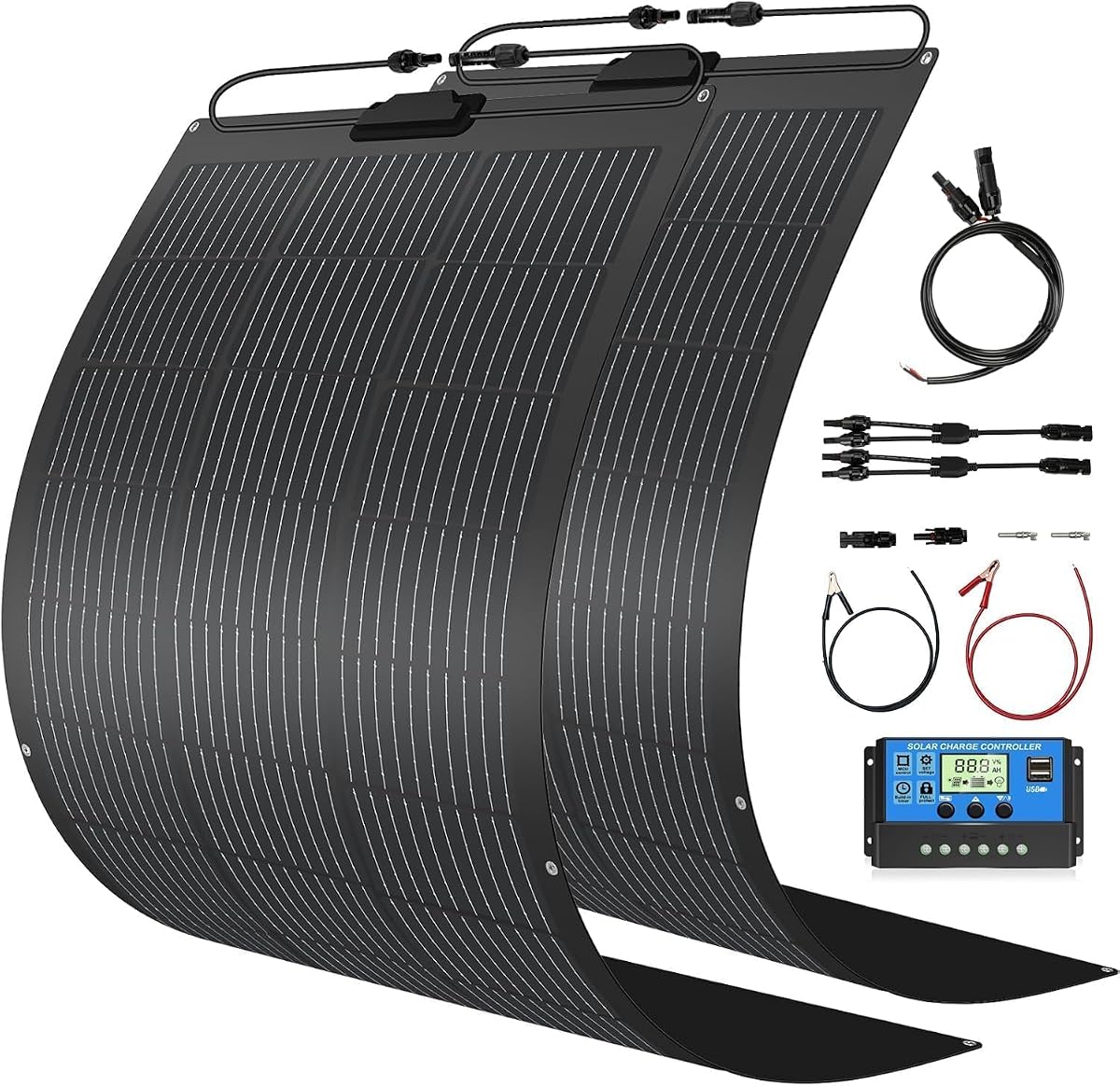
This 800W Solar Panel Kit combines two flexible 400W monocrystalline modules with a 40A charge controller. It is designed for curved or irregular surfaces, including RVs, boats, sailboats, yachts, trucks, cars, coaches, cabins, campers, tents, trailers, and golf carts. No customer rating is shown for this listing, so its value proposition must be assessed primarily from the supplied features.
We may earn a commission when you buy through this link, at no additional cost to you.
The flexible format allows the panels to follow a roof or body contour, while six grommet holes offer attachment with fasteners. Silicone and adhesive tape are also presented as installation options. A sealed, water-resistant junction box supports outdoor use, and the controller inclusion gives buyers a more complete off-grid charging package.
Careful preparation is essential when attaching flexible panels with adhesive. The surface must be clean, dry, and appropriate for the chosen sealant, and edges and cable exits should be protected from abrasion and water intrusion. Buyers should also confirm that the 40A controller supports the selected battery chemistry and system voltage rather than assuming it is universally compatible.
The kit suits mobile installers who value a curved low-profile layout and want a controller in the box. It is less appealing to buyers who need independently certified wind and snow ratings or a substantial history of customer feedback. As with all complete kits, confirm every included component and its specifications before installation.
The ability to conform to curved surfaces broadens the available mounting locations. This is useful on boat roofs and camper bodies where a rigid panel would require a raised frame or substantial adaptation.
The included 40A controller removes one major component from the shopping list. It still requires a battery-bank and power-system review to ensure that voltage, chemistry, and load requirements are properly matched.
We may earn a commission when you buy through this link, at no additional cost to you.
The second 800W flexible kit offers two 400W monocrystalline panels and a 40A solar charge controller. Like the closely related option above, it is oriented toward camping, off-grid charging, and curved marine or vehicle surfaces. The listing does not provide a customer rating, which limits the amount of social proof available for buyers.
We may earn a commission when you buy through this link, at no additional cost to you.
Its flexible construction makes it useful on boats, RVs, trucks, trailers, cabins, campers, and other surfaces that are not flat. The panels have sealed, water-resistant junction boxes, and six grommets allow attachment with fasteners. Silicone and adhesive tape provide alternative installation methods for buyers who cannot drill into a surface.
The controller is the kit's strongest practical addition. A buyer can use the included component as the charging interface between the solar array and a compatible battery bank, while the flexible modules provide a low-profile alternative to rigid panels. The battery system, wiring, and controller settings must still be selected carefully, especially for lithium, gel, and AGM batteries.
This kit is best for value-oriented buyers who know their installation will involve a curved surface and want a coordinated package. It may not be the first choice for buyers seeking detailed load ratings, a long customer-review history, or rigid panels for exposed rooftop mounting. Confirm the package contents and technical specifications before finalizing the installation.
Flexible modules reduce the visual bulk and physical burden associated with framed panels. Their shape also allows placement across irregular surfaces that would otherwise require a custom support structure.
Grommets support mechanical attachment, while adhesive and silicone methods can avoid permanent holes. The correct method depends on the roof material, movement, sealant compatibility, and the need to remove the panels later.
We may earn a commission when you buy through this link, at no additional cost to you.
The EPOCH 860W Bifacial Solar Panels set consists of two 430W modules and has a 4.5 rating, making it one of the strongest customer-rated options in the roundup. It exceeds the nominal 800W target while using a 16BB half-cut cell design, bypass diodes, and Class A-grade solar cells intended to support efficient conversion and consistent long-term output.
We may earn a commission when you buy through this link, at no additional cost to you.
Transparency is listed at up to 91.5%, and efficiency can reach 25%. Bifacial construction captures light from both sides, improving performance when the rear face receives reflected light. The panels also carry stated wind and snow load capabilities of 2400Pa and 5400Pa, respectively, while an IP68 junction box and IP67 MC4 connectors add environmental protection.
The trade-off is installation sophistication. Bifacial performance depends on the mounting environment, and users need enough clearance and suitable reflective surroundings to benefit from the rear surface. As with every 800W-class array, the charge controller and inverter must be sized for the combined current and correctly configured for the battery-bank voltage.
This set is an excellent premium option for permanent home, cabin, RV, rooftop, and marine installations. Pre-drilled mounting holes work with several common bracket styles, and the stated 12-year quality warranty plus 25-year linear power-output warranty provide unusually long coverage. The supplied information also says every panel receives 100% electroluminescence testing to check for microcracks.
Using two 430W modules provides an 860W nominal total, giving the system more headroom than a conventional 800W pair. The higher rating can support larger daily charging goals when sunlight and system conditions permit.
Per-panel electroluminescence testing is intended to identify subtle internal defects before installation. Combined with the stated quality and linear-output warranties, it gives this set a strong long-term ownership profile.
We may earn a commission when you buy through this link, at no additional cost to you.
A useful 800W solar panel is not simply the one with the highest headline wattage. The right choice depends on battery voltage, mounting surface, portability, shading, weather exposure, controller compatibility, and the amount of hardware included in the package.
Prioritize a panel pair that reaches your daily energy target without exceeding the system's electrical limits. Also consider whether the installation needs one high-output array or several smaller arrays with separate shade zones.
Choose a panel and controller combination whose voltage and current ratings agree with your battery bank. Never assume that a kit labeled for 12V and 24V can be wired in any arrangement.
Match panel construction to the mounting surface and how often the system moves. Flexibility and portability are useful features only when they align with the intended installation.
For a space-limited installation, favor higher efficiency, half-cut cell layouts, and shade-aware designs. For an open site with ample area, simpler construction and easier mounting may matter more than a small efficiency advantage.
Check the material ratings and mounting requirements for the actual environment. For marine systems, pay particular attention to connector protection, corrosion resistance, and secure attachment.
List the parts already owned before choosing a bundle. The best kit is the one that fills genuine gaps in the system without including incompatible or unnecessary equipment.
For frequent travel, weigh convenience and storage against permanent capacity. For stationary installations, prioritize secure mounting and low cable-routing complexity instead.
Use ratings and warranty information together, not as substitutes for checking specifications. Read the full warranty terms, confirm what is covered, and investigate whether the listing includes every accessory shown in the product information.
Before installation, map the array's sun exposure, identify mounting points, and calculate the controller and inverter requirements for the combined panel current. Organize the battery bank by chemistry and series-parallel configuration, then confirm that every cable, connector, breaker, and charge controller is rated for the intended voltage and current. Test the components before permanently attaching panels or routing wiring.
Mount rigid panels using the specified brackets and fasteners, keeping the frames secure and the junction boxes free from strain. Flexible panels should be attached to a clean, dry, compatible surface with suitable fasteners or adhesive methods, while foldable panels should be placed on firm, level ground with all adjustable stands locked. Connect the panels according to the planned controller instructions and avoid creating extra cable joints whenever possible.
Keep the surfaces clean by wiping away dust, bird droppings, salt residue, and leaves with a soft damp cloth. Avoid abrasive tools, harsh solvents, and flooding the junction boxes or connectors. Inspect seals, cables, mounting hardware, and connectors periodically, especially after storms or long periods of heavy use. Remove any damaged or hot connector before operating the system, and follow the manufacturer's cleaning, storage, and warranty guidance.
It can be enough for moderate daily loads, but the appropriate size depends on the appliance load, battery capacity, available sunlight, and how long the system must operate without other charging. An 800W array reaches its nominal rating only under favorable conditions, so users with high daily consumption may need more capacity. Include controller, inverter, and conversion losses when estimating usable daily energy.
No, a solar panel should normally feed a compatible charge controller rather than connect directly to a battery. The controller regulates charging voltage and current, protects the battery, and manages the panel's operating behavior. It must support the selected battery chemistry, battery-bank voltage, panel configuration, and combined current.
The correct method depends on the battery bank and the charge controller's input range. Parallel wiring keeps panel voltage at the module's rated level and is commonly used for 12V charging. Series wiring raises voltage and may suit a 24V system, but it should only be used when the controller and other components can safely handle that voltage.
Rigid panels use a glass-and-frame construction that generally performs well in permanent fixed installations and is easy to mount with standard brackets. Flexible panels are lighter, thinner, and able to conform to curved surfaces, making them useful on RVs, vans, and boats. Flexible construction may be less appropriate for every long-term rooftop configuration, so mounting method and surface condition are important.
No. Bifacial panels collect light on both faces, but the rear-side contribution varies with reflective surroundings, mounting clearance, orientation, and other conditions. They can outperform comparable front-only modules in suitable environments, but they should not be assumed to deliver twice the output.
Maintenance is generally modest but important. Keep the glass or ETFE surface free of dust, leaves, salt, and bird droppings, and inspect cables, seals, connectors, and mounting hardware for damage. Flexible adhesive-mounted panels may need their attachment checked periodically, while fixed rigid arrays benefit from occasional roof-access inspections.
Only when the power station's solar input voltage, current, connector type, and charging protocol are compatible with the panel set. Nominal wattage alone is not enough to guarantee compatibility. Check the portable power station's solar input specification and use the required adapter and charge controller arrangement.
It will still generate power, but output will decline as sunlight becomes weaker or the panels are shaded. Snow cover, heavy clouds, shorter days, and high panel temperatures can all affect production. Users in colder or frequently cloudy regions may need more total capacity, a good charge controller, and realistic expectations about seasonal output.
The EPOCH 860W Bifacial set stands out for the highest stated capacity, N-Type construction, bifacial collection, detailed environmental specifications, and long warranty coverage. The Renogy 800W N-Type set is another premium contender, particularly for buyers who value bifacial energy collection and a dual-module approach to partial shade. For curved or mobile surfaces, the flexible monocrystalline kit offers the most attractive combination of lightness, adaptability, and customer rating.
The right decision starts with the installation rather than the product label. Confirm battery-bank voltage, controller limits, inverter requirements, mounting surface, available sunlight, and whether portability matters. Rigid panels fit permanent structures, flexible modules suit curved roofs, and foldable sets serve mobile use, but each format has practical limits that should guide the purchase.
Finally, check the current listing for exact dimensions, included accessories, warranty terms, and customer feedback before ordering. Promotions and prices change, so the live product page remains the best source for current availability and offer details. Use this guide to compare performance, construction, and compatibility rather than choosing on headline wattage alone.