
Heavy Duty 3/4-Inch Regulator
4.5Editor score
140 SCFM rated flow
Seven-to-215 PSI range
Locking composite adjustment knob
An air pressure regulator helps maintain a controlled downstream pressure even when compressor output or air demand changes. A useful model should match your line size, support the required airflow, offer a readable gauge, and provide secure adjustment. These factors matter most for pneumatic tools, spraying, inflation, and workshop equipment.
This guide compares ten air pressure regulators based on their listed thread sizes, pressure ranges, flow capacities, adjustment mechanisms, included components, and suitability for common compressed-air applications. It covers compact 1/4-inch models, higher-flow 1/2-inch and 3/4-inch options, general-purpose regulators, and purpose-built choices for spraying or filter-regulator-lubricator assemblies.
Each review explains the strongest reasons to choose a particular regulator, along with any visible trade-offs in capacity, installation, adjustment, or included hardware. The badge identifies our overall, budget, and premium selections from the full list. Product prices and availability can change, so confirm current listings and compatibility before purchasing.
4.5Editor score

4.5Editor score
4.7Editor score
As an Amazon Associate we earn from qualifying purchases.
The comparison below organizes all ten regulators by port size, pressure capability, airflow rating, and practical equipment needs, making it easier to identify the model that fits your compressor and intended applications.


The SNS AR2000-N02 is a straightforward inline regulator for users who want controlled pressure from a standard air line. It carries a 4.2 rating and includes a mounting bracket and gauge, reducing the need to source basic installation hardware separately. Its quarter-inch NPT connection and zero-to-150 PSI range make it most natural for individual pneumatic tools, spraying setups, inflation equipment, and other modest-flow applications.
We may earn a commission when you buy through this link, at no additional cost to you.
The regulator uses an aluminum alloy body and a 1/4 NPT female thread. Its rated flow is 19.4 SCFM, or 550 liters per minute, while the specified operating temperature range is 41 to 140 degrees Fahrenheit. Adjustment follows a familiar pull-and-turn format: pulling up the rotary knob permits adjustment, clockwise rotation raises the setting, and anticlockwise rotation lowers it.
The principal limitation is its comparatively modest 19.4 SCFM rating. It is not the natural choice for a workshop running several large pneumatic tools at once, and its listed information does not state a maximum inlet pressure. Buyers should also consider whether a 1/4-inch line can physically deliver the volume required by their equipment; reducing downstream pressure does not increase the regulator's rated capacity.
This is a sensible pick for a single-tool or light-duty branch line where the included gauge, bracket, and compact quarter-inch format matter more than maximum flow. Confirm the compressor's outlet rating, match the thread correctly, and use suitable thread sealing. For heavier demand, the PneumaticPlus or 3/4-inch options in this guide provide more capacity.
Including a gauge and mounting bracket makes setup more convenient because the regulator can be installed and monitored without separately locating those basic accessories. The bracket also helps position the unit more securely in a workshop.
The pull-up rotary control provides a clear operating sequence for changing the downstream setting. Once the desired pressure is selected, the regulator is intended to maintain that level as line demand changes.
We may earn a commission when you buy through this link, at no additional cost to you.
The heavy-duty 3/4-inch regulator is built for compressed-air systems that need more capacity than a small branch-line unit can provide. It has a 4.5 rating, a stated 140 SCFM flow rate, and an adjustment range from 7 to 215 PSI. That makes it the strongest high-flow selection here for workshops operating multiple pneumatic devices or feeding a larger distribution point.
We may earn a commission when you buy through this link, at no additional cost to you.
Its inlet can withstand up to 250 PSI, and the 3/4-inch female NPT connections provide a larger air path than the quarter-inch alternatives. The product includes a wall-mounting bracket and gauge, while its high-impact locking composite knob is designed to help maintain a selected setting during demanding use. The listed outside thread diameter is 1.05 inches.
The tradeoff is physical scale and installation complexity. A 3/4-inch regulator is unnecessary for a single small pneumatic tool and may require adapters if the existing compressor hose or air line uses a smaller connection. Buyers should also verify that the compressor, receiver, fittings, and downstream equipment are rated for the intended operating pressure and airflow.
Choose this model when capacity, broad adjustment, and secure control matter more than compact size. It is a strong main-line option for a serious shop with several air tools, while smaller regulators are more appropriate for isolated low-flow branches. Its included hardware and locking control make it especially useful as a central supply regulator.
A listed 140 SCFM flow rate separates this model from the more compact regulators in the guide. That extra capacity is useful when several pneumatic devices may operate without requiring individual pressure branches.
The locking composite knob is intended to hold the adjustment more securely in a busy workshop. It adds practical value where vibration, frequent access, or unintended pressure changes are concerns.
We may earn a commission when you buy through this link, at no additional cost to you.
The PneumaticPlus SAR200-N02BG is a well-rounded 1/4-inch regulator and our overall selection. Its 4.5 rating reflects a combination of useful capacity, a 0-150 PSI adjustment range, and installation features that matter in professional settings. The listed flow rate of 39 SCFM at 90 PSI is notably higher than that of several other quarter-inch models included in the comparison.
We may earn a commission when you buy through this link, at no additional cost to you.
Its relieving design automatically vents downstream pressure when it rises above the selected setpoint, helping protect air tools, actuators, spray guns, and pneumatic machinery. A push-to-lock knob helps preserve the chosen setting under vibration, while the included 0-160 PSI gauge provides immediate pressure visibility. A panel or wall bracket is also supplied.
The main limitation is that the 1/4-inch body constrains the system's maximum practical throughput despite the 39 SCFM rating. It is also not a purely dry-air component: because it is a relieving regulator, excess downstream pressure can be discharged rather than retained. Users who require very high capacity should consider a 1/2-inch or 3/4-inch main-line regulator.
This is the most versatile choice for general-purpose shop and production lines, especially when you want more flow than a basic 1/4-inch model without moving to larger plumbing. It is manufactured to ISO 6953 compressed-air regulator standards and includes a one-year limited manufacturer warranty. For most professional users, its feature balance and clear specifications justify placing it near the top of the list.
Automatically venting excess downstream pressure gives the regulator a useful safety function. This behavior can help maintain the selected working pressure when demand falls or line conditions fluctuate.
The included gauge and mounting bracket cover two common installation needs. They make the unit easier to position for visibility and reduce the number of separate parts required for a basic setup.
We may earn a commission when you buy through this link, at no additional cost to you.
The Ingersoll Rand ARO R37121-600-VS combines a recognizable industrial regulator design with a 1/4-inch NPT connection. It has a 4.3 rating and is listed for a zero-to-140 PSI range with 59 CFM flow capacity. That combination places it among the higher-capacity quarter-inch options in this guide.
We may earn a commission when you buy through this link, at no additional cost to you.
This is a relieving regulator with standard knob control, allowing excess downstream pressure to vent when the pressure rises above the setpoint. Its flush-mount gauge can suit installations where a visible but relatively integrated instrument is preferred. The unit is designed for compressed-air applications that need consistent downstream pressure.
Some important procurement details are not supplied, including a maximum inlet pressure, operating temperature limits, and included mounting hardware. A buyer should not infer those specifications from competing products. It is also important to confirm whether the desired installation method requires a separate mounting arrangement.
This model is most attractive to users who prefer the ARO name and want more flow than compact quarter-inch regulators provide. It works well for individual pneumatic tools or grouped loads when the installation can support the stated 59 CFM. For installations where maximum inlet pressure and accessory details are critical, request current manufacturer documentation before final selection.
The listed 59 CFM capacity is a meaningful advantage when line sizing must remain compact. It offers additional headroom for suitable pneumatic equipment without moving immediately to half-inch or three-quarter-inch plumbing.
As a relieving regulator, the unit can discharge excess downstream pressure to maintain the selected setpoint. This is useful for protecting downstream equipment, although it may create audible venting under some operating conditions.
We may earn a commission when you buy through this link, at no additional cost to you.
The LE LEMATEC Paint Spray Gun Air Pressure Regulator is a focused inline option for controlling air at spray guns and other pneumatic tools. It has a 4.4 rating and a 0-150 PSI integrated gauge, making it appealing to users who want visible control close to the tool rather than only at the compressor.
We may earn a commission when you buy through this link, at no additional cost to you.
Its solid brass body and robust adjustment knob are designed for regular workshop use. The listed quarter-inch male and female threads allow connection to a compressor, hose, or spray gun using common air fittings. The regulator is marketed for automotive painting, airbrushing, tire inflation, and other tasks where controlled airflow can improve consistency and reduce overspray.
The supplied information does not state a rated flow rate or maximum inlet pressure, so those limits should be confirmed before installation. It should not be assumed to deliver the capacity of a higher-flow shop regulator. The tool-focused application is also narrower than that of general-purpose models, although many pneumatic tools can still benefit from its inline adjustment.
This is a compelling pick for painting and detailed spray work where the operator wants convenient local control. Choose it when a solid body, readable gauge, and straightforward quarter-inch connection matter more than a published high-flow rating. It can also serve as a convenient tool-side control when paired with a capable upstream source.
Positioning the regulator close to the tool makes pressure changes immediate and convenient. The integrated gauge helps the operator evaluate airflow while adjusting the coating or pneumatic-tool result.
The solid brass body provides a substantial feel and a material commonly used in air-control hardware. It is a practical choice for users who want an inline regulator dedicated to spraying or individual pneumatic tasks.
We may earn a commission when you buy through this link, at no additional cost to you.
The Primefit CR1401G is presented as a replacement air regulator with a 1/4-inch NPT connection, 1-to-150 PSI adjustment range, and 4.5 rating. Its listed 60 SCFM capacity at 100 PSI is among the strongest quarter-inch figures in this guide, while the stated 200 PSI maximum inlet and 150 PSI maximum output provide useful operating boundaries.
We may earn a commission when you buy through this link, at no additional cost to you.
A steel-protected gauge and high-impact composite adjustment knob are included as standard features. The unit can be configured for right-to-left airflow with the knob on top or left-to-right airflow with the knob on the bottom. This flexibility can be useful when the compressor outlet and desired downstream direction do not align with a single fixed orientation.
Correct airflow direction is essential. The instructions specifically state that the regulator must be configured to match the direction of air, and an incorrect setup can prevent proper operation. A replacement-style product also needs careful compatibility checking; buyers should compare ports, pressure limits, mounting requirements, and flow needs with the unit being replaced.
This model is worth considering when a compact 1/4-inch regulator with high listed flow and clear pressure limits is needed. It is particularly suitable for users who understand directional installation or can verify the orientation before commissioning it. Its combination of capacity, adjustable range, and a protected gauge makes it a strong alternative to the other quarter-inch selections.
A listed 60 SCFM at 100 PSI provides considerable capacity for a quarter-inch design. It may suit moderate-flow tool groups when the surrounding hoses and fittings are also appropriately sized.
Supporting two airflow orientations can simplify certain replacement installations, but orientation must be confirmed before operation. The arrow and knob position should be checked against the actual direction of compressor airflow.
We may earn a commission when you buy through this link, at no additional cost to you.
The Milton 1114-8 stands apart from the quarter-inch and large-line models with its 3/8-inch NPT connection. It has a 4.3 rating and a stated maximum flow of 80 SCFM at 100 PSI. Its identity as a high-pressure FRL regulator also makes it relevant to air-preparation assemblies that combine regulation with filtering or lubrication components.
We may earn a commission when you buy through this link, at no additional cost to you.
The operating temperature range is listed as 40 to 120 degrees Fahrenheit, and the product is made in the United States. The relatively high flow rating makes the compact 3/8-inch format potentially attractive where space is limited but 1/4-inch capacity would be too restrictive. Its mid-sized thread can bridge the gap between common small-tool branches and larger main-line regulators.
The main purchasing consideration is compatibility. A 3/8-inch NPT connection is less universal than 1/4-inch, and existing fittings may not fit without suitable adapters. The supplied information also does not list a pressure range, included gauge, or mounting hardware, so buyers should confirm the full configuration and current documentation.
This is a specialized option for users with a compatible 3/8-inch air-preparation setup or a need for a compact, higher-flow FRL-style regulator. It is not the safest automatic choice for an unfamiliar installation because several common selection details are absent from the provided specifications. Verify thread size, pressure capability, accessories, and flow requirements before buying.
The 3/8-inch NPT port offers a practical middle ground between quarter-inch branches and half-inch main lines. It can help avoid unnecessary enlargement while supporting a listed 80 SCFM at 100 PSI.
Its FRL regulator designation makes it relevant to assemblies where pressure regulation is combined with filtration or lubrication. Buyers should match the complete air-treatment configuration to their equipment rather than treating it as a universal standalone regulator.
We may earn a commission when you buy through this link, at no additional cost to you.
The 3/4-inch Air Pressure Regulator is a large-port option aimed at compressed-air systems requiring substantial line capacity. It has a 4.4 rating, an adjustable range from 7 to 225 PSI, and a maximum stated pressure of 225 PSI. The broad control range covers many workshop and general pneumatic applications.
We may earn a commission when you buy through this link, at no additional cost to you.
Both main connections use 3/4-inch female NPT threads. Two outer 1/4-inch gauge ports allow the gauge to be placed on either side, and a plug is provided for the unused position. A free wall-mounting bracket and clear IN and OUT markings are also supplied, which supports organized installation and correct flow orientation.
Although its physical size indicates a high-capacity design, the supplied product information does not provide a specific SCFM rating. Buyers should therefore verify airflow independently rather than assuming it matches the 140 SCFM model in this guide. The large threads also mean it is unsuitable for a small hose branch without appropriately sized adapters and fittings.
Choose this regulator for a workshop main line, a compressor feeding multiple pneumatic circuits, or an installation that already uses three-quarter-inch plumbing. Its flexible gauge placement and included bracket make it practical to integrate. The main reason to hesitate is the lack of a published flow figure, particularly for buyers with a precisely calculated demand.
Two gauge ports offer installation flexibility that single-side designs cannot provide. Choosing the more accessible side can make pressure readings easier to check during routine work.
A seven-to-225 PSI adjustment range serves equipment with widely differing pressure requirements. The pull-to-unlock and push-to-lock control helps distinguish the setting from an active adjustment state.
We may earn a commission when you buy through this link, at no additional cost to you.
The 1/2-inch Air Pressure Regulator offers a middle-sized connection for compressed-air installations that have outgrown quarter-inch branch lines but do not need the physical scale of a three-quarter-inch model. It holds a 4.4 rating and regulates from 7 to 225 PSI, giving users a broad working range.
We may earn a commission when you buy through this link, at no additional cost to you.
The listed construction includes a durable aluminum body and corrosion-resistant components. It includes a steel wall-mount bracket, clear IN and OUT labels, flow arrows, a 0-to-230 PSI gauge, two 1/4-inch gauge ports, and a plug for the unused port. The operating temperature is listed as up to 140 degrees Fahrenheit.
As with the 3/4-inch companion model, a specific rated airflow is not provided. That omission limits certainty for an engineered system with a closely calculated load. The half-inch thread also requires a compatible main line; adding it to a one-quarter-inch hose with improvised fittings is not an appropriate way to obtain additional flow.
This model is well suited to a shop central supply line or a compressor feeding a moderate group of pneumatic tools. It is particularly attractive for users who want installation flexibility without moving directly to large three-quarter-inch hardware. Confirm the actual flow requirement, current temperature conditions, and all connection sizes before ordering.
The half-inch connection gives installers a useful middle option between compact tool branches and high-capacity shop mains. It is a natural fit when the surrounding air system already uses that pipe size.
The aluminum body, corrosion-resistant components, and steel bracket support regular workshop installation. Two gauge-port positions and the supplied plug let the installer orient the instrument for convenient access.
We may earn a commission when you buy through this link, at no additional cost to you.
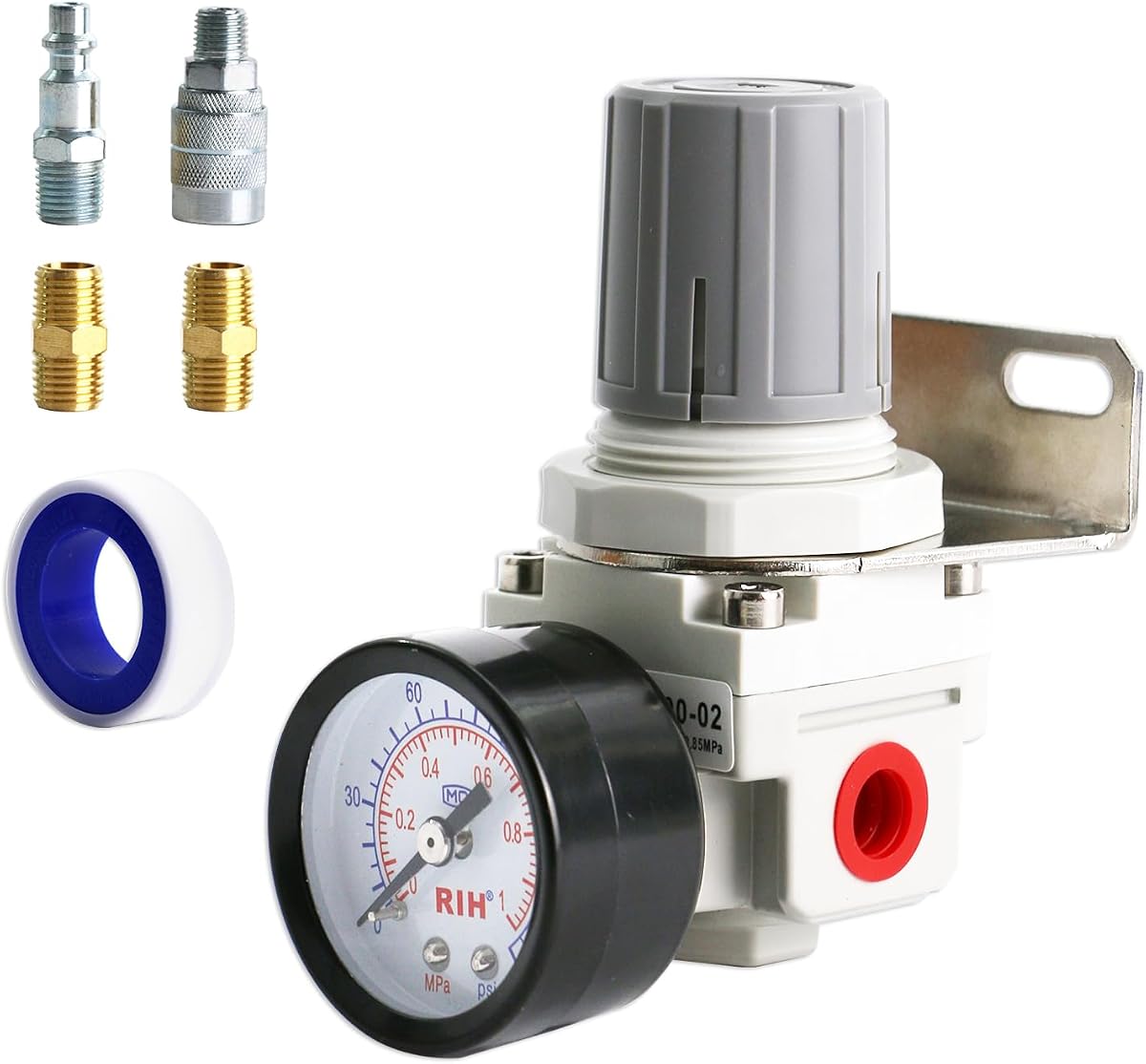
The RIH AR2000-02 is a compact quarter-inch regulator with a 4.7 rating, the highest customer rating among the ten products in this guide. It is intended to lower or maintain downstream air pressure, and its aluminum body, 0-150 PSI gauge, and pull-and-turn knob give it a straightforward setup for individual tools and light pneumatic duties.
We may earn a commission when you buy through this link, at no additional cost to you.
The package includes more than the bare regulator: users receive the body, gauge, bracket, an air-coupler and plug kit, thread seal tape, and two 1/4-inch NPT fittings. Its listed flow rate is 20 SCFM, or 550 liters per minute, at 90 PSI, while the working temperature range is 32 to 140 degrees Fahrenheit.
The maximum pressure is listed as 145 PSI, which is lower than the inlet or maximum ratings given for several alternatives. That makes upstream verification especially important if the compressor receiver can build pressure above the regulator's stated limit. Its 20 SCFM rating also limits performance when several tools operate simultaneously.
This is an attractive budget pick when the goal is a complete, ready-to-install quarter-inch assembly without sourcing several accessories separately. Choose it for a single pneumatic tool, spray-gun branch, inflation use, or other modest-flow application. For a busy workshop main line, choose a model with greater flow and a clearly stated higher inlet rating.
The included couplers, plug, fittings, and thread seal tape cover several common setup items. This package is especially useful for users creating a new regulator branch rather than replacing a fully equipped assembly.
A 20 SCFM rating and aluminum body keep the unit appropriate for modest-flow air lines. It is most useful when convenient adjustment and a complete accessory bundle matter more than serving a multi-tool system.
We may earn a commission when you buy through this link, at no additional cost to you.
Choosing an air pressure regulator requires matching line size, airflow, pressure limits, adjustment style, and installation conditions to the equipment being supplied. The most important starting point is the compressor and tool requirements rather than simply the largest or smallest available model.
The port connection must match the compressor outlet, hose, manifold, and downstream fitting. Most individual-tool setups use 1/4-inch NPT, while larger shop main lines commonly use 1/2-inch or 3/4-inch NPT. The Milton 1114-8 offers a less common 3/8-inch NPT option. A mismatched thread may require adapters, and adapters can add restriction or leak points if they are not installed correctly.
Check both inlet and outlet threads rather than assuming they are interchangeable. Some products in this guide specify female NPT main ports, while the LE LEMATEC model has both male and female quarter-inch sides. Measure the existing fittings and identify whether the regulator will sit directly on the hose, inside a wall, or on a manifold.
The regulator's SCFM rating should exceed the combined airflow required by the connected equipment under normal working conditions. Models range from 19.4 or 20 SCFM for compact branches to 140 SCFM for the heavy-duty 3/4-inch model. The Primefit and Ingersoll Rand options also list relatively high quarter-inch capacities, while two large-port products omit a specific flow figure.
Do not select a regulator only by outlet diameter. A larger fitting does not guarantee a published flow rate, and a small regulator cannot overcome its capacity limit by lowering pressure. Compare the compressor's delivery capability, receiver size, hose diameter, and tool requirements. Where several tools can run simultaneously, choose a main-line model and consider separate branches to prevent one tool from starving another.
Both maximum inlet pressure and maximum output pressure matter. The heavy-duty 3/4-inch model lists a 250 PSI maximum input, the PneumaticPlus lists a 250 PSI maximum supply, and the Primefit lists 200 PSI maximum inlet and 150 PSI maximum output. The RIH model lists a lower 145 PSI maximum pressure. A regulator must be suitable for the maximum pressure produced by the compressor, not merely the desired tool pressure.
Check receiver and compressor ratings before installation. Also consider temperature, which can influence both compressor output and the regulator's operating environment. When a listing omits a maximum inlet pressure, as several entries do, seek current manufacturer specifications instead of assuming it equals the gauge range or the compressor's shutoff pressure.
Many of the listed regulators use a pull-to-unlock control that must be held or extended while the knob is turned, followed by pushing it inward to lock the setting. The PneumaticPlus uses a push-to-lock adjustment knob, while the SNS and RIH units use pull-up rotary knobs. The Ingersoll Rand model provides standard knob control, and the heavy-duty model uses a high-impact locking composite knob.
Select a control that is easy to reach and provides positive feedback when locked. Positive locking is particularly helpful in workshops where vibration or accidental contact could change the pressure. If another user will service the equipment, favor a visible lock position and a plainly marked adjustment direction over a design that is difficult to distinguish between unlocked and locked states.
A gauge makes it easier to set and monitor downstream pressure, while a bracket can keep the regulator stable and visible. The SNS, PneumaticPlus, heavy-duty 3/4-inch model, 3/4-inch unit, half-inch unit, and RIH model are listed as including gauges and mounting brackets. The Ingersoll Rand has a flush-mount gauge, while some listings do not specify included installation hardware.
Consider where the unit will be mounted and who needs to read it. A flush-mount gauge may suit a panel, while a bracket-mounted gauge is convenient for an open shop wall. If a gauge is not included, verify the thread size and range before assuming another gauge will fit. Also ensure that the bracket can support the regulator without obstructing adjustment or connections.
A relieving regulator can vent excess downstream pressure when pressure rises above the selected setpoint. The PneumaticPlus and Ingersoll Rand are explicitly described as relieving units, which can be helpful for protecting tools and actuators. Such a design may produce audible or continuous exhaust under certain conditions, so it should be evaluated against the user's equipment and safety expectations.
Directional models add another installation requirement. The Primefit can be configured for right-to-left or left-to-right flow depending on knob position, while the 3/4-inch and half-inch products use marked IN and OUT ports and flow arrows. Confirm airflow direction before operating the regulator. Incorrect orientation can prevent it from regulating correctly and may leave the installation in an unsatisfactory operating state.
General workshop users should prioritize flow, clear pressure limits, locking control, and sturdy mounting. Spray-focused users may prefer the LE LEMATEC model because its gauge and inline design place convenient airflow control near the gun. A replacement installation may make the Primefit particularly relevant, while the Milton unit may suit a compatible FRL configuration. The large 1/2-inch and 3/4-inch models make more sense for central shop lines than single small tools.
Avoid selecting a regulator simply because it appears specialized. A spray gun may use a low-flow line, while multiple inflating or pneumatic tools may need far more volume than the spray designation suggests. List the connected equipment, required operating pressures, duty cycle, and installation environment before choosing the model. That process usually reveals whether a compact branch regulator, mid-sized FRL unit, or high-capacity main-line regulator is appropriate.
The RIH model has the most explicitly itemized accessory package, including fittings, an air-coupler and plug kit, and thread seal tape. Other products prominently include a gauge and bracket, while the detailed contents of a few listings are less explicit. A complete package can simplify a new installation, but it can also introduce adapters that are unnecessary for an existing system.
Compare the package with your actual needs. Do not count duplicate fittings as value if they do not match your line. Likewise, a supplied gauge is useful only if its range adequately reflects the pressures you intend to monitor. Confirm included parts, dimensions, connection orientation, and installation requirements before completing an order.
Begin by confirming that the regulator's thread size, airflow rating, maximum inlet pressure, and temperature range suit the compressor and connected equipment. Install it in the correct airflow direction, using marked IN and OUT ports or arrows where provided. Apply suitable thread seal to tapered NPT connections, tighten carefully without exceeding fitting or housing limits, and position the gauge where it can be read safely.
Open the compressor's airflow path and allow the system to pressurize before making a final adjustment. Pull up or release the adjustment control, turn it according to the marked direction, and then engage the lock. If the regulator has a relief or venting function, confirm that the discharge area is unobstructed and acceptable for the workshop. Test the setup with the intended tool and watch the gauge while the tool operates under load.
For maintenance, isolate and depressurize the air line before removing the regulator or any fitting. Check connections for leakage, inspect the adjustment mechanism, and confirm that the gauge remains readable. Replace damaged seals or thread tape as needed, and keep the inlet filter or moisture control in the system clean. Do not exceed the regulator's maximum pressure, and have unusually noisy, unstable, or leaking units inspected before continued use.
A 1/4-inch NPT regulator is common for individual pneumatic tools, spray guns, and small air accessories. A 1/2-inch model is more appropriate when several tools may share a central line, while a 3/4-inch regulator suits higher-capacity shop distribution. Base the decision on both connection size and rated airflow rather than assuming a larger port automatically provides enough capacity.
It can be used if the regulator's listed flow capacity covers the combined demand and the hoses and fittings are also appropriately sized. A quarter-inch model with a 60 SCFM rating may handle some grouped loads, but lower-capacity units are better for one tool or a small branch. A shared system often performs more consistently with a larger main-line regulator and separate branches.
A relieving regulator can discharge excess downstream air when the pressure rises above the selected setpoint. This helps keep pressure near the chosen level and protects downstream equipment from pressure spikes. It may produce audible venting, and the discharge should be directed safely away from people, finished surfaces, and equipment.
Start the compressor, allow the line to fill, and connect the intended equipment. Unlock the adjustment control, increase or decrease pressure according to the manufacturer's direction, and lock the knob in place. Watch the gauge while the tool operates because pressure can respond differently under load. Confirm that the selected setting remains within the requirements of both the regulator and the connected device.
The regulator must tolerate the maximum pressure available from the compressor and provide a range that includes the required tool pressure. Several models offer maximum inlet ratings from 145 to 250 PSI, but the RIH model's lower limit warrants particular attention. If a listing does not state the maximum input pressure, obtain current manufacturer specifications before connecting it to a high-pressure system.
A gauge is highly useful because it allows you to confirm downstream pressure rather than relying only on compressor settings. A bracket helps keep the regulator stable, visible, and away from moving parts. Several models include both accessories, but others do not list them clearly, so check the package contents and plan to source compatible components when needed.
First confirm that the airflow direction is correct, especially on units with configurable or directional inlet and outlet sides. Check that the adjustment knob is unlocked during adjustment and fully locked afterward, and verify that the gauge and regulator are reading the downstream side you expect. Leaking fittings, an undersized supply line, or demand beyond the regulator's rated capacity can also create unstable readings.
A shared regulator may work when its pressure range and airflow satisfy both the spray gun and the tools. A tool-specific model such as the LE LEMATEC regulator is convenient for painting, while a higher-capacity general regulator may be better for multiple pneumatic tools. Separate branches often make pressure control easier when tools require different settings.
The PneumaticPlus SAR200-N02BG is the strongest all-around choice because it combines a 39 SCFM listed flow rate, a zero-to-150 PSI range, relieving behavior, secure locking control, and included installation hardware. The heavy-duty 3/4-inch regulator is the better main-line option when 140 SCFM capacity and a wide adjustment range are priorities, while the RIH AR2000-02 is the best budget-oriented package for a compact quarter-inch branch.
Start with your compressor, line size, tools, and required pressure rather than choosing by appearance. Quarter-inch models suit many individual tools, half-inch and three-quarter-inch models make more sense for shared workshop lines, and FRL-style units should be matched to the rest of the air-preparation system. Pay particular attention to maximum inlet pressure, rated airflow, flow direction, and whether the gauge and bracket are included.
Finally, check the current listing before purchasing because product prices, package contents, and availability can change. Confirm the actual port size, compare the regulator's pressure limits with your compressor's maximum output, and make sure the rated flow covers expected demand. With those checks completed, the right regulator should provide more stable pressure, clearer monitoring, and better control across pneumatic tools, spraying equipment, inflation tasks, or workshop air distribution.