
Anker USB Charger Block, 67W GaN Wall Charger, 3-Port Compact Fast Charging
4.6Editor score
Up to 67W single-device output
Two USB-C and one USB-A
Compact GaN construction
ActiveShield 2.0 safeguards
Our Anker USB Charging Block guide compares ten Anker wall chargers for power, portability, port count, safety, and ideal everyday use for travel in 2026.
An Anker USB charging block can replace several bulky adapters while keeping phones, tablets, earbuds, and compatible notebooks powered from one wall outlet. The best model depends on the number of devices you charge, the power each device accepts, and how much space you need to save.
We compared these ten chargers by examining their stated wattage, port configurations, supported charging technologies, dimensions, safety systems, and intended uses. The list covers compact single-device options, flexible two-port chargers, GaN models, and high-capacity desktop charging stations.
Each recommendation highlights a different practical advantage, from dedicated phone charging to simultaneous laptop and device charging. Product ratings, features, and availability can change, so readers should confirm the current listing, compatibility, warranty, and included accessories before purchasing.
4.6Editor score

4.8Editor score

4.8Editor score
The table below compares all ten Anker charging blocks by maximum power, port count, portability, and best-suited charging scenario. It makes it easier to identify the right model for a phone-only setup, a travel kit, or a multi-device desk.




The Anker Zolo USB C Charger Block combines four ports, a maximum output of 50W, and a two-pack format, making it the most versatile all-around choice in this guide. Its 4.8 rating reflects a particularly attractive balance of charging capacity, portability, and device coverage. It is especially useful for travelers, families, and anyone who regularly carries more than one powered device.
We may earn a commission when you buy through this link, at no additional cost to you.
Its two USB-C ports and two USB-A ports allow up to four devices to charge at once. The product information states that USB-C1 maintains its full 30W output when both USB-C ports are used, while USB-C2 delivers up to 20W. That makes the charger well suited to a phone, tablet, earbuds case, and power bank, although its 50W ceiling means it is not the first choice for a high-power USB-C notebook.
The included foldable plugs make the two chargers easier to pack, and their stated size is similar to a small charging accessory rather than a conventional power brick. ActiveShield 4.0 adds 24-hour temperature monitoring, upgraded GaN architecture, and protection-focused power management. One trade-off is that the package does not mention charging cables, so users may need compatible USB-C or USB-A cables of their own.
This is the right recommendation for people who want one compact charging solution to cover several devices without moving to a larger desktop hub. The two-pack also allows one charger to remain at home or in the office while another travels. Choose it over a single-port model if port variety and simultaneous charging matter more than maximum single-device laptop power.
The mixed USB-C and USB-A layout is more useful than adding several identical ports because it supports newer phones, tablets, and accessories alongside legacy USB-A hardware. With four devices connected, the charger becomes a practical all-purpose power source for a desk, suitcase, or shared travel bag.
Receiving two chargers adds useful placement flexibility without changing the core design. One can remain in a carry-on while the other stays in a bedside outlet, and both benefit from foldable plugs that reduce snagging and make packing easier.
We may earn a commission when you buy through this link, at no additional cost to you.
The Anker 33W two-port charger is a strong choice for travelers who want more power than a basic phone adapter without carrying a large laptop charger. It earns a 4.7 rating and offers a USB-C port with up to 33W alongside a USB-A port, allowing a phone and accessory such as earbuds or a power bank to charge together.
We may earn a commission when you buy through this link, at no additional cost to you.
The USB-C port uses Power Delivery and is described as capable of charging compatible iPhones, iPads, Galaxy devices, and Pixels up to three times faster than standard chargers. That statement depends on the device, its cable, and the charging protocol it supports. The second USB-A port expands compatibility with older accessories and makes the charger a more complete travel companion than a single USB-C model.
Its compact body and foldable plug are important advantages because the charger can be moved between a home, office, and carry-on without taking up much room. ActiveShield provides continuous temperature monitoring and intelligent output control. The main limitation is that 33W is insufficient for the fastest charging of many USB-C notebooks, and the two-port layout offers less flexibility than the four-port Zolo model.
Choose this charger for a travel bag, a mixed phone-and-tablet setup, or an everyday outlet where two devices need power at once. It is a more capable option than the single-port Nano Pro while remaining less bulky and less demanding than the 65W and 67W GaN chargers.
The 33W output provides more headroom than conventional low-wattage wall adapters while remaining suitable for common travel electronics. It is a sensible middle point for users who charge one modern device and one smaller accessory at the same time.
Combining USB-C with USB-A removes the need to carry separate adapters for newer and older devices. The two-port arrangement also reduces outlet congestion, which can be valuable in hotels, airports, and crowded workspaces.
We may earn a commission when you buy through this link, at no additional cost to you.
The Anker two-pack 12W wall charger remains a straightforward option for users centered on older USB-A accessories. Its 4.7 rating and two included chargers offer dependable everyday charging for compatible phones, tablets, headphones, and portable batteries. The design is especially appealing for households that want a compact adapter in several rooms.
We may earn a commission when you buy through this link, at no additional cost to you.
PowerIQ detects connected devices and adjusts the voltage output, while two USB-A ports support simultaneous charging. The stated compatibility list includes several iPhone, iPad, Samsung Galaxy Note, HTC, and Moto models, although current devices should be checked for their required connector and charging standard. The package includes two PowerPort mini compact wall chargers and an 18-month warranty.
The charger is smaller than a golf ball and has a foldable plug, helping it fit into smaller outlets and travel bags. An 11-point safety system covers concerns such as overvoltage and temperature control. Its limitations are clear: the 12W output is modest, all ports are USB-A, and Qualcomm Quick Charge is not supported.
This model makes the most sense for legacy USB-A equipment, backup adapters, or a simple two-device setup where fast laptop charging is irrelevant. For a modern phone or tablet, a USB-C model with greater wattage will usually be more versatile, but this two-pack remains useful for older devices and inexpensive secondary charging locations.
The two USB-A ports support a broad collection of phones, earbuds, older tablets, and small accessories that still rely on USB-A. PowerIQ helps tailor the output to recognized devices, making the adapter convenient for mixed but relatively simple charging needs.
The two-pack format is more valuable here than in a higher-power model because each unit is small and intended for light-duty charging. One charger can remain in a bedroom while the other travels or sits in an office.
We may earn a commission when you buy through this link, at no additional cost to you.
The Anker 65W Nano II is the leading choice in this guide for buyers who want one compact block that can charge a phone, tablet, and compatible USB-C notebook. Its 4.7 rating reflects a capable combination of portability and high single-device power. The stated 65W output is sufficient for a 2020 MacBook Pro 13-inch when connected alone.
We may earn a commission when you buy through this link, at no additional cost to you.
Two USB-C ports and one USB-A port allow up to three devices to be connected. When only one device is attached, it can receive the full 65W maximum; with several devices connected, output is distributed efficiently among the ports. This behavior makes the charger suitable for both solo notebook charging and a mixed desktop setup, provided the device combination does not exceed the available power.
GaN II technology supports the compact construction by increasing operating frequency, stacking components, and improving the circuit board structure. The result is described as roughly the size of an AirPods Pro case, a meaningful reduction from a traditional 65W wall brick. The package includes the charger, welcome guide, and 18-month warranty, but no cable is mentioned.
Choose this model if your power needs extend beyond a phone but the charger must remain easy to carry. It outperforms compact phone-only blocks for tablets and notebooks, yet it is less flexible than the four-port Zolo for many small USB-A accessories. It is an excellent middle option for a mixed mobile and lightweight computing setup.
A 65W ceiling makes the Nano II relevant to compatible 13-inch notebooks, including the 2020 MacBook Pro 13-inch cited in the product information. Users should verify their notebook's charging requirements and use a cable capable of carrying the required power.
The GaN II platform provides high output in a body much smaller than the original 65W MacBook charger. That reduction is valuable in a carry-on, laptop sleeve, or crowded travel bag where every bit of space matters.
We may earn a commission when you buy through this link, at no additional cost to you.
The Anker 112W desktop charger is the most capable multi-device option here, with six ports and enough aggregate power to serve a collection of phones, tablets, laptops, and accessories. Its 4.7 rating reflects a broad charging capacity paired with a relatively compact footprint of 3.0 by 3.2 by 1.3 inches.
We may earn a commission when you buy through this link, at no additional cost to you.
Three USB-C ports and three USB-A ports share 112W of total output. A single USB-C connection can deliver up to 30W, while a single USB-A port can provide up to 18W. The product information specifically notes that 30W charging for MacBook Air is limited to USB-C1, an important detail for anyone planning to use the hub with a notebook.
The stated performance includes charging a MacBook Air to 50% in one hour and 40 minutes and an iPhone 16 Pro Max to 50% in 30 minutes under the relevant conditions. A silicone cable organizer is included to help reduce desk clutter. USB-C charging cables are not included, so buyers must supply the correct cables for their devices and the highest-output port they intend to use.
This charger is best for a busy desk, shared workspace, or household with many low- to medium-power devices. It can replace several small wall chargers, but its higher capacity and larger body make it less convenient for minimalist travel. For one or two devices, a smaller Nano or 33W model would be easier to carry.
Six ports allow phones, tablets, earbuds, power banks, and other USB-powered accessories to remain connected to one wall outlet. The combination of three USB-C and three USB-A ports makes the hub useful for collections that still contain legacy hardware.
The included silicone organizer gives users a simple way to keep charging leads grouped and accessible. Combined with the six-port layout, it can turn a collection of separate adapters into a more orderly workstation.
We may earn a commission when you buy through this link, at no additional cost to you.
The Anker 20W two-port charger focuses on the needs of phone owners who also want to keep a small USB-A accessory powered. Its 4.6 rating reflects a simple, practical design that delivers up to 20W through USB-C while permitting USB-C and USB-A devices to charge simultaneously.
We may earn a commission when you buy through this link, at no additional cost to you.
The 20W output is suitable for compatible iPhones, Samsung phones, and other USB-C devices that support the relevant fast-charging standard. The second USB-A port is useful for earbuds, older accessories, or a power bank that does not use USB-C. The product information states that both ports can operate without compromising speed or performance, though the charger is limited by its overall 20W capacity.
One of the most convenient features is the inclusion of two five-foot USB-C to USB-C cables. Users can charge a compatible phone immediately and keep a second cable in a bag or vehicle without buying one. Overvoltage protection, temperature control, and other safety measures are also included.
Choose this charger for an everyday phone-and-accessory setup or as an easy-to-justify second adapter for travel. It offers more flexibility than the single-port Nano Pro, but its 20W ceiling and lack of USB-A-only ports make it less suitable for tablets and notebooks. It is most convincing for users charging two relatively modest devices.
Including two USB-C to USB-C cables removes a common source of setup friction. One cable can stay with the charger while another moves to a desk, bedroom, or travel bag, and the five-foot length provides useful reach in many locations.
The USB-A port gives the charger broader usefulness than a USB-C-only block. It can handle a pair of earbuds, a portable battery, or another legacy accessory while a modern phone uses the main USB-C connection.
We may earn a commission when you buy through this link, at no additional cost to you.
The Anker 60W six-port USB charging hub is built for environments that contain many USB-A-powered devices. Its 4.8 rating is among the highest in this guide, and the six-port arrangement offers an easy way to consolidate chargers for a shared desk, classroom, office, or large household collection.
We may earn a commission when you buy through this link, at no additional cost to you.
PowerIQ and VoltageBoost distribute up to 2.4 amps per port, with a cumulative 12 amps across the hub. The 60W output is shared across connected devices, so each device receives an appropriate portion based on the overall load. The product supports 100–240V input, allowing use in many international locations with a suitable plug adapter.
Its USB-A-only design is the primary limitation in a modern context. It does not support Qualcomm Quick Charge and cannot provide the high USB-C power demanded by many tablets or notebooks. The detachable five-foot power cord adds placement flexibility, and a hook-and-loop strip is included for cable management.
This hub is best for teams or households with numerous older accessories, such as multiple phones, headphones, game controllers, and battery packs. It can organize a charging area efficiently, but anyone starting with modern USB-C equipment may prefer the 112W desktop charger, which combines USB-A convenience with USB-C power delivery.
Six USB-A ports mean several small devices can remain connected at the same time without requiring separate wall outlets. That is especially useful in offices, studios, guest rooms, and homes where devices accumulate throughout the day.
The stated 100–240V input range makes the hub suitable for international use with an appropriate country plug. The detachable cord also allows it to be positioned more flexibly than a charger with a permanently attached lead.
We may earn a commission when you buy through this link, at no additional cost to you.
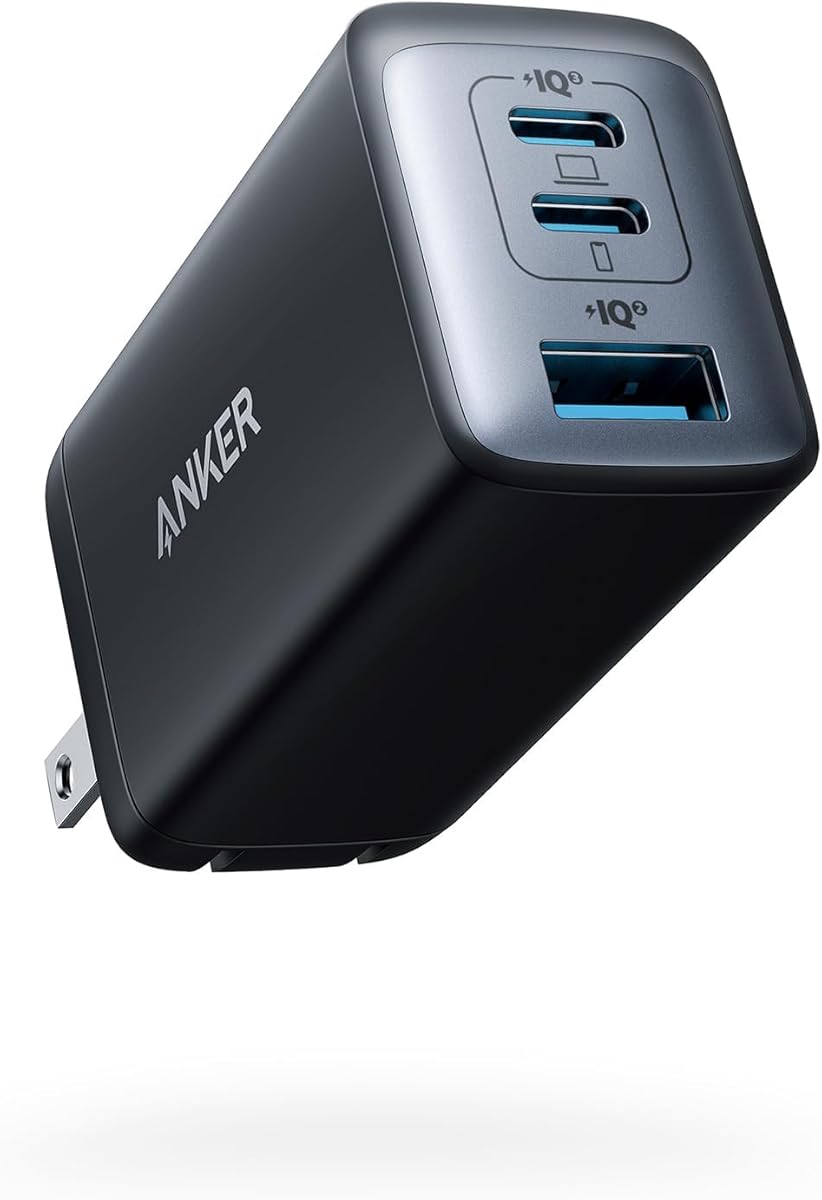
The Anker Prime 67W GaN Wall Charger is the premium choice in this roundup because it combines the highest stated single-device output with a remarkably small three-port design. It holds a 4.6 rating and is built for users who need serious charging power without carrying the original bulky 67W MacBook charger.
We may earn a commission when you buy through this link, at no additional cost to you.
With two USB-C ports and one USB-A port, the charger can handle a phone, tablet, and notebook together. A single connected device can receive up to 67W, while using two ports provides a maximum of 65W whether both connections are USB-C or one is USB-C and the other USB-A. Actual output varies with the devices and their supported charging protocols.
GaN construction allows the charger to be 51% smaller than the original 67W MacBook charger, making it much more travel-friendly. ActiveShield 2.0 provides built-in safeguards, and the package includes a 24-month warranty. The primary practical drawback is that no cable is included, so users need a USB-C cable rated for the power and protocol they intend to use.
Choose this model when you want a premium, compact charger that can handle a demanding device alone and still support a two- or three-device setup. It is especially relevant to frequent travelers who need notebook-class power. Users who only charge two phones and accessories will receive less benefit from the 67W ceiling than the Zolo's four-port flexibility.
The key benefit is high charging capacity in a housing substantially smaller than the original 67W notebook charger. GaN technology makes that reduction possible, so the charger is easier to carry while retaining a power level suited to demanding devices.
Three ports and a 65W two-port maximum let the charger serve more than a phone without becoming a large desktop hub. This creates a useful middle ground for travelers who alternate between a notebook, tablet, phone, and smaller accessory.
We may earn a commission when you buy through this link, at no additional cost to you.
The Anker Nano Pro 20W is a focused phone charger that delivers modern fast-charging performance in a notably small body. Its 4.8 rating makes it one of the most well-regarded options here, while the single USB-C port and 20W maximum output align closely with the needs of compatible iPhones and other USB-C devices.
We may earn a commission when you buy through this link, at no additional cost to you.
The charger is designed to provide full-speed 20W charging for the iPhone 16 and can charge it to 50% in approximately 25 minutes under the stated conditions. This is reported as up to three times faster than an older 5W charger. Performance on other devices depends on their charging protocols, so buyers should verify compatibility before expecting identical results.
PIQ 3.0 technology, a Dynamic Temperature Sensor, and a Power Tuner Chip form part of the charging and safety system. The body is 45% smaller than the original 20W charger without reducing its stated power. An 18-month warranty is included, but a cable is not.
This is the best recommendation for someone who mainly charges one compatible phone and values a tiny, uncomplicated adapter. Its single-port design means it cannot charge a phone and earbuds together, and the 20W limit does not extend to laptops. Even with those boundaries, it is one of the most practical ways to replace a bulky legacy phone adapter.
Moving from a basic 5W adapter to a compatible 20W charger can materially shorten charging time while taking up less room. The combination of fast output and a body 45% smaller than the original 20W model makes this useful for travel and everyday carry.
The Dynamic Temperature Sensor monitors heat, while the Power Tuner Chip adjusts power output to safeguard connected devices. These features make the compact charger better suited to regular use than an unprotected generic wall adapter.
We may earn a commission when you buy through this link, at no additional cost to you.
The Anker Nano 30W charger delivers more power than a basic phone adapter while retaining the extreme portability associated with the Nano range. It carries a 4.8 rating and offers a useful middle ground between a 20W single-device charger and a larger multi-port block.
We may earn a commission when you buy through this link, at no additional cost to you.
Its 30W output can provide full-speed charging for iPhone 15 Pro and Pro Max models and can charge an iPad Air fifth generation to 50% in approximately 45 minutes, according to the product information. It also supports Samsung Super Fast Charging at 25W. Compatibility and actual charging speed depend on the connected device, its protocol, and the cable used.
The charger is only 1.12 inches thick and is described as 70% smaller than the original 30W charger. Its foldable plug and GaN construction make it easy to carry, while ActiveShield 2.0 monitors temperature more than three million times per day. A 24-month warranty is included, though a cable is not.
Choose the Nano 30W for a phone-first travel kit, a compact office setup, or a user who wants faster charging than the 20W Nano Pro in a similarly small format. It cannot charge multiple devices and its 30W maximum is below the requirements of most notebooks. Within those limits, it offers an attractive balance of speed, size, and protection.
The 30W output offers useful headroom for compatible phones and tablets while preserving the small footprint of the Nano form. It is a practical upgrade for anyone who finds 20W limiting but does not need multiple ports.
At just 1.12 inches thick, with a foldable plug, the charger takes up very little room in a pocket, laptop sleeve, or carry-on. Its GaN-based construction explains how 30W can be packed into such a narrow body.
We may earn a commission when you buy through this link, at no additional cost to you.
Choosing an Anker USB charging block starts with the devices you use, the number of ports you need, and the charging power each device requires. The following factors help separate a convenient phone adapter from a capable travel charger or desktop charging hub.
Maximum wattage is the first specification to compare because it indicates the highest output the charger can deliver to a single device. A compact 20W or 30W USB-C model is appropriate for many phones and smaller tablets, while 65W or 67W models are more relevant to compatible USB-C notebooks. Higher total output does not automatically mean each device receives that amount when several are connected, so the product's power-sharing rules matter as much as the headline figure.
Choose enough power for your largest device, not merely the largest number printed on the box.
The number of ports determines how many devices can charge at once, but the connector mix determines whether they can use the charger. USB-C serves modern phones, tablets, and many notebooks, while USB-A remains important for legacy accessories, power banks, and some headphones. Two-port models suit a phone and small accessory; four- and six-port hubs serve crowded desks; a single-port design is simplest but prevents simultaneous charging.
Match the port layout to the connectors and quantity of devices you regularly carry.
Some chargers advertise a high maximum wattage that is available only when one device is connected. When several devices draw power simultaneously, output is redistributed among the ports. The 65W Nano II, for example, reaches 65W with a single device and distributes power when three are attached, while the 112W desktop charger offers up to 30W on one USB-C port but has a larger shared pool for six devices.
Check both the single-port rating and the combined behavior before buying for multiple devices.
Compactness matters when a charger must fit in a carry-on, laptop sleeve, or small pouch. The Nano Pro, Nano 30W, and 65W Nano II use small bodies, while foldable plugs reduce snagging and make storage easier. Larger hubs trade portability for capacity, and the presence of a detachable cord on the 60W six-port hub provides more placement flexibility than a permanently attached lead.
For frequent travel, prioritize a small body, foldable plug, and enough ports to replace several adapters.
USB-C describes the connector, but it does not guarantee identical charging speeds on every phone, tablet, or notebook. The best charging result requires compatible USB Power Delivery, proprietary fast charging, or another supported protocol, along with a suitable cable. Some Anker models explicitly note that Qualcomm Quick Charge is not supported, so buyers of older Android devices should check those details. Older USB-A models remain useful for legacy accessories even when a newer USB-C model is a better primary charger.
Verify both connector compatibility and the charging standards supported by your devices.
All ten models describe temperature monitoring, intelligent output control, or broader protection systems. Anker's ActiveShield technology appears across several products, with ActiveShield 4.0 in the Zolo, ActiveShield 2.0 in the Prime 67W and Nano 30W, and an 11-point safety system in the 12W two-pack. These protections are particularly helpful when many devices share a compact power supply or when a charger is used in a warm travel environment.
Look for active temperature monitoring, voltage protection, and controlled power sharing.
A larger multi-port charger is most valuable when it replaces a collection of adapters and reduces outlet clutter. The 112W desktop model includes a silicone cable organizer, while the 60W six-port hub includes a hook-and-loop strip and detachable power cord. The 20W two-port product includes two USB-C cables, which is convenient for new users, whereas most of the other selected models do not include cables.
Check the package contents because included cables and organizers can improve convenience.
Warranty length can be a useful indicator of the support package surrounding a charger. The Zolo, Prime 67W, and Nano 30W list 24-month coverage, while several other models include an 18-month warranty. Warranty terms provide added reassurance for an electrical accessory intended for years of regular use, although buyers should still retain receipts and follow the manufacturer's care and warranty instructions.
Consider the stated warranty alongside safety features and device compatibility.
Begin by confirming that your device, charging cable, and charger support a compatible protocol. Connect the charger to a grounded wall outlet, then attach the appropriate USB-C or USB-A cable. For the fastest advertised result, use the port identified in the product instructions, especially with multi-port models whose output is shared or assigned differently.
When connecting several devices, avoid forcing a single port beyond its stated maximum and monitor whether the charger becomes unusually hot. A charger may become warm during normal high-output use, but excessive heat, a loose connection, visible damage, or an unusual smell are reasons to stop charging and inspect the setup. Keep the charger uncovered and away from liquids, bedding, and tightly confined spaces.
For travel, fold the plug before packing the charger and avoid placing a heavy load against its housing. Use the correct regional plug adapter when the input range supports the destination. Clean the exterior with a dry or lightly damp cloth, keep moisture out of the ports, and replace the charger if the casing cracks, the plug bends, or the safety behavior becomes unreliable.
The Anker Nano Pro 20W is a focused choice for a compatible iPhone because it provides 20W USB-C output in a very compact body. The Nano 30W is preferable when you want additional headroom for an iPad or a smaller travel kit. For charging an iPhone and another accessory together, the 20W two-port model includes a USB-A connection and two USB-C cables.
It depends on the charger's maximum output and the laptop's charging requirements. The 65W Nano II is stated to support a 2020 MacBook Pro 13-inch at full speed, and the Prime 67W can supply up to 67W to one device. Smaller 20W and 30W models are intended for phones, earbuds, and tablets rather than notebooks.
USB-C is the newer connector used by many current phones, tablets, and notebooks, while USB-A serves many older accessories and power banks. Having both can be more practical than choosing a USB-C-only block because it reduces the need to carry separate adapters. Charging speed still depends on the device, protocol, cable, and port.
A compatible modern charger should negotiate an appropriate power level with the connected device rather than forcing its maximum output onto unsupported hardware. Phones and tablets also control charging internally. It is still important to use a reliable cable and a charger with recognized safety protections, such as the temperature and voltage management described for these Anker models.
Total power is shared among connected devices, so each one may receive less output when several are drawing power simultaneously. Some models also reserve their highest output for a particular port. If maximum speed matters, connect one device to the appropriate high-power port or disconnect the other devices before beginning a faster charge.
The featured models include protection systems such as ActiveShield, temperature monitoring, overvoltage protection, and intelligent output control. Their compact sizes and foldable plugs also make them practical in a travel bag. Users should still confirm input compatibility, use a suitable country adapter where necessary, and never cover the charger with clothing or other insulating items.
The Anker 20W two-port charger includes two five-foot USB-C to USB-C cables. The 112W desktop charger includes a silicone cable organizer but no USB-C charging cables, and the other featured listings generally mention a welcome guide and warranty without including charging leads. Check the package contents before ordering if you do not already own compatible cables.
Yes, as long as the total device demand stays within the charger's stated shared output and each device uses a compatible port and protocol. The Zolo supports up to four devices, the 65W Nano II and Prime 67W support three, and the desktop hubs support six. Output may be reduced when several high-power devices are connected at once.
The Anker Zolo 50W charger is the strongest all-around recommendation because its four mixed ports, two-pack format, and foldable plugs cover phones, tablets, accessories, and two separate locations. The Nano 30W is ideal for a phone-first travel kit, while the Nano Pro 20W delivers the simplest focused solution for one compatible phone.
For users who need notebook-class power, the 65W Nano II provides an excellent balance of high output and compact GaN construction, while the Prime 67W offers more maximum single-device power and a longer warranty. The 112W desktop charger is the strongest choice when six devices and a busy charging area are the priority, and the 60W six-port hub remains useful for USB-A-heavy collections.
Before buying, match the charger to your largest device, confirm port and protocol compatibility, and verify what is included in the box. Product listings, ratings, warranty terms, and availability can change, so check the current Amazon listing and the included instructions before making a final purchase.