
VTech SN5147
4.0Editor score
Corded and cordless system
90dB adjustable ringer
50dB audio assist
Photo speed dial buttons
Our 2026 guide compares 10 captioned telephones for hearing impaired, evaluating real-time captions, amplification, displays, ringer alerts, and calling
Captioned telephones help people with hearing loss follow conversations by combining stronger audio with visual information, such as real-time text, illuminated displays, talking caller ID, or flashing call alerts. The best model depends on hearing needs, internet availability, household layout, and how easily each user can operate the controls and screen.
We compared all ten products by examining their captioning functions, amplification, ringer alerts, hearing aid compatibility, display visibility, dialing features, answering-machine functions, and corded or cordless design. The list includes one true captioning telephone alongside several amplified landline options that provide useful visual or speech-based alternatives.
Each review identifies the product's strongest benefits, practical limitations, and likely users. Feature availability can vary by location, service plan, hearing level, and setup, so check the current listing and service requirements before buying. Prices and offers change frequently, making direct comparison of current product pages especially important.
4.0Editor score

4.3Editor score

4.1Editor score
This side-by-side overview highlights the main distinctions among the ten phones, including real-time captioning, sound amplification, visual alerts, display features, calling controls, and corded or cordless flexibility.




The Hamilton CapTel 2400iSPNBT is the most directly relevant product in this guide because it puts real-time captions on a large touchscreen while preserving spoken audio. It holds a 4.3 rating and stands out from conventional amplified phones by allowing users to read what is being said. That combination is especially useful when listening alone is difficult, when a speaker talks quickly, or when ambient noise makes audio-only calls frustrating.
We may earn a commission when you buy through this link, at no additional cost to you.
Its strongest feature is the choice between fully automated captions and assisted captions with live operator support. Incoming and outgoing calls can both be captioned, and voicemail appears in text on the built-in screen. Amplification reaches up to 40dB, while adjustable caption size and tone controls help make the display more comfortable. The touchscreen layout also allows users to review written information without relying entirely on a small caller-ID screen.
The important trade-off is service dependence. This model needs high-speed internet, standard electrical power, and potentially telephone service. Captioning is available only to US residents with hearing loss, and registration is required. Those limitations make it less convenient for people who want a self-contained landline, but they also explain how the telephone can deliver live captioning rather than relying only on prerecorded visual prompts.
This is the strongest recommendation for someone who specifically wants to read conversations in real time. It is also well suited to family members who communicate frequently by phone and want both captions and amplified audio. Buyers should confirm internet quality, eligibility, registration procedures, and service availability before ordering.
Unlike phones that merely announce caller ID, this model transcribes incoming and outgoing conversations on its large touchscreen. The display can be adjusted for caption size and tone, making it easier to follow speech with low vision or reduced contrast.
Users can choose automated captioning for routine calls or assisted captioning with live operator support for more demanding conversations. Captioned voicemail extends the same text-based approach to messages that might otherwise be difficult to hear.
We may earn a commission when you buy through this link, at no additional cost to you.
The Geemarc Ampli550 is built around extremely loud sound and multiple ways to notice an incoming call. Its 4.1 rating reflects its appeal as a dedicated amplified home telephone rather than a general-purpose household phone. A loud ringer, an extra-bright flashing strobe, a backlit display, and large keys help users with hearing or vision challenges respond more readily.
We may earn a commission when you buy through this link, at no additional cost to you.
Sound customization is extensive. TrueSound amplification can add up to 55dB, the speakerphone can deliver up to 12dB, and the ringer can reach 95dB. Talking caller ID speaks the caller's identity, while talking keys provide spoken feedback during dialing. Nine one-touch memory buttons and three color-coded special keys make frequently called and emergency numbers easier to reach.
It is important not to confuse loud amplification with text captioning. The Ampli550 does not transcribe live conversations; its accessibility benefits come from stronger sound, spoken information, and visual alerts. It is also a corded telephone, which provides a stable connection and reduces the chance of a misplaced handset, but users must stay within reach of the base.
This model is a strong choice for a household that needs very loud ringing, hearing aid compatibility, and straightforward access to important numbers. It may also suit people who find speech-based caller information easier to process than reading small text. Prospective buyers should test the available volume levels in their actual home environment and confirm compatibility with their hearing devices.
A 95dB ringer and bright strobe provide two ways to notice incoming calls. This combination is useful in noisy rooms, at night, or whenever the user may not hear a conventional ringer.
Talking caller ID and talking keys reduce the need to read a display or confirm a button press audibly. Nine memory buttons and three highlighted emergency keys further simplify access to important contacts.
We may earn a commission when you buy through this link, at no additional cost to you.
The Captel MDL 200 is explicitly positioned as a corded phone for people with hearing impairment. Its supplied information is concise, so it is best understood as a focused traditional landline rather than a screen-based captioning system. It offers a straightforward option for users who want a home telephone without the complexity of a cordless system or internet-dependent captioning service.
We may earn a commission when you buy through this link, at no additional cost to you.
Its main appeal is simplicity. A wired design means the handset remains connected to the base, eliminating both charging and the risk of leaving the receiver elsewhere. That can make the MDL 200 easier to manage in a household where a user benefits from one dedicated phone placed in a familiar location.
The biggest limitation is the lack of detailed specifications. The available data does not confirm amplification levels, hearing aid compatibility, caller-ID functions, visual alerts, or live caption capabilities. It also has no available numerical customer rating, so there is no rating basis for judging owner satisfaction. Buyers need to examine the current product page and documentation for exact compatibility details.
This phone may suit a shopper seeking a simple, dedicated corded telephone marketed specifically for hearing-impaired users. It is less suitable for someone whose main requirement is readable real-time captions or a large collection of visual call alerts. Confirm dimensions, controls, assistive-technology connections, and local telephone compatibility before making a final decision.
The connected handset removes the need to recharge a battery or locate a wireless handset. For users who keep one phone in a consistent place, that predictable setup can be a meaningful advantage.
The supplied listing does not detail text display, speaker volume, hearing aid compatibility, or visual notification features. Those specifications should be checked directly because they determine how effectively the phone can serve a particular hearing need.
We may earn a commission when you buy through this link, at no additional cost to you.
The Clarity AltoPlus is designed for people with mild, moderate, or severe hearing loss and carries TIA-4953 certification. Its defining advantage is comprehensive amplification: incoming calls can be boosted by up to 53dB, outgoing speech can be amplified by 15dB, and the ringer reaches 100dB. That range makes it a credible option when stronger audio alone is the priority.
We may earn a commission when you buy through this link, at no additional cost to you.
Visual and spoken features broaden the experience beyond raw volume. The phone has a backlit screen with large fonts, talking caller ID, a talking keypad with Clarity Voice Assist, and a visual indicator for incoming calls. Three one-touch memory buttons provide direct access to frequently used numbers, while the controls are positioned for people who may also have arthritis.
The model supports several assistive connections, including a 2.5mm headset jack, a 3.5mm neckloop jack, and a connection for an optional bed shaker. It also accepts four AA batteries for backup, although those batteries are not included. Its dimensions are 10.4 by 8 by 4.4 inches, so buyers should make sure the base has enough room and the handset can be comfortably used.
The AltoPlus is most appropriate for users with substantial hearing loss who want powerful sound amplification and clear visual or spoken prompts. It does not provide real-time captions, and there is no available customer rating for this listing. Confirm hearing aid compatibility, required accessories, and backup-power needs before purchasing.
Incoming amplification can reach 53dB, while outgoing speech amplification makes the user's voice louder for the other caller. This two-way approach supports more natural conversations than a model that only boosts incoming sound.
A 100dB ringer and visual indicator provide audible and visual call notifications. Talking caller ID and a talking keypad add spoken information for users who may struggle with small display text.
We may earn a commission when you buy through this link, at no additional cost to you.
The Serene Innovations SI-CL-65 HD is a cordless telephone centered on talking caller ID. Its core premise is simple: announce who is calling so the user does not have to approach the base and read a small screen. That makes it particularly useful for people who can hear spoken information more easily than they can visually interpret caller identification.
We may earn a commission when you buy through this link, at no additional cost to you.
Cordless operation gives the handset more freedom than a tethered model. A user can carry it around the home, answer in another room, or keep it close while working. This is a meaningful convenience for people who want a dedicated home phone without remaining beside the base at all times.
Available product information is limited, so buyers should not assume features that are not listed. The supplied data confirms talking caller ID and a cordless format but does not quantify amplification, hearing aid compatibility, visual ringer alerts, answering-machine functions, or captioning. There is also no available numerical customer rating, making careful review of the current listing and manual important.
This phone is best for someone who prioritizes spoken caller identification and cordless convenience over live written captions. It may fit a household where one handset can move between the bedroom, living room, and kitchen. Prospective buyers should verify charger requirements, sound controls, assistive connections, and base placement before ordering.
Talking caller ID converts an important visual task into speech. This can reduce the need to walk to a base unit and may make incoming calls easier to identify in a noisy or dim room.
A wireless handset allows users to keep the phone nearby while moving through the home. It is a better fit for active users than a permanently tethered corded receiver.
We may earn a commission when you buy through this link, at no additional cost to you.
The VTech SN5147 combines a reliable corded base with one cordless handset, offering a balanced alternative for users who want flexibility without giving up a wired connection. It has a 4.0 rating and is designed specifically for seniors and people with hearing loss. The corded base remains usable during a power outage, while the cordless handset allows calls from elsewhere in the home.
We may earn a commission when you buy through this link, at no additional cost to you.
Accessibility features cover several common needs. The ringer can reach 90dB and includes a flashing visual indicator, and a one-touch boost adds up to 50dB to incoming audio. Oversized high-contrast buttons and an extra-large backlit display improve dialing and caller-ID visibility. A full-duplex speakerphone is available on both the base and handset for hands-free conversation.
The SN5147 also includes practical calling tools. It can block up to 1,000 unwanted numbers, offers four photo speed-dial slots, and provides a 22-minute answering machine with remote access and slow playback. Spoken caller ID announces the caller, while the system can expand to as many as four SN5307 handsets. These features make it a flexible choice for multi-person homes.
This is a strong recommendation for someone who wants several accessibility features in a familiar corded and cordless format without committing to a service-dependent captioning phone. It does not display live conversation captions, and the cordless handset requires routine charging. Users should also consider whether four photo buttons are enough for their most important contacts.
The corded base provides a stable, outage-ready option, while the cordless handset adds mobility. A separate handset can also be carried to another room during a call without disrupting the base.
Large high-contrast keys, a bright backlit display, spoken caller ID, and photo speed dialing address several different barriers at once. These features make routine calls more predictable for seniors and users with reduced vision.
We may earn a commission when you buy through this link, at no additional cost to you.
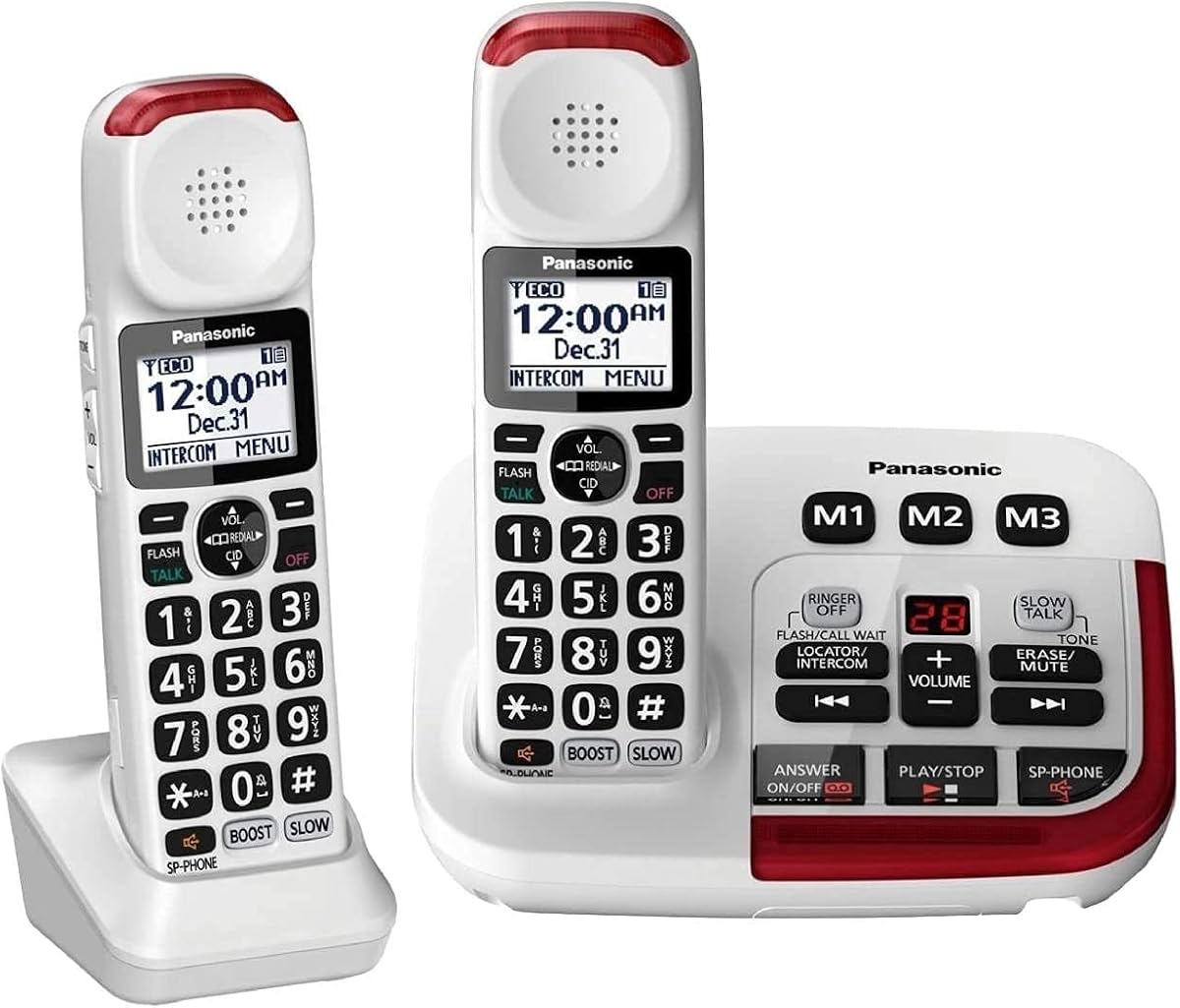
The Panasonic KX-TGM420W and KX-TGMA44W package is a two-handset amplified cordless system with a 4.3 rating. Its most distinctive hearing-support feature is Slow Talk, which reduces the speed of speech during real-time calls and while checking voicemail. That can make fast or unclear speech easier to understand without requiring the caller to repeat themselves.
We may earn a commission when you buy through this link, at no additional cost to you.
The system also offers volume boost up to 40dB and six voice tone settings, allowing users to shift emphasis toward frequencies that may be more perceptible to them. Noise Reduction suppresses background interference, while a loud base ringer helps announce incoming calls. Bright red LED visual ringers appear on both the base and handset.
The remaining features cover everyday household calling. It includes a digital answering machine, power backup, speakerphone, talking caller ID, talking keypad and phonebook, nine speed dials, a 250-number call blocker, and an intercom. Users can expand the system to as many as six handsets, which provides more flexibility than the two units included in the package.
This Panasonic system is well suited to someone who benefits more from slowed speech and tailored tone than from written captions. Its two included handsets support several rooms, while the expansion option prevents the system from becoming too limited later. It does not transcribe live speech, so shoppers seeking visible captions should choose the Hamilton CapTel instead.
Slow Talk reduces speaking speed during calls and voicemail playback. This gives the listener more time to process words and is especially useful when the original speaker talks quickly or has unclear diction.
Six tone settings and a boost control of up to 40dB offer different ways to improve intelligibility. Noise Reduction helps separate the conversation from distracting background sound.
We may earn a commission when you buy through this link, at no additional cost to you.
The SWISSVOICE 3355 is a large-button home phone system designed for older adults and people with hearing or vision difficulties. It includes a corded base and an additional cordless handset, combining the reliability of a wired phone with the convenience of a portable unit. Its 3.4 rating reflects a mixed customer reception, so accessibility features should be evaluated carefully before purchase.
We may earn a commission when you buy through this link, at no additional cost to you.
Four large photo memory buttons are the model's most distinctive feature. Users can associate family members, friends, or emergency contacts with recognizable images, making frequent calls easier to initiate. The dialing keys are also extra large, while an adjustable ringer can reach 90dB. The phone is hearing aid compatible and includes call blocking to reduce unwanted calls.
An answering machine adds value for users who cannot answer every incoming call, and the base can work with up to three additional handsets beyond the cordless unit supplied. The corded handset remains available for users who prefer a permanent connection or want a readily accessible receiver. The extra cordless handset gives other household members another way to make calls.
The 3355 is a practical consideration for users who benefit from photographic contact recognition and very large controls. Its lower customer rating warrants checking recent owner feedback for recurring concerns. It is less appropriate for someone who needs written live captions or very subtle button sizes, and buyers should verify whether hearing aid compatibility meets their individual equipment requirements.
Four large photo buttons let users choose a familiar face instead of searching through a text directory. The dedicated SOS button adds another prominent route to emergency assistance.
A corded base keeps one phone permanently available, while the included cordless handset supports use around the home. Additional compatible handsets can be added when more room coverage is needed.
We may earn a commission when you buy through this link, at no additional cost to you.
The three-handset Panasonic KX-TGM420W and KX-TGMA44W bundle expands on the same amplified cordless platform by including two KX-TGMA44W handsets in addition to the base unit. It has a 4.3 rating and is aimed at households that want accessible phones in several rooms without buying separate systems for each location.
We may earn a commission when you buy through this link, at no additional cost to you.
Its primary hearing features include voice volume boost up to 40dB, six tone settings, noise reduction, and Slow Talk. Slow Talk adjusts the speed of live speech and voicemail, which can be valuable for listeners who need more processing time. The base and each handset also have bright red LED visual ringers, and the large white backlit display improves readability.
The package provides a digital answering machine, power backup, speakerphone, talking caller ID, talking keypad and phonebook, nine speed dials, a 250-number call blocker, and intercom. It can expand to six handsets, so the included three represent a flexible starting point for a larger home. A 10-digit memory list is also available for storing additional numbers.
This setup is most useful for family members who want several accessible cordless phones distributed around the home. Because the included handsets are cordless, each requires charging, and the complete system depends on its base. It does not offer text captions, so buyers focused on reading conversations should consider the Hamilton CapTel. Prospective users should confirm room coverage and charging locations.
Three included handsets allow a user to keep a phone in several rooms. Expansion up to six handsets provides additional coverage for larger homes or for family members who need separate devices.
Slow Talk, noise reduction, tone settings, and volume boost work together to improve speech perception. Talking caller ID and a talking keypad reduce dependence on visual reading.
We may earn a commission when you buy through this link, at no additional cost to you.
This Amplified 100dB Landline is a straightforward corded desktop phone with a 3.9 rating. It emphasizes very loud sound, large controls, photo speed dialing, and a bright LED call indicator. The receiver can provide up to 80dB of gain, the incoming ringer can reach 100dB, and the speaker is adjustable for personalized sound.
We may earn a commission when you buy through this link, at no additional cost to you.
Three one-touch speed-dial keys can hold photos of family members, friends, or emergency contacts. A press automatically dials the stored number and activates the hands-free function. Additional memory includes three one-touch slots and ten two-touch number memories. A redial button, call indicator light, adjustable ringtone volume, and speakerphone round out the basic operation.
The manufacturer explicitly says the phone is not designed for profound hearing loss and recommends a professional amplified phone for extreme volume needs. It also provides troubleshooting for photo programming: enter the number, hold the MEM key for five seconds, press and release the image button, then hold it again for five seconds. This process may need to be repeated if the first attempt does not save correctly.
The phone is a practical option for someone with mild or moderate hearing loss who values loud alerts and large keys more than advanced connectivity. It provides one-year support through the seller and a durable wired design that cannot be misplaced. It does not provide real-time captions, so buyers needing visible conversation text should choose a caption-focused model instead.
A 100dB incoming ringer and bright LED give the user both audible and visual notification. These alerts are useful in noisy settings or whenever the sound can be lowered without losing awareness of an incoming call.
Three replaceable photo buttons provide direct access to important contacts. Automatic activation of the hands-free function makes it easier for users who may have difficulty holding the receiver for long conversations.
We may earn a commission when you buy through this link, at no additional cost to you.
The right accessible telephone depends on the user's hearing level, ability to read or distinguish visual prompts, home environment, service access, and comfort with different controls. Reviewing these factors before shopping prevents an emphasis on louder sound from being mistaken for the same benefit as real-time captions.
Choose real-time captions when reading live text is comfortable and reliable. Choose amplification when speech is still understandable when louder, clearer, slower, or less noisy. These are different solutions to different access barriers.
More power is not automatically better for every user. Choose output that is comfortable in the intended environment and confirm that a separate professional amplified solution is preferable for profound hearing loss.
Look for more than one notification method. Combining sound, speech, and light provides redundancy and makes it less likely that a single inaccessible format will cause a missed call.
Confirm compatibility, connector size, and required accessories before ordering. A stated compatibility label does not replace checking the user's hearing devices and preferred assistive setup.
Choose based on actual daily movement. Multiple rooms and active users favor cordless handsets, while a single dedicated calling location may make a corded model simpler and more dependable.
The best controls are the ones a person can identify and use consistently. Test the menu depth, key contrast, label size, and photo-programming process whenever possible.
Verify eligibility, installation requirements, and recurring service conditions before checkout. A device cannot provide full captioning functionality if its required service is unavailable.
Prioritize the management tools used most often. A larger answerphone capacity, more memory slots, or easier programming may be more valuable than a secondary feature that the household will rarely touch.
Begin by placing the telephone where the user can reach it easily and see or sense incoming alerts without extra movement. Connect the base to a reliable power source, install any backup batteries if the model supports them, and place the cordless handset on its charger. For the Hamilton CapTel, complete the registration process, connect the required internet service, and test both automatic and assisted captioning before relying on it for an important call.
Program essential contacts while another household member can help. Use photo buttons for the people who call most often, store emergency contacts in clearly identified memory slots, and verify every programmed number by making a test call. Speak the saved name or label in a form that the caller ID announcement will announce clearly. On models with adjustable tone, caption size, or volume, make a few short test calls and record which settings remain comfortable in the user's normal environment.
For ongoing care, wipe the handset, buttons, and display with a soft dry or lightly damp cloth, avoiding excessive moisture around openings and connections. Keep charging contacts and the handset cradle free of dust. Check battery performance, ringer visibility, photo labels, and stored numbers periodically. When an important call fails, test the line with another phone before assuming the accessible telephone is the source of the problem.
The Hamilton CapTel 2400iSPNBT is the model in this guide confirmed to caption both incoming and outgoing calls. It displays the conversation in real time and offers automated or assisted captioning. It also supports captioned voicemail. This capability requires compatible service, high-speed internet, standard power, registration, and eligibility within the United States.
No. An amplified telephone increases sound or makes call information available through speech and light, while a captioned telephone converts conversation into visible text. Several amplified models include talking caller ID, large displays, or slowed speech, but those features do not create a live transcript. Buyers who need to read what the other person is saying should look specifically for real-time captions.
The appropriate solution depends on individual audiological needs and the device's amplification limits. The Amplified 100dB Landline explicitly states that it is not made for profound hearing loss, while several other models offer substantially higher gain and output. A professional amplified phone or an audiologist's guidance may be more appropriate than relying on a standard consumer model.
The supplied information identifies the Geemarc Ampli550, Clarity AltoPlus, VTech SN5147, SWISSVOICE 3355, and Amplified 100dB Landline as hearing aid compatible. Compatibility should still be confirmed with the user's hearing aid manufacturer or audiologist. Users who rely on a neck loop, headset, or bed shaker should also check the required jack size and whether accessories are included.
A corded model offers a permanent connection, avoids routine handset charging, and can be simpler for one dedicated calling location. A cordless system lets the user answer from different rooms and may be necessary for users who move around the home. The VTech SN5147 combines both approaches, while the Panasonic bundles shown are entirely cordless and therefore require charging for each handset.
The Hamilton CapTel 2400iSPNBT requires high-speed internet for its captioning function, so it is not designed to deliver that feature without suitable connectivity. The other products in the guide are conventional amplified landline phones and do not list an internet requirement for their core operation. Local telephone service and exact setup conditions should still be confirmed for every model.
The most useful visual features are flashing ringer indicators, illuminated displays, bright strobes, and photo buttons that make the phone itself easier to use. The Geemarc has an extra-bright strobe, the VTech and Panasonic systems have flashing visual ringers, and the Hamilton uses a large screen for captioned alerts and messages. No substitute for captions provides the same live visual record of a conversation.
Choose the VTech SN5147 when a corded base, photo dialing, a 90dB ringer, and a larger set of call-blocking features are priorities. Choose the Panasonic packages when slowing the caller's speech, tone adjustment, multiple cordless handsets, and expansion are more valuable. Both provide strong amplification and visual call alerts, but neither writes a live transcript of the conversation.
The Hamilton CapTel 2400iSPNBT is the leading choice for someone who specifically needs live written captions, offering assisted and automated options plus captioned voicemail. The VTech SN5147 stands out as a budget-friendly balance of corded reliability, cordless mobility, loud alerts, and accessible photo dialing. For very loud output, a bright strobe, and spoken controls, the Geemarc Ampli550 is the premium amplified option in this roundup.
For the remaining users, prioritize the problem that causes the most difficulty. Clarity AltoPlus serves people with severe hearing loss who need powerful two-way amplification, while the Panasonic systems suit listeners who benefit from slowed speech and tailored tone. The SWISSVOICE 3355 and Amplified 100dB Landline emphasize large controls and photo-based contacts. The Captel MDL 200 and Serene SI-CL-65 HD may appeal to buyers seeking simpler dedicated home-phone arrangements.
Before ordering, confirm service eligibility, internet requirements, hearing aid compatibility, accessory needs, room placement, and the user's ability to operate each control. Compare the current product pages because prices, availability, and offers change. The right telephone is not simply the loudest model; it is the one that matches the user's preferred way of receiving and following conversations.