
Keychron K1 Ultra 8K
4.7Editor score
Up to 8K wired polling
Hot-swappable low-profile POM switches
Open-source ZMK customization
Compact 80% TKL layout
Compare the best low profile mechanical keyboards for typing, gaming, wireless use, customization, comfort, and compact desk setups.
Low profile mechanical keyboards combine short-travel keys with the responsiveness and distinct feel of mechanical switches. They suit desk-conscious users, frequent travelers, gamers, and anyone who prefers a lower typing angle without giving up customizable switches, wireless connectivity, or tactile feedback.
This guide compares ten low profile mechanical keyboards based on their published layouts, switch characteristics, connection options, programmability, lighting, sound controls, and build details. It covers compact 75%, 80%, 84-key, 96%, and full-size designs for different productivity and gaming needs.
Each review explains the keyboard's strongest benefits, practical trade-offs, and ideal user, while the comparison table makes major differences easier to scan. Ratings reflect the supplied product information, and prices and availability can change, so confirm current listings before purchasing.
4.7Editor score

4.6Editor score

4.1Editor score
The table below compares all ten keyboards by layout, connectivity, switch configuration, programmability, and standout physical features, making it easier to identify the model that best matches your typing, gaming, and desk-space priorities.




The Redragon K618 PRO combines a very low-profile wireless design with a generous set of controls that are rarely included on compact keyboards. Its supplied rating is 4.1, and its standout qualities are the dedicated 20-key macro zone, media controls, tri-mode connectivity, and linear Red switches. The layout offers a practical balance between screen space and dedicated functionality.
We may earn a commission when you buy through this link, at no additional cost to you.
The 4-by-5 macro area is one of this model's most useful features. Users can record combinations directly on the keyboard without first installing software, while the adjacent controls provide straightforward volume and media-track changes. Connection flexibility is equally notable: USB-C, Bluetooth, and 2.4GHz options allow the keyboard to move among a desktop PC, laptop, and tablet. A one-touch Windows-to-Mac layout switch adds further cross-platform convenience.
Low-profile switches and keycaps reduce travel and help the board occupy less vertical space than a conventional mechanical keyboard. Redragon's software expands the customization options through key remapping, extensive keybinding combinations, and 16.8 million-color lighting effects. The trade-offs are that the software is required for deeper configuration, and the listed backlight is white rather than full-spectrum RGB. Buyers who prioritize immediate macro access and flexible connectivity may accept those limitations more readily than those who need maximum lighting control from the outset.
This is an attractive recommendation for a gamer or multitasker who wants dedicated shortcuts, fast wireless switching, and a slim mechanical format without moving to a larger board. It is especially useful when a separate numpad or macro pad would consume too much desk space. For users who only need basic typing and are unconcerned with game commands, one of the more conventional Keychron or Lofree layouts may be simpler, but the K618 PRO makes a compelling case for value-focused, feature-rich use.
The onboard macro zone lets users record and replay combinations without beginning with installation-based configuration. That direct-access workflow is useful for launchers, chat commands, editing tools, and repeated productivity actions.
USB-C, Bluetooth, and 2.4GHz modes make this board versatile for a multi-device desk. Its Windows and Mac switch also helps preserve productivity when moving between operating systems.
We may earn a commission when you buy through this link, at no additional cost to you.
The Keychron K3 Version 2 is a compact 75% wireless mechanical keyboard aimed at users who want extensive software control without a full-size footprint. It carries a supplied rating of 4.3 and stands out for open-source QMK firmware, broad device pairing, a floating keycap design, and one of the slimmer constructions in this guide.
We may earn a commission when you buy through this link, at no additional cost to you.
QMK support is the defining advantage for keyboard enthusiasts. Users can remap keys, create macros, and establish shortcuts through the Keychron Launcher web app, while the listed AI assistant offers a less technical route to configuration. Bluetooth 5.1 can connect the keyboard with up to three devices, allowing convenient movement among a laptop, PC, tablet, or phone. Mac-oriented multimedia and function keys are included, and alternate Windows keycaps support mixed operating-system environments.
The reinforced aluminum upper body and plastic lower frame create a balance between rigidity and low weight. Its floating keycap style and white backlight produce a distinctive appearance, although users who prioritize multicolor RGB may find the monochrome lighting restrictive. The supplied information also does not identify a physical knob, so functions such as volume adjustment must be assigned through the software or key combinations. These are meaningful trade-offs for buyers who value a polished, compact, programmable board more than colorful lighting or a dedicated dial.
The K3 Version 2 is a strong recommendation for programmers, writers, and productivity-focused users who enjoy remapping and layered shortcuts. It also suits anyone wanting a clean 75% desk arrangement without giving up Bluetooth. Gaming buyers seeking maximum wireless polling specifications or broad RGB control should examine the K1 Ultra 8K instead, but for open-source flexibility in a slim, lightweight format, the K3 Version 2 remains especially compelling.
QMK firmware makes the keyboard more than a fixed set of keys. Layers, shortcuts, remapping, and macros can be refined through the Launcher, giving experienced users a high degree of control.
The 75% format preserves familiar navigation and function keys while reducing desk consumption. Its floating keycaps, aluminum frame, and restrained white lighting create a clean appearance suited to shared workspaces.
We may earn a commission when you buy through this link, at no additional cost to you.
The Cherry MX 10.0N RGB delivers one of the most deliberately slim forms in this roundup, with a stated height of just 0.87 inches. Its supplied rating is 4.3, and the defining strengths are Cherry MX Low Profile Speed switches, an aluminum housing, full RGB lighting, and an integrated fold-out support bar.
We may earn a commission when you buy through this link, at no additional cost to you.
The low-profile MX Speed switches are described as linear, quiet, and responsive. Their short travel suits both quick typing and gaming, while the aluminum housing gives the keyboard a refined, durable appearance. RGB backlighting allows users to personalize colors and effects, addressing a limitation of some minimalist low-profile boards. The fold-out aluminum support bar can adjust the typing angle without requiring a separate wrist rest or loose desktop accessory.
Unlike several competitors in the guide, the supplied information does not emphasize wireless connectivity, extensive programmability, or hot-swappable sockets. As a result, buyers seeking tri-mode operation or extensive layer-based customization may find this model less flexible. The omission of a wrist-rest or multi-device feature is less concerning if the preference is a straightforward, polished mechanical keyboard with a distinctive low profile. Its integrated stand is the more important ergonomic consideration, particularly since low-profile boards can feel flat without some degree of incline.
The MX 10.0N RGB is best suited to users who value the feel and identity of Cherry MX Speed switches in a very thin aluminum design. It also makes sense for gamers who want fast, quiet linear operation and RGB lighting without needing extensive wireless functionality. For productivity users with several devices or a strong interest in remapping, a programmable Keychron model may be the better fit.
Cherry MX Low Profile Speed switches deliver short-travel linear action designed for quick registration. Their published characteristics emphasize responsiveness and a quieter experience for work and play.
The aluminum housing and 0.87-inch height create a notably slim visual profile. The fold-out stand adds a useful incline while keeping the desk free of a separate accessory.
We may earn a commission when you buy through this link, at no additional cost to you.
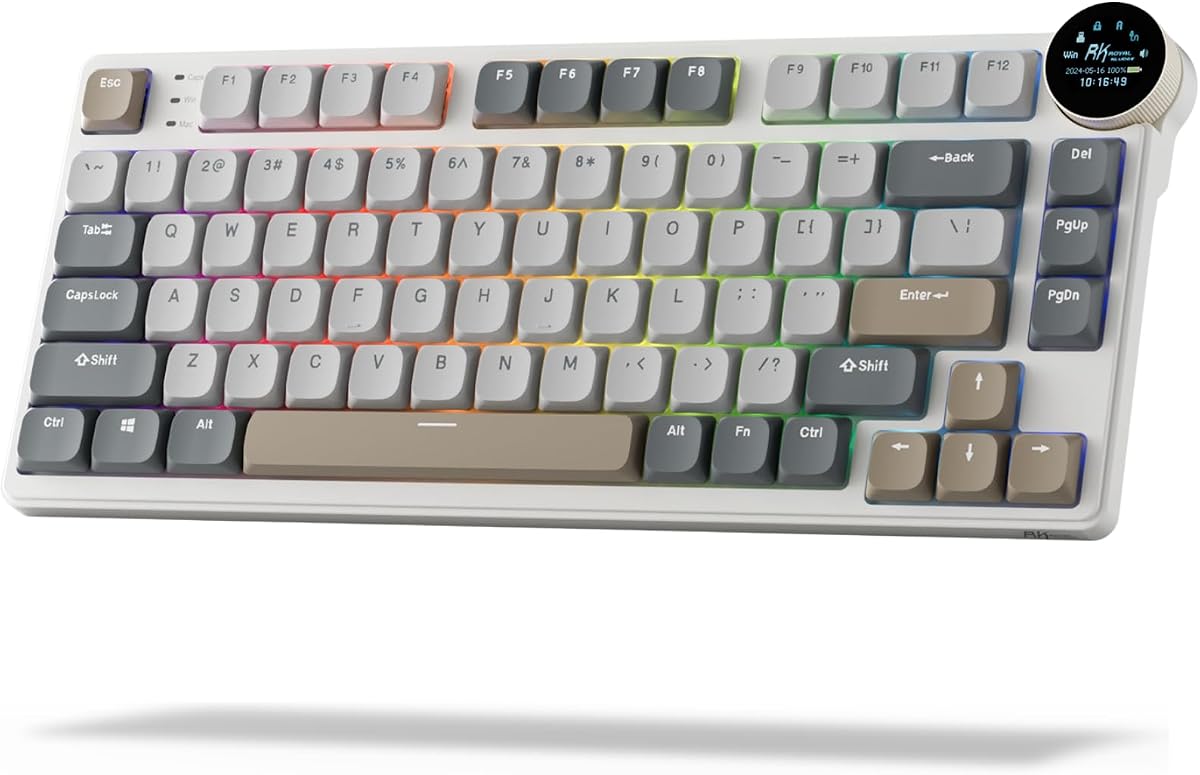
The RK Royal Kludge N80 differentiates itself with a small smart display and a multifunction rotary knob. Its supplied rating is 4.1, while its most compelling features include connection-status information, customizable GIF support, tri-mode connectivity, a top-mounted structure, and several layers of sound absorption.
We may earn a commission when you buy through this link, at no additional cost to you.
The display can show custom GIFs, the current date, connection mode, Windows or Mac layout, and battery status. A twist or click of the knob then adjusts volume, connection modes, lighting brightness and speed, and RGB modes or colors. This centralizes frequently used functions into one accessible control and makes the board more engaging than a standard compact keyboard. The feature set is particularly suited to users who enjoy having workspace information visible directly on the keyboard.
Low-profile switches shorten actuation distance, while the top-mounted case is intended to provide firm feedback and reduce the wobble sometimes associated with low-profile designs. Dual sound-absorbing foams and a silicone bottom pad target hollow sound and cavity noise. The display and knob inevitably add some thickness and visual complexity, however, and the supplied information gives less detail about switch replacement or advanced remapping than it does for the Keychron alternatives.
The N80 is a strong option for a gamer or desk enthusiast who wants visible information and convenient rotary control in a low-profile wireless board. It is less compelling for a minimalist workspace where every millimeter and every illuminated element matters, or for a specialist who prioritizes open-source firmware above all else. Even so, its tri-mode flexibility, sound-control structure, and useful display give it broad everyday appeal.
The smart display keeps battery, date, connection, and layout information visible without occupying more monitor space. Custom GIF support adds a more personal element to the workspace.
Twisting and clicking the rotary knob handles volume, lighting, RGB, and connection changes. This reduces dependence on layered shortcuts and makes common adjustments more immediate.
We may earn a commission when you buy through this link, at no additional cost to you.
The Lofree Flow Lite 84 is a compact 75% keyboard designed around lighter switches, wireless flexibility, and a softer acoustic profile. Its supplied rating is 4.3. The 84-key format balances navigation keys with a small footprint, while the Specter Full POM linear switches reduce operating force from 50gf to 40gf for less finger effort during extended typing.
We may earn a commission when you buy through this link, at no additional cost to you.
The keyboard supports 2.4GHz wireless, Bluetooth, and wired USB-C connections, and its 2.4GHz mode offers a 1000Hz polling rate. A 2000mAh battery provides up to 80 hours with lighting turned off and recharges in roughly three hours. Its gasket-mounted structure and upgraded sound-dampening layer aim for a cushioned tone, while the textured ABS shell keeps the overall design lighter and more approachable.
PBT double-shot keycaps provide a matte, durable surface, with PC letter sections allowing light to pass through. The body is ABS rather than aluminum, which helps explain the positioning but may not satisfy buyers who equate premium construction with a metal frame. A roller volume control, integrated adjustable kickstand, and dedicated key remapping through the Lofree Key Mapper add functional value. Users should also recognize that hot-swappability and lower-force switches still cannot compensate for an uncomfortable layout or poor fit.
The Flow Lite 84 is an excellent recommendation for writers, students, and office workers who spend long periods typing and prefer a light linear action. It also works well for travel because wireless operation and a compact layout reduce dependence on a full-size board. Gaming users can benefit from 1000Hz 2.4GHz polling, although the K1 Ultra 8K offers a higher stated wired polling rate and more open-source control.
The Specter switches' reduced 40gf operating force requires less finger pressure than a 50gf design. That lighter action can reduce joint effort during long writing or coding sessions.
A 1000Hz 2.4GHz polling rate supports responsive gaming, while Bluetooth and wired modes cover everyday use. The kickstand and roller volume wheel add convenience without separate desk accessories.
We may earn a commission when you buy through this link, at no additional cost to you.
The Keychron K1 Ultra 8K is the strongest all-round choice in this guide for buyers who want gaming speed, open-source customization, and a practical compact layout. It has the highest supplied rating at 4.7. The keyboard combines an 80% TKL arrangement, a programmable knob, tri-mode connectivity, hot-swappable low-profile POM switches, and up to 8K polling in wired mode.
We may earn a commission when you buy through this link, at no additional cost to you.
Its headline gaming specification is the ability to poll at up to 8K over USB-C, while 2.4GHz and Bluetooth 5.2 provide wireless flexibility. The knob can be assigned to volume, backlighting, media, or other functions, and the north-facing RGB system provides 22 lighting effects. Compatibility with Mac, Windows, and Linux broadens its appeal, while the compact TKL format retains common navigation keys without occupying a full-size footprint.
ZMK firmware and the Keychron Launcher Web App provide key remapping, layers, macros, and shortcut creation. The listed AI-assisted customization tools can simplify setup across all three operating systems. Hot-swappable sockets let users replace the low-profile POM switches without soldering, making the keyboard more adaptable than a fixed-switch model. Sound-dampening layers, double-shot keycaps, and wax-oil-treated hardwood side panels add refinement, although the side panels increase visual bulk compared with an all-plastic travel board.
This model is ideal for competitive gamers, programmers, and advanced keyboard enthusiasts who value control as much as speed. The most significant trade-off is complexity: its polling options, firmware, layers, lighting, and knob assignments demand an initial learning period. For a simpler wireless experience with more traditional open-source customization, the K3 Max SE is an alternative. For users who understand modern keyboard software, however, the K1 Ultra 8K offers the most advanced feature set here.
The keyboard supports up to 8K polling through its wired connection, making it attractive for competitive gaming. Wireless modes provide the expected 2.4GHz and Bluetooth 5.2 alternatives.
ZMK firmware supports remapping, layers, macros, and shortcuts through the Launcher. Hot-swappable POM sockets make switch changes possible without soldering.
We may earn a commission when you buy through this link, at no additional cost to you.
The Keychron K17 Max targets users who want a full-size-style productivity keyboard without the depth of a traditional mechanical board. Its supplied rating is 4.4. The 96% layout retains a dedicated number pad and useful navigation area, while low-profile Gateron switches and an aluminum frame keep the overall construction notably slim.
We may earn a commission when you buy through this link, at no additional cost to you.
Connectivity covers 2.4GHz wireless, Bluetooth 5.1, and a wired Type-C connection. The 2.4GHz mode supports a 1000Hz polling rate, and Bluetooth can connect up to three devices for switching among a computer, phone, or tablet. QMK firmware and the cross-platform Keychron Launcher provide regular updates, key remapping, macros, and shortcuts. The listed low-profile brown switches deliver tactile feedback, which may appeal to users who want more noticeable key events than a linear switch.
The switches are described as 31% thinner than standard models, and the aluminum frame helps maintain rigidity despite the reduced height. Double-shot PBT keycaps are built for durability, oil resistance, and a non-shine-through feel. The 96% design creates a trade-off between utility and desk space: it is substantially more compact than a standard full-size board, yet still wider and more crowded than the K3, K1, or Lofree Flow Lite 84.
The K17 Max is a strong recommendation for spreadsheet users, programmers, accountants, and hybrid work environments where a number pad remains necessary. It suits travelers better than a full-size board because of its lower profile and wireless options, although a 75% model remains easier to carry. Buyers choosing between it and the Flow Lite 100 should prioritize tactile brown feedback and QMK software versus the latter's lighter linear switches and larger battery.
The 96% format preserves a number pad and dedicated navigation cluster in a slimmer footprint. It is a useful middle ground for users who want more function keys than a 75% board provides.
Low-profile brown switches offer a tactile bump while maintaining shorter travel. This gives typists a distinct actuation event without the height of a conventional mechanical keyboard.
We may earn a commission when you buy through this link, at no additional cost to you.
The Lofree Flow Lite 100 provides a roomier compact alternative to the 84-key Flow Lite. Its supplied rating is 4.4, and it stands out for a 100-key layout, a large 3000mAh battery, lighter 40gf Specter linear switches, and a 1000Hz 2.4GHz polling rate.
We may earn a commission when you buy through this link, at no additional cost to you.
The additional keys create more room for everyday productivity while preserving a lower-profile, space-conscious design. Specter Full POM linear switches use a reduced 40gf operating force, and the gasket mount incorporates an upgraded sound-dampening layer for a softer, more cushioned acoustic result. PBT double-shot keycaps offer a textured matte surface, while PC letter sections support backlight transmission.
The keyboard supports 2.4GHz, Bluetooth, and wired Type-C connections. Its larger 3000mAh battery is listed at up to 100 hours with lights off and charges in approximately three hours, making it a sensible choice for mobile use. The built-in adjustable kickstand and aluminum roller volume wheel remain useful. The main compromise is the textured ABS shell rather than metal construction, and the supplied information does not specify multi-device Bluetooth pairing in as much detail as the Keychron models.
The Flow Lite 100 is a good recommendation for users who want more usable keys than an 84-key compact board without moving to a full-size keyboard with a larger number pad. It is particularly appealing to writers, hybrid workers, and travelers who value a light linear action and strong listed battery endurance. Buyers who want tactile feedback should look toward the K17 Max, while those seeking maximum open-source control may prefer the K1 Ultra 8K.
The 100-key layout offers additional utility keys without becoming a large full-size board. It is a practical compromise for users who often navigate documents, spreadsheets, and media controls.
The 3000mAh battery is listed for up to 100 hours with lighting off. Combined with wireless modes and the integrated kickstand, it supports a portable desk arrangement.
We may earn a commission when you buy through this link, at no additional cost to you.
The Keychron K3 Max SE is a particularly well-rounded 75% low-profile keyboard, combining a supplied rating of 4.6 with QMK support, tri-mode connectivity, hot-swappable switches, and extensive acoustic tuning. It is narrow enough for a small desk but preserves the function and navigation keys that make a 75% layout productive.
We may earn a commission when you buy through this link, at no additional cost to you.
The 2.4GHz mode supports a 1000Hz polling rate, while Bluetooth 5.2 can pair with up to three devices. Wired operation is also available. QMK firmware allows key remapping, macros, layers, and shortcut creation through the Keychron Launcher web app. The Mac layout maintains familiar Apple-style multimedia and function-key behavior while remaining compatible with Windows, making the keyboard appropriate for mixed-OS desks.
The slim Keychron Milk POM switches are listed as 31% shorter than traditional full-profile switches and can be changed without soldering. EPDM acoustic foam, bottom-case foam, and redesigned stabilizers address both noise and uneven movement on larger keys such as Space, Shift, Backspace, and Enter. The absence of a physical knob means some controls will remain key-based, and Bluetooth should not be confused with the higher-performance 2.4GHz gaming connection.
This is a strong all-round recommendation for users who want open-source software, good acoustics, wireless flexibility, and a practical compact layout without chasing the very highest polling specification. It works particularly well for programmers, writers, and mixed-platform users. If maximum gaming speed is the priority, the K1 Ultra 8K is a better match; if a knob and display-based controls are important, the RK N80 offers a more control-heavy alternative.
EPDM and bottom-case foam soften the acoustic profile, while the redesigned stabilizers target wobble on frequently used larger keys. The result is a more consistent low-profile typing experience.
Bluetooth 5.2 pairing supports three devices, and the 75% layout preserves useful controls. This makes the K3 Max SE convenient for users moving between a computer, tablet, and phone.
We may earn a commission when you buy through this link, at no additional cost to you.
The Razer Ornata V3 is built around short switches, slim keycaps, and a magnetic wrist rest, offering a more approachable form of low-profile gaming input. Its supplied rating is 4.5. Although its unique mecha-membrane mechanism differs from a standard mechanical switch, the model remains relevant for buyers who prioritize a familiar feel, a low profile, and long-session comfort.
We may earn a commission when you buy through this link, at no additional cost to you.
Slimmer keycaps and shorter switches promote a more natural hand position and reduce wrist strain during extended use. The mecha-membrane switches combine conventional keyboard familiarity with a snappy, clicky response that can satisfy gamers who want clear feedback. Dedicated backlit media keys can handle play, pause, skip, brightness, and volume adjustments without requiring software navigation.
UV-coated keycaps are designed to resist fading and wear, while the soft-touch wrist rest attaches magnetically to the keyboard. That removable support is convenient because users can change desk positions without losing the rest. The compromises are inherent to the hybrid switch design: it does not provide the same internal mechanical construction as the genuinely mechanical alternatives here, and the supplied details are limited regarding advanced remapping, polling rates, and RGB options.
The Ornata V3 is a practical recommendation for a gamer who wants a slim keyboard, visible media controls, and wrist support without adapting to a highly specialized low-profile mechanical format. It may also appeal to office users who value the included rest. Enthusiasts seeking genuine mechanical switches, hot-swappable sockets, open-source firmware, or advanced connectivity should instead consider the Keychron K1 Ultra 8K or K3 Max SE.
The hybrid mecha-membrane mechanism provides familiar feedback with a short-travel profile. This can be approachable for gamers accustomed to conventional keyboard feel but interested in lower height.
The magnetic soft-touch wrist rest attaches directly to the keyboard and can be repositioned or removed. It provides a simple way to add support during longer gaming and work sessions.
We may earn a commission when you buy through this link, at no additional cost to you.
Choosing a low profile mechanical keyboard means balancing height, layout, switch behavior, connectivity, programmability, and build quality. The right board depends less on one universal specification than on how you work, play, and organize your desk.
Layout determines which keys are available and how much desk space the keyboard occupies. A 75% arrangement is a versatile starting point because it retains function and navigation keys while eliminating the number pad. The Keychron K3 Version 2 and K3 Max SE fit this category, while the Lofree Flow Lite 84 offers a similarly compact shape with its own feature arrangement. An 80% TKL design, represented by the Keychron K1 Ultra 8K, can feel familiar and provides a slightly broader navigation cluster without a full number pad.
Choose a 75% or 80% layout for a smaller desk, frequent travel, or a minimalist workspace. Choose a 96% or 100-key design when a number pad or extra productivity keys remain important. Layout should come before decorative features because it has the greatest effect on daily usability.
Low profile mechanical switches come with different feedback characteristics. The Redragon K618 PRO uses stock Red linear switches, and the Lofree Flow Lite models use 40gf Specter linear switches. Linear switches move smoothly without a pronounced tactile bump, which many typists and gamers find easy to press rapidly. The Keychron K17 Max uses low-profile Gateron brown switches, offering a noticeable tactile event while remaining relatively short.
Linear switches suit fast, quiet workflows and users who dislike a bump during long typing. Tactile switches provide clearer confirmation of actuation and can satisfy users who want more physical feedback. Sound should be considered alongside switch type because the frame, stabilizers, dampening material, and keycaps all influence the final acoustic result.
Wireless flexibility is one of the strongest reasons to choose a modern compact keyboard. Most models in this guide support 2.4GHz, Bluetooth, and wired USB-C connections. The Redragon K618 PRO and Keychron K1 Ultra 8K support all three, as do the Lofree Flow Lite models and Keychron K17 Max and K3 Max SE. Bluetooth is convenient for pairing phones and tablets, while 2.4GHz generally offers a more consistent gaming-oriented connection.
Check the listed polling rate as well as the connection type. The Lofree Flow Lite 84 and 100, Keychron K17 Max, and Keychron K3 Max SE support 1000Hz in 2.4GHz mode, while the K1 Ultra 8K reaches up to 8K over wired USB-C. Do not assume a wired polling specification applies equally to every wireless mode.
Programmable firmware can turn a compact layout into a productivity advantage. Keychron models emphasize open-source platforms: the K3 Version 2 and K3 Max SE use QMK, while the K1 Ultra 8K uses ZMK. Their web-based Launcher tools support remapping, layers, macros, and shortcuts. The Redragon K618 PRO also offers extensive remapping and lighting customization, but its dedicated macro zone provides an easier starting point for users who do not want to configure every shortcut immediately.
Prioritize open-source firmware and cross-platform Launcher support if you use layers, alternate layouts, or application-specific commands. If you only need volume and media keys, extensive software may be unnecessary. When evaluating a configurator, confirm that it runs on your operating system and check whether setup requires a wired connection.
Hot-swappable sockets let users change compatible low-profile switches without soldering. The Keychron K1 Ultra 8K, K3 Max SE, and Lofree Flow Lite models are positioned as swappable designs, allowing the feel to be adjusted over time. The Keychron K3 Version 2 instead emphasizes QMK remapping but does not list hot-swappable sockets in the supplied information.
Check that a keyboard is genuinely hot-swappable rather than merely described as swappable. Also confirm the switch format and required operating force. A user who prefers a light 40gf linear switch may find 50gf alternatives tiring, while someone seeking stronger tactile feedback may need to test available switch options before purchasing.
Low profile does not automatically mean comfortable. The Cherry MX 10.0N RGB includes a fold-out aluminum stand, the Lofree Flow Lite models include adjustable kickstands, and the Razer Ornata V3 supplies a magnetic soft-touch wrist rest. Other boards rely on their chassis angle and may not include a separate support. Users accustomed to wrist rests should consider whether the desk setup allows their palms to rest naturally without pressing the wrists onto a hard edge.
Look for an adjustable incline when possible, especially if you normally type on a raised keyboard. A low front edge can reduce wrist extension, but adequate support still matters. Avoid choosing solely from the stated total height, because keycap shape, switch travel, chassis angle, and typing position influence comfort more than a single measurement.
Low profile boards can sound hollow if their internal cavities are not controlled. The RK Royal Kludge N80 uses dual sound-absorbing foam and a silicone bottom pad, while the Lofree Flow Lite models use a gasket-mounted structure with upgraded dampening. The Keychron K3 Max SE combines EPDM acoustic foam with bottom-case foam, and the Keychron K1 Ultra 8K also lists internal sound-dampening layers.
Build materials deserve equal attention. Aluminum frames and housings can provide rigidity, while textured ABS can reduce weight and cost. The Cherry MX 10.0N RGB uses an aluminum housing, whereas the Flow Lite models use ABS. Consider both acoustic treatment and structural stability, and read descriptions carefully about whether claims refer to the entire frame or only part of the case.
Extra features are useful only when they match your habits. The RK N80's display and rotary knob suit users who want visible status information and direct control of lighting and media. The Redragon K618 PRO's macro zone serves repetitive commands and game shortcuts. RGB matters more to users who personalize their desk, while PBT keycaps, acoustic foam, and adjustable stabilizers may matter more to everyday typists.
Avoid paying for multiple controls you will never use. List the functions you perform daily, then prioritize the board that makes those actions easiest. A useful product should reduce desk clutter or streamline a real task, not merely add more buttons and lighting effects.
Begin by choosing the appropriate connection mode. Use USB-C for a straightforward wired setup, Bluetooth when pairing with a phone or tablet, and 2.4GHz for a responsive desktop wireless connection. Install the manufacturer's recommended configuration software before assigning macros, layers, lighting effects, or knob functions, and update the firmware if the device supports it.
Set a comfortable angle and adjust the typing position. Use an integrated kickstand or fold-out stand if one is included, and attach a wrist rest only when it supports a natural hand posture without forcing the wrists upward. Learn the selected switch feel gradually, paying particular attention to the spacebar and other stabilized keys so the revised stabilizer movement becomes familiar.
Keep the keyboard clean by disconnecting it before removing loose debris. Use a soft brush or microfiber cloth for the keycaps and case, and avoid spilling liquid directly onto the switches. Charge the battery periodically, protect the receiver when using 2.4GHz mode, and review the manufacturer's instructions before opening a hot-swappable keyboard or replacing compatible switches.
They can be, especially for users who prefer shorter key travel or a flatter desk setup. Lower actuation distance can reduce finger movement and make rapid typing feel light. Comfort still depends on switch force, keycap shape, chassis angle, and wrist position, so personal preference remains important.
Low profile mechanical keyboards use shorter switches and slimmer keycaps to reduce overall height. Standard mechanical keyboards usually have taller switches, more visible key travel, and a larger case. The shorter design can save desk space and make the wrist angle flatter, but some users prefer the greater travel of a conventional board.
They can be well suited to gaming because short travel permits quick actuation without moving through a long key path. Response also depends on connection method, polling rate, switch feedback, and stabilization. The Keychron K1 Ultra 8K stands out here with up to 8K wired polling, while several other models offer 1000Hz 2.4GHz performance.
A 75% keyboard is usually the most practical compact starting point because it removes the number pad while retaining function and navigation keys. An 80% TKL provides a similar idea with a slightly broader navigation area. Choose a 96% or 100-key model only when you strongly need a number pad or additional keys.
Most models in this guide support Bluetooth, 2.4GHz wireless, and wired USB-C. The main consideration is connection performance: 2.4GHz is generally better suited to responsive gaming, Bluetooth is convenient for portable devices, and wired mode often provides the most consistent connection and highest polling specification.
A hot-swappable keyboard uses sockets that allow compatible switches to be removed and replaced without soldering a replacement to a circuit board. It makes it easier to alter switch feel over time. Users should confirm the required switch format and follow the manufacturer's removal and installation instructions.
Start with models that include sound-dampening foam, a gasket mount, or a silicone bottom pad, because internal case vibration contributes to hollow noise. Stabilizer tuning also matters, especially on the spacebar and Enter key. O-ring or other switch modifications may help, but compatibility with a low profile switch system must be checked carefully.
Many models in this guide support both operating systems, and several include alternate Mac and Windows keycaps. The Redragon K618 PRO provides a one-touch operating-system switch, while the Keychron boards offer Mac layouts with Windows compatibility. Remapping software can further align shortcuts for each operating system.
The Keychron K1 Ultra 8K is the strongest premium all-rounder, combining an 80% layout, up to 8K wired polling, hot-swappable switches, and deep ZMK customization. The Keychron K3 Max SE offers a particularly balanced 75% experience with QMK, refined acoustics, and versatile wireless connectivity, while the Redragon K618 PRO stands out as the budget-focused choice for dedicated macros and immediate control.
Your priorities should determine which feature earns the most attention. Choose the RK Royal Kludge N80 for a display and multifunction knob, the Lofree Flow Lite models for light 40gf linear switches and battery endurance, or the Cherry MX 10.0N RGB for a very thin aluminum design and MX Speed switch feel. Layout comes first, followed by switch feedback, connectivity, software, and acoustic construction.
Ratings, product details, prices, and availability can change over time, so review the current listing before buying. Confirm that the keyboard includes the particular functions and key count you need, then compare its connectivity, switch type, and dimensions with your existing desk setup. That focused check is the best way to choose a low profile mechanical keyboard that remains comfortable and useful every day.