
Logitech G PRO X2 SUPERSTRIKE
4.6Editor score
Adjustable click actuation
Haptic trigger feedback
8 kHz LIGHTSPEED polling
Our Mouse for Valorant guide compares 10 top gaming mice across sensitivity, weight, polling, buttons, wireless latency, battery life, grip, features, and
A Mouse for Valorant must balance quick aim adjustments, controlled movement, reliable clicks, and comfort across long matches. Sensor precision matters, but weight, grip shape, button placement, connection method, and software can have an equally noticeable effect on how a mouse feels in a fast tactical shooter.
We compared ten gaming mice using their supplied specifications, including sensitivity options, polling rates, switch technology, weight, connectivity, battery life, and control layouts. The list covers wireless and wired models, lightweight esports shapes, ergonomic designs, and highly programmable options for different play styles.
Each review explains who the mouse suits, what stands out, and where compromises may appear. Ratings and product details can change over time, and prices also vary between retailers, so confirm the current specifications, software requirements, and deal before buying.
4.6Editor score

4.4Editor score

4.5Editor score
This side-by-side overview compares the ten shortlisted mice by their most important Valorant-related characteristics, including weight, sensing precision, connection style, polling capability, battery considerations, and control features.


The Razer Viper V3 HyperSpeed is our overall Mouse for Valorant because it combines a relatively light 82g shell, a 30,000 DPI Focus Pro sensor, a low-latency wireless connection, and a battery claim of up to 280 hours. Its 4.4 rating reflects a strong overall package, although the most compelling reason to choose it is the balance between competitive features and everyday usability.
We may earn a commission when you buy through this link, at no additional cost to you.
The centrally balanced design is particularly useful for maintaining control when making rapid corrections. A forward-positioned sensor supports accurate tracking across a wider variety of surfaces, including glass, while the on-mouse DPI control lets players change among five stages without leaving the game. Gen-2 mechanical switches are rated for 60 million clicks, and their gold-plated contact points are designed to resist wear.
Its main compromises are inherent to the design. The five-stage DPI control is less granular than a mouse offering a direct DPI-adjust button, and wireless operation means players need to keep a charged AA battery ready. Razer also advises disabling Windows pointer acceleration and using Synapse for further optimization, so the mouse should be configured before relying on a particular sensitivity setting.
This is a strong recommendation for Valorant players who want a proven competitive shape, precise tracking, and long wireless battery life without moving to a larger ergonomic platform. It may not suit players who want numerous side buttons or the lightest possible shell, but for straightforward aiming performance and dependable control, it remains one of the most complete picks in this guide.
The mass-centered 82g design seeks to reduce the imbalance that can make fast directional changes feel less controlled. That makes the Viper V3 HyperSpeed a practical choice for players who alternate between holding an angle, strafing, and snapping toward a newly revealed opponent.
HyperSpeed wireless supports a competitive connection while the stated 280-hour battery figure reduces the likelihood of interruption during long practice sessions. Multi-device support also makes the mouse easier to move between a gaming PC and another connected system.
We may earn a commission when you buy through this link, at no additional cost to you.
The Logitech G PRO X2 SUPERSTRIKE earns the premium recommendation with a 4.6 rating and the most unusual click system in this group. Its Haptic Inductive Trigger System provides feedback, while ten actuation levels and five rapid-trigger reset levels allow players to tune the relationship between physical click movement and the in-game shot.
We may earn a commission when you buy through this link, at no additional cost to you.
The HERO 2 sensor tracks at more than 888 IPS, handles 88 g-force, and reaches up to 44,000 DPI. Those figures make the mouse well suited to fast flicks and rapid repositioning in Valorant. LIGHTSPEED wireless supports 8 kHz polling, while the stated 60–90-hour battery provides a reasonable balance for an esports-focused device. A USB-A to USB-C cable is included.
This is not a simple plug-and-play recommendation. Advanced features require Logitech G HUB, and polling performance was tested on a G640 mousepad. The advertised POWERPLAY 2 capability also requires a separately sold receiver, so buyers should not assume endless wireless play is included with the mouse itself. The 0.7 mm thin-wall case and UHMWPE feet also point toward a design optimized for movement efficiency.
The SUPERSTRIKE is ideal for players who want to experiment with trigger behavior, value tactile feedback, and prefer wireless operation at a high polling rate. It is less convincing for someone who only wants a simple wired mouse or strongly prefers fewer configuration options. For those who can use the software and understand the optional accessories, it offers a compelling high-end feature set.
Ten actuation points and five rapid-trigger reset levels give players more influence over click timing than a standard switch offers. The haptic system communicates the trigger state physically, which can make repeated shooting feel more deliberate without relying entirely on visual cues.
The HERO 2 sensor combines 888+ IPS tracking, 88 g-force capability, and up to 44,000 DPI. Those specifications suit players who make frequent corrections and need the cursor to remain composed during abrupt directional changes.
We may earn a commission when you buy through this link, at no additional cost to you.
The Razer DeathAdder Essential is the best budget choice in this guide, combining a 4.5 rating with a familiar ergonomic layout, a 6,400 DPI optical sensor, and five programmable buttons. It offers fewer advanced features than the newest esports mice, but those covered controls are useful in a game like Valorant, where quick access to abilities can be valuable.
We may earn a commission when you buy through this link, at no additional cost to you.
Dedicated DPI buttons support on-the-fly sensitivity adjustment and can be remapped through Razer Synapse. The ridged rubberized scroll wheel adds traction and provides more controlled scrolling than a smooth wheel, while the five programmable buttons allow users to assign macros and secondary functions. Mechanical switches are rated for up to 10 million clicks, which is a lower stated lifespan than several optical-switch alternatives.
The clearest limitation is connectivity. This is a wired mouse, so there is no receiver, charging routine, or wireless polling rate to manage. Its 6,400 DPI sensor also offers less maximum sensitivity than the 18K, 26K, 30K, 36K, 44K, or 50K sensors found elsewhere in the list. However, a high sensor rating does not automatically produce better aiming than the sensitivity and movement technique a player already uses.
The DeathAdder Essential is well suited to beginners, regular Valorant players, and anyone who wants an ergonomic wired mouse without investing in a full esports platform. It is particularly attractive for users who value button placement, a secure shape, and uncomplicated operation over wireless freedom or extreme specifications.
Five programmable buttons provide enough room for essentials without turning the shell into a dense control panel. Remapping the DPI and other buttons through Synapse lets players keep frequently used abilities close at hand.
The ergonomic design supports the hand and positions controls for easy access. That makes it a sensible choice for long sessions or for players who prefer a fuller shape over the compact shells common among lightweight esports mice.
We may earn a commission when you buy through this link, at no additional cost to you.
The Razer Basilisk V3 is a feature-rich wired Mouse for Valorant with a 4.6 rating, an ergonomic thumb-rest shape, and 11 programmable buttons. It is the most control-heavy conventional ergonomic mouse in this group, making it useful for players who want abilities, communications, and other commands close to the primary buttons.
We may earn a commission when you buy through this link, at no additional cost to you.
The FOCUS plus 26K optical sensor is designed for accurate tracking without smoothing, while Gen-2 optical switches provide a stated 0.2 ms actuation speed and a lifespan of up to 70 million clicks. Its standout secondary control is the Hyperscroll tilt wheel, which can free-spin for rapid movement or switch to tactile mode for more precise actions such as cycling through weapons or abilities.
The tradeoff is complexity. A large button count may require a learning period, and players who bind commands without a clear purpose can create more friction than convenience. Wired operation is consistent and removes battery concerns, but it does not offer the desk flexibility of a wireless model. The 11 separately configurable RGB zones and support for more than 150 Chroma-integrated games also add visual customization that has little direct effect on aim.
Choose the Basilisk V3 if you play several games, use a wide range of abilities, or want the option to remap a mouse rather than live with a fixed layout. It is less appropriate for a strict minimalist setup, yet its precise sensor, fast switches, and flexible wheel make it a strong all-around choice for customizable play.
Eleven programmable buttons can be assigned to macros and secondary functions such as push-to-talk or ping. The tilted Hyperscroll wheel adds another input mode, allowing players to alternate between fast scrolling and deliberate selection.
The 26,000 DPI sensor and 0.2 ms optical switches form a technically strong foundation. A wired connection keeps the setup simple while giving the mouse a consistent, always-ready connection.
We may earn a commission when you buy through this link, at no additional cost to you.
The ASUS ROG Harpe Ace Aim Lab is built around a 54g semi-symmetrical right-handed shape, a 36,000 DPI ROG AimPoint optical sensor, and tri-mode connectivity. Its 4.3 rating is the lowest in this group, but the mouse offers a distinctive combination of esports weight, flexible connections, and settings assistance for players who are uncertain how to tune their setup.
We may earn a commission when you buy through this link, at no additional cost to you.
The Aim Labs Setting Optimizer analyzes a user's habits and play style, then suggests DPI, angle tuning, and lift-off distance. This can provide a structured starting point for Valorant, although players should still make small adjustments based on their own comfort. The sensor's stated CPI deviation below 1% supports consistent sensitivity, and NVIDIA Reflex verification is included for latency monitoring.
Connectivity covers wired USB, 2.4 GHz RF, and Bluetooth, with support for up to three paired devices. The ROG Omni Receiver can link multiple supported devices through one receiver in 2.4 GHz mode, while SpeedNova technology is intended to support low latency and efficient power use. The limitation is handedness: this particular version is designed for right-handed users, excluding players who favor a left-hand grip.
This mouse is best for right-handed Valorant players who want a very light shell and multiple connection options. It also suits users willing to use software to establish a baseline sensitivity. Those who already know their preferred grip, sensitivity, and angle may find the optimizer less useful, but the underlying hardware remains a credible lightweight competitive option.
The Aim Labs Setting Optimizer offers recommendations for DPI, angle tuning, and lift-off distance. This is helpful for new players, although the suggestions should be treated as a starting point rather than a substitute for practice and personal preference.
Wired USB, 2.4 GHz RF, and Bluetooth cover different desktop and portable setups. Supporting up to three paired devices also makes the mouse convenient for players who alternate between a gaming PC and another computer.
We may earn a commission when you buy through this link, at no additional cost to you.
The Razer Viper V4 Pro is the lightest mouse in the guide at 49g and one of the most technically ambitious choices. It combines a 50,000 DPI Focus Pro Gen-3 sensor, true 8,000 Hz polling, Gen-4 optical switches, an optical scroll wheel, and a stated battery life of up to 180 hours when operating at 1,000 Hz.
We may earn a commission when you buy through this link, at no additional cost to you.
HyperSpeed Wireless Gen-2 is described as delivering improved speed, reliability, and power efficiency, with a 55% latency reduction compared with the prior generation. The sensor tracks up to 930 IPS and 90 G of acceleration, while Frame Sync aligns sensor data with the PC to reduce latency. The Gen-4 optical switches use optical actuation, provide a tactile feel, and carry a stated 100-million-click lifespan.
The meaningful compromise is battery behavior. At 8,000 Hz polling, the stated runtime falls to about 45 hours, so players who prioritize the highest polling rate will need to charge more often than players using the standard 1,000 Hz mode. The 49g weight also favors fast movement over a fuller, more sculpted ergonomic shape. Synapse 4 remains necessary for detailed customization on PC and Mac.
The Viper V4 Pro is ideal for competitive players who value minimum weight and maximum polling performance over extended battery life between charges. It is a compelling option for fast flick-oriented play and users who are comfortable maintaining a high-performance wireless setup. For longer sessions away from a charger, switching to a lower polling mode provides a more practical battery balance.
At 49g, the Viper V4 Pro offers a notably light competitive shell. The weight was informed by professional player input and is intended to support agile control during fast directional changes.
True 8,000 Hz polling is the headline performance feature, while the lower-polling configuration extends stated battery life. Players can select the mode that best fits the length and frequency of their practice sessions.
We may earn a commission when you buy through this link, at no additional cost to you.
The Logitech G PRO X Superlight 2 pairs a 60g shell with 8 kHz polling, a 95-hour stated battery life, and the HERO 2 sensor. Its 4.5 rating reflects a well-rounded wireless design developed in collaboration with leading esports professionals, and the specification set remains well suited to precise Valorant play.
We may earn a commission when you buy through this link, at no additional cost to you.
The HERO 2 sensor tracks at more than 888 IPS and up to 44,000 DPI, with calibration described as free of smoothing, acceleration, and filtering. LIGHTFORCE hybrid switches deliver a tactile click intended to balance responsiveness and reliability. Zero-additive PTFE feet are designed to create a smooth glide, while USB-C charging simplifies the connection to a compatible power source.
Compared with the newest 49g esports mice, the Superlight 2 is not the absolute lightest option, and its hybrid tactile switches may not appeal to someone who prefers an extremely light or silent action. It also does not include the adjustable click actuation and haptic feedback of the Logitech G PRO X2 SUPERSTRIKE. Nevertheless, its established feature set is focused and easier for many players to understand.
The Superlight 2 is a strong choice for a player who wants a proven lightweight wireless mouse without prioritizing adjustable trigger behavior. It works particularly well for users who value long battery life, fast polling, and a sensor with a high maximum DPI. It is a versatile selection for a primary gaming setup and a capable all-round choice for Valorant.
The HERO 2 sensor is specified for more than 888 IPS, up to 44,000 DPI, and zero smoothing, acceleration, or filtering. These characteristics help keep pointer movement direct and predictable.
Eight-kilohertz polling supports rapid input, while the stated 95-hour battery gives players room to choose between performance-focused and endurance-focused sessions without constantly checking the charge level.
We may earn a commission when you buy through this link, at no additional cost to you.
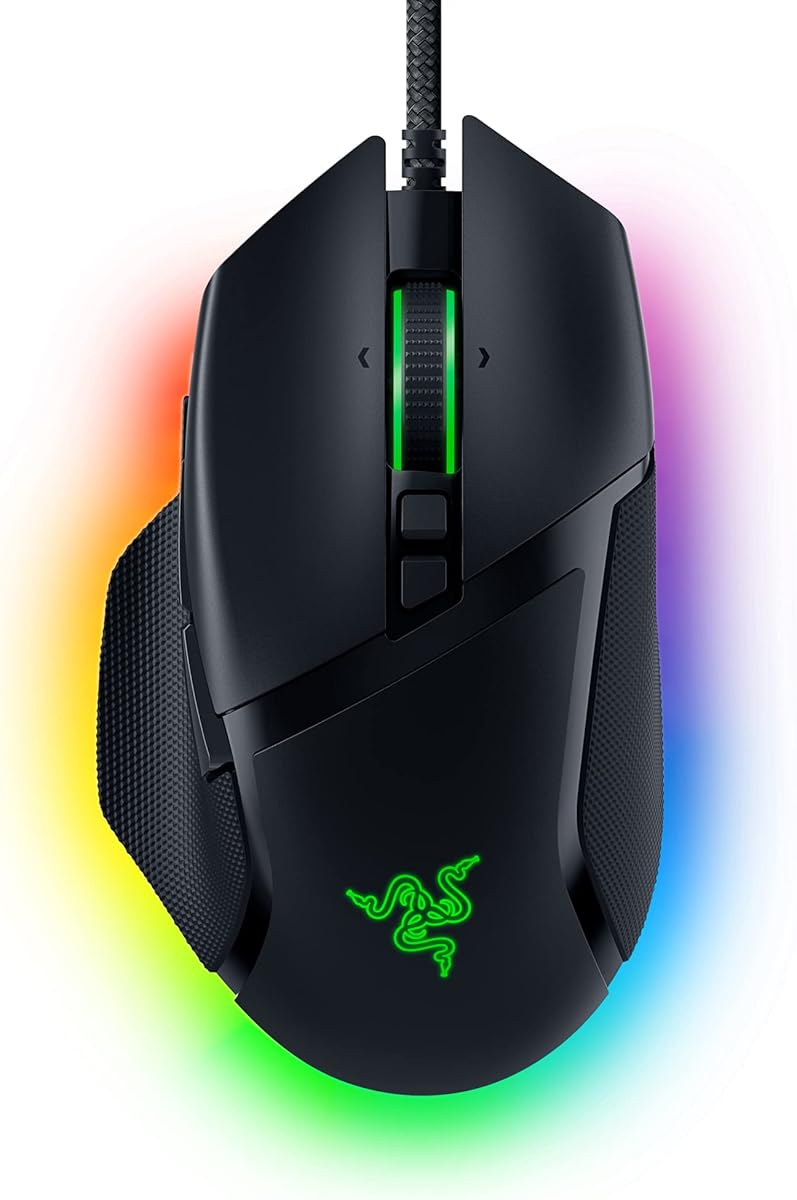
The Razer Basilisk V3 X combines the familiar Basilisk ergonomic form with HyperSpeed wireless, Bluetooth, nine customizable controls, and an 18,000 DPI optical sensor. Its 4.4 rating makes it one of the more approachable wireless options here, especially for players who want a full-size grip and abundant controls rather than a minimal esports shape.
We may earn a commission when you buy through this link, at no additional cost to you.
Battery life is the standout specification, with up to 285 hours in HyperSpeed mode and up to 535 hours over Bluetooth. Gen-2 mechanical switches carry a stated 60-million-click lifespan and use gold-plated contact points. The Razer 5G Advanced 18K sensor supports sensitivity adjustment and is specified to track without spinouts, while 16.8 million-color Chroma lighting adds visual customization.
Compared with newer 26K, 36K, 44K, and 50K sensor options, the 18K maximum is less ambitious. That distinction rarely matters unless the player uses an unusually low in-game sensitivity with a high physical mouse sensitivity, but it makes the V3 X less attractive for maximum specification comparison. The full ergonomic shell may also feel less agile to players accustomed to 49g or 54g competition mice.
The Basilisk V3 X is a good fit for players who prefer a supportive, ergonomic wireless design, want many remappable controls, and value battery life. It works well for mixed gaming and everyday use, particularly when Bluetooth convenience matters. It is less suited to buyers whose sole priority is the highest sensor specification or the lightest available shell.
The ergonomic form supports the hand while its easy-access controls remain visible. Up to 285 hours of stated HyperSpeed battery life makes it suitable for players who want to avoid frequent charging interruptions.
Nine customizable controls can be assigned to commands and macros, while Razer Synapse provides sensitivity and button management. The same software ecosystem also supports the company's lighting and other gaming features.
We may earn a commission when you buy through this link, at no additional cost to you.
The Razer Cobra is a 58g wired Mouse for Valorant that focuses on fast optical switches, precise sensitivity adjustment, and smooth movement. Its 4.5 rating reflects a capable general-purpose design that should appeal to players who want a light competitive shell without moving to a wireless-only ecosystem.
We may earn a commission when you buy through this link, at no additional cost to you.
Gen-3 optical switches offer a stated 0.2 ms actuation time, no debounce delay, and a 90-million-click lifecycle. Sensitivity can be adjusted in 50-DPI increments, giving users finer control than a basic multi-stage DPI button. The SpeedFlex cable is designed for minimal drag, and 100 percent PTFE feet cover the front, rear, and sensor ring to promote smooth gliding across surfaces.
The wired connection means there is no battery, receiver, or wireless latency to consider, but it also means the mouse cannot be used freely away from the PC. Chroma gradient underglow and support for numerous lighting effects add visual flair, though those features do not change the core competitive specifications. As with other Razer products, pointer precision can be further optimized through Synapse and Windows settings.
The Cobra is well suited to players who value quick actuation, fine sensitivity changes, and a relatively light design without needing extensive side-button macros. It is a particularly straightforward choice for a desktop gaming setup. Those wanting maximum sensor resolution or a high-refresh wireless connection should look elsewhere, but the Cobra covers the essentials with a compact, polished feature set.
The Gen-3 optical switches are specified for 0.2 ms actuation and a 90-million-click lifespan. Their rapid response suits a shooter in which repeated clicks must register consistently during short engagements.
Adjusting sensitivity in 50-DPI increments provides more granular control than cycling through a few preset levels. That can be useful when a player is balancing in-game sensitivity against a preferred physical pointer speed.
We may earn a commission when you buy through this link, at no additional cost to you.
The Razer Cobra Gengar Edition is a licensed variation of the Cobra with a 4.7 rating, the highest rating among the ten products. It retains the original model's 58g lightweight design, Gen-3 optical switches, 0.2 ms actuation, 50-DPI sensitivity adjustment, SpeedFlex cable, and 100 percent PTFE feet.
We may earn a commission when you buy through this link, at no additional cost to you.
Its principal distinction is visual. The officially licensed Pokémon Gengar theme gives the mouse a distinctive appearance, while Chroma gradient underglow provides customizable lighting across a large color range. For Valorant, the underlying performance specifications remain the important consideration, and the fast optical switches and low shell weight support responsive, precise control.
Like the standard Cobra, this model is wired, so buyers gain a simple connection and no charging routine but lose the flexibility of wireless operation. It also lacks the adjustable trigger system offered by the Logitech G PRO X2 SUPERSTRIKE and the 8 kHz polling available on several high-end models in this guide. The Gengar theme is the main reason to choose this version rather than the standard Cobra.
This is a fitting recommendation for a player who values a light, fast wired mouse and wants a more personal desktop setup. It is also a straightforward gift option for a Pokémon fan. Players focused strictly on technical versatility may prefer the standard Cobra, but the Gengar Edition does not sacrifice core competitive features to achieve its distinctive appearance.
The 58g shell, Gen-3 optical switches, and 0.2 ms actuation keep the Gengar Edition focused on responsive play. The licensed theme changes the appearance without introducing a fundamentally different control layout.
The wired design avoids battery charging and receiver management. That simplicity makes it convenient for a stationary gaming desk where consistent operation and a flexible SpeedFlex cable are priorities.
We may earn a commission when you buy through this link, at no additional cost to you.
The best Mouse for Valorant is not necessarily the model with the largest number or highest rating. A useful purchase depends on grip, sensitivity, connection preference, available controls, and how the mouse feels during repeated aim corrections.
Sensor precision determines how accurately physical mouse movement is translated into cursor movement. The models here range from a 6,400 DPI optical sensor to a 50,000 DPI Focus Pro sensor, but maximum DPI is only one part of the equation. Valorant sensitivity, Windows settings, pointer behavior, and personal aim habits all influence the final result. A high-resolution sensor can offer fine adjustment options, while a lower maximum can still feel accurate if the chosen sensitivity is suitable.
Choose a sensor that gives you a comfortable sensitivity range and supports any software needed to adjust it. In every case, test the mouse with your preferred in-game sensitivity and verify that pointer acceleration is not altering the response.
The list includes shells weighing from 49g to 82g. A lighter mouse can support quick repositioning and reduce the effort required for repeated flicks, while a somewhat heavier design may feel more settled and controlled to another player. Weight does not determine skill or accuracy, and a lighter body is not automatically better. The shape, feet, cable, and surface all influence movement.
Prioritize a weight you can control comfortably. If you tend to make large, quick movements, a lighter competitive shell may be worth trying, while a fuller ergonomic shape may feel more natural for controlled tracking.
A mouse that suits the hand can reduce tension during long matches. Compact and semi-symmetrical shapes are often considered for fast esports play, while fuller ergonomic designs offer support for a relaxed palm or claw grip. The ASUS ROG Harpe Ace Aim Lab in this list is specifically right-handed, and the Razer DeathAdder Essential and Basilisk models use fuller ergonomic forms.
Choose based on where your palm and fingers naturally rest. Do not force a compact grip onto a large hand or a palm grip onto a very small mouse; comfort and control should come before labels such as esports or ergonomic.
Optical switches offer fast actuation and can provide a stated 0.2 ms response on the Razer Basilisk V3 and Cobra models. Mechanical alternatives include the 60-million-click Gen-2 switches in the Viper V3 HyperSpeed and the 10-million-click switches in the DeathAdder Essential. Switch feel also matters: the Logitech G PRO X Superlight 2 uses tactile LIGHTFORCE hybrid switches.
Look for a response and sound profile you can use consistently. The Logitech G PRO X2 SUPERSTRIKE goes further by allowing ten actuation levels and adding haptic feedback, which can be valuable for players who want more control over click timing.
Wireless mice in this guide use low-latency technologies, with some supporting high polling rates. The Razer Viper V4 Pro, Logitech G PRO X Superlight 2, and Logitech G PRO X2 SUPERSTRIKE advertise 8 kHz polling, while the Razer Viper V3 HyperSpeed and ASUS ROG Harpe Ace use wireless receiver connections. Wired alternatives avoid receiver setup and wireless power management altogether.
Choose 8 kHz polling if you specifically value maximum input frequency and have a setup that supports it. Otherwise, a stable lower-polling wireless connection may be more practical. Always place the receiver close to the PC and keep the mouse unobstructed.
Battery life matters for players who dislike interruptions. Stated figures range from 60–90 hours for the Logitech G PRO X2 SUPERSTRIKE and up to 95 hours for the Logitech G PRO X Superlight 2 to 180 hours at 1,000 Hz for the Razer Viper V4 Pro. The Viper V3 HyperSpeed uses an AA battery, while the other rechargeable wireless options in the list have different charging arrangements.
Compare real-world priorities rather than headline numbers. A mouse that supports 8 kHz polling may consume power faster, while a Bluetooth mode can extend endurance. Keep a charging routine that matches your play schedule and avoid leaving a rechargeable mouse unattended on an unsafe surface.
Valorant uses several abilities, but not every player benefits from binding all of them. The Razer Basilisk V3 offers 11 programmable buttons, the Basilisk V3 X offers nine customizable controls, and the DeathAdder Essential includes five programmable buttons. The HyperScroll-style wheel on the Basilisk V3 can move between free-spin and tactile behavior, potentially simplifying weapon or ability cycling.
Choose a control layout that remains understandable during a match. Begin with a few useful bindings, test them, and avoid placing essential commands where accidental presses are likely. Extra controls are helpful only when they improve access rather than cluttering the shell.
Razer Synapse is referenced for button remapping, DPI control, lighting, and pointer optimization across several Razer products. The Logitech G PRO X2 SUPERSTRIKE requires Logitech G HUB for advanced features, and the ASUS ROG Harpe Ace includes an Aim Labs Setting Optimizer that suggests sensitivity and lift-off settings. Software can make a mouse easier to adapt, but it also creates a setup requirement.
Confirm that the relevant application supports your operating system and that you are comfortable managing profiles, updates, and device settings. Start with one clean profile for Valorant, then make small adjustments while evaluating actual match performance rather than relying on a temporary test.
Begin by choosing a suitable Valorant sensitivity and pairing or connecting the mouse according to its instructions. For wireless models, update the receiver firmware and software, connect the receiver directly to the PC, and position it on the desk rather than behind an obstruction. For a wired mouse, route the cable away from areas where it could catch while preserving the gentle movement of the cable.
Configure the DPI or sensitivity settings before entering a match. Disable Windows pointer acceleration where applicable, use the supplied software to set an appropriate profile, and assign only the buttons you can use consistently. Test the configuration in the practice range, then make modest changes over several matches. Avoid changing multiple settings at once because it becomes difficult to identify which adjustment improved the result.
For care, keep the sensor free of dust and debris and clean the feet with a soft, lint-free cloth. Do not use excessive liquid around optical switches, ports, or the sensor. Check wireless battery levels regularly, keep spare batteries available for AA-powered models, and recharge rechargeable mice on a safe surface. Replace the surface pad when tracking becomes inconsistent, since debris and wear can affect movement as much as the mouse itself.
Not necessarily. A lighter mouse can make rapid, large movements feel easier, but the best choice is one whose shape, sensitivity, and controls you can control comfortably. Players who make smooth adjustments may prefer a fuller ergonomic design, while competitive players who favor fast directional changes may appreciate a 49g or 54g shell. Weight should be evaluated together with grip and movement style.
A higher maximum DPI does not automatically improve Valorant performance. It simply provides a broader range of physical sensitivity settings, and most players use a small portion of that range. The sensor's tracking consistency, mouse weight, shape, and your ability to maintain a stable sensitivity are more relevant to the overall experience. Test at your normal in-game sensitivity before judging the specification.
A wired mouse offers the simplest setup and avoids battery charging, while a wireless model offers greater desk flexibility and modern low-latency technology. Several wireless choices in this guide support 8 kHz polling and long stated battery lives. Consider your setup, charging habits, and sensitivity to any possible connection interruptions before choosing.
There is no universal DPI that suits every player. The best value is one that lets you move comfortably across a useful portion of the mousepad while maintaining accuracy in Valorant's settings. Because the recommended sensitivity differs among players, begin with an established range, test it in the practice range, and adjust gradually rather than copying another player's configuration without considering mouse size and grip.
Disabling pointer acceleration can make physical movement map more predictably to cursor movement, which many competitive players prefer. Razer explicitly recommends disabling the Windows setting called Enhance pointer precision for several of its products in this guide. After changing the setting, restart the game and test the mouse again to confirm that the movement feels consistent.
They can be, particularly for abilities that benefit from quick access, but excessive bindings may make the mouse harder to use under pressure. The Razer DeathAdder Essential has five programmable buttons, while the Basilisk V3 and V3 X offer larger control counts. Start with the most frequently used commands and ensure each binding can be activated without disrupting your aim.
Inspect the sensor and feet regularly, especially if the cursor stutters, drifts, or stops gliding smoothly. A soft, lint-free cloth can remove ordinary surface dust, while compressed air may help clear debris around buttons and the scroll wheel. Keep liquids away from the sensor and electronics, and replace the mousepad if its woven surface becomes worn or uneven.
Weight can influence how easily a player performs fast movements, but it does not directly determine accuracy. A lighter mouse may reduce the effort needed for abrupt flicks, while a heavier or more ergonomic model may feel stable during controlled tracking. Practice consistency, sensor performance, and comfort are more useful than treating one weight as universally superior.
The Razer Viper V3 HyperSpeed is the strongest all-around recommendation because it balances an 82g competitive design, a 30K sensor, centered weight distribution, and long stated wireless battery life. The Logitech G PRO X2 SUPERSTRIKE is the premium choice for players who want adjustable click actuation, haptic feedback, and 8 kHz wireless polling, while the Razer DeathAdder Essential delivers the most approachable wired setup with useful programmable controls.
Your priority should be the feature that affects your play most. Choose an ultra-light shape for fast movement, a fuller ergonomic body for comfort, high-refresh wireless polling for maximum input frequency, or programmable controls for a customized command layout. The Razer Viper V4 Pro, ASUS ROG Harpe Ace Aim Lab, Logitech G PRO X Superlight 2, and Razer Basilisk V3 X offer different ways to satisfy those needs.
Before purchasing, verify the current specifications, operating-system support, included accessories, and required software. Ratings, product details, and prices can change, so check the current listing and retailer information at the time of purchase. The most successful setup is ultimately the one you can configure confidently and use consistently.

