
YAMAHA MG10XU
4.6Editor score
Ten-input compact mixer
USB audio and SPX effects
Three-band EQ and compressors
A powered mixer combines a signal mixer and amplifier in one enclosure, making it a practical centerpiece for cafés, rehearsal rooms, pop-up events, worship spaces, karaoke venues, and other compact performance settings. A suitable model should provide enough clean output, sensible inputs, dependable controls, and the connectivity needed to run a small show without a complicated equipment stack.
This guide compares ten current options using their published channel counts, amplifier configurations, effects, input types, media functions, dimensions, ratings, and stated use cases. The list includes dedicated powered mixers, compact mixers with USB recording, and complete speaker systems so readers can compare more than one way of building a small-venue sound setup.
The recommendations reveal how different designs serve different needs, from portable two-channel recording to multi-channel live amplification and bundled PA systems. Ratings and availability can change over time, as can retailer pricing, so check the current listing and verify compatibility with microphones, instruments, media players, and passive speakers before buying.
4.6Editor score

5.0Editor score

4.3Editor score
As an Amazon Associate we earn from qualifying purchases.
The table below compares all ten products by their most useful small-venue characteristics, including mixer capacity, amplification, effects, and playback or recording options.




The TF-800 8-Channel Power Mixer combines an eight-channel mixer with a built-in 650-watt-plus-650-watt amplifier, giving it unusually broad capability for a small-venue device. Its 5.0 rating reflects strong buyer satisfaction, while the combination of Bluetooth, USB, multiple effects, phantom power, and per-channel controls makes it suitable for karaoke, mobile DJ work, lectures, bar entertainment, and small stages.
We may earn a commission when you buy through this link, at no additional cost to you.
Its strongest feature is the integration of an amplifier and mixer in a relatively compact 41.5 by 35.5 by 13-centimeter enclosure. The product information states that it can drive two 15-inch professional speakers simultaneously. Each channel includes one-touch mute, gain adjustment, a three-band EQ, auxiliary send, and effect send, providing enough control for performers who need to balance several sources without relying on external outboard processing.
The TF-800 also supports 99 reverb effects, including Delay, Echo, Chorus, Flange, Tremolo, Wah-Wah, RadioVoice, and PitchShifter. Bluetooth and USB playback let operators add background tracks or karaoke media directly, and the large spectrum display and level indicators are intended to make monitoring easier in bright or busy environments. Phantom power allows compatible condenser microphones to be used with the appropriate channel.
This is not the simplest mixer for an absolute beginner, and buyers must supply compatible passive speakers and any necessary cables. Even so, the feature density, strong stated output, channel controls, and media connectivity justify considering it first for a compact but capable event rig. It is the most complete general-purpose choice in this group for users who want mixing and amplification in a single box.
Choose the TF-800 when the venue needs several microphones or instruments, two powered speaker connections, wireless background music, and onboard vocal effects. It is especially attractive for mobile performers, karaoke hosts, lecturers, and bar setups that require flexibility without a large collection of separate equipment.
Combining the mixer and amplifier reduces the number of separate signal-chain components. The eight input channels, individual gain and EQ controls, effect sends, auxiliary send, and quick mute function provide a practical foundation for live mixing with microphones, instruments, and media sources.
Bluetooth and USB playback make it easy to bring in tracks from a phone, tablet, or stored media, while the 99-effect processor offers substantial sound-shaping options. The large spectrum display helps operators watch levels and musical peaks during performance.
We may earn a commission when you buy through this link, at no additional cost to you.
The YAMAHA MG10XU is a compact 10-input stereo mixer that combines a 4.6 rating with a broad set of mixing and recording functions. Although it does not contain a power amplifier, its focused feature set, clear value, and modest dimensions make it an excellent entry point for rehearsals, podcasting, home recording, and small events that already have an amplifier or powered speakers.
We may earn a commission when you buy through this link, at no additional cost to you.
The mixer includes SPX digital effects, discrete class A D PRE amplifiers, three-band EQ, and high-pass filters on every channel. One-knob compressors provide an approachable way to control dynamics on vocals, guitars, bass, and drums. These controls make it easier for newer operators to develop a clean mix without diving into complicated external signal processing.
USB connectivity is one of the most useful additions. It can serve as a simple recording interface for a computer, which makes the MG10XU relevant to podcasters, streamers, musicians, and anyone who wants to capture rehearsals or performances. Its rugged, impact-resistant powder-coated metal chassis also suggests that it can tolerate the movement associated with regular mobile use.
The important limitation is that it is a mixer rather than a powered mixer in the strict sense. Users must add a compatible amplifier or powered speakers, and those components also need suitable cables. For a first recording setup or a small rehearsal, however, that flexibility is an advantage because the same mixer can work with different playback systems.
The MG10XU is best for budget-conscious buyers who want more than two input channels, reliable preamps, and USB recording without paying for a bulky power section. It also works well as a compact live mixer when a separate amplifier is already available or when powered speakers are a more practical choice for the venue.
The 244 by 71 by 294-millimeter chassis is easy to carry and occupies little space in a rehearsal room or home studio. USB connectivity adds a practical path to computer recording without requiring a separate interface.
Three-band EQ, high-pass filters, one-knob compressors, and SPX effects cover several common mixing needs. The controls are broad enough for live work yet approachable for users building confidence with a first multi-channel setup.
We may earn a commission when you buy through this link, at no additional cost to you.
The Mixers Audio 8-Channel Mixer is a powered desktop unit built around eight input channels, dual 300-watt output, and 16 digital reverb effects. Its 4.2 rating reflects a generally positive reception, while the mixture of microphone, line, instrument, and media interfaces gives it broad usefulness for karaoke, DJ events, live performances, and stage shows.
We may earn a commission when you buy through this link, at no additional cost to you.
A particularly notable detail is the range of supported connections. The mixer accepts headphone, musical instrument, microphone, line, XLR, and unbalanced quarter-inch inputs, allowing vocalists, instrumentalists, and playback devices to share a mixer. Mono high and low balance controls, a five-band master equalizer, and 48V phantom power make the unit more versatile than a basic karaoke board.
Media playback expands its use beyond live inputs. The built-in controller supports functions such as play, pause, track skipping, and mode switching for compatible USB flash readers, MP3 devices, and Bluetooth sources. This means background music or karaoke tracks can be integrated without using every live input channel.
The dual 300-watt specification should be understood as an amplifier rating rather than a guarantee of performance in every room. Actual usable output depends on speaker impedance, room acoustics, source levels, and how the amplifier is operated. The mixer also lacks the larger effect library offered by some competitors, and its less established 4.2 rating warrants careful comparison.
This model is a sensible choice for small performers who need many input types and direct speaker capability in a single package. It is particularly useful when the priority is flexible connectivity, moderate amplification, and a manageable number of onboard effects rather than premium construction or a large-format control surface.
XLR, quarter-inch, RCA, line, microphone, and headphone connections provide flexibility for a typical small-stage lineup. Phantom power supports compatible condenser microphones, while individual channel controls help organize the balance.
Bluetooth and USB flash-reader support can handle background tracks independently of the live microphone or instrument channels. The transport controls make basic media operation more convenient during rehearsal or karaoke.
We may earn a commission when you buy through this link, at no additional cost to you.
The TF600 6-Channel Professional Mixer combines six input channels with a dual 450-watt powered output, 99 DSP effects, Bluetooth streaming, and USB recording. Its 4.2 rating and feature-rich specification make it a credible option for compact performances where a mixer, amplifier, media source, and basic recording workflow are desired in one enclosure.
We may earn a commission when you buy through this link, at no additional cost to you.
The product description highlights a digital DSP audio-processing chip intended to enhance vocals and reduce howling. A seven-band master equalizer offers more detailed tonal adjustment than the common three-band layout, which is useful for shaping a PA system to the acoustics of a particular room. Reverb can be adjusted from the processor when a particular song or speaking environment calls for more or less ambience.
Its media options are particularly useful for rehearsal rooms, small halls, karaoke bars, and mobile event work. Compatible phones and tablets can stream through Bluetooth, while USB and flash-card sources can be used for music. The mixer can also record to a USB memory stick or computer, adding a useful way to preserve a rehearsal or capture a simple performance.
The six-channel mixer section is the main constraint for buyers with larger bands. A singer, drummer, bassist, guitarist, and backing-track source can already occupy much of that capacity, so additional performers may require a larger board or an input expansion. The absence of a published customer rating also means the TF600 has less visible market history than established models in the list.
Choose the TF600 when direct speaker power, wireless background music, and USB capture matter more than maximum channel count. It is a particularly engaging option for a rehearsal space, classroom presentation, karaoke session, or small gathering where a single operator wants to mix, amplify, play media, and record.
The seven-stage equalizer gives the operator finer control than a conventional three-band master section. It can help correct persistent bass, vocal muddiness, or harshness in a small room when the system is adjusted carefully.
USB recording lets performers save a rehearsal or event directly, while Bluetooth playback supports streamed background tracks. This combination reduces the need for a separate media player or capture device in simpler setups.
We may earn a commission when you buy through this link, at no additional cost to you.
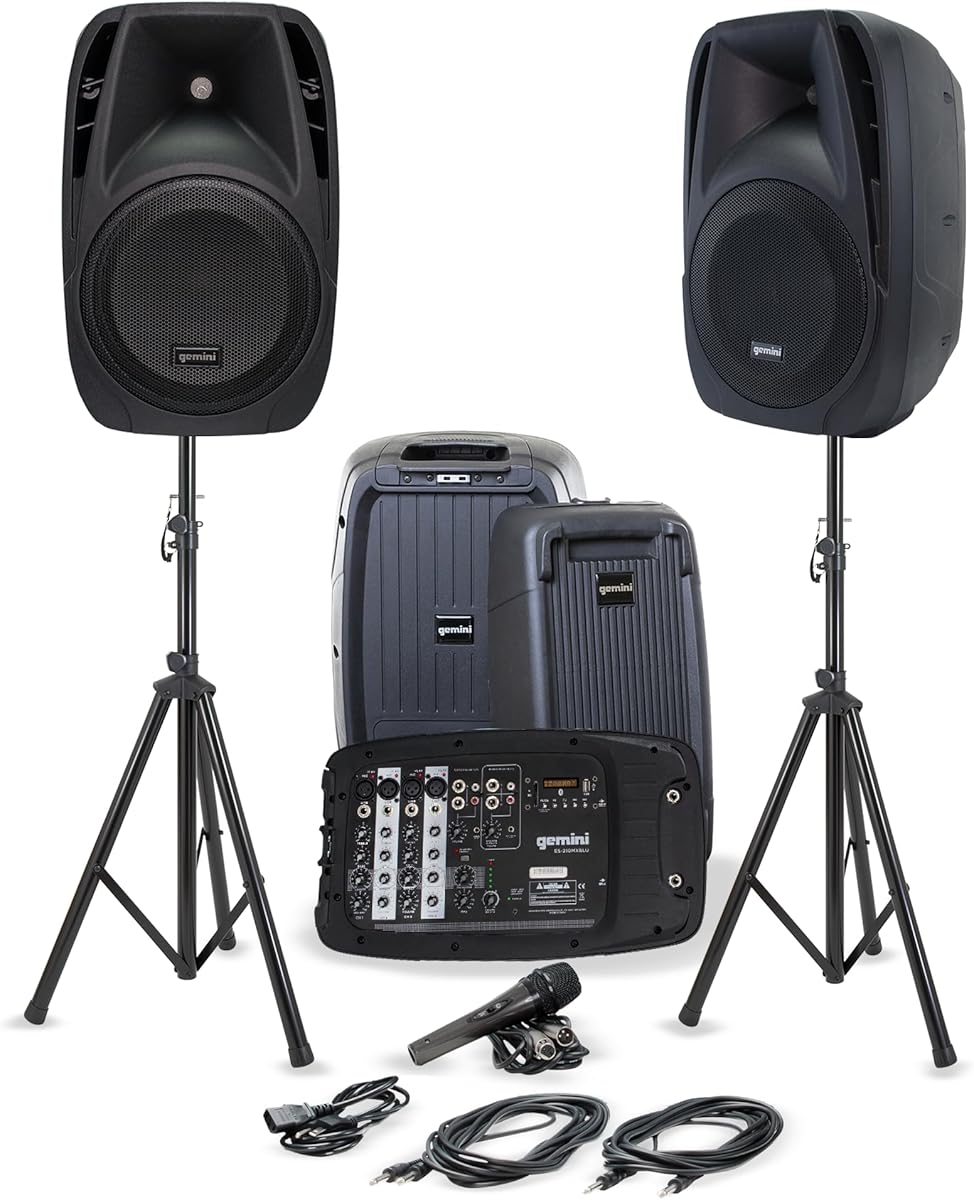
The Gemini ES-210MXBLU-ST is not merely a mixer but a complete portable PA system with two 10-inch passive speakers, a powered six-channel mixer, two adjustable tripod stands, a wired dynamic microphone, and cables. Its 4.2 rating reflects a balanced package for mobile DJs, churches, weddings, school functions, fitness classes, bands, and karaoke events serving as many as 150 people.
We may earn a commission when you buy through this link, at no additional cost to you.
The 600-watt system includes a built-in mixer with four XLR microphone or line channels. Each of those channels has bass, treble, echo effects, and volume control, while 48V phantom power supports condenser microphones. A separate stereo auxiliary channel accepts RCA and 1/8-inch sources, keeping the four main performance inputs open for singers, presenters, or instruments.
Its media capabilities are extensive for a portable PA. Bluetooth supports streaming from phones, tablets, and laptops, while USB and SD card playback handle MP3, WAV, and FLAC files. The built-in FM radio adds another source option, and monitor outputs plus a headphone jack allow the operator to check the mix during setup or performance.
The bundle is convenient but not the lightest option. Its total weight is listed at 48.5 pounds, so one person may need to make multiple trips when moving stands and cabinets. The speakers are passive and depend on the included mixer for amplification, meaning the system cannot be separated into independent speaker components without another suitable amplifier.
This package is the most practical choice for someone starting from almost nothing. Rather than comparing channel strips and amplifier specifications before sourcing every cable, stand, and speaker, the buyer receives a coherent wired rig ready for rehearsal or an event. It is less suitable for operators who already own good speakers and only need a mixer.
The two speakers, mixer, microphone, stands, and cabling form a complete connected system. Its storage compartment also allows smaller accessories to be packed with the speakers, simplifying transport between locations.
A separate stereo media channel prevents Bluetooth or file playback from consuming the four XLR performance inputs. Peak LEDs, a master limiter, monitor outputs, and a headphone jack support cleaner operation and quicker troubleshooting.
We may earn a commission when you buy through this link, at no additional cost to you.
The Astatic M2 is a highly compact two-channel mixer and USB interface with a 4.8 rating, making it one of the most highly rated products here. It is aimed at small-venue use, live performance, broadcasting, podcasting, and home recording, with a particularly clear advantage for operators who want to capture audio directly on a computer.
We may earn a commission when you buy through this link, at no additional cost to you.
Its two XLR combo inputs accept microphones or instruments, and the USB output records at 16-bit and 48kHz. Because it can operate on bus power from a connected computer, it does not require a separate external supply during the primary recording workflow. That makes it suitable for mobile podcasting, compact rehearsal recording, and small sessions where a full mixer would be excessive.
The mixer also provides 48V phantom power for compatible condenser microphones. That feature closes a common gap in inexpensive two-channel interfaces and allows a creator to use a studio-style vocal microphone without adding a separate preamp. Its small format makes it particularly convenient for a compact desk, mobile recording bag, or rehearsal space.
The M2 lacks an integrated power amplifier, and its two-channel format places clear limits on simultaneous live inputs. It cannot replace a multichannel live mixer for a band or event with several performers, and stereo or additional media routing may not match the flexibility of a larger console. Those are important distinctions when comparing it with the phrase powered mixers.
Choose the Astatic M2 when the primary goal is a simple, reliable two-source recording interface with microphone support. It is a particularly strong fit for podcasters, home recordists, and solo performers who value portability and direct computer capture over stage amplification.
The USB output moves the mix directly into a computer, where it can be recorded or monitored through familiar software. Bus power further simplifies setup by reducing the number of connections and power adapters.
Switchable 48V phantom power allows compatible condenser microphones to operate through the combo inputs. This makes the unit practical for polished spoken-word, podcast, and home vocal recordings.
We may earn a commission when you buy through this link, at no additional cost to you.
The Behringer EUROPOWER PMP2000D combines a 14-channel mixer with up to 2 x 1000 watts of stereo power and a 4.4 rating. It is designed for live performances, rehearsals, events, presentations, churches, and PA setups, offering more channel capacity and stated amplification than the compact models in this guide.
We may earn a commission when you buy through this link, at no additional cost to you.
Nine high-quality microphone preamps with switchable 48V phantom power provide a useful foundation for vocals and condenser microphones. The 14-channel design can accommodate a larger band, several presenters, keyboard, playback media, and other sources without forcing operators to share too few inputs. Two 25-foot XLR microphone cables are included in the bundle to help get the system connected.
The integrated 24-bit FX processor supplies 25 presets, including reverb, chorus, flanger, delay, and pitch shifting. These effects can add polish to vocals and instruments without requiring external processing. Class-D amplifier technology is also used to keep the unit relatively lightweight and compact for a mixer with this much stated output.
The headline power figure can be more than a very small room needs. Pushing a powerful amplifier harder does not automatically produce better sound, and excessive output may encourage overdriving the preamp or speakers. The large control surface may also feel unnecessarily complicated for a solo acoustic performer who only needs one microphone and a backing track.
Despite those cautions, the PMP2000D is a strong choice when a small venue occasionally hosts a full band, rehearsal, community event, or multi-speaker presentation. It offers the headroom and input variety to support a busier program, provided the operator selects appropriate speakers, sets conservative levels, and learns the channel controls.
Fourteen channels and nine microphone preamps support more simultaneous sources than the compact alternatives. This makes the mixer relevant to small clubs, rehearsal groups, and events with several presenters or performers.
Class-D amplification technology supports a powerful output in a comparatively manageable enclosure. The included long XLR cables also make it easier to position microphones away from the mixer in a small stage or room.
We may earn a commission when you buy through this link, at no additional cost to you.
The W IN-MIX 200W x2 is an eight-channel powered mixer designed for small cafés, karaoke parties, intimate gigs, home studios, worship leaders, fitness instructors, and traveling musicians. Its published feature set is appealing for mobile operators, with 200-watt-per-channel amplification, Bluetooth 5.1, USB/MP3 playback, multiple input formats, and phantom power.
We may earn a commission when you buy through this link, at no additional cost to you.
Channels can accommodate XLR microphones, quarter-inch instruments, and RCA sources, with independent volume, EQ, and effect-send controls. A dedicated stereo channel and real-time monitoring help with playback and performance balance. Phantom power on channels one and three supports compatible condenser microphones, giving users some flexibility for spoken-word, streaming, and recording applications.
Bluetooth pairing and USB media playback reduce the need for an external source device, while the built-in power section eliminates the need for a separate amplifier when driving compatible passive speakers. The stated pairing guidance is for passive speakers up to 10 inches at 8 ohms, so buyers should follow those limits rather than assume the unit can drive any speaker configuration.
No customer rating is published for this model, so there is less direct buyer feedback available than with established products. Its stated output is lower than that of the TF-800, TF600, Behringer models, and Yamaha EMX5, which may limit it in louder or larger rooms. The concise product description also provides less detail on exact EQ and effect options.
The W IN-MIX is best considered when portability, eight input channels, and convenient media connections are priorities. It can serve a mobile DJ, compact café, rehearsal room, or intimate karaoke event, provided the selected passive speakers remain within its stated compatibility range and the venue does not demand extreme output.
The compact metal chassis is intended to fit into a gig bag and move between a rehearsal, a small café, or an intimate event. Integrated amplification also reduces the number of separate boxes that need transport.
Independent channel volume, EQ, and effect-send controls support straightforward live mixing. Real-time monitoring and a dedicated stereo channel help users connect backing tracks, speakers, or recording devices.
We may earn a commission when you buy through this link, at no additional cost to you.
The Behringer EUROPWER PMP1680S is an ultra-compact, rack-mountable powered mixer with a 4.4 rating and up to 2 x 800 watts of stereo output. It also supports a 1600-watt bridged mode, making it a more installation-oriented alternative to the tabletop mixers in this roundup.
We may earn a commission when you buy through this link, at no additional cost to you.
Its mixer section includes six mono channels, two stereo channels, and a separate CD or tape input and output. That arrangement is useful for fixed rooms, rehearsal spaces, small worship venues, and events where microphones, instruments, and media need clearly assigned paths. Two studio-grade 24-bit stereo effects processors offer 100 presets, including reverb, chorus, flanger, delay, and pitch shifting.
The Class-D amplifier design is central to the product's portability. According to the product information, the chassis is nearly half the depth and weight of conventional powered mixers. That makes it easier to move into a venue and install when a rack cabinet is available or when the unit is placed in a suitable stand or enclosure.
Rack-mountable construction is not universally convenient. A small café, classroom, or mobile performer may prefer a tabletop mixer that can be set up and taken down without a rack. The product description also focuses on analog connections and traditional media input rather than modern USB recording or Bluetooth, so current streaming workflows may require a separate source device.
Choose the PMP1680S for a permanent small-room installation or an event team that values channel count, effects, and high stated output in a compact chassis. Its 4.4 rating and established feature set make it a solid all-around powered mixer, especially when the physical installation can accommodate a rack-oriented format.
Six mono inputs, two stereo inputs, and a dedicated CD or tape path provide a clear structure for live and playback sources. This is helpful in installations where several microphones and instruments must remain connected simultaneously.
Two 24-bit processors with 100 presets provide extensive sound-shaping choices. The shallow, comparatively light Class-D chassis is especially useful where backline space is limited or a rack is available.
We may earn a commission when you buy through this link, at no additional cost to you.
The Yamaha EMX5 combines a 12-input stereo mixer with a built-in 2 x 630-watt amplifier and earns a 4.3 rating. It is particularly well suited to users who want a straightforward powered console with feedback suppression, output EQ, and SPX effects, making it a strong premium choice for small halls, worship rooms, and event work.
We may earn a commission when you buy through this link, at no additional cost to you.
Its 12 inputs offer a useful balance between capacity and simplicity. Instead of emphasizing a large display or extensive digital media features, the EMX5 focuses on core live-mixing tools. Output equalization can shape the overall system response, while the feedback-suppression function gives an operator additional assistance when close-miked speakers create problematic acoustic feedback.
SPX effects provide familiar Yamaha processing for vocals and instruments, and the amplifier section removes the need for a separate power unit. The stated 2 x 630-watt configuration at 4 ohms provides a straightforward path to compatible passive speakers for a compact room or event.
Its main limitations are the lack of built-in Bluetooth or USB playback and the fact that its 4.3 rating is not the highest in the group. A mobile DJ or karaoke operator accustomed to streaming directly into a mixer may need a separate media source. A buyer also needs to assess whether the additional spending is justified for this specific feature set.
The EMX5 is best for operators who prioritize dependable live-mixing fundamentals, portability, and helpful feedback control over built-in wireless connectivity. For a small venue that already has a clear source plan and wants a capable powered console, its 12 inputs and 630-watt-per-channel amplifier make it a premium but logical choice.
The built-in feedback-suppression function can help operators manage howling in challenging acoustic environments. It does not replace proper speaker placement or disciplined gain control, but it adds a valuable safety net for small rooms.
The lightweight, portable design supports transport between events, while the integrated 2 x 630-watt amplifier reduces the number of components required. Output EQ and SPX effects complete the package for essential live reinforcement.
We may earn a commission when you buy through this link, at no additional cost to you.
The right powered mixer depends on the number of performers, source types, room size, transport requirements, and whether you need recording or wireless media playback. These factors help prevent a specification-heavy purchase from creating practical problems after delivery.
Begin with the sources that must operate at the same time rather than the total number of sockets printed on the box. Count microphones, instruments, playback devices, computers, turntables, and any dedicated stereo source. A vocalist with a backing track, for example, may need only two channels, while a four-piece band and stereo playback may require six or more. Products described as eight-, ten-, twelve-, or fourteen-channel mixers provide different amounts of room for expansion and routing.
Pay attention to the difference between input channels and physical connectors. Multiple sockets may share a channel, and a stereo input may occupy two mono channels. XLR combo inputs can be convenient when a venue needs to switch between microphones and instruments, but users should check whether all channels provide balanced inputs, gain controls, EQ, and effects sends. The number of usable microphone preamps is also important because condenser microphones generally require 48V phantom power.
Choose enough channels for the normal program plus one or two spare positions if growth is possible. Too few channels forces compromises and makes it hard to add a guest performer, while far more channels than needed can make the control surface larger and more intimidating. A 10- or 12-input console is often a practical middle ground for growing small-venue operations.
A powered mixer eliminates the need for a separate amplifier, but its output must be matched to the speakers and venue. The room's dimensions, ceiling height, audience size, program type, and material absorption all influence how much output is useful. A classroom presentation needs clean speech intelligibility, while live music can demand more headroom for transients. A small café with reflective surfaces can become harsh or excessively loud even at a moderate level.
Review the stated output configuration carefully, especially whether it refers to stereo operation, bridged operation, or maximum peak capability. Speaker impedance also matters because an amplifier's output changes with the load. Passive speakers must have a compatible impedance and power handling, while powered speakers have their own amplifiers and should not be connected to a mixer output in the same way.
Do not equate the largest wattage figure with the best sound. Clean headroom, appropriate preamp behavior, usable controls, and room-friendly speakers usually matter more than maximum output. For intimate venues, a well-matched pair of smaller speakers may sound better than a powerful mixer driving oversized cabinets. For busier or louder programs, choose additional channel capacity and headroom before chasing an extreme headline rating.
The input format should match the equipment already in the venue. XLR connections are standard for microphones, quarter-inch sockets accommodate many instruments and line-level devices, and RCA inputs are common for consumer media equipment. Combo connectors can save space by accepting both XLR and quarter-inch plugs, but operators should verify the features available on each channel. A small venue with several vocalists may prioritize multiple XLR preamps and phantom power over additional RCA convenience.
Condenser microphones generally need 48V phantom power, while dynamic microphones do not. Headphone and monitor outputs are valuable for rehearsal, recording, and troubleshooting because they let the operator hear the mix without disturbing the audience. High-pass filters can remove rumble and stage noise, while compressors can help control wide variations in vocal or instrument levels. A unit with one-knob compressors is particularly approachable for new operators.
For electronic instruments, direct connection may be sufficient. Guitarists using pickups often benefit from a guitar amplifier or a proper instrument-level input, and users should check signal requirements rather than assuming every line input has identical behavior. The best mixer is one that accepts the intended sources cleanly and offers the controls needed to manage them.
Although the guide focuses on powered mixers, some highly rated compact models are mixers without an integrated power amplifier. These can be excellent choices for recording, podcasting, rehearsals, or use with already-owned powered speakers. A true powered mixer is more useful when the goal is a self-contained live rig with passive speakers and minimal extra equipment.
A compact mixer without amplification can offer lower weight, a smaller footprint, and direct computer connectivity. A powered mixer provides a simpler connection path, but it is generally larger and may not offer the same audio interface features. Buyers should not exclude a strong compact mixer merely because it lacks a power section; the correct choice depends on the complete signal path rather than the label alone.
If a complete package is the goal, the Gemini system includes speakers, mixer, microphone, stands, and cables. If existing speakers are already available, a mixer-only model may provide better value and flexibility. Consider also whether the system will be transported frequently, because additional power and weight matter more to a mobile performer than to a fixed installation.
Bluetooth has become a common expectation for karaoke, DJ, hospitality, and rehearsal work because it allows a phone or tablet to supply background tracks. USB flash or media playback can be more reliable for unattended operation and often provides direct track selection. Models with dedicated media-volume controls make it easier to balance playback without altering live microphone channels. USB recording is valuable for capturing rehearsals, podcasts, or simple performances, but it should be evaluated separately from playback.
File compatibility, control behavior, latency, and recording format matter. A mixer advertised as USB-compatible may be intended for playback rather than multichannel recording, while a computer interface may record only a stereo mix. The Astatic M2, for example, clearly focuses on 16-bit, 48kHz USB output and bus-powered computer operation, whereas several powered units emphasize Bluetooth, flash media, and one-click recording.
Operators should plan for a fallback source. Having a locally stored file or a wired connection can prevent a failed wireless pairing from stopping a service. Also verify that the mixer's output or recording path includes the sources that matter; convenient playback controls do not guarantee that every microphone or effect is captured separately.
Built-in reverb, delay, chorus, and related effects can make a small mixer more practical for karaoke and acoustic performances. The number of presets is not the only consideration. It is more important to know whether effects are global, assignable per channel, adjustable by send level, and easy to recall during a show. A large library can be useful, but a performer operating alone benefits more from a small set of clear, repeatable choices.
Digital signal processing can also help control feedback or shape vocals, although no preset replaces correct gain staging, speaker placement, and disciplined EQ. Models offering effect-send controls allow the operator to blend reverb into a vocal or instrument without changing the entire mix. The TF-800, TF600, and Behringer models provide extensive libraries, whereas the Yamaha units emphasize established SPX processing.
Avoid choosing solely by preset count. A larger library can be impressive but difficult to use under pressure. Test whether effect selection, parameter adjustment, and channel assignment are understandable from the front panel. For a beginner, clear labeling and a manageable workflow may be more valuable than dozens of additional presets.
Small-venue equipment is often carried between rehearsal rooms, community halls, restaurants, and pop-up events. Weight, chassis depth, handle placement, and control accessibility can determine whether a mixer is pleasant or frustrating to transport. Compact Class-D designs and shallow rack-style mixers reduce bulk, while a complete PA bundle saves assembly time but adds the weight of speakers and stands.
Construction should feel suitable for repeated handling. Impact-resistant cabinets, powder-coated metal, and clearly labeled controls are useful signs that a product is intended for active use. A large display may be easier to read in bright conditions, while a conventional mixer can be more approachable for users who already understand live sound. A screen is not automatically better; it should make operation clearer.
Measure the available table, shelf, or rack space before ordering. Leave room for cables, ventilation, and safe access to controls. In a permanent installation, prioritize access for maintenance and cable routing. For a mobile operation, choose the smallest complete system that can handle the required inputs and speakers without exceeding the transport capacity of the person carrying it.
Customer ratings can provide a useful signal about satisfaction, but they should be interpreted alongside the size and age of the review base. A 5.0 rating on a less-established product is encouraging, while a 4.4 rating with a longer history may provide more context. The W IN-MIX listing has no published rating, so it should be compared primarily on specifications and fit for the intended setup.
Look beyond the average number for recurring comments about noise, control clarity, heat, reliability, missing accessories, or mismatched descriptions. However, do not assume every review reflects normal use, and do not treat one isolated issue as proof that a product is defective. Use feedback to identify recurring concerns and then check whether the intended application would be affected.
The most important final step is to verify the current manufacturer information and user manual. Inputs, impedance requirements, output power, effects, and firmware behavior can change between revisions. A mixer that appears ideal on a shopping page may have connector limitations that only become clear in the manual. Current ratings and listings should therefore be treated as one part of the decision rather than a substitute for system planning.
Begin by planning the signal path and speaker placement before powering the mixer. Connect microphones and instruments with powered speakers switched off, confirm cable routing, and make sure passive speakers have the required impedance. Set gain controls conservatively, leave the master level low, and then raise levels gradually while checking for hum, clipping, and acoustic feedback. For models with feedback suppression, remember that the feature is a backup rather than a substitute for correct placement.
Build the mix in layers. Start with the most critical vocal or lead source, establish a useful level, and add instruments without overwhelming it. Use high-pass filters on voices or acoustic sources when rumble is present, apply modest EQ to correct obvious problems, and introduce reverb through an effect send rather than flooding the full mix. Keep media playback on a separate level or channel so background tracks remain consistent as live sources change.
For maintenance, switch off and unplug the mixer before changing connections, and allow ventilation around the power section. Keep the chassis dry, remove dust from controls and vents, and inspect cables for damaged insulation or intermittent contacts. Store the unit in a padded case away from moisture and extreme temperatures. Before each event, check phantom-power settings, speaker polarity, input assignments, recording destinations, and media playback levels before raising the master output.
A mixer combines and controls audio signals, while a powered mixer also includes an amplifier capable of driving compatible passive speakers. A conventional mixer may instead feed a separate amplifier, powered speakers, or a computer interface. The distinction matters because a mixer without built-in power generally cannot drive passive speakers directly.
A solo singer with a backing track may need only two channels, while a small band with stereo playback can require six to ten. Add channels for presenters, guest performers, and future growth, but also check that the required preamps, effects, and outputs are available on every channel. A modest channel count with useful controls is often easier to operate than a much larger board.
No. Speaker impedance and power handling must be compatible with the mixer, and the product's stated speaker-size guidance should be followed. Connecting an unsuitable or underpowered speaker can produce poor results or damage equipment. When specifications are unclear, select a mixer and speaker combination that the manufacturer explicitly supports.
You need it for compatible condenser microphones, which require power through the XLR cable. Most dynamic microphones do not need phantom power. Some compact mixers provide it on every channel, while others limit it to selected channels, so verify the channel layout before choosing a microphone and mixer combination.
Bluetooth is convenient but can be affected by interference, pairing behavior, software changes, and device battery level. For critical performances, prepare locally stored files on a USB drive or keep a wired fallback available. Test the entire playback chain during soundcheck rather than waiting for the event to begin.
A USB recorder is valuable for rehearsals, podcasts, streaming, and simple performance capture. Verify whether it records a stereo mix or separate channels, and check the supported file format and connection requirements. For live sound alone, media playback and reliable microphone preamps may matter more than recording capability.
A complete system is usually easier for a first-time buyer because the mixer, speakers, stands, microphone, and cables are designed to work together. It can also reduce setup time. Existing owners of quality speakers and accessories may get better flexibility and value by selecting each component separately, but must verify compatibility themselves.
Start by positioning speakers away from microphones and away from the direction they face, then reduce gain and monitor levels. Use a high-pass filter when appropriate, keep microphones at a consistent distance, and avoid pointing the rear of a directional microphone directly at a speaker. Built-in feedback suppression can help, but placement and gain control remain the primary solutions.
The TF-800 8-Channel Power Mixer stands out as the strongest general-purpose choice because it combines eight channels, substantial stated amplification, 99 effects, Bluetooth, USB, and phantom power in a portable enclosure. The YAMAHA MG10XU is the budget leader for users who already have an amplifier or powered speakers, while the Yamaha EMX5 offers a more refined premium path for live events with 12 inputs, feedback suppression, and 630 watts per amplifier channel.
Prioritize the features your actual program requires rather than the largest specification. Count simultaneous sources, match compatible passive speakers, confirm phantom-power locations, and decide whether Bluetooth, USB recording, or a complete speaker bundle will save more time than it adds in cost. A smaller mixer with clear controls and adequate headroom will usually be easier to operate than a larger model packed with features that will never be used.
Finally, check current retailer listings, ratings, manuals, and accessory information before ordering. Product availability and pricing change, and specifications can vary by revision. Confirm that all required microphones, instruments, media players, cables, and speakers are compatible so the chosen powered mixer integrates cleanly into the venue rather than creating additional setup problems.