
SG90 9g Micro Servo Motor 4Pcs
4.6Editor score
1.9 kg-cm stall torque
0.08-second 60-degree transit
Metal pinion and shaft
5 microsecond deadband
Four-servo kit
Explore the best servos for RC planes, comparing torque, speed, gearing, voltage, size, and control features for different aircraft.
Servos for RC planes must translate radio signals into smooth, dependable control-surface movement, yet their size, weight, gearing, and power demands vary significantly. A lightweight micro servo may suit a small trainer, while a larger digital model can provide the holding strength needed by a sport aircraft or demanding scale project.
This guide compares ten available servos using the specifications and feature information supplied for each product. It considers stall torque, transit speed, operating voltage, gear construction, rotation range, dimensions, electrical demands, and practical relevance for fixed-wing aircraft, gliders, helicopters, boats, and robotic projects.
The selections show where compact SG90-style units offer excellent value, where metal-geared MG90S models add strength, and where higher-voltage or larger servos provide greater control authority. Each review highlights the most useful application for that model, while current prices and availability should be checked before ordering.
4.6Editor score

4.6Editor score

4.5Editor score
The table below compares all ten servo options by their most decision-relevant specifications, including output strength, response speed, voltage range, gearing, and package quantity.




The Miuzei MG90S is a compact two-pack that combines a 9-gram servo format with metal gearing and higher specified torque than a basic plastic SG90. Its 4.5 rating reflects a generally favorable balance of size, response, and construction, while its 2.0 kg-cm stall torque makes it one of the stronger choices for small fixed-wing aircraft.
We may earn a commission when you buy through this link, at no additional cost to you.
The aluminum metal teeth and coreless motor are the main differentiators. The servo is rated to move 60 degrees in 0.08 seconds at 6V and operates from 4.8 to 6V, providing the quick movement needed for elevator, rudder, or aileron corrections. Its 180-degree travel and compact dimensions also suit RC planes, drones, crawler models, robot arms, boats, and other small mechanisms.
A stable supply is important because the manufacturer recommends 5V power and advises an external supply for multi-servo arrangements. That requirement is reasonable for aircraft with several control surfaces, but it means the receiver or battery system must be able to handle simultaneous starting loads without voltage drops. The servo also does not support the higher voltage range available from the Spektrum A6380.
This is an excellent choice for builders wanting more durability than an ordinary plastic-geared micro servo without moving to a much larger standard servo. Choose it for lightweight trainers, compact park flyers, small gliders, or mixed projects. For a larger or more aggressively powered aircraft, the MG995 or A6380 offers more torque headroom.
The aluminum gearing adds resistance to tooth wear and breakage while preserving the installation footprint expected from a 9-gram micro servo. That combination makes the MG90S useful where a standard SG90 would save a little weight but provide less mechanical durability.
Because multiple servos can draw sharply during startup, a stable external supply helps prevent unexpected resets or control pauses. Match the supply to the aircraft's receiver and battery system rather than assuming the receiver regulator alone will handle every load.
We may earn a commission when you buy through this link, at no additional cost to you.
The Smraza SG90 10-Pack is a practical choice for builders who need several compact servos for one aircraft or a larger group of projects. Its 4.4 rating reflects a well-established combination of quick movement, standard 9-gram dimensions, and a useful ten-piece count.
We may earn a commission when you buy through this link, at no additional cost to you.
The upgraded motor pinion and shaft are designed to resist the tooth breakage and heat deformation associated with plastic-gear versions. Rated stall torque is 1.9 kg-cm, speed is 0.08 seconds per 60 degrees, and the operating range is 4.8 to 6.0V. A 5-microsecond deadband supports precise movement, while the included arms and 24.5-millimeter leads simplify installation.
The important limitation is electrical. The manufacturer specifies that the servo requires a continuous PWM signal and a supply capable of more than 1 amp of starting current. That is particularly relevant for an RC plane because simultaneous startup of several servos can create a brownout if the power source cannot deliver the required current.
The ten-piece format makes this servo particularly appealing for clubs, classrooms, repair stock, and aircraft requiring multiple channels. It is less compelling for a single-aircraft installation where only two servos are needed, but for broad projects the quantity offers useful flexibility and simplifies keeping matched spares on hand.
Having ten matching units can save time when building several planes, teaching control systems, or maintaining spare aircraft. Matching specifications also make troubleshooting easier because a problem is less likely to be caused by inconsistent servo behavior.
The 9-gram format is appropriate for small aircraft, gliders, helicopters, and compact mechanisms. It is not intended to replace a high-torque standard servo on a large plane with heavy control loads or substantial aerodynamic forces.
We may earn a commission when you buy through this link, at no additional cost to you.
This four-pack combines the familiar SG90 footprint with metal pinion gearing, a 1.9 kg-cm stall torque, and an advertised 0.08-second speed for 60 degrees. Its 4.6 rating makes it one of the strongest-rated products in this guide and a sensible default choice for small RC aircraft and educational electronics.
We may earn a commission when you buy through this link, at no additional cost to you.
The fine deadband is particularly useful for control applications. A deadband of 5 microseconds or less can reduce unwanted movement around the commanded center position, helping with stable elevator, rudder, and aileron behavior. The four included servo arms and 24.5-millimeter leads also make the set convenient for tidy installations in compact aircraft.
This servo still operates at a maximum of 6V and provides less holding strength than the MG995 or Spektrum A6380. Its strongest applications are small fixed-wing planes, gliders, KT aircraft, micro-robots, and other mechanisms where low mass is more important than maximum torque. A stable supply and correct PWM signal remain essential.
The four-unit quantity is more restrained than the larger Smraza bundles, but it fits common aircraft needs without creating unnecessary extras. For builders seeking a balanced mix of speed, precision, metal gearing, and favorable listed ratings, this is a particularly attractive choice at the budget end of the category.
The 5-microsecond deadband can improve the apparent centering of small control surfaces. It also makes the servo practical for articulated mechanisms where repeated small corrections are more useful than large, abrupt movements.
Four units are enough for several small projects and common two-control-surface aircraft while avoiding the storage and setup burden of a much larger kit. The matched set is also convenient for projects requiring identical response characteristics.
We may earn a commission when you buy through this link, at no additional cost to you.
The Hosyond five-pack focuses on all-metal gears and consistent 9-gram sizing for RC planes, helicopters, boats, cars, robots, and Arduino projects. Its 4.3 rating is solid, and the five-unit bundle gives a builder enough matched servos for a multi-control aircraft plus a spare.
We may earn a commission when you buy through this link, at no additional cost to you.
The metal gear set is intended to improve durability and rotational accuracy. The servos turn approximately 180 degrees, with 90 degrees available in each direction, and move 60 degrees in 0.10 seconds at 4.8V or 0.08 seconds at 6V. Their stated dimensions are 22.8 by 12.2 by 28.5 millimeters, and each weighs 13.5 grams.
Compared with the SG90 four-pack, this set uses a 13.5-gram weight and all-metal gears, so it is better suited to applications where gear durability takes priority over minimum mass. Compared with the MG995, it still lacks the torque required for large control surfaces. Buyers should also note that the supplied information does not quote a deadband figure.
The set works well for small aircraft, micro helicopters, boats, smart robot cars, and mechanical arms. It is a practical choice for a builder who regularly switches between compact projects and values having several matching servos ready. A five-volt BEC or other stable supply remains advisable.
An all-metal internal gear train is a useful distinction in the micro-servo category. It is especially attractive for mechanisms that repeatedly move against light mechanical resistance or where gear teeth are more likely to experience wear.
The listed dimensions remain compact enough for small aircraft and robotics projects. At 13.5 grams per servo, however, it saves less mass than a typical 9-gram SG90 and should be considered carefully on weight-sensitive planes.
We may earn a commission when you buy through this link, at no additional cost to you.
The Smraza SG90 six-pack offers a middle-sized bundle for aircraft, robotics, and classroom projects. Its 4.4 rating, 1.9 kg-cm torque, and 0.08-second movement speed align closely with the ten-pack version, while the lower unit count can be more practical for a single builder.
We may earn a commission when you buy through this link, at no additional cost to you.
Metal pinion and shaft construction helps the servo resist tooth breakage and heat deformation. The specified 5-microsecond deadband supports precise response, and compatibility with JR and Futaba receiver systems makes it straightforward to incorporate into many conventional RC layouts. Servo arms and 24.5-millimeter leads are included for tidy hookups.
As with the other Smraza SG90 sets, the power system must deliver more than 1 amp of starting current and maintain a continuous PWM signal. That limitation deserves attention in a plane with multiple servos. A receiver powered from a weak regulator can experience resets when several outputs move at once.
Six units provide enough equipment for a typical control setup, a small robot, or a cluster of teaching exercises without going as large as the ten- or twenty-piece kits. This is a flexible choice for hobbyists who want a moderate amount of matching inventory, especially when the model is intended for small planes and light mechanisms.
Six servos cover common multi-axis projects while leaving room for a spare without creating the largest storage commitment. The matching set also simplifies repeated maintenance across several compact aircraft.
The metal pinion and shaft improve the weakest part of a basic SG90 design without moving into a larger standard-size housing. That makes this a straightforward durability upgrade for compatible installations.
We may earn a commission when you buy through this link, at no additional cost to you.
This eight-pack is the lightest and least mechanically robust option in the list, but it can still be appropriate for small fixed-wing aircraft, gliders, KT models, and compact teaching projects. Its 3.7 rating is the lowest here, which fits a product that emphasizes basic function, quantity, and low mass.
We may earn a commission when you buy through this link, at no additional cost to you.
The listed no-load speed is 0.09 seconds per 60 degrees at 4.8V and 0.08 seconds at 6V. Stall torque is 1.0 kg-cm at 4.8V, with a 7-microsecond deadband and full 180-degree running range. Compatibility includes JR and Futaba radio-control interfaces, as well as Arduino and Raspberry Pi projects.
The plastic gear train is the central trade-off. It offers less resistance to tooth wear and breakage than the metal-pinion or all-metal alternatives, and the lower torque figure leaves less margin for large control surfaces, aggressive linkages, or high loads. The starting-current requirement of more than 1 amp still applies despite the otherwise simple design.
This bundle makes sense for a light trainer, a classroom exercise, or a hobbyist who wants spare micro servos without carrying much extra weight. It is less suitable for a fast sport plane, a heavily loaded glider, or any installation where a gear failure would be costly. Strong supply wiring and sensible mechanical limits are especially important.
The 1.0 kg-cm torque figure leaves limited force for large surfaces or restrictive linkages. Keep the control horn short, ensure the linkage moves freely, and use this servo where aerodynamic loads remain modest.
At a listed nine grams each, the servos are suitable for projects where every gram matters. Eight matching units also provide useful stock for training, repairs, and multiple lightweight aircraft.
We may earn a commission when you buy through this link, at no additional cost to you.
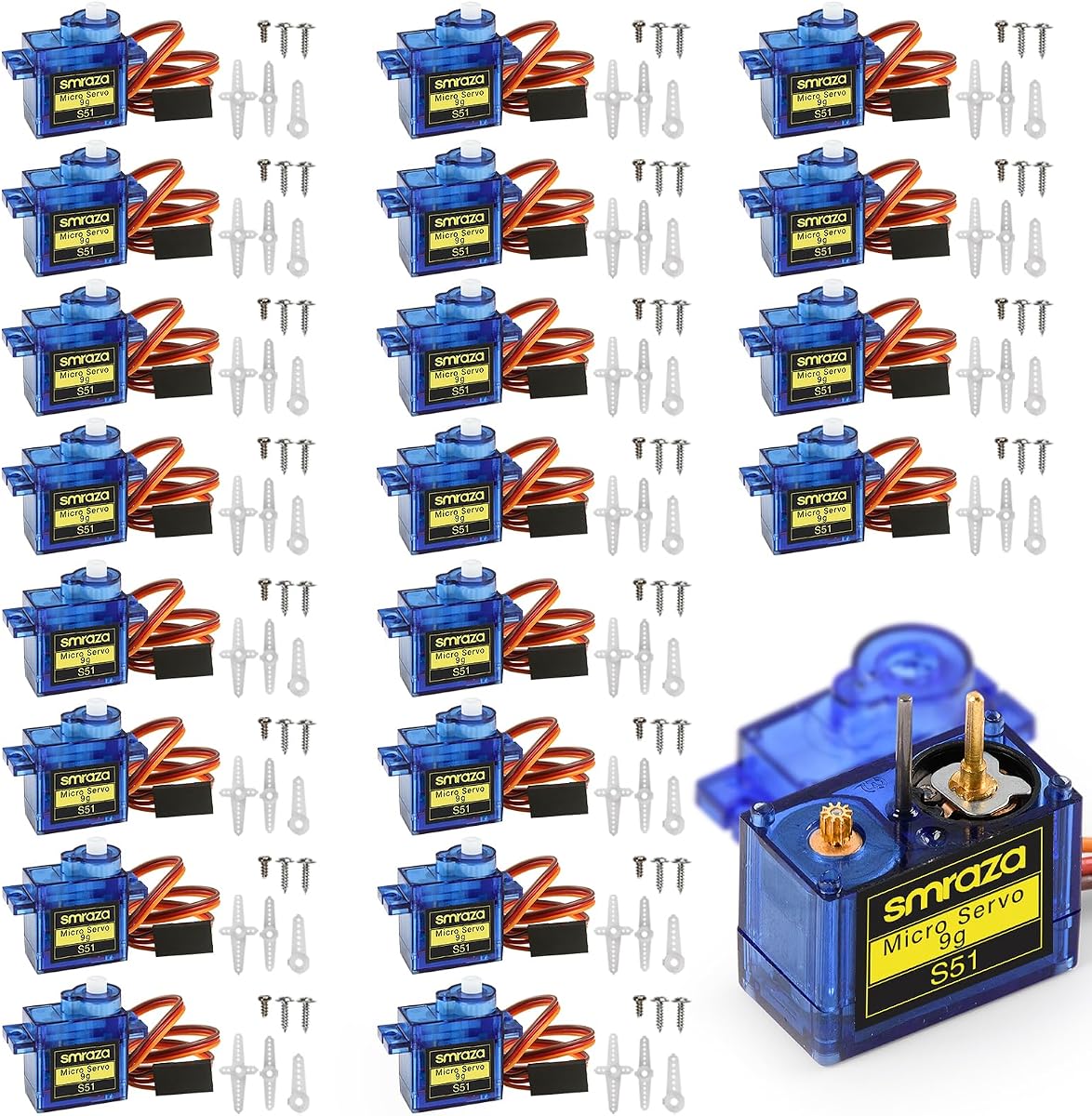
The Smraza SG90 20-Pack is built for builders who need substantial matching inventory, whether for a fleet of small aircraft, robotics exercises, or repeated repairs. Its 4.4 rating and specifications match the other Smraza SG90 kits, so the defining advantage is quantity rather than a different type of servo.
We may earn a commission when you buy through this link, at no additional cost to you.
Each unit provides 1.9 kg-cm stall torque, a 0.08-second 60-degree transit time, a 5-microsecond deadband, and a 180-degree range at 4.8 to 6.0V. Metal pinion and shaft components improve resistance to wear and heat deformation. The standard three-pin PWM connection supports Arduino, Raspberry Pi, and JR- or Futaba-style receiver arrangements.
Twenty units demand more attention to inventory and power planning. Every aircraft still needs a supply that can manage more than 1 amp of starting current, and the total current draw rises as more servos share a power system. A single weak regulator or undersized wiring run can become a reliability problem even when each individual servo is appropriate.
This pack is most useful to clubs, schools, serious tinkerers, and builders who expect to install many compact servos. For a one-off aircraft with only a few channels, a smaller kit is more convenient. For a dedicated project fleet or replacement inventory, however, the twenty matching units simplify procurement and maintenance.
A large matched inventory reduces the need to source replacements separately and keeps operating specifications consistent across many builds. It is especially convenient for instructional environments where several students or aircraft need identical components.
More servos can create a larger simultaneous load on a receiver or battery connector. Use a supply rated for the actual configuration and verify that wiring, connectors, and switch hardware can carry the current safely.
We may earn a commission when you buy through this link, at no additional cost to you.
The MG995 four-pack is a standard-size servo that brings far more torque than the 9-gram options, making it relevant to larger RC planes, boats, robot arms, and climbing cars. Its 3.8 rating is among the lower scores in the guide, so buyers should focus on the substantial specification difference rather than expecting a compact or premium-grade micro servo.
We may earn a commission when you buy through this link, at no additional cost to you.
Stall torque reaches 9.4 kg-cm at 4.8V and up to 12 to 13 kg-cm at 6V. The operating voltage extends from 4.8 to 7.2V, while no-load speed is listed at 0.17 seconds per 60 degrees at 4.8V and 0.13 seconds at 6V. All-metal gears, a double coreless motor, and a ball-bearing design support durability under heavier loads and vibration.
This power and construction come with weight and electrical demands. The model is much bulkier than an SG90, and the supplied information recommends an external 5V to 6V adapter rated from 1 to 2 amps. The long 300-millimeter connector wire aids routing, but it may require trimming or adapting to fit a compact airframe.
Choose the MG995 for a large trainer, powerful sport plane, heavy glider, or other mechanism that puts meaningful strain on a control surface. It is overkill for a tiny micro aircraft. Its broad voltage range also offers flexibility, but the model should still be matched to the receiver, battery, and BEC used in the aircraft.
The nearly tenfold increase in stall torque compared with a typical 9-gram micro servo provides much better margin for large ailerons, elevators, and rudders. It also tolerates more binding in a mechanical linkage, though correct setup remains necessary.
The MG995 requires more space and mass than a micro servo, so a large airframe must have appropriately sized mounting points. Confirm clearance around the horn, linkage, and airfoil before installation.
We may earn a commission when you buy through this link, at no additional cost to you.
The Spektrum A6380 is the most explicitly aircraft-focused product in the guide. Designed as a high-voltage, high-torque, high-speed standard servo, it pairs a 4.6 rating with dual-bearing output support, metal-gear durability, and smooth coreless motor operation for RC sport planes.
We may earn a commission when you buy through this link, at no additional cost to you.
At 6V, it delivers 102 ounce-in, or 7.3 kg-cm, of torque and moves 60 degrees in 0.17 seconds. At 8.4V, torque rises to 160 ounce-in, or 11.5 kg-cm, while speed improves to 0.13 seconds. Its 6.0 to 8.4V input range gives builders access to more performance when the battery and receiver system support it.
The important qualification is that the A6380 cannot operate from a standard 4.8 or 5V micro-aircraft supply. The complete electrical system must be compatible with its six-volt minimum, and high-speed control may require a higher rate setting and appropriate receiver capability. A single servo is also supplied, so additional units must be purchased for a multi-control aircraft.
This is the most compelling option here for a sport plane that benefits from stronger, faster, high-voltage control. It combines aircraft-specific design, strong torque, and a favorable rating without being as oversized as many general high-torque servos. It is less suitable for tiny models or builds limited to five volts.
The increase from 7.3 kg-cm at 6V to 11.5 kg-cm at 8.4V demonstrates why matching the battery to the servo matters. A compatible high-voltage system can provide both stronger holding force and faster correction while still respecting the receiver's limits.
Dual-bearing output support and metal gears are particularly relevant to control surfaces exposed to vibration and repeated movement. These features make the A6380 more purpose-specific than a generic micro servo dressed up for RC use.
We may earn a commission when you buy through this link, at no additional cost to you.
The MG90S 9g four-pack is a compact drop-in-style upgrade for SG90 installations, combining copper-aluminum gears with 2.0 kg-cm stall torque. Its 4.3 rating and stated precision features make it well suited to small RC planes, RC cars, and compact Arduino or Raspberry Pi mechanisms.
We may earn a commission when you buy through this link, at no additional cost to you.
At 6V, the servo provides 2.0 kg-cm of torque and a 0.08-second 60-degree transit; at 4.8V, torque is 1.8 kg-cm and transit is 0.11 seconds. The listed deadband is within plus or minus 5 microseconds, while dual bearings are intended to keep output movement smooth. Operation is stated below 40 decibels for quieter classroom and DIY use.
The gear system claims no more than 3 degrees of backlash, and the included 250-millimeter cable provides practical routing flexibility. A three-pin PWM connection is compatible with Futaba-style receivers, Arduino, and Raspberry Pi, while the included arms and screws simplify installation. As with other micro servos, the aircraft supply must handle startup current without voltage instability.
This is a strong choice for a small trainer, glider, or lightweight sport model where more torque is needed than a basic plastic SG90 can provide. Its 180-degree travel and compact format preserve the micro-servo footprint. It remains limited to 6V and lacks the authority of a standard high-torque servo on a large model.
The stated deadband and reduced backlash support a stable center position in small aircraft. These characteristics can make subtle corrections cleaner than a looser mechanism, provided the linkage remains free of binding.
The hardened copper-aluminum gear set and dual bearings improve durability without moving to a full-size housing. This makes the servo a practical upgrade path for builders familiar with the SG90 format.
We may earn a commission when you buy through this link, at no additional cost to you.
Choosing an RC plane servo means balancing airframe weight, control load, available voltage, receiver compatibility, and mechanical durability. The most important step is to match the servo's physical size and electrical requirements to the aircraft rather than selecting on speed alone.
Stall torque indicates the maximum turning force a servo can produce before its gears stop or the motor stalls. Larger ailerons, long control horns, high-speed aircraft, and steep control linkages create greater loads, so a 1.0 to 2.0 kg-cm micro servo may be inadequate. A standard high-torque servo provides more reserve, while the Spektrum A6380 and MG995 offer substantially greater strength for sport and larger fixed-wing aircraft. Stall torque is a maximum capability rather than a recommended constant operating load, and a properly adjusted linkage should require far less than the limit.
Choose a micro servo for lightweight aircraft with modest surfaces. Move up in size when the plane is fast, heavily loaded, or equipped with large control surfaces.
A servo must fit the mounting bay without crowding the receiver, battery, or linkage. The 9-gram micro format is ideal for small trainers, gliders, and compact park flyers, but some metal-geared models weigh more than a standard 9-gram servo. The MG995 uses a substantially larger standard housing and is better reserved for aircraft with adequate space. Always check the listed dimensions, horn clearance, and total aircraft weight before ordering.
Measure the installation bay and include room for the horn. Favor the lightest servo that comfortably handles the intended control load.
The servos in this guide divide into standard-voltage micro models operating from 4.8 to 6V, the wider-range MG995 operating from 4.8 to 7.2V, and the high-voltage Spektrum A6380 running from 6.0 to 8.4V. A servo outside the aircraft's power range may operate incorrectly or fail. Confirm the battery configuration, receiver specification, BEC rating, and any voltage regulator before installation. Higher voltage can increase speed and torque, but the complete electrical system must support it.
Never connect a six-volt-minimum servo directly to a lower-voltage system. Use the voltage and current range as hard installation constraints.
Gear material matters where servos see repeated movement, vibration, or occasional binding. Basic plastic-pinion SG90 designs are lightest but offer less resistance to tooth wear. Metal pinion and shaft upgrades improve durability, while all-metal gear trains are better suited to heavier loads. The A6380 adds dual-bearing output support for an aircraft-focused design. Bearings and gears work together: good bearings reduce shaft play, while strong teeth prevent the drive system from stripping under load.
Metal gearing is a useful upgrade for frequently used aircraft, but it does not compensate for a servo that is too small or a control surface that is too large.
Transit speed tells how quickly the output horn moves through 60 degrees, while deadband describes the command range around a position where the servo may remain still. A tighter deadband can improve apparent centering and reduce small unwanted movements. Most micro servos here respond in 0.08 seconds per 60 degrees at 6V, while the A6380 reaches 0.13 seconds at 8.4V. Faster response is not automatically better: aircraft can become twitchy if pulse rates, travel, or expo are not configured carefully.
Prioritize smooth, repeatable movement over the fastest headline number. A stable deadband and proper transmitter setup often contribute more to enjoyable handling.
Most listed servos use a standard three-pin PWM arrangement, but voltage and signal specifications still matter. The Smraza SG90 kits are described as compatible with JR and Futaba receivers, the MG90S 9g four-pack supports Futaba-compatible connections, and the Spektrum A6380 should be matched to a compatible high-voltage receiver setup. Some receivers support both analog and digital PWM signals, while others have restrictions or dedicated servo ports. Confirm connector pin order, pulse rate, and channel capacity before ordering multiple units.
Check the receiver manual, not just the servo connector shape. Proper signal compatibility prevents reversed wires, erratic travel, or an unresponsive control channel.
Several micro servos in this guide require a supply capable of more than 1 amp of starting current. Multiple servos can draw sharply at the same time, causing the receiver voltage to dip and the aircraft to reset or lose control momentarily. A BEC or external supply should be rated for the complete connected load, with suitable wiring and a reliable connection. The MG995 description suggests an external 5V to 6V adapter with 1 to 2 amps of capacity, while the A6380 benefits from a receiver system designed for high voltage.
Treat the power supply as part of the servo installation. Include wire length, connectors, and all simultaneously operating outputs in the load calculation.
Pack size can be more important than a small specification difference when a builder maintains several aircraft. The SG90 4-pack, six-pack, ten-pack, and twenty-pack provide increasing inventory, while the MG90S options cover two-, four-, and five-unit configurations. Matched units simplify repairs and make it easier to maintain consistent response across a fleet. A large bundle is not automatically economical if most units will sit unused, so consider the number of channels on the aircraft, the project schedule, and the need for spares.
Buy enough matched servos for the current build and realistic spares. Avoid purchasing a very large kit for a single simple aircraft.
Begin with a complete electrical and mechanical inspection. Confirm that the servo voltage rating matches the aircraft's receiver and power source, then verify the pin order before connecting it. Mount the servo securely with the output shaft in the correct orientation, install the appropriate horn, and check that the linkage has free movement. The included arms and screws on several models help establish a neutral position, but the manufacturer-supplied geometry is not always ideal for every aircraft.
Power the system on the bench before installing the control surface. Verify neutral, endpoint travel, and full deflection in both directions. If the servo approaches a mechanical stop or stalls, disconnect power immediately and reduce the linkage angle, horn length, or control-surface travel. After setting the transmitter's travel limits, perform a range check with the motor removed or the propeller absent so that the full command range can be observed safely.
During use, listen for buzzing, grinding, or repeated clicking, and feel for unusual heat after a flight. A servo that becomes hot while holding a surface may be under excessive load, binding, or near stall. Check the linkage for tight fittings and ensure that the control surface is not over-traveling. Disconnect the battery before changing horns or linkages, and keep the receiver and servo connectors dry, fully seated, and clear of moving control surfaces. Periodic inspection of mounting screws, horn security, wiring, and cleanliness will help maintain consistent control.
SG90 servos can be suitable for lightweight trainers, small gliders, KT aircraft, and other models with light control surfaces. Their 9-gram size and approximately 1.9 kg-cm class torque are useful for compact builds, but larger or faster aircraft need more torque. Metal-pinion versions are preferable where repeated use and vibration are concerns. Always match the servo to the aircraft's size, weight, and control loads.
The main difference is the gear construction. The MG90S models listed here use metal gearing, including aluminum or copper-aluminum teeth, and offer slightly greater specified torque than basic plastic-pinion SG90 units. They can better resist wear and tooth damage, but they are also heavier and consume more space in some installations. The electrical operating range remains broadly similar at 4.8 to 6V.
It is strongly advisable when several servos operate at once. The Smraza SG90 models specify more than 1 amp of starting current, and the Miuzei MG90S description recommends an external stable supply for multi-servo setups. A receiver powered by a weak regulator may experience voltage drops, resets, or loss of control. Select a BEC or external supply rated for the entire connected load.
No, not unless the servo and the rest of the aircraft's power system explicitly support that voltage. Most of the 9-gram micro servos in this guide are rated only from 4.8 to 6V. Feeding them a higher voltage can damage the electronics. The Spektrum A6380 is designed for 6.0 to 8.4V, while the MG995 has a 4.8 to 7.2V range, so each must be used only within its stated limits.
A larger sport plane generally needs more torque than a micro SG90 can provide. The Spektrum A6380 is purpose-built for high-voltage RC aircraft and provides 7.3 kg-cm at 6V and 11.5 kg-cm at 8.4V. The MG995 is another high-torque option with an all-metal gear set. The final choice also depends on the receiver voltage, airframe mounting space, and weight allowance.
Not automatically. A fast servo can correct disturbances quickly, but it can also make a model feel twitchy if pulse rate, travel, or expo settings are poorly matched. Mechanical setup, deadband, control throws, and the aircraft's weight are equally important. Use the fastest response that remains controllable and test the aircraft in small increments.
Install the horn while the servo is at its commanded neutral position, then adjust the linkage so the control surface is also physically centered. Avoid forcing the horn onto a tooth that creates an awkward linkage angle. After setting the transmitter's neutral and endpoint limits, perform a complete range check and ensure the mechanism never binds before flight.
Yes, when their size, weight, torque, and voltage are appropriate for the model. The MG90S options remain compact enough for many small aircraft, while the Smraza SG90 kits use metal pinions and shafts. Weight should be checked carefully because stronger components can add grams. Larger aircraft should generally use a standard-size servo rather than multiple micro servos carrying the load.
The SG90 9g four-pack stands out as the best budget selection, combining a favorable 4.6 rating with metal pinion gearing, a 5-microsecond deadband, and four matched units. The Spektrum A6380 earns the editor's choice for sport aircraft because its dedicated high-voltage design, dual-bearing support, and strong torque at 6V and 8.4V provide meaningful performance for a larger airframe. The Miuzei MG90S two-pack is the premium compact pick, combining a strong 2.0 kg-cm torque figure with aluminum metal gearing.
For most small-aircraft builders, torque should be matched to control-surface size, while weight, deadband, signal compatibility, and power capacity should determine whether the servo fits the installation. Micro servos work well in light models, but larger trainers, fast sport planes, and heavily loaded gliders benefit from a high-torque standard servo. The electrical system is just as important as the servo itself, so verify voltage, starting current, connector order, and receiver compatibility before installation.
Specifications and customer ratings can change, and current prices vary by seller and time. Check the latest product listing, package contents, dimensions, and electrical requirements before buying, especially when mixing a servo with an existing receiver, battery, or BEC. With those checks completed, the right servo can provide smoother movement, stronger control authority, and more dependable operation.