
Sewing Table with Storage, 46.5'' Folding Sewing Table -70 Pegs, 4 Drawers
4.6Editor score
70-spool peg storage
Four accessible storage drawers
360-degree rotating tabletop
Six wheels with four locks
Discover the best sewing cabinets for compact storage, organized craft space, smooth mobility, and dedicated machine workstations in this practical comparison
A sewing cabinet can transform a crowded craft corner into an organized, efficient workstation. The best models combine useful storage, an appropriate work surface, smooth mobility, and enough stability for sewing, quilting, and other detailed projects.
We compared all 10 products using their stated dimensions, construction, storage features, mobility options, sewing-machine support, and customer ratings. The list covers compact folding stations, full-size cabinetry, multipurpose desks, and premium hydraulic-lift designs.
Each review explains the cabinet's strongest qualities, practical limitations, and ideal owner. Product details and availability can change over time, so readers should verify the current listing before making a final purchasing decision.
4.6Editor score

4.3Editor score

4.0Editor score
This side-by-side comparison covers the main differences among 10 sewing cabinets, including cabinet format, machine support, storage capacity, folded size, mobility, and the extra features that make each design suited to particular workspaces.



The Arrow Harriet is a full-size sewing cabinet built around a three-position hydraulic lift, giving it a more dedicated feel than the folding tables in this guide. Its 4.3 rating reflects a practical balance of machine support, storage, mobility, and expandable work surfaces. The lift opening is designed to accommodate most standard sewing machines weighing up to 55 pounds.
We may earn a commission when you buy through this link, at no additional cost to you.
Storage is one of the cabinet's strongest attributes. Four large drawers on the right provide room for notions, accessories, and small tools, while a large interior cubby offers another place to keep supplies. Four interior embroidery hoop storage hooks help reduce clutter, and the expandable leaves create useful extra surface when larger pieces need support. Heavy-duty locking casters allow the cabinet to be moved and then held securely in place.
The main trade-off is the size and permanence of the format. Unlike a narrow folding station, the Harriet is intended to remain a central sewing destination, so it may demand more room than a multipurpose craft room can spare. The hydraulic lift also represents more moving machinery than a simple tabletop, although the stated three positions and compatibility with custom acrylic sewing inserts make the system versatile for different machine tasks.
This is the most convincing choice for a serious sewist who wants a permanent workstation instead of a portable table. It suits anyone who regularly changes machine positions, needs a flush surface option, or wants substantial drawer storage near the machine. For occasional sewing in a very small room, a folding design may be more practical, but for a dedicated studio the Harriet offers the stronger all-around feature set.
The hydraulic lift moves the machine among free-arm, flat-bed, and storage positions without requiring the user to remove it from the cabinet. Custom acrylic sewing inserts can create a flush working surface when that configuration suits the project.
Four right-side drawers, an interior cubby, and dedicated embroidery hoop hooks keep frequently used supplies accessible. This arrangement reduces trips to separate organizers and helps maintain an uncluttered sewing surface.
We may earn a commission when you buy through this link, at no additional cost to you.
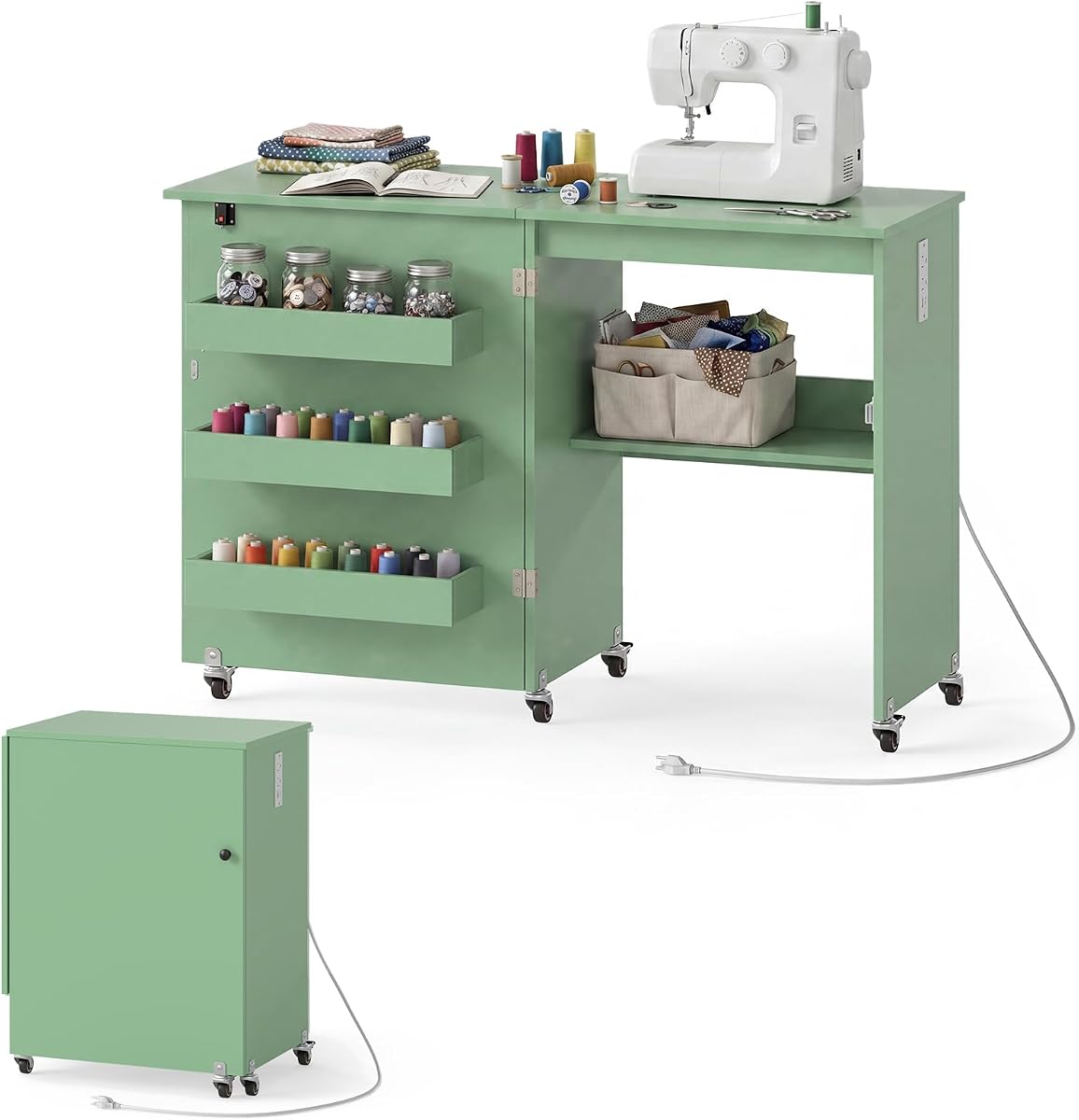
This folding sewing table combines a 46.5-inch workstation with unusually comprehensive organization, earning a 4.6 rating—the highest listed among the ten products. Two rows of pegs can hold up to 70 miniature spools, while four drawers accommodate larger thread spools and sewing accessories. A two-tier shelf and spacious top keep the machine and active tools within reach.
We may earn a commission when you buy through this link, at no additional cost to you.
Its most distinctive feature is the rotating foldable design. Bearings allow one wooden panel to swivel through 360 degrees, adapting the work area to different projects. Fully unfolded, the table measures 46.5 by 13.8 by 29 inches; folded, it measures 32.7 by 13.8 by 29 inches. This makes it a practical choice for people who need a broad sewing surface but also want to reclaim floor space afterward.
Construction combines thickened wood panels with a metal support frame. Pre-drilled holes and illustrated instructions support assembly by one person, while six rolling wheels provide mobility. Four universal casters can be locked for stability, addressing one of the most common concerns with lightweight folding craft furniture. The tradeoff is that it does not include a hydraulic machine lift, so the machine remains on the work surface rather than descending into a cabinet well.
This table is best for hobby sewists, quilters, and beginners who value accessible storage and flexible layout more than a recessed machine system. It also works as a writing desk or side storage table, making it practical for shared rooms. Those seeking a compact dedicated cabinet may prefer a two-panel folding model, while those with many small spools will find the 70-peg arrangement especially useful.
The two peg rows keep as many as 70 miniature spools visible and organized. Four drawers then handle bulkier thread spools and accessories, making the storage system unusually practical for active sewing projects.
A 360-degree rotating panel lets the user reshape the work area rather than work around a fixed rectangle. The table folds to a more compact form when the machine is not in use, helping a multipurpose room function more efficiently.
We may earn a commission when you buy through this link, at no additional cost to you.
The Best Choice Products folding station is designed to alternate between an open sewing and craft area and a compact side table. It holds a 4.2 rating and offers a broad collection of storage features, including two rows of pegs, two attached trays, one large interior shelf, and a generous tabletop. Those details make it a natural choice for small apartments, guest rooms, and multipurpose home offices.
We may earn a commission when you buy through this link, at no additional cost to you.
The construction uses MDF wood with metal hinges intended to resist wobbling when the unit is open. Magnetic door locks help keep contents from falling out while the station is moved. Lockable wheels provide another layer of stability during use. Open dimensions are 46 by 14.75 by 30.5 inches, while the closed form is 23 by 14.75 by 31 inches, reducing the occupied length by approximately half.
Its limitations come from the same simplicity that makes it affordable and approachable. There is no hydraulic lift or recessed sewing well, and the narrow width may not provide enough support for large quilts. The MDF construction and compact storage arrangement are better suited to everyday garment sewing and small craft projects than to a machine-heavy professional studio. Still, the clean side-table conversion gives it value beyond sewing.
This folding station suits beginners, casual sewists, and anyone whose craft station must double as ordinary furniture. It is especially helpful in rooms where floor space is limited and the machine must be put away regularly. Buyers who work primarily on wide quilting projects should look for a larger surface, while those wanting a straightforward mobile sewing table will find this design easy to recommend.
The hinged cabinet closes into a compact side table, allowing the sewing setup to blend into a living or work area. Magnetic doors help conceal and protect supplies when the station is being repositioned.
Pegs, trays, a shelf, and enclosed compartments distribute supplies vertically instead of relying on one crowded area. This makes frequently used notions easier to locate and keeps the tabletop more functional.
We may earn a commission when you buy through this link, at no additional cost to you.
The Arrow K8405 Wallaby Kangaroo is the most expansive premium sewing and quilting cabinet in the group, with a 4.0 rating. It combines a three-position hydraulic lift, a rear quilt leaf, a serger foldout leaf, enclosed storage, and broad spool organization. The machine opening accommodates most standard sewing machines up to 55 pounds and can accept custom acrylic inserts for a flush surface.
We may earn a commission when you buy through this link, at no additional cost to you.
Its strongest advantage is the amount of supported work area. The rear quilt leaf expands the surface behind the machine so larger projects do not have to pull toward the floor or bunch near the cabinet. A foldout serger leaf keeps a serger within reach, while a wood panel can cover the sewing well to create additional workspace when the machine is stored. Full-view, soft-closing drawers and a large door bin simplify access to bulky accessories.
This is also a highly organized cabinet, with 33 spool holders, a dedicated notions drawer, locking doors, and a large storage door bin. The trade-offs are its substantial footprint and the greater complexity of a full cabinet with multiple moving elements. Portable locking wheels make it possible to move the unit, but this is not the same as the simple mobility of a narrow folding table. A buyer should also account for the space needed to operate the leaves.
The K8405 is best suited to a dedicated craft room, serious quilter, or sewist who performs several specialized machine tasks in one location. It makes more sense for long-term daily use than for occasional sewing. Those who need maximum surface area and integrated organization will find its premium feature set unusually complete, while small-space users should consider one of the folding cabinets instead.
The rear quilt leaf extends the work area behind the machine, reducing the chance that a large piece will drag or bunch. The serger leaf adds another dedicated surface, making the cabinet practical for mixed machine workflows.
Thirty-three spool holders, a large door bin, an extra notions drawer, and full-view soft-closing drawers create a more considered storage system. Locking cabinet doors add security when the unit is moved or when children or pets are nearby.
We may earn a commission when you buy through this link, at no additional cost to you.
The Garvee 82.5-inch foldable sewing table is designed for users who need more usable surface than a conventional sewing cabinet can provide. Its stated folding design includes side leaves that create a broad workspace for sewing, cutting, quilting, and other crafts, while the hydraulic lift supports free-arm, flat-bed, and storage positions for the machine.
We may earn a commission when you buy through this link, at no additional cost to you.
Storage is distributed across multiple drawers, open shelves, and lower areas designed for fabric, thread, patterns, tools, and project boxes. Four front hooks provide hanging space for lightweight accessories such as scissors, measuring tapes, and small bags. Lockable casters make it possible to move the table between rooms and hold it steady when the broad leaves are open.
The most important caveat is that the product has no listed customer rating, so the guide cannot place it in the same evidentiary category as well-reviewed alternatives. Its large dimensions may also require substantial open floor space, particularly when the side leaves are deployed. The hydraulic lift and folding format suggest strong versatility, but buyers should review the current assembly and operating details carefully before choosing it for a confined area.
This table is best for a spacious sewing room, dedicated craft studio, or home business where a large cutting and quilting surface is a priority. It appeals to sewists who want the convenience of a machine lift without giving up the ability to collapse the unit. People working in small rooms should measure the fully expanded footprint and consider whether a narrower folding table would be more manageable.
The stated 82.5-inch work surface offers considerably more room for fabric handling than a standard table. Side leaves create a wide temporary workspace for cutting or supporting large quilt sections.
Drawers, shelves, and lower compartments can separate everyday notions from larger project materials. This vertical organization helps keep bulky fabric and boxed supplies accessible without crowding the main worktop.
We may earn a commission when you buy through this link, at no additional cost to you.
The VIVOHOME folding sewing table offers a balanced combination of compact storage, mobility, and a useful work surface. Its 4.4 rating places it among the better-reviewed products in the guide. Extended, the cabinet measures 46 by 16 by 31 inches; folded, it measures 23 by 16 by 31 inches, making the conversion especially noticeable along its length.
We may earn a commission when you buy through this link, at no additional cost to you.
The interior contains three hidden bins and one shelf for thread, needles, and other sewing tools. A solid handle and magnetic button help the user open and close the cabinet, while metal fittings and flexible hinges support the folding mechanism. Five swivel casters allow the table to move smoothly, and two can be locked to stabilize it during sewing or crafting.
This design is less specialized than the Arrow cabinets because it does not include a hydraulic lift, dedicated quilting leaves, or extensive spool infrastructure. Particle-board construction is practical for a multipurpose desk but requires care around moisture and heavy impacts. Its narrow cabinet also provides less enclosed capacity than a full sewing cabinet. Even so, the storage and folding conversion add utility without making the machine difficult to access.
The VIVOHOME table is well suited to apartment dwellers, beginners, and casual hobby sewists who need a dedicated machine surface that can disappear when finished. It can also serve as a computer, writing, or storage station, which is valuable in multipurpose rooms. Buyers prioritizing specialized quilting support or heavy-duty cabinetry should look beyond this lighter-format alternative.
The extended length of 46 inches becomes a 23-inch footprint when the table is folded. That substantial reduction makes the unit easier to store against a wall or use as a compact cabinet between sewing sessions.
Three hidden bins and a shelf divide sewing supplies into manageable categories. The magnetic closure and side handle support quick access without leaving drawers or doors open across the workspace.
We may earn a commission when you buy through this link, at no additional cost to you.
This VIVOHOME model is a compact folding sewing table with a 4.4 rating. Its extended dimensions are 46.1 by 15.9 by 30.9 inches, while the folded cabinet is 23 by 15.9 by 30.9 inches. That almost exact halving of the length allows the machine station to fit into spaces where a permanently open sewing desk would be inconvenient.
We may earn a commission when you buy through this link, at no additional cost to you.
Inside are three hidden bins and one shelf, giving fabric, notions, thread, needles, and sewing baskets dedicated locations. Premium particle board and metal fittings form the structure, and flexible hinges are intended to make opening and closing straightforward. Five casters allow smooth movement, with two swivel wheels locking the unit in place for stability while the user sews.
As with other lightweight folding stations, it lacks a recessed machine well or hydraulic lift. The machine therefore remains visible on the tabletop, which may be convenient for quick changes but offers less cabinet-style storage. It also has fewer dedicated thread-management features than the 70-peg table in this list. The benefit is a cleaner, simpler cabinet that can serve several household purposes beyond sewing.
This VIVOHOME is best for a compact multipurpose room where a sewing machine is used regularly but the table must be folded away afterward. It also works for crafts, reading, writing, or computer use, according to the listed functions. People seeking dedicated quilting space, a wider cutting area, or extensive machine-specific storage may find a specialized model more suitable.
With the panels folded, the table retains a 15.9-inch width and height while cutting its occupied length to 23 inches. This allows the sewing setup to remain in the room without visually dominating it.
The concealed bins and shelf prevent small tools from spreading across the work surface. A magnetic closure keeps the cabinet visually neat and helps protect its contents while the unit is moved.
We may earn a commission when you buy through this link, at no additional cost to you.
The VIVOHOME 46-inch folding sewing table is another compact cabinet in the guide, and its 4.4 rating indicates strong customer reception. It opens to 46 by 16 by 31 inches and closes to 23 by 16 by 31 inches. The transformation preserves a useful 16-inch depth, which provides enough room for a sewing machine and nearby tools while significantly shortening the station when folded.
We may earn a commission when you buy through this link, at no additional cost to you.
Three hidden bins and one shelf organize the interior, and a magnetic button with a solid handle helps the user operate the cabinet. Premium particle board and metal fittings provide the stated materials, while flexible hinges are designed to withstand repeated folding. Five swivel casters support movement, and two locking casters secure the table during a project.
The main limitation is its general-purpose design. It has no hydraulic mechanism, no dedicated machine recess, and no listed pegs for thread spools. That means the owner must arrange thread and tools inside the bins or on the open work surface. It also lacks the broad leaves and specialized supports needed for large quilting work. For ordinary garment sewing, however, the basic platform can be entirely adequate.
This table fits users who want one station to support sewing, crafts, computer work, reading, or writing. It is particularly useful in home offices and multipurpose rooms where a permanent desk would take too much space. Buyers focused on machine configuration or fabric handling should consider the Arrow options, while those prioritizing a simpler foldaway station will find this VIVOHOME design easy to manage.
The table's alternate uses include storage, dining, computer placement, reading, and writing. This versatility makes it a practical shared furnishing rather than a single-purpose craft accessory.
Casters allow the cabinet to be positioned near an outlet, window, or shared activity area. Locking two of the wheels gives the user a stable platform without permanently dedicating the room to sewing.
We may earn a commission when you buy through this link, at no additional cost to you.
The COSTWAY folding sewing cabinet distinguishes itself with an integrated charging station, giving it a 4.2 rating and a clear identity among otherwise similar foldable tables. The station includes two AC outlets, one USB port, one Type-C port, and a 4.8-foot power cord. This makes the unit more useful as a shared work surface for devices as well as sewing projects.
We may earn a commission when you buy through this link, at no additional cost to you.
Extended, the table measures 45.5 by 16 by 31 inches; folded, it measures 23 by 16 by 31 inches. An easy-grip round handle assists with the conversion, while a magnetic lock, spring pin, and anti-collision pads support smooth operation. Storage includes a spacious top, a three-tier shelf, and an open rack for the machine, computer, spools, scissors, and other supplies.
Five swivel casters make the cabinet mobile, and three can be locked for stable operation. As with the other narrow folding designs, there is no recessed sewing well or hydraulic lift, and the 16-inch depth is not ideal for oversized quilt sections. The charging station is most relevant to users who also work from the station with a computer or frequently charge small devices. Others may not use that feature regularly.
The COSTWAY table is a good fit for a home studio, multipurpose office, or creative room where one surface must support sewing and technology. It also converts into a side table, study table, craft table, or computer desk. Buyers looking for a dedicated quilting cabinet should choose a broader model, while those who value a useful power hub may find this design particularly convenient.
Two AC outlets plus USB and Type-C connections keep several devices powered from the station. The 4.8-foot cord adds placement flexibility, reducing the need for an extension cord in many setups.
The broad top, open rack, and three-tier shelf can accommodate both sewing supplies and a computer setup. This makes the table especially useful for designers who alternate between digital work and hands-on crafting.
We may earn a commission when you buy through this link, at no additional cost to you.
The Best Choice Products large folding station is built for users who want a roomier alternative to a compact sewing desk. It has a 4.4 rating and an overall size of 62 by 19 by 31.25 inches. That expanded footprint gives fabric, cutting tools, and a machine more room, while the folding design and caster wheels retain some portability when the station is not needed.
We may earn a commission when you buy through this link, at no additional cost to you.
Storage is unusually extensive. The cabinet has two rows of pegs, two attached trays, a wide interior shelf, and a three-section cabinet with adjustable shelves. Magnetic door locks help protect supplies during movement, and lockable wheels add stability. The listed main-table capacity is 330 pounds, with separate capacities of 22 pounds for the extended top and each shelf.
The tradeoff is size. A 62-inch overall length needs more clearance than a typical folding sewing cabinet, and the extended top should not be treated as supporting the same heavy loads as the main table. Its MDF construction and metal hinges prioritize a versatile workbench format rather than a built-in hydraulic machine system. The unit can serve as a computer station, craft table, or sewing workspace, which broadens its appeal.
This model is best for dedicated craft rooms, home studios, and sewing areas where large work areas matter more than minimal floor usage. It suits users with a broad collection of materials who need shelving, trays, and pegs beyond what a small sewing table provides. People in compact rooms should choose a narrower model, while serious quilting users may appreciate the large surface despite checking the clearances first.
A 62-inch overall length and 19-inch width provide a generous platform for garments, crafts, and fabric preparation. The wide interior shelf also gives bulky supplies a dedicated place away from the active work surface.
Pegs, attached trays, adjustable shelves, and a three-section cabinet support everything from thread to larger tools. Magnetic doors help keep the interior secure when the station is rolled or folded.
We may earn a commission when you buy through this link, at no additional cost to you.
The most useful sewing cabinet is the one that fits the available room, supports the projects you make, and keeps everyday supplies organized. Comparing format, machine support, storage, mobility, and construction will narrow the options before you focus on individual features.
Sewing cabinets fall into several broad formats: dedicated full-size cabinets, compact two-panel folding tables, rotating-panel workstations, and large folding craft stations. Full-size cabinets usually place the machine in a recessed well and may include a hydraulic lift, making them appropriate for frequent machine work and users who want the sewing area to remain visually tidy. Folding tables keep the machine on top and emphasize flexibility, easier storage, and lower space requirements. Large folding stations sit between those formats, offering greater surface area but requiring more room when opened.
A sewing cabinet should accommodate the dimensions, weight, and operating position of your machine. The Arrow Harriet and K8405 are specified for most standard machines up to 55 pounds, and both use a three-position hydraulic lift supporting free-arm, flat-bed, and storage positions. They are also compatible with custom acrylic sewing inserts for a flush work surface. Folding models provide a standard top platform instead, which may be adequate for many machines but offers less integrated support and no lower storage position.
The surface must suit the type and size of your projects. Standard folding tables generally measure around 45 to 46 inches when open, while the Garvee is advertised at 82.5 inches with side leaves and the Best Choice large station has an overall length of 62 inches. A wider surface can reduce fabric bunching and provide room for cutting, but it also needs more clearance. Dedicated cabinets may add separate leaves, a rear quilt leaf, a serger foldout, or a wood cover panel to expand the available area without relying on one continuous top.
Useful storage should follow how you actually work. Small thread spools benefit from peg rows, with the 70-peg folding table offering the most dedicated capacity in this group. Large spools, fabric, patterns, tools, and project boxes need drawers, bins, shelves, or trays. The K8405 provides extensive specialized storage with 33 spool holders, a large door bin, and a notions drawer, while the Best Choice large station uses pegs, two trays, an adjustable three-section cabinet, and a broad shelf. Enclosed storage reduces clutter, whereas visible organizers make frequently used supplies faster to locate.
A sewing machine is heavy, and a mobile station should remain steady while it is in use. All the listed designs use casters, but the number and type of locks differ. The 46.5-inch table has six wheels with four lockable universal casters, the VIVOHOME tables have five casters with two locks, and the COSTWAY model has five swivel casters with three locks. Dedicated Arrow cabinets use heavy-duty locking casters, while magnetic doors and locks help keep stored supplies secure when the cabinet is moved.
A foldable cabinet is especially attractive in rooms where the sewing station shares space with guests, office equipment, or everyday furniture. The Best Choice compact model and the three VIVOHOME listings reduce their length to approximately 23 inches when folded. The COSTWAY design follows a similar pattern, while the Best Choice large station retains a much longer form because of its 62-inch overall dimensions. Some folding units also convert into side tables, study desks, or computer tables, helping justify their footprint in a multipurpose area.
The products use a mix of MDF, particle board, thickened wood panels, metal frames, hinges, and fittings. Sturdiness should be judged in the context of the intended load, including machine weight, cutting tools, and stored fabric. Some listings specify pre-drilled holes and illustrated assembly instructions, while others provide a more traditional cabinet-style product. Hydraulic and rotating mechanisms also require extra care during assembly and folding. Reviewing the included instructions and understanding which components are permanently attached can help prevent damage or incorrect positioning.
Features such as charging ports, computer compatibility, spool pegs, and front hooks can improve daily usability. The COSTWAY cabinet includes two AC outlets, USB and Type-C ports, and a 4.8-foot cord for a connected work area. The Garvee table provides four front hooks for lightweight accessories, while several VIVOHOME and Best Choice models can serve as side tables or computer desks. These extras are most valuable when they support an established habit rather than simply adding more features.
Begin by measuring the intended location, including space for the open cabinet, extended leaves, and access to storage compartments. Place the unit on a level floor, engage the locking casters before installing the machine, and connect the machine according to its manufacturer's instructions. For cabinets with a hydraulic lift, lower the machine into the storage position before adjusting the table or folding panels, and never place fingers in the lift mechanism while it is moving.
Organize supplies according to frequency and size. Keep needles, small notions, and frequently used tools in easy-access drawers or bins, while larger fabrics and project boxes belong on lower shelves. Use the spool pegs and holders for thread rather than leaving loose spools on the worktop. Before starting a large project, clear enough surface for the fabric and deploy any appropriate leaves so the material can lie flat without pulling against the machine.
Care for the cabinet by moving it with the sewing machine removed or secured as directed by the manufacturer. Lock the doors or magnetic catches before rolling, and avoid dragging the unit across the floor. Clean work surfaces with a soft, slightly damp cloth, and use dry methods on MDF and particle-board panels. Do not overload shelves, extended tops, or the main surface, and periodically check casters, hinges, screws, and hydraulic components for secure operation.
A sewing cabinet is usually better when you want the machine concealed when not in use, more integrated storage, or multiple machine positions. A regular or folding sewing table may be better for portability, a lower-cost multipurpose setup, or rooms where the station must be moved frequently. The best choice depends on how often you sew and how much cabinet-style storage your space needs.
Measure the floor area, nearby doorways, and the distance needed to open drawers, doors, and work-surface leaves. Check both the open and folded dimensions when a cabinet has a convertible design. Also consider where the sewing machine will sit, whether a power outlet is nearby, and whether the cabinet can be moved into position without blocking a walkway.
It depends on the cabinet's stated machine capacity and the lift mechanism. The Arrow Harriet and K8405 are specified for most standard machines up to 55 pounds, while folding tables provide support through their top surfaces. A heavy quilting machine may also require a wide, stable platform, so owners should verify both weight capacity and available surface area before purchasing.
A hydraulic lift is valuable for sewists who regularly switch between free-arm, flat-bed, and storage positions. It lowers the machine into the cabinet and can create a flush surface with a compatible acrylic insert. The tradeoff is a larger, more specialized cabinet and a moving mechanism that may cost more and require more space than a simple folding table.
The amount depends on the size of your fabric collection, number of thread spools, types of machines, and whether you keep active projects in progress. A hobbyist may be well served by a few drawers and bins, while a frequent quilter may need wide shelves, lower compartments, trays, and dedicated spool holders. Planning storage by frequency of use helps prevent the work surface from becoming cluttered.
Lockable casters keep a mobile sewing station from rolling while a heavy machine is in use. They are especially important on folding tables because the broad top can otherwise shift when the user reaches across it. The best design combines smooth swivel movement with enough locking wheels to create a stable platform once the cabinet reaches its intended position.
Several models are designed to serve multiple purposes, including sewing, crafts, writing, reading, and computer work. The COSTWAY model adds a charging station, while the VIVOHOME and Best Choice products can convert into side tables or work desks. A computer should be placed only where the surface and shelf capacities support it, and heavy equipment should not be placed on a lower-capacity extended top.
Position it on a level floor, engage all available locking casters, and avoid leaning against the cabinet when pulling fabric. Expand or lock any folding panels before beginning a project. For very heavy machines, check the stated capacity and consider whether the station needs additional stabilization or a more rigid surface than a lightweight folding table can provide.
The Arrow Harriet stands out as the strongest dedicated workstation, offering a three-position hydraulic lift, four large drawers, embroidery hoop hooks, expandable leaves, and sturdy locking casters. The 46.5-inch folding sewing table is the top budget-oriented choice because its 70-peg thread system, rotating top, drawers, and multipurpose design combine exceptional organization with flexible space use.
The Arrow K8405 Wallaby Kangaroo takes the premium position with extensive quilting support, an expanding rear leaf, a serger foldout, 33 spool holders, and full-view soft-closing drawers. For buyers who need less specialized cabinetry, the VIVOHOME models provide dependable compact stations, while the COSTWAY and Best Choice tables are better suited to wide, multipurpose work areas.
Before choosing, prioritize the machine position, available floor space, project size, and the way you store supplies. Verify the current listing, dimensions, included components, and warranty details, since product information can change. A careful fit check is the best way to avoid choosing an attractive sewing cabinet that does not suit the room or workflow.