
Flair Smart Vent 6×10
3.8Editor score
Central-system room control
Flexible seven-day scheduling
Voice-assistant compatibility
Smart motorized HVAC register vents can give central heating and cooling systems more granular room control than conventional fixed louvers. The best models combine accurate sizing, responsive airflow, useful automation, quiet operation, and installation methods suited to floors, walls, or ceilings.
We compared ten products across important buying factors, including vent dimensions, control methods, temperature sensing, fan speeds, noise specifications, airflow ratings, power requirements, and smart-home compatibility. The list includes both complete vent-register systems and add-on booster fans.
Each pick reveals a different route to better room comfort, from Flair's app-based room scheduling to Biowind's remote-controlled fans and Wi-Fi control. Ratings and specifications can change, product availability also varies, and current prices should always be checked before purchasing.
3.8Editor score

3.8Editor score

4.3Editor score
As an Amazon Associate we earn from qualifying purchases.
The following comparison highlights the clearest differences among these ten registers, including physical fit, automation, airflow, sound level, installation needs, and control style.


The Flair Smart Vent 4×12 is a complete motorized register designed to replace a conventional vent in a central heating and cooling system. Its 3.8 rating reflects a product that prioritizes connected room control rather than simply adding a fan. It stands out in this list because it combines motorized vent operation, temperature-based automation, app access, seven-day scheduling, and compatibility with an existing thermostat.
We may earn a commission when you buy through this link, at no additional cost to you.
The system uses information from a smart thermostat and a room temperature sensor to determine when it should open and close. Users can create individual schedules for each room, mark rooms inactive, and manage the setup through Flair's hvacOS software. It also works with voice assistants, making it a strong option for homeowners who want room-level control integrated into a broader smart home.
The main trade-off is system complexity. A Flair Bridge is required and sold separately, and every room using a Flair Smart Vent needs a temperature sensor, which may be a Flair Puck, an integrated smart thermostat, or another compatible room sensor. That ecosystem may be excessive for someone who only wants a quiet booster for one troublesome room.
Installation itself is comparatively approachable because the vent is designed as a drop-in replacement without drilling or wiring, while the app guides users through setup and connection. For households seeking a broader room-by-room HVAC strategy, this is the most balanced and expandable choice in the guide.
The 4×12 format is particularly useful because it provides another common sizing option for many existing central systems. Buyers should still confirm the actual opening rather than assuming that the nominal size will fit.
Seven-day room schedules are the Flair system's defining advantage over a basic motorized booster. Each room can be managed separately, adjusted from the app, and marked inactive when it does not need conditioned airflow.
Removing the old vent and dropping in the replacement avoids the drilling and wiring associated with many electrical controls. Flair's app provides step-by-step guidance, although the required Bridge and room sensor must also be set up.
We may earn a commission when you buy through this link, at no additional cost to you.
The Flair Smart Vent 6×10 shares the same connected ecosystem as the 4×12 model but is intended for a different common register size. With a 3.8 rating, it offers a focused solution for homeowners who want the vent itself to become an intelligent part of a central HVAC setup rather than merely increasing airflow at the grille.
We may earn a commission when you buy through this link, at no additional cost to you.
Its primary strengths are room-level control, app-based management, and flexible seven-day scheduling. The vent can use data from a smart thermostat and compatible room sensor to decide when to open and close, while the hvacOS interface gives users a central place to manage schedules and mark rooms inactive. Voice-assistant support extends the convenience beyond the app.
As with the other Flair vents in this roundup, the system requires a separately sold Flair Bridge. Each room also needs a temperature sensor, and the app-led setup process adds more planning than a single remote-controlled booster fan. Buyers considering a full Flair setup should inventory every room's opening and sensor requirements before installation.
The 6×10 option is a logical premium recommendation for a larger connected-home project because it adds another usable size while preserving the same scheduling and automation model. It is best for households willing to build a consistent Flair ecosystem across multiple rooms rather than install one isolated fan.
Its drop-in installation method reduces physical work, but compatibility and sensor planning are essential. Those requirements are acceptable for users who value whole-home zoning over a simple, self-contained register accessory.
The strongest reason to choose this model is consistency across a connected installation. The same app, room-scheduling approach, thermostat integration, and voice-control framework can extend across the home.
Because the vent can work with an existing smart or traditional thermostat, it offers a way to add room-level behavior without requiring a separate HVAC controller for every room. The central system still performs the heating and cooling.
We may earn a commission when you buy through this link, at no additional cost to you.
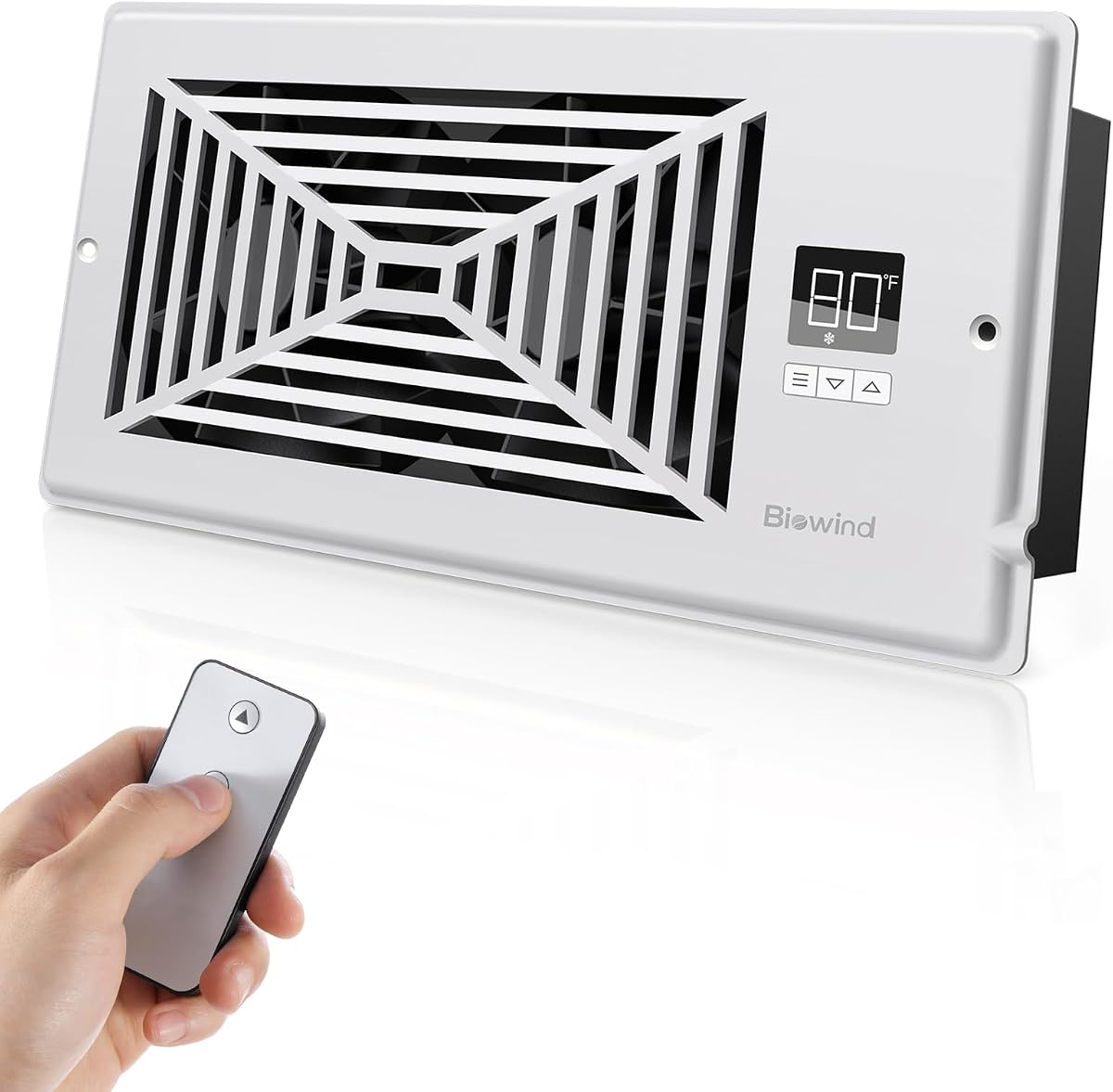
The BIOWIND Quiet Smart Register Booster Fan for a 6×10-inch opening is the best budget-oriented option because it adds useful automation without requiring a separate central ecosystem. Its 4.3 rating is also the highest listed among the products in this roundup, giving prospective buyers a favorable customer feedback signal.
We may earn a commission when you buy through this link, at no additional cost to you.
This booster uses a high-precision temperature sensor and programmable LED controller to turn the fan on or off as the room needs additional warm or cool air. The upgraded remote provides ten fan-speed levels, ranging from gentle circulation to a stronger boost. Its stated airflow is 200 CFM, and the specified noise level is 18 dBA.
Power comes from a 6-watt unit with a 100-240V AC input range. A wall adapter and plug are included for quick setup. Unlike the Flair products, however, its smart functionality is centered on remote operation and automatic temperature-based fan control rather than whole-home app scheduling.
The important installation caveat is size. BIOWIND says the listed size refers to the actual duct opening, not the old cover's outer dimensions. Its neck measures 9.72 by 5.63 inches, its face measures 11.98 by 7.92 inches, and the insertion depth is 1.96 inches.
This is a strong choice for a household trying to solve weak airflow or uneven temperatures in one or a few rooms without building a full zoning network. Remote-only operation is the main limitation, but it keeps the setup approachable and self-contained.
The built-in temperature sensor lets the fan respond to the room rather than requiring constant manual adjustment. The programmable controller and ten remote-controlled levels make it useful for both heating and cooling seasons.
Measure the actual wall or floor duct opening and compare it with the listed neck dimensions. Also check the surrounding surface, where the face frame will sit, to avoid interference with trim or nearby objects.
We may earn a commission when you buy through this link, at no additional cost to you.
The BIOWIND 4×12-inch Smart Register Booster Fan is built for households that want more air movement in a narrow, elongated vent opening. Its 4.3 rating and stated 16 dBA operating level make it particularly appealing for bedrooms, offices, and other spaces where background fan noise would be distracting.
We may earn a commission when you buy through this link, at no additional cost to you.
The product uses an anodized aluminum frame with CNC-machined details and a programmable LED controller. A high-precision temperature sensor supports automatic on-and-off operation, while the included remote controls ten fan-speed levels. Its stated airflow is 140 CFM, making it more modest than the 200 CFM BIOWIND models designed for wider 6-inch openings.
Installation is designed to be straightforward. The unit has a 6-watt rated power draw, accepts 100-240V AC input, and includes a wall adapter and plug. The neck insertion depth is 1.96 inches, while the 9.72 by 3.93-inch neck rests within a nominal 4×12-inch duct opening.
The trade-offs are understandable. This is not an app-controlled zoning vent, and its exact dimensions must match the opening rather than the existing face frame. The face size is also wider than the opening, so the surrounding area needs enough clearance.
For a quiet room where airflow is weak rather than entirely absent, this model offers a focused solution. It combines automatic temperature response with remote speed control, giving users more flexibility than a fixed-position fan without the complexity of a full smart-home hub.
The listed 16 dBA figure makes this one of the quietest specifications in the comparison. That low sound level is most relevant in sleeping areas, home offices, and rooms where a constant fan sound could interfere with concentration or rest.
Automatic temperature operation can reduce the need for constant intervention, while the remote's ten levels let users tune airflow for a specific room. The two approaches work together without requiring network setup.
We may earn a commission when you buy through this link, at no additional cost to you.
The Flair Smart Vent 4×10 is designed for a narrow register size and delivers the same app-based room automation as the larger Flair models. Its 3.8 rating places it within the established Flair range, and its strongest appeal is the organization of central HVAC airflow through individual schedules.
We may earn a commission when you buy through this link, at no additional cost to you.
The vent can draw on data from a smart thermostat and room sensor to open and close automatically. Flair's hvacOS supports seven-day scheduling, allowing each room to follow its own plan. Rooms can also be marked inactive, and users can access the system remotely through the app or supported voice assistants.
Unlike a booster fan, the Flair unit functions as a smart vent that regulates how much central conditioned air reaches its room. It can work with an existing smart or traditional thermostat, which gives it broad potential within central systems.
The ecosystem is the principal drawback. A Flair Bridge is required and sold separately, and every room needs a compatible temperature sensor. A homeowner with only one difficult room may find that a local booster is more economical and easier to manage.
For a multi-room Flair project, the 4×10 model is a useful size option. It supports floor, wall, and ceiling registers, and the drop-in installation avoids drilling and wiring. Users should measure each opening carefully and plan sensor placement before replacing multiple vents.
A separate seven-day schedule for every room is especially useful when family schedules differ. Individual plans let users avoid treating an entire home as one uniform temperature zone.
The register can be used at floors, walls, or ceilings, making it easier to create a consistent room-control strategy in homes with varied register locations. The vent is designed to replace an existing opening rather than require a new cutout.
We may earn a commission when you buy through this link, at no additional cost to you.
The Flair Smart Vent 10×10 is the largest register size in the Flair group and stands out for larger wall and ceiling openings. Its 3.8 rating reflects the shared features of the ecosystem: motorized register control, centralized app management, and room-level temperature logic.
We may earn a commission when you buy through this link, at no additional cost to you.
The vent automatically opens and closes using thermostat and room-sensor information. Users can schedule each room separately over a seven-day period, mark rooms inactive, and manage behavior through Flair's hvacOS software. Compatibility with existing smart or traditional thermostats and voice assistants broadens the control options.
The 10×10 format may be especially relevant to older or larger homes with square vents, although exact measurements should always be confirmed. The product title specifies walls and ceilings, making it less suitable for buyers specifically seeking a floor-rated option.
As with the other Flair models, a Bridge is required and sold separately. A compatible temperature sensor must also be present in every room. Those dependencies make this a better fit for a planned system installation than for a one-register test.
The 10×10 model is a logical choice when matching the largest available opening is the priority and the homeowner wants comprehensive room scheduling. Its drop-in design reduces installation work, while the app and scheduling software provide the intelligence.
The square 10×10 format gives homeowners with matching large vents a direct way to add room-level control without changing the general appearance of the register. The same app-based management applies across the installation.
This vent works best when the Bridge, room sensors, thermostat integration, and app settings are considered as one project. Planning those requirements before removing vents makes installation more organized and reduces compatibility surprises.
We may earn a commission when you buy through this link, at no additional cost to you.
The BIOWIND 6×12-inch Smart Register Booster Fan combines the airflow rating of the 6×10 model with a longer face dimension. Its 4.3 rating and 200 CFM specification make it a practical option for larger rooms where the central system produces conditioned air but distributes it too weakly.
We may earn a commission when you buy through this link, at no additional cost to you.
A high-precision temperature sensor and programmable LED controller support automatic fan operation. The upgraded remote provides ten speed settings, allowing a user to move from a gentle circulation setting to a more powerful boost. Its stated noise level is 18 dBA, and the fan uses 6 watts of rated power with a 100-240V AC input.
The product includes a wall adapter and plug for straightforward setup. It can be positioned in wall or floor vents, and its aluminum frame is intended to blend with existing decor. The fan also continues briefly after the HVAC system stops, helping move remaining conditioned air into the room.
The principal limitations are its remote-only control and substantial physical footprint. The face is listed at 14.22 by 7.92 inches, while the neck is 9.72 by 5.63 inches. The 1.96-inch insertion depth is another useful installation measurement.
This model is well suited to a buyer who wants a strong, quiet boost in a large room without installing a room-based connected thermostat. Automatic temperature response and ten manual levels offer a useful balance between hands-on control and unattended operation.
The listed 200 CFM airflow makes this model more forceful than the 140 CFM options. It is a better fit for larger rooms where the goal is to improve distribution of central heating or cooling.
The included adapter and plug allow the booster to operate independently from the central thermostat's wiring. That makes it approachable for targeted rooms, although users will need to route the cord to a suitable outlet.
We may earn a commission when you buy through this link, at no additional cost to you.
The AC Vent Booster Fan for a 6×12-inch register differentiates itself with a built-in aroma pad, an LCD display, and selectable timers. Its 3.9 rating puts it near the top of the roundup, while the combination of automatic temperature adjustment and remote control makes it approachable for a single problematic room.
We may earn a commission when you buy through this link, at no additional cost to you.
The fan has ten adjustable speed levels intended to range from gentle circulation to a stronger boost. Automatic thermostat airflow adjustment is supplemented by remote operation and 2H and 4H timer settings, giving users several ways to define when and how the fan runs.
Its stated operating noise is 18 dBA, making it suitable for bedrooms, nurseries, living rooms, and offices where stronger airflow is desired without a loud appliance. The included aroma pad allows essential oils to be added for a more customized experience, although the oils themselves are not included.
Installation requires attention to two details. Users must measure the actual register opening rather than the outer frame, and they should verify that the booster's overall dimensions leave enough room around the existing register. A nearby outlet is needed, with cables routed in advance for a neat appearance.
This is the most distinctive feature package in the guide because of the aroma support, display, and timer choices. It does not offer the Flair system's whole-home scheduling or the app-based control of the Wi-Fi model, but it covers the most common local booster functions in one unit.
Two timer durations make it easy to run the fan for a defined period rather than leaving it operating indefinitely. Automatic thermostat adjustment provides another layer of automation for changing room temperatures.
The built-in aroma pad adds a feature not offered by the other register boosters. Users can place their own essential oils on the pad, but should follow the product directions and avoid applying oils directly to fan components.
We may earn a commission when you buy through this link, at no additional cost to you.
The WiFi Smart Register Vent is the most clearly app-focused booster in the list, offering both button and smartphone control. Its 4.0 rating and smart thermostat features make it appealing for users who want local room automation without the broader Flair Bridge ecosystem.
We may earn a commission when you buy through this link, at no additional cost to you.
The upgraded thermostat controller monitors temperature and adjusts fan speed in real time. It can automatically switch the booster on or off, while the mobile app allows control from anywhere a Wi-Fi connection is available. This makes the product well suited to rooms that need attention while the household is away or in different areas of the home.
Its PWM fan is described as using stator-blade and hydro-mechanical blade design, with operation under 16 dBA at the lowest setting. Airflow is listed at 140 CFM. The panel is made from 2mm steel and is stated to support up to 300 pounds, while a two-way airflow design is intended to broaden room distribution.
Fit is the most important issue. Although the product title refers to 6×12-inch register holes, the supplied product description says it fits only a 6×10-inch register vent. Buyers should measure the actual opening, verify the current listing details, and make sure the unit's physical dimensions suit the installation location.
This product makes sense for a homeowner seeking Wi-Fi control, automatic temperature response, and very quiet low-speed operation in a single room. Its main compromises are the need for network access and the inconsistent sizing language, making careful measurement essential before purchase.
Wi-Fi access separates this booster from remote-only designs. Users can check and adjust the fan from the app, while physical buttons provide an immediate local option when the network is unavailable or manual control is preferred.
The title and description name different opening sizes, so the description's 6×10-inch instruction should be treated cautiously. Measure the duct opening, compare the physical unit, and verify the current product page before ordering.
We may earn a commission when you buy through this link, at no additional cost to you.
The BIOWIND 4×10-inch Smart Register Booster Fan is a compact option for narrow openings that need a quiet local airflow improvement. Its 4.3 rating is among the strongest in the comparison, and it combines the same remote, temperature-sensing, and automatic operation features found in the other BIOWIND boosters.
We may earn a commission when you buy through this link, at no additional cost to you.
The fan is rated at 140 CFM and 16 dBA, with ten selectable speed levels. A high-precision temperature sensor works with the programmable LED controller so the unit can switch on or off in response to the room. The remote lets users adjust intensity without walking to the register.
Its 6-watt rated power and 100-240V AC input range make it straightforward to power through the included wall adapter and plug. The fan is also described as continuing briefly after the HVAC system stops, which helps draw remaining conditioned air into the room.
This model is not a Wi-Fi device and does not provide the multi-room scheduling or voice-assistant integration of the Flair range. It is better understood as a convenient local booster that can operate automatically rather than a complete connected HVAC zoning system.
Physical dimensions deserve careful attention. The neck is 9.72 by 3.93 inches, the face is 11.54 by 5.51 inches, and insertion depth is 1.96 inches. The product fits only a 4×10-inch duct opening, not merely a cover with those outer dimensions. Subject to a correct fit, it is a quiet and capable choice for a small register.
A listed 16 dBA operating level and compact 1.96-inch insertion depth make the unit practical where space is limited. Its narrow neck is designed for a 4×10-inch opening rather than a larger register face.
The temperature sensor and programmable controller can operate the fan automatically, while the ten-level remote provides immediate manual adjustment. This makes the booster useful for solving uneven comfort in one specific room.
We may earn a commission when you buy through this link, at no additional cost to you.
The best register vent depends on your opening size, HVAC layout, desired level of automation, installation conditions, and tolerance for additional accessories. These factors help separate a complete room-control system from a local booster fan.
Start with the clear opening inside the wall, floor, or ceiling rather than the dimensions of the existing decorative face frame. A cover can be larger than the duct it conceals, and a replacement that fits the visible frame may still be too large for the neck. For BIOWIND models, the listed size explicitly refers to the duct opening; the 6×10, 4×12, 6×12, and 4×10 options each have different neck and face dimensions.
Measure width, height, and available depth, then compare those figures with the product specifications before buying. Also inspect the area around the opening for trim, furniture, baseboards, or ceiling fixtures that could interfere with the face. When a listing's title and description disagree, treat the opening and physical dimensions as essential verification points.
Flair's Smart Vents are designed to control airflow within a connected central HVAC system. They use thermostat and room-sensor information, support individual schedules, and require a Flair Bridge. BIOWIND and comparable boosters are intended to increase local air movement at one register and usually operate independently through a remote, buttons, or an app.
A zoning-oriented system is more appropriate when the goal is to coordinate several rooms or reduce hot and cold spots throughout a home. A local booster is usually easier to add for a single room where conditioned air reaches the vent but circulates poorly. Consider how many rooms you actually want to improve before paying for a broader ecosystem and its accessories.
Smart functionality varies substantially across the category. Flair provides app management, seven-day room schedules, inactive-room settings, and voice-assistant compatibility through its broader platform. The WiFi Smart Register Vent includes app and button controls, while the BIOWIND products and the 6×12 AC Vent Booster Fan emphasize remote operation and automatic temperature response.
App control is convenient, but it also creates a dependency on network access, setup, and ongoing software compatibility. Remote-only products can be simpler and may remain useful without internet connectivity. Consider whether voice control, phone access, room-specific schedules, or merely temperature-triggered operation best matches your household habits.
Airflow and sound are closely related because moving more air can require a faster, louder fan. The BIOWIND 6×10 and 6×12 models list 200 CFM, while the 4×10, 4×12, and Wi-Fi model list 140 CFM. Published noise levels range from a stated 16 dBA on several models to 18 dBA on others.
Use airflow as an indicator of the intended installation rather than a guarantee of room-wide performance. Larger rooms and weakly designed ductwork may benefit from greater movement, while bedrooms and offices may value the lowest available sound specification. Compare the stated figures, but also consider the speed setting and background noise of the building.
A vent that appears complete may still need essential components. Every Flair Smart Vent requires a separately sold Flair Bridge, and each room using one needs a temperature sensor such as a Flair Puck, integrated smart thermostat, or compatible room sensor. This changes both the cost and effort of a multi-register installation.
The booster fans use a wall adapter and plug, but they still need a nearby outlet and a practical route for the cord. The 6×12 AC Vent Booster Fan specifically calls for advance cable planning. List the required accessories before purchase and confirm that the intended control method can actually be configured in the home.
Most of the vents in this guide are intended for wall or floor registers, while the Flair models also support ceilings and the 10×10 Flair is specifically listed for walls and ceilings. The BIOWIND boosters fit a register opening and place a larger face over the surrounding surface, so the visible dimensions matter as much as the duct dimensions.
Flair's drop-in method requires no drilling or wiring, and its app guides users through setup. Powered boosters need an outlet and some cord management. Before removing a vent, photograph the existing installation, note the duct orientation, confirm the opening is accessible, and review the manufacturer's directions for the selected model.
These devices redistribute the air produced by a central heating or cooling system; they do not replace that system. A smart register or booster can help a room reach the delivered air temperature more quickly, but it cannot correct undersized equipment, severe duct restrictions, refrigerant problems, or other mechanical issues.
The BIOWIND models include automatic on-and-off behavior, while the AC Vent Booster Fan offers thermostat adjustment and timers. Flair uses thermostat and sensor data to manage vent operation across rooms. Choose based on whether the priority is immediate airflow, scheduled zoning, or a balance of manual and automatic room control.
The most eye-catching features are not necessarily the most important ones. Wi-Fi access, automatic temperature control, multiple fan speeds, timers, voice support, and aroma pads each serve different purposes. Some products automate on and off, some continuously adjust speed, and others rely more heavily on user settings.
Create a short list of the functions you will actually use. Remote speed control may matter more than voice integration in a child's bedroom, while room scheduling may be worth the extra Flair hardware in a home with several frequently occupied spaces. A useful feature should solve a known comfort or convenience problem.
Begin by measuring the actual duct opening and comparing its width, height, and depth with the selected register. For Flair systems, install the required Bridge and confirm that each controlled room has a compatible temperature sensor. Follow the app's connection sequence before relying on schedules or automatic behavior, and make sure your existing thermostat and voice assistant are configured as needed.
For a powered booster, position the neck within the opening and secure the face over the surrounding surface. Connect the included adapter to a suitable outlet, route the cord safely, and test the remote, display, buttons, timer, and automatic temperature mode. Begin with a moderate speed and adjust it based on airflow, room temperature, and noise rather than assuming the highest setting is always appropriate.
Clean the vent face and accessible fan components according to the manufacturer's instructions, disconnect power before servicing any part that could expose moving components, and keep the register and surrounding area free of dust, debris, and obstructions. Review schedules and temperature responses as seasons change, and periodically confirm that sensors still read accurately and that the app remains connected.
A smart HVAC register is intended to regulate airflow as part of a central heating and cooling system, often using room sensors, schedules, and thermostat data. A smart vent booster is installed at one register to move more of the air already being delivered through the duct. The former is better suited to coordinated room zoning, while the latter is a targeted answer to weak circulation in a particular room.
Measure the clear duct opening inside the wall, floor, or ceiling, not the visible outer frame of the old cover. Record both width and depth, and compare them with the product's stated opening and neck dimensions. Also check the area where the new face will rest and make sure nearby trim, furniture, or outlets will not interfere with the installation.
No. The supplied product information states that Flair Smart Vent systems require a Flair Bridge, which is sold separately. Every room with a Flair Smart Vent also needs a temperature sensor, such as a Flair Puck, an integrated smart thermostat, or another compatible room sensor. These requirements should be planned before purchasing multiple vents.
Several models in this guide have stated noise levels of 16 dBA, while others list 18 dBA. Those specifications make bedroom use plausible, although perceived sound also depends on the selected speed, duct design, and surrounding room acoustics. Start with a low speed and test the unit in the intended location during normal nighttime conditions.
No. A smart vent can improve distribution and room-level control, but it cannot correct an undersized HVAC system, blocked ductwork, poor system airflow, or mechanical problems. If a room remains uncomfortable after airflow distribution improves, an HVAC professional may need to evaluate the larger system.
The BIOWIND models use an included wall adapter and plug, so they are designed for electrical power through an outlet rather than thermostat wiring. Flair Smart Vents also avoid drilling and wiring during the vent replacement, but they require their own Bridge and compatible room sensors. In every case, plan for access to a suitable outlet and safe cord routing where applicable.
CFM measures cubic feet of air moved per minute, so a 200 CFM model is specified to move more air than a 140 CFM model. Higher airflow may be useful in larger rooms or poorly circulated areas, but it does not guarantee faster heating or cooling because room size, duct design, and system capacity also matter. Sound and energy requirements should be considered alongside flow.
A single vent may influence the airflow in its own room, but controlling an entire floor generally requires compatible registers, room sensors, and a central control system. Flair is designed for that multi-room approach through its Bridge, app, and per-room sensors. Local boosters are better suited to improving one register at a time.
The Flair Smart Vent 4×12 is the best overall choice for buyers who want a genuinely integrated room-control experience, with app management, schedules, thermostat integration, and voice support. The Flair 6×10 is especially attractive for connected projects needing that common opening size, while the BIOWIND 6×10 Smart Register Booster represents the best budget-oriented option for improving local airflow without a separate hub.
Before choosing, measure the real duct opening, confirm the product's current dimensions, and decide whether you need full multi-room zoning or a local booster. Pay close attention to required accessories, nearby outlets, control methods, noise levels, and whether the register is installed in a wall, floor, or ceiling. A solution that fits precisely and matches the intended room is more useful than one with extra features you will never use.
Product ratings, specifications, availability, and prices can change, so review the current listing and manufacturer instructions before purchasing. In particular, confirm size information when a title appears inconsistent, and include any required Bridge, sensors, adapters, or other components in your overall buying plan.