
SureFire CR123A 3V Lithium Battery, 12 Pack
4.7Editor score
1,550mAh rated capacity
Designed for high-drain devices
Wide temperature tolerance
Compare the best CR123A batteries for flashlights, cameras, security devices, and emergency kits, with ratings, capacities, compatibility, and shelf life
CR123A batteries are compact 3-volt lithium cells used in flashlights, cameras, sensors, rangefinders, medical devices, and other equipment. A dependable CR123A should deliver consistent voltage, resist leaks during storage, fit the intended device, and remain ready for years when kept as an emergency spare.
This guide compares ten CR123A battery options based on their stated capacity, voltage, discharge performance, storage life, temperature range, compatibility, safety features, and customer ratings. It includes multipacks for households and professionals, as well as smaller packs for occasional camera or flashlight use.
Each review highlights the most useful characteristics and trade-offs of its product, while the comparison table makes pack size and technical differences easy to scan. Product details and prices can change, so check the current listing and device requirements before ordering.
4.7Editor score

4.8Editor score

4.6Editor score
The table below compares all ten options by pack quantity, capacity, intended use, and storage characteristics. It is a practical starting point for choosing a battery, but the original device manual should remain the final authority on compatibility.




The Duracell CR123A 3V Lithium Battery, 6 Count stands out as the most balanced option in this guide, combining a 4.8 customer rating with an extensive list of practical use cases. Its stated strengths include high-energy lithium chemistry, reliable output for demanding devices, a ten-year storage guarantee, and performance across a wide temperature range.
We may earn a commission when you buy through this link, at no additional cost to you.
The broad compatibility is particularly valuable for households and professionals. Duracell identifies tactical flashlights, home-security cameras from Ring, Nest Cam, and Arlo, alarm sensors, professional cameras, and other 3-volt CR123A devices as suitable applications. That makes the pack useful for building a camera bag, vehicle kit, security-system reserve, or general emergency supply rather than keeping separate batteries for different tasks.
The main trade-off is that the listing does not publish a specific rated capacity, so buyers cannot compare it directly with products claiming 1,550mAh or 1,700mAh. Its six-cell format may also be more than a casual user needs, although the guaranteed ten-year shelf life makes the multipack easier to justify for long-term storage. Compatibility should still be checked in the manual for each device.
This is the strongest general recommendation for readers who want a recognized battery option, broad device support, and an emphatic storage guarantee. It is especially suitable for people replacing batteries across several types of equipment, building an emergency kit, or needing dependable spares for a security camera and flashlight collection.
The combination of camera, sensor, flashlight, and professional-equipment applications gives this multipack unusually broad utility. A buyer can standardize a household or work kit without first confirming that each product was designed around a different battery brand.
The ten-year guarantee makes the batteries practical for emergency reserves, vehicle kits, and infrequently used equipment. Keeping spare cells in a cool, dry location can help preserve their readiness for long-term needs.
We may earn a commission when you buy through this link, at no additional cost to you.
The Energizer 123 Lithium Batteries, 6 Pack earns a place as a premium general-purpose option with a 4.7 rating and a strong focus on photography, flashlights, and smart-home equipment. Its appeal comes from a balance of broad compatibility, long storage life, and a pack size suited to regular use or a shared household reserve.
We may earn a commission when you buy through this link, at no additional cost to you.
Energizer states that these 3-volt photo batteries can replace 5018LC, CR123, CR123A, CR17345, and EL123 cells. This list is useful when the device compartment is marked with an older or less familiar designation. The batteries are also positioned for cameras, flashlights, and smart-home devices, giving the pack relevance across common household and outdoor categories.
The listing does not provide a precise capacity or a detailed maximum-discharge figure, so buyers prioritizing a technical specification may need to look elsewhere. There is also a smaller two-pack version of the same battery, which may be more sensible for a single camera or flashlight user. Even so, the six-cell pack is more convenient for distributing batteries throughout a home, vehicle, or camera bag.
Choose this Energizer set if photo and electronics performance matter, you want a recognizable battery with an established customer rating, and you want one product to cover several CR123-form devices. It is a particularly sensible premium choice for users who will rotate batteries between cameras, flashlights, and smart-home accessories.
Supporting 5018LC, CR123, CR123A, CR17345, and EL123 designations makes it easier to match the battery with devices labeled in different formats. Always confirm the required chemistry and dimensions rather than relying on the replacement list alone.
The stated storage life of up to ten years suits photographers and households that keep spare cells for occasional flashes, rangefinders, cameras, and flashlights. Periodic checks and proper storage conditions still help maintain an organized reserve.
We may earn a commission when you buy through this link, at no additional cost to you.
The SureFire CR123A 3V Lithium Battery, 12 Pack is built around high-drain performance, making it an attractive option for tactical flashlights and other equipment where steady output matters. It has a 4.7 rating, a stated 1,550mAh capacity, and a 3-volt lithium format that positions it as a specialized alternative to general-purpose photo cells.
We may earn a commission when you buy through this link, at no additional cost to you.
SureFire specifically describes the battery as optimized for high-drain devices and says it is designed to maintain output without the voltage drop-off associated with standard alkaline chemistry. The stated applications include flashlights, cameras, medical devices, and emergency kits. A twelve-cell format also provides a meaningful reserve for frequent users, professional teams, vehicle kits, or households that need several batteries at once.
Its stated ten-year shelf life and wide temperature tolerance are useful for long-term storage. However, buyers should not mistake the description of the battery as engineered for demanding applications for proof that it will outperform every competitor in a specific device. Actual performance can vary with load, temperature, device design, and battery age. The large pack may also be excessive for a user replacing one camera battery.
This SureFire set is a strong choice for high-drain flashlights, repeated equipment use, and stockpiling. It is less compelling for occasional camera use, but professionals or dedicated preparedness-minded users may appreciate the combination of technical specifications, consistent-output intent, and twelve individually useful cells.
The high-drain design is the defining advantage here. SureFire positions the cell to provide consistent power in devices that demand more from a battery than a low-drain sensor or occasional remote control.
Twelve cells make it easier to prepare a complete kit without relying on mixed brands. Keep each battery accessible, identify its intended device, and rotate older stock forward as expiration dates approach.
We may earn a commission when you buy through this link, at no additional cost to you.
The Panasonic CR123 CR123A 3V Lithium Battery, 6 Count is a well-documented option with a 4.6 rating, a stated 1,550mAh capacity, and a nominal voltage of 3.00V. Those concrete specifications make it easier to compare with other lithium CR123A cells and with the requirements printed in a device manual.
We may earn a commission when you buy through this link, at no additional cost to you.
The listing is especially clear about replacement compatibility. It identifies CR123, CR123A, CR17345, DL123A, EL123AP, K123LA, SF123A, and VL123 as replaceable designations, while also naming cameras, flashlights, and digital flashes as intended applications. That makes it a sensible multipack for photographers, flashlight users, and people maintaining several pieces of equipment.
Unlike some competing listings, the product information does not provide a specific storage-life claim or operating-temperature range. That is a limitation when long-term readiness and cold-weather performance are the deciding factors. It is also important to remember that capacity alone does not tell the entire performance story; device requirements, pulse loads, and discharge design still influence results.
The Panasonic set is best for buyers who prioritize transparent capacity, voltage, and compatibility information. It is a balanced choice for general camera and flashlight use and should work particularly well when its listed dimensions and electrical characteristics align with the equipment being serviced.
A stated 1,550mAh capacity and 3.00V output make this listing convenient for direct technical comparison. Confirm that your device expects a 3-volt primary lithium cell and check its polarity and physical fit before installation.
The extensive list of replacement designations reduces confusion when an old device uses a different marking. It does not override the need to verify voltage, dimensions, and manufacturer guidance.
We may earn a commission when you buy through this link, at no additional cost to you.
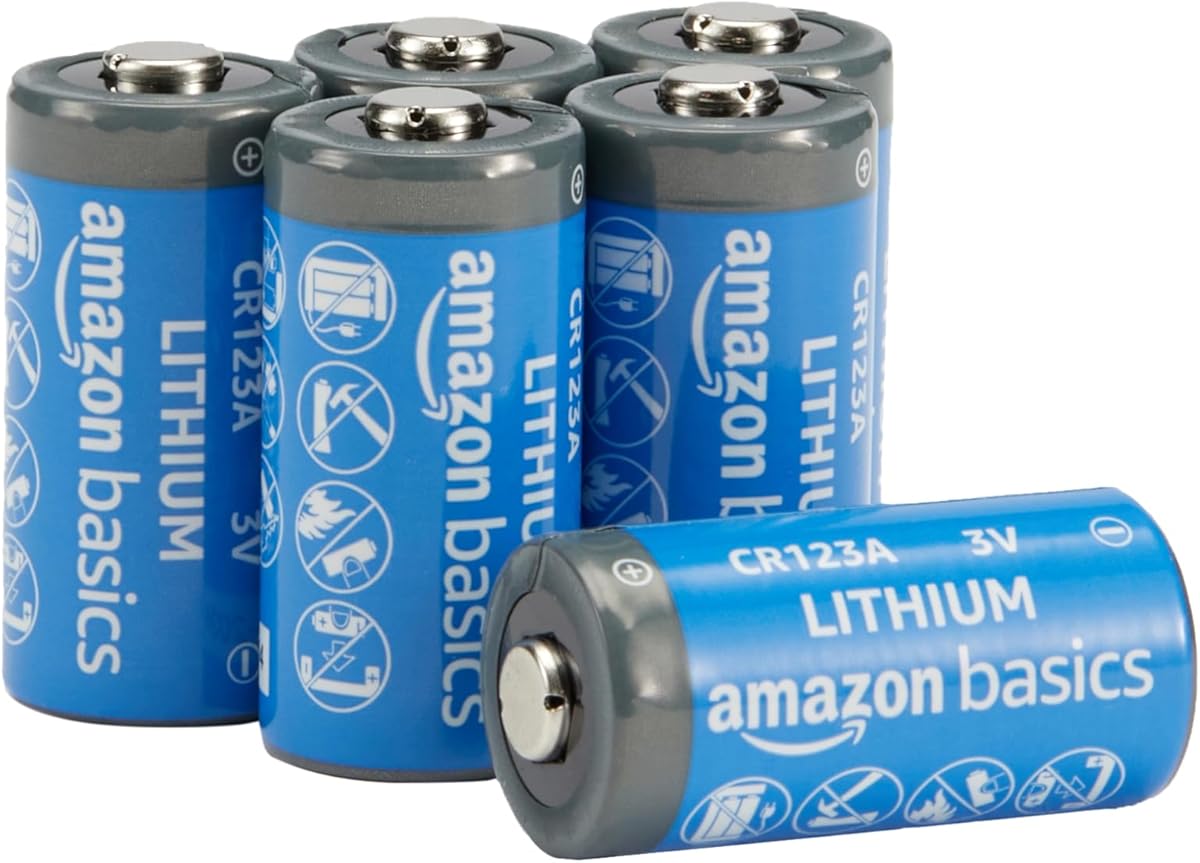
The Amazon Basics 6-Pack Non-Rechargeable CR123A Lithium Batteries offer a straightforward combination of a 4.6 rating, a 1,550mAh capacity, and an up-to-ten-year shelf-life claim. The six-pack format makes it convenient for users who want spares for more than one flashlight, sensor, or other compatible device.
We may earn a commission when you buy through this link, at no additional cost to you.
The listing identifies flashlights and night-vision goggles among suitable applications, while the leak-resistant storage claim makes the batteries practical for emergency supplies. Because they are non-rechargeable, they should be replaced after use and kept away from a charger or any setup intended for rechargeable cells.
The most important limitation appears directly in the product information: these batteries are not recommended for Arlo security cameras. That warning deserves attention because many CR123A buyers use camera batteries and may assume physical compatibility guarantees universal device support. The pack is also marketed for one-time use, so it is not a solution for equipment that explicitly requires rechargeable CR123A cells.
This Amazon Basics set is a practical choice for standard flashlights, night-vision equipment, and compatible household devices where disposable lithium chemistry is appropriate. It works especially well for maintaining a general-purpose spare collection, provided buyers read the device-specific warning and do not use these cells in Arlo cameras.
The listing expressly says not to use these batteries in Arlo security cameras. Check the battery requirements supplied with your camera model before buying, even when the cell appears to fit physically.
Six cells provide a useful balance between availability and excess inventory. A cool, dry storage location and a system for rotating older batteries help keep the multipack ready for occasional use.
We may earn a commission when you buy through this link, at no additional cost to you.
The Energizer 123 Lithium Batteries, 2 Pack is a focused option for someone who needs a quick replacement for a camera, flashlight, or smart-home device. Its 4.7 rating, long storage claim, and support for several CR123-related designations offer the same core strengths as the larger Energizer set without carrying a large inventory.
We may earn a commission when you buy through this link, at no additional cost to you.
The battery is designed to replace 5018LC, CR123, CR123A, CR17345, and EL123 cells, giving it flexibility across devices with different markings. Its stated uses include cameras, flashlights, and smart-home devices, and the up-to-ten-year storage life is useful for keeping a pair on hand until it is needed.
The obvious limitation is quantity. Two batteries are enough for one immediate replacement, but they are less convenient for a camera bag with multiple compartments, a household with several sensors, or a vehicle emergency kit. The listing also lacks an exact capacity, so shoppers focused on electrical specifications cannot compare it directly with products that state 1,550mAh or 1,700mAh.
This is a good pick for occasional users and current owners of a compatible device who recognize the Energizer name and prefer a smaller pack. It is also a convenient trial format for people who want two cells on hand without maintaining a larger battery collection.
A two-cell pack suits a single camera, flashlight, or sensor and provides a spare without much storage overhead. For broader preparation, consider a larger multipack instead.
The 3-volt photo-battery positioning and broad replacement list suit several common electronics. Verify the device manual and compare the cell dimensions before installation.
We may earn a commission when you buy through this link, at no additional cost to you.
The DURNERGY CR123A Lithium Batteries 12 Pack combines a 4.5 rating with a broad compatibility list, a ten-year storage guarantee, and a stated operating range of -40°F to 185°F. Its twelve-cell quantity makes it a practical option for maintaining several wireless security systems, home-automation accessories, lighting devices, and other compatible equipment.
We may earn a commission when you buy through this link, at no additional cost to you.
Compatibility is the most distinguishing feature. The product information names CR17345, CR123, 123, 123A, BR2/3A, CR17335, DL123A, EL123AP, K123LA, L123A, SF123, SF123A, VL123A, and 5018LC as replaceable types. It also states that the cells passed CE, IEC60086-4, and UL1642 certifications, adding useful safety context for buyers comparing the listing with other manufacturers.
One drawback is that no exact capacity is provided, making detailed electrical comparison difficult. Its 4.5 rating is also lower than the ratings of the leading products in this list, although that difference should be considered alongside the much broader compatibility presentation. As with any disposable lithium cell, users should not attempt to recharge it.
DURNERGY is worth considering when a large reserve, extensive replacement-code support, and a wide temperature claim are priorities. It may be especially useful for installers or homeowners managing numerous compatible low-drain devices, provided the device requirements are confirmed and the cells are stored properly.
The extensive designation coverage is useful for mixed equipment collections. Physical fit alone is not enough, so verify voltage, dimensions, polarity, and the manufacturer's recommended battery type.
Twelve cells and a ten-year guarantee suit bulk reserves. Store them in a cool, dry area away from direct heat, and use older cells first to minimize prolonged inventory turnover.
We may earn a commission when you buy through this link, at no additional cost to you.
The HW CR123A 3V Lithium Battery 6-Pack stands out for its stated 1,700mAh capacity, a 4.6 customer rating, and a feature set centered on safety. It is a compelling budget-oriented choice for readers who want a higher stated capacity than the common 1,550mAh figure and value leak-resistant construction.
We may earn a commission when you buy through this link, at no additional cost to you.
The listing says the cells use PTC protection and are UL and RoHS certified, while also advertising a leak-proof design. Its stated operating range runs from -40°F to 158°F, and the product includes a ten-year storage claim. Compatibility covers fire alarms, smoke alarms and detectors, rangefinders, Ring sensors, and flashlights.
Capacity should be interpreted carefully. A higher amp-hour rating can suggest greater potential endurance, but real runtime also depends on device design, drain rate, cutoff behavior, temperature, and the age of the cell. The product information does not provide a detailed standard or maximum continuous-discharge specification comparable with the Panasonic Industrial listing, so buyers seeking precise engineering data should consider that option.
HW is a strong value pick for standard compatible electronics, sensors, and flashlights, particularly when a higher stated capacity is important. It is less ideal for buyers who need extensive discharge specifications or extensive replacement-code documentation.
The 1,700mAh claim differentiates this option from the many 1,550mAh cells in the guide. Treat it as a useful comparison point while recognizing that device-level runtime remains the practical measure.
PTC protection and the stated leak-proof design are reassuring for storage and installation. Continue to follow the battery compartment's polarity and contact-cleaning instructions.
We may earn a commission when you buy through this link, at no additional cost to you.
The Panasonic CR123A Lithium 3V Photo Lithium Batteries, 4 Pack is a compact camera-oriented option with a 4.6 rating. Four cells are enough to carry a spare alongside a primary battery in two devices or to keep a small set of replacements in a camera bag, making the format relevant to photographers who do not need bulk inventory.
We may earn a commission when you buy through this link, at no additional cost to you.
The CR123A and 3-volt specifications provide the basic information needed to begin checking compatibility. Panasonic is also a widely recognized battery brand, and the product's photo-battery positioning fits devices such as cameras, flashes, and other compatible electronics that use primary lithium cells.
The supplied product information is much less detailed than that found for the six-count Panasonic listing. It does not state capacity, a storage-life period, a temperature range, or detailed replacement designations. As a result, buyers who need a comprehensive specification comparison should examine the original listing carefully or consider the other Panasonic option. Device-specific guidance also remains more important than the brand name alone.
The four-pack is a sensible choice for a photographer or occasional user who wants a moderate reserve without maintaining a large collection. It works best for known-compatible equipment and regular use, while large-kit builders may prefer the six-count or twelve-count options.
Four cells are convenient for camera bags and small equipment kits. They offer enough spares for active use without requiring the space and rotation discipline of a larger battery inventory.
The listing provides limited technical detail, so consult the camera or accessory manual for required voltage and battery type. Confirm that rechargeable cells are not required before installing disposable lithium batteries.
We may earn a commission when you buy through this link, at no additional cost to you.
The Panasonic Industrial CR123A Lithium Battery 3V 6 Pack is distinguished by the most detailed electrical specifications in the guide. It has a 4.5 rating, nominal 3.0-volt output, a 1,550mAh capacity based on a 20mA continuous drain at 20°C, and clearly stated continuous and pulse-discharge figures.
We may earn a commission when you buy through this link, at no additional cost to you.
Those figures make the product easier to evaluate for equipment designers, technical buyers, and users with a specific load requirement. It lists a 20mA standard continuous drain, a 1,000mA maximum continuous discharge at 20°C, and a 900mA typical maximum pulse discharge using a three-second-on, 27-second-off pattern. Dimensions of 17.0mm by 34.5mm and an approximate weight of 16.0g to 17.0g also help with fit and logistics.
The operating range is specified as -40°C to +70°C, giving users a clearer idea of environmental limits. However, the listing does not state a shelf-life period, and the rating is slightly below those of the top selections. The technical discharge values should also be compared with device requirements rather than assumed to be suitable for every high-drain application.
This Panasonic Industrial pack is the strongest option for buyers who prioritize transparent electrical and physical data. It is particularly useful for equipment planning, technical procurement, and compatibility checks, while ordinary users can still appreciate the clear dimensions and six-cell quantity.
The continuous and pulse figures offer a more precise basis for comparison than a capacity number alone. Match the load pattern and cutoff behavior of the target device before using the battery in a demanding application.
The stated diameter, height, and weight help confirm a proper compartment fit. These dimensions should be measured against the actual battery compartment rather than inferred solely from the CR123A name.
We may earn a commission when you buy through this link, at no additional cost to you.
The right CR123A battery depends on device requirements, expected drain, pack size, and how long the cells must remain in storage. Review the technical specifications and device guidance before choosing a brand or multipack.
Most CR123A batteries are primary 3-volt lithium cells, but a matching size or printed designation does not guarantee that every device is designed for the same chemistry. Rechargeable CR123A products may have different charging requirements, while some equipment may specify a particular brand, voltage range, or protected cell. Check the battery compartment, user manual, and any markings on the original battery before making a selection. If the device calls for rechargeable cells, do not substitute a disposable lithium battery, and if it calls for disposable cells, do not assume a rechargeable pack is a drop-in replacement.
Capacity is commonly stated in milliampere-hours, or mAh, and can provide a useful indication of potential energy storage. Several options in this guide list 1,550mAh, while the HW set states 1,700mAh. Do not treat that difference as a guaranteed runtime increase because the device's drain rate, voltage cutoff, temperature, and conversion efficiency all matter. Higher capacity can also be valuable in devices that run continuously, but a smaller battery may meet the needs of an occasional-use product. Compare capacity only when the test conditions and device requirements are reasonably similar.
A CR123A used in a low-drain sensor has different requirements from one powering a bright flashlight, camera, rangefinder, or other active device. High-drain options are designed to maintain output more effectively as demand increases. Technical buyers should review the continuous and pulse-discharge figures, especially when their equipment periodically draws a strong current. The Panasonic Industrial listing is particularly useful here because it states a 20mA standard drain, a 1,000mA maximum continuous discharge, and a 900mA typical pulse figure.
CR123A batteries may be stored in vehicles, outdoor cameras, emergency bags, and other locations where temperature varies. The products in this guide make different temperature claims, including a wide -40°F to 185°F range for DURNERGY, -40°F to 158°F for HW, and -40°C to +70°C for Panasonic Industrial. These figures communicate the stated operating boundaries, but they do not mean every battery performs equally under every condition. Avoid exposing cells to extreme heat, direct sunlight, moisture, or physical damage, and keep spares in a stable indoor environment when possible.
Long shelf life is valuable for emergency supplies, infrequently used cameras, and equipment that sits idle between outings. Duracell, Energizer, DURNERGY, and other listings state storage periods of around ten years, with some described as guarantees and others as maximum or typical claims. Storage duration depends on proper conditions, including moderate temperature, dry surroundings, and limited contact with conductive materials. A long advertised shelf life is not a substitute for checking cells periodically, organizing them by purchase date, and rotating older batteries forward.
Two-cell packs suit a single device or occasional replacement, while four- and six-cell packs serve typical camera bags, household sensors, and vehicle kits. Twelve-cell options are convenient for professional users, high-turnover flashlights, or substantial emergency reserves. More batteries do not automatically make a purchase better: large packs require more storage and a rotation plan, while small packs may run out during a busy week. Consider how many devices you actively maintain, the number of batteries each requires, and whether you prefer a compact emergency pair or a centralized inventory.
CR123A is one of several designations used for similar-looking primary lithium cells. Listings in this guide reference alternatives such as CR123, CR17345, DL123A, EL123AP, K123LA, SF123A, VL123, 5018LC, and others. A listed replacement code is useful evidence that the cell may fit, but it should not replace checking the required voltage, diameter, height, and discharge behavior. Some cameras, security systems, and rangefinders have unusual battery requirements or brand restrictions that are not obvious from the physical shape.
A leak-resistant or protected design is valuable because electrolyte leakage can damage a battery compartment or nearby electronics. Look for claims such as PTC protection, leak-proof construction, and recognized UL, RoHS, CE, or IEC60086-4 certifications. Certification does not make a battery indestructible, so correct installation remains important. Do not mix old and new cells casually, do not recharge disposable lithium chemistry, and avoid exposing cells to crushing, short-circuiting, high heat, or moisture. Replacing a cell correctly also means observing the polarity shown by the device or battery compartment.
Before installing a CR123A, turn off the device if possible, open the battery compartment carefully, and note the existing battery's type and polarity. Remove the old cell promptly, inspect the compartment for corrosion or residue, and make sure the replacement matches the required 3-volt chemistry and physical dimensions. Do not mix disposable and rechargeable batteries unless the device manufacturer explicitly permits it.
Insert the new battery in the direction indicated by the positive and negative marks. Avoid using metal tools or metal fingers to hold the cell against the contacts, and close the cover securely so it cannot press against the terminals. For devices that use multiple cells, follow the manual's replacement guidance and avoid combining cells from different packs if consistent performance is important.
Store unused CR123A batteries in their original packaging or another arrangement that prevents terminals from contacting metal objects. Keep them in a cool, dry place away from direct heat, direct sunlight, moisture, and children. These batteries are not ordinarily rechargeable, so remove them from a compatible device before charging and dispose of them according to local battery and electronic-waste rules.
CR123A is commonly used as the standard designation for a 3-volt primary lithium battery in the size sold as a CR123A. Many manufacturers also list CR123 as a replacement, but the included letters can sometimes relate to dimensions or regional naming conventions. Check the device manual and compare the diameter, height, voltage, and required battery type before installing one in place of the other.
Only if the device manufacturer explicitly approves disposable CR123A cells for that model. Most rechargeable products use a rechargeable battery with protection circuitry, and a disposable cell may lack the required charging protection. Never place a non-rechargeable CR123A in a charger. Conversely, do not assume a rechargeable CR123A is suitable for a device designed only for primary lithium cells.
Several products in this guide advertise storage lives of up to or guaranteed for ten years under appropriate conditions. Real retention can be affected by temperature, humidity, manufacturing date, and storage practices. Keep spares dry and at a stable temperature, rotate them periodically, and use older batteries first. Before placing a long-stored cell in a critical device, inspect it for swelling, leakage, corrosion, or other visible damage.
No. A higher milliampere-hour rating generally indicates greater potential capacity, but runtime also depends on device load, voltage cutoff, temperature, battery age, and the efficiency of the device. The 1,700mAh HW option may have an advantage on paper over 1,550mAh cells, but the actual result in your equipment is the meaningful comparison. Ensure the battery also satisfies the device's voltage and discharge requirements.
A high-drain CR123A designed for consistent output is generally the most appropriate choice for demanding flashlights. The SureFire set is specifically positioned for high-drain illumination, while the Duracell option also targets demanding flashlights. For ordinary household lights, several six-cell packs provide plenty of suitable spares. Confirm the flashlight manual's battery specification and avoid mixing cells with different ages in the same device.
Some security cameras use CR123A cells, but compatibility is model-specific. The Duracell listing specifically includes Ring, Nest Cam, and Arlo among its supported applications, while Amazon Basics expressly says its batteries are not recommended for Arlo cameras. Other products may work with a camera without being formally listed for it. Check the camera maker's battery requirements before ordering, especially when replacement cells must meet a specific brand or protection requirement.
Stop using the device, remove the batteries only as directed in the manual, and avoid touching leaked material directly. Lithium primary cells can produce alkaline electrolyte residue that may damage the compartment or contacts. Dispose of the affected cells according to local guidance and have the compartment inspected before installing replacements. Protected-cell designs can reduce risk, but they do not eliminate the need for correct installation and timely replacement.
Keeping a separate, organized set of spares is generally helpful, but do not leave unused batteries inside a device unless its manual recommends it. Devices can drain stored cells slowly, and temperature inside a vehicle or outdoor enclosure can accelerate deterioration. Store spares in a cool, dry place with their terminals protected, and check them periodically if they are part of a long-term emergency supply.
The Duracell CR123A 3V Lithium Battery, 6 Count is the best overall choice because it combines the highest customer rating with broad support for cameras, security systems, sensors, flashlights, and emergency equipment. The SureFire 12 Pack is the strongest premium option for high-drain equipment, while the HW six-pack offers a budget-friendly alternative with a high stated capacity and added safety features.
For occasional users, the Energizer two-pack or Panasonic four-pack may prevent excess inventory. Larger Panasonic, Energizer, Duracell, SureFire, and DURNERGY multipacks are more suitable for frequent users, professional equipment, camera bags, vehicle kits, and preparedness supplies. Prioritize correct chemistry, required voltage, physical fit, and appropriate discharge performance before focusing on capacity or pack quantity.
Product details, ratings, and prices can change after this guide was prepared, so check the current listing and manufacturer guidance before buying. Also verify any device-specific restrictions, particularly for security cameras, rechargeable systems, and equipment that requires a particular protected battery design.
