ELECTOP HDMI 2.1 Wall Plate
3.9Editor score
48 Gbps bandwidth
8K at 60Hz
4K at 120Hz
eARC and VRR support
Explore the best HDMI junction box options, comparing wall plates, keystone inserts, panel couplers, waterproof connectors, and converter-switchers for home
An HDMI junction box provides a neat, dependable connection point for routing HDMI cables through walls, furniture, or equipment installations. The right model depends on bandwidth, mounting style, environmental protection, and whether you also need switching or legacy audio conversion. A well-matched box improves cable management while protecting frequently connected devices.
We compared all ten products by examining their stated HDMI specifications, supported resolutions, installation method, port configuration, and practical use cases. The list includes conventional wall plates, keystone inserts, panel-mount bulkheads, waterproof couplers, and multifunction HDMI switchers with RCA conversion. It also distinguishes dedicated junction hardware from products that perform additional signal-routing functions.
Each review highlights the product most relevant use, important strengths, and practical limitations. The top selections provide convenient options for straightforward in-wall connections, high-bandwidth installations, and organized component setups. Product details, ratings, and availability can change, so readers should confirm the current specifications and compatibility before purchasing.
3.9Editor score

4.3Editor score

4.6Editor score
The comparison below shows how each product approaches connection management, from decorative in-wall plates and compact keystone inserts to protected bulkhead couplers and switching converter units. Video capability, installation style, and additional functions separate the options more clearly than their shared HDMI category does.




The TNP 2 Port HDMI Wall Plate is a practical all-around choice for installers who want to connect two HDMI runs without leaving loose cables around a television or entertainment center. Its 4.3 rating reflects a generally useful design, and its strongest qualities are the two-port configuration, standard 4.5-by-2.7-inch format, and a straightforward pass-through layout. The included pigtails connect directly to cables running inside the wall.
We may earn a commission when you buy through this link, at no additional cost to you.
The plate supports common 4K UHD resolutions up to 3840 by 2160, along with HDR-era features such as Audio Return Channel, HDMI Ethernet Channel, 48-bit color depth, and 32-channel audio. Its stated 18 Gbps bandwidth matches the needs of many HDMI 2.0 installations. The recommendation for a maximum combined cable length of 25 feet for 4K HDR is also a useful installation consideration, because very long runs can become more sensitive to signal quality and cable quality.
The two-piece design separates the decorative faceplate from the functional insert, and the included mounting screws make it easier to connect and secure the cables. No soldering is required, which makes this suitable for a new installation by a homeowner as well as a professional installer. Its limits are principally related to bandwidth and format: it is not presented as an HDMI 2.1 solution for 8K or 4K at 120Hz, and the white faceplate is a design choice rather than a universally neutral finish.
This is the best general pick for a conventional home theater wall with one or two fixed HDMI connections. Choose it when your equipment operates at 4K UHD, you want the cables concealed, and a standard low-voltage opening is available. For newer 8K systems, unusually long cable runs, or exposed installations, a higher-bandwidth or more specialized junction solution will be a better fit.
The front receptacles provide convenient service points while the short rear pigtails disappear into the wall cavity. This arrangement keeps the visible area organized and allows a conventional HDMI cable to run from each source or display.
Support for ARC, HEC, high-resolution 4K video, and advanced audio formats makes the plate useful for a broad range of home theater equipment without requiring the bandwidth of an 8K-focused HDMI 2.1 installation.
We may earn a commission when you buy through this link, at no additional cost to you.
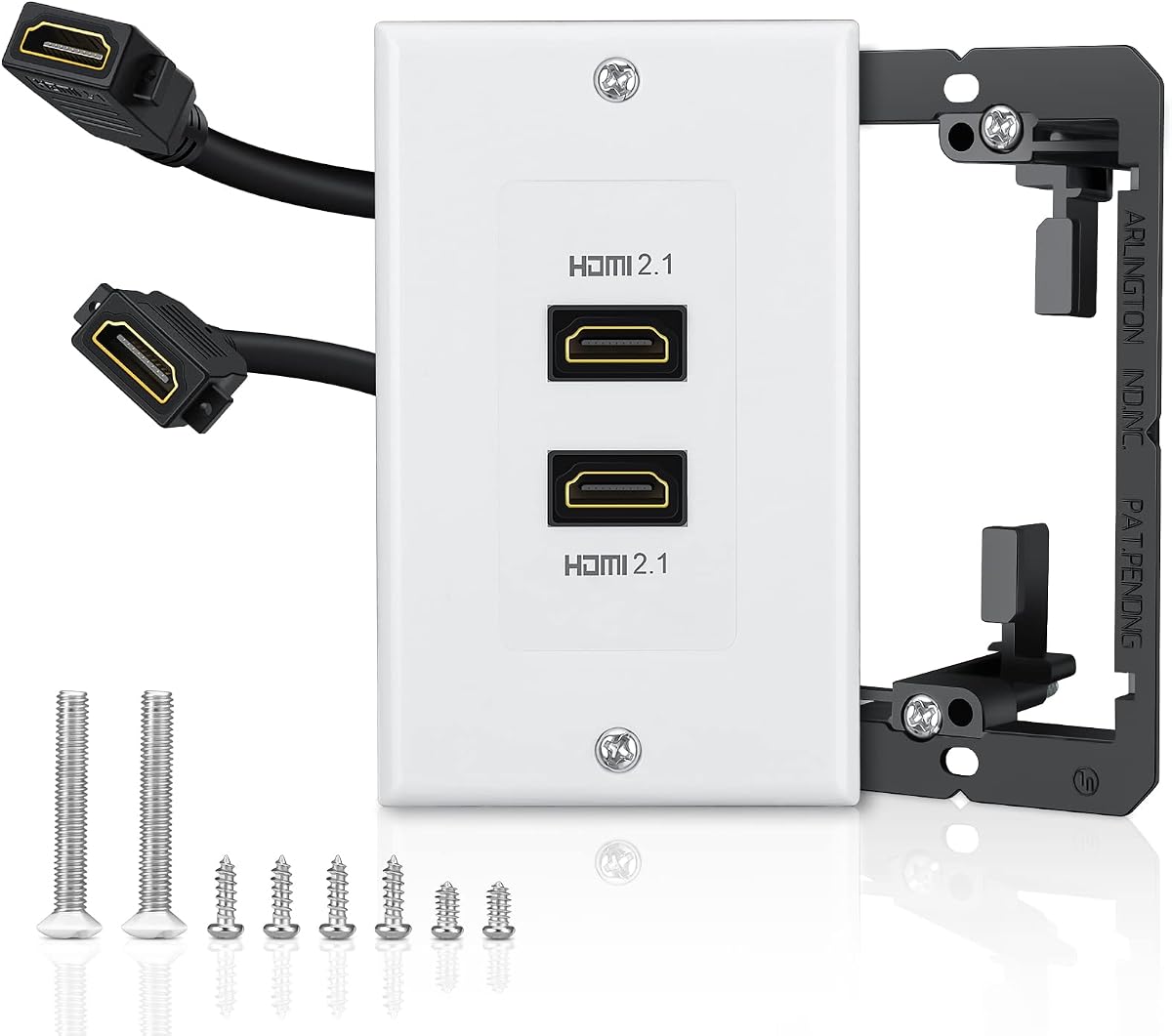
The ELECTOP HDMI 2.1 Wall Plate is the premium option in this guide because it targets current high-bandwidth displays, game consoles, and home theater equipment. Its 3.9 rating is the lowest among the ten listed products, but the underlying specification set is among the most ambitious. It provides two pass-through connections, a 48 Gbps bandwidth target, and support for 8K UHD and 4K at 120Hz.
We may earn a commission when you buy through this link, at no additional cost to you.
The plate is designed around modern HDMI 2.1 features, including Auto Low Latency Mode, Variable Refresh Rate, Enhanced Audio Return Channel, HDMI Ethernet Channel, 48-bit color depth, and 32-channel audio. Its stated resolution support extends to 7680 by 4320 at 60Hz, 3840 by 2160 at 120 or 144Hz, and even higher refresh rates at some lower resolutions. These are meaningful advantages when a television, projector, or console can use the added headroom.
Installation is more complete than a simple insert-only solution because the package includes a single-gang low-voltage metal mounting bracket and eight screws. A detachable 0.66-foot HDMI extension is attached to the port, while the front offers a female connection and the rear provides a pigtail for the in-wall cable. The plate has a more robust presentation than lightweight decorative plates, although the requirements are correspondingly more specific to modern HDMI systems.
This product is best for a new installation serving an 8K television, a high-refresh-rate gaming display, or a carefully planned home theater where future bandwidth is important. Buyers should ensure that every cable, source, receiver, and display in the chain supports the intended format. It is less necessary for a basic 1080p television or a temporary connection, and the modest user rating means potential buyers should carefully assess fit and compatibility before installation.
The 48 Gbps design provides substantially more headroom than conventional 4K pass-through hardware. That makes it a forward-looking choice for 8K panels, 4K gaming at elevated refresh rates, and connected components that benefit from HDMI 2.1 features.
The included metal low-voltage bracket, mounting screws, detachable extension, and two-piece plate design reduce the number of separate parts needed for a standard one-gang installation.
We may earn a commission when you buy through this link, at no additional cost to you.
The D-Type HDMI Panel Coupler is a compact solution for equipment enclosures, desks, walls, or other installations where a standard D-type opening is available. Its 4.5 rating indicates a favorable reception, and the product's defining advantage is its simple female-to-female pass-through design. It joins two HDMI cables while presenting one clean connection point at the panel.
We may earn a commission when you buy through this link, at no additional cost to you.
HDMI 2.0 bandwidth of 18 Gbps supports 4K at 60Hz, 3D content, 60 frames per second, Audio Return Channel, and HDMI Ethernet Channel. It can bridge computers, Blu-ray players, televisions, and projectors without requiring a long exposed cable. The coupler also has a practical secondary benefit: regularly plugging and unplugging at the panel can reduce direct handling of the HDMI ports on the source and display.
Its restrictions come from the compact format. This is not designed to deliver 8K or 4K high-refresh-rate performance, and it does not include a decorative wall plate or low-voltage mounting bracket. The opening must be compatible with the D-panel format, and the installation may still require an enclosure or panel to give the connector a finished appearance. It is therefore most appropriate for builders already working with panel-mount hardware.
Choose this coupler for a compact 4K project, a conference room, a workstation, or a custom enclosure where a full wall plate would be unnecessary. It provides an economical way to establish a stable pass-through without changing the HDMI format of the source or display. For modern gaming systems, 8K televisions, or decorative residential walls, a higher-bandwidth wall plate or keystone insert is a stronger choice.
Because the coupler mounts directly into a compatible D-type panel, it is well suited to equipment boxes and built-in furniture where every millimeter of space and visual simplicity matters.
A fixed panel connection can serve as the regular plug-in point, keeping the frequently used HDMI connections on the television, computer, or player from receiving unnecessary handling.
We may earn a commission when you buy through this link, at no additional cost to you.
The Cable Matters 8K HDMI Keystone Jack is a strong budget-oriented selection for users who want high-end HDMI capability without a complete branded wall plate. Its 4.5 rating and two-pack configuration make it appealing for both single-room installations and projects that need multiple connection points. The vertically oriented inserts fit standard keystone wall plates and patch panels.
We may earn a commission when you buy through this link, at no additional cost to you.
Despite the budget label, the connectors support HDMI 2.1 performance, including 8K at 60Hz and 4K at 120Hz. They also support eARC, Auto Low Latency Mode, Variable Refresh Rate, 5.1 and 7.1 surround sound, and object-based audio. The female-to-female construction creates a stable pass-through, while the snap-in design permits tool-free installation and removal when equipment is upgraded or the room changes.
The main compromise is that the compatible wall plate or patch panel is not included. Buyers also need a keystone opening of the appropriate size and orientation. Although the stated feature set is strong, the actual resolution and refresh rate remain limited by the connected source, display, and cables. A keystone insert is a wiring component rather than an active converter, so it cannot make an older source output a newer format.
This is a good choice for a homeowner creating a tidy wall connection for a modern television, projector, or game console. It is particularly useful when the existing wall already has a compatible keystone faceplate. The included pair provides flexibility, and the removable design makes future changes easier. Buy a dedicated HDMI 2.1 wall plate instead if you want the bracket and matching faceplate supplied as one coordinated package.
The insert delivers modern HDMI 2.1 capabilities without occupying a complete gang box. That makes it useful when you want one or two dedicated connections in a wall that already contains other low-voltage modules.
Tool-free removal lets installers replace or repurpose the connection without rebuilding the wall. The two-pack also gives users a spare or a second point for another display.
We may earn a commission when you buy through this link, at no additional cost to you.
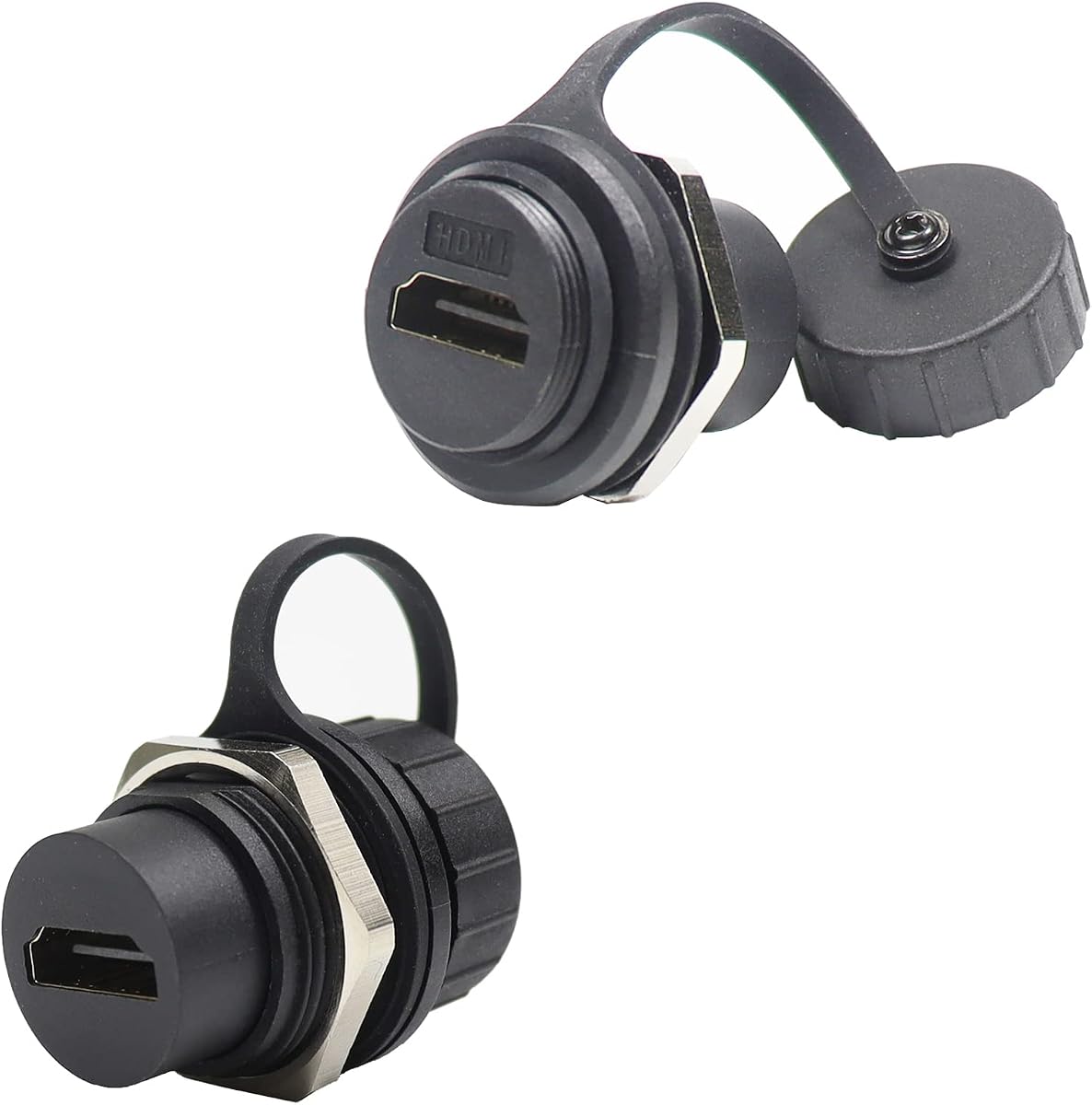
The PENGLIN Waterproof HDMI Panel Mount Coupler has a 4.9 rating, the highest in this comparison, and targets installations where moisture, dust, or physical exposure may be a concern. The package contains two panel-mount bulkhead connectors, each capable of joining HDMI cables or adapting a connection point in a protected enclosure.
We may earn a commission when you buy through this link, at no additional cost to you.
Its stated IP67 protection is the defining feature. The reinforced PA6BG33 material is described as scratch resistant and structurally durable, while the standard round panel-mount opening provides a straightforward mechanical installation. The couplers support HDMI sources including TV boxes, Xbox and PlayStation systems, Blu-ray players, PCs, streaming sticks, and laptops before sending the signal to a television, monitor, or projector.
This is an HDMI 2.0-oriented product rather than an 8K unit. It supports 4K video and uncompressed stereo sound, with plug-and-play operation and no driver or software requirements. The two-pack is helpful for equipment cabinets, outdoor entertainment areas, workshop setups, or other installations where an exposed connection could collect moisture or debris. A sealed enclosure and suitable cable glands are still important parts of a professional protected installation.
This coupler is best for users who specifically need environmental resistance rather than a decorative residential wall plate. Its excellent rating and durable construction make it a compelling protected connection point, provided the equipment enclosure and cable entry points are designed properly. Choose an HDMI 2.1 keystone or wall plate instead when the primary goal is high refresh rates, eARC, or advanced gaming features rather than physical protection.
The IP67-rated body helps protect the connection in environments where dust or water could otherwise reach the panel. It is a better match for outdoor cabinets, workshops, and utility areas than an ordinary decorative plate.
The straightforward bulkhead design works with game consoles, computers, disc players, streaming devices, televisions, projectors, and monitors, making it convenient for mixed equipment installations.
We may earn a commission when you buy through this link, at no additional cost to you.
The Waterproof Metal HDMI Bulkhead is a rugged option for equipment cabinets and other panel-mounted applications where mechanical strength and environmental sealing matter. Its 4.4 rating reflects a favorable reception, and the package includes two female-to-female M25-style panel connectors with protective dust and water caps.
We may earn a commission when you buy through this link, at no additional cost to you.
The housing is made from zinc die-cast material described as flame retardant, ultraviolet resistant, and resistant to aging. Its phosphor-bronze contact pins receive a 7-micrometer gold plating, which supports reliable contact and corrosion resistance. The stated bandwidth reaches 18 Gbps, enabling 4K HDR and 1080p at 60 frames per second. A screw-free field-installable design means the HDMI cables connect without soldering or special tools.
The protective cap is the main advantage over a normal panel coupler, provided it is properly fitted when the connection is not in use. The product is still designed around a standard D-series panel installation, and its enclosed metal body is less visually suitable for a living room wall. Its 4K-oriented specification is sufficient for many displays but does not match the 8K and high-refresh capabilities of the HDMI 2.1 alternatives.
Choose this bulkhead for an outdoor equipment box, workshop control system, AV rack, or utility installation where the connector must tolerate handling and environmental exposure. It is particularly useful when a permanent panel interface and a positive connection method are more important than a decorative finish. For a standard living room installation, a keystone insert or finished wall plate will normally be easier to coordinate with the interior.
The die-cast shell and plated contacts are designed to resist wear, corrosion, and aging. This makes the bulkhead more appropriate for repeated service than a lightweight plastic adapter.
The included dust and water cap helps protect the interface while cables are disconnected. Pairing it with a properly sealed enclosure improves its value in outdoor or industrial-style installations.
We may earn a commission when you buy through this link, at no additional cost to you.
The Cable Matters 4K HDMI Keystone Jack is a flexible choice for home theater rooms, offices, conference spaces, and other installations that use standard keystone openings. Its 4.6 rating is among the strongest in the lineup, while the two-pack provides useful flexibility for creating multiple concealed HDMI routes. The insert has a vertical orientation and connects a source to a display through two HDMI cables.
We may earn a commission when you buy through this link, at no additional cost to you.
The product supports the major features associated with modern 4K HDMI connections, including 3D, Audio Return Channel, Consumer Electronics Control, and Ethernet. Gold-plated pass-through contacts are intended to support signal transmission and resist corrosion. Because the insert is passive, it preserves the capabilities of the connected cables and devices rather than changing the source format.
Installation is particularly convenient. The snap-in construction allows the insert to be pressed into a compatible wall plate or patch panel without tools, then removed for relocation or upgrades. A standard 90- or 270-degree HDMI angle adapter can also be used in tight routing situations, although such an adapter is not described as part of the included package. The faceplate or patch panel is sold separately.
This model is best for users with an existing decoratively finished wall or a flexible plan for adding HDMI ports. It makes an especially good companion to other low-voltage inserts, allowing a television, network, power, or audio module to share the same wall plate. It is not the right choice for an 8K television or 4K high-refresh gaming chain, and buyers should confirm that their keystone opening is sufficiently large for the insert.
Using a keystone opening allows an HDMI connection to share a finished plate with power, network, or other low-voltage modules. This is useful when appearance and coordinated wiring matter.
The insert passes HDMI signals through without attempting format conversion. Common 4K features remain available when the source, display, and cables support them.
We may earn a commission when you buy through this link, at no additional cost to you.
The HDMI 2 Port Wall Plate is designed for straightforward home theater connections where cable clutter should disappear into the wall. It has a 4.4 rating and uses a familiar white finish intended to blend with common interior decoration. Each front connector is female, providing a pair of service points for televisions, game systems, streaming boxes, and other sources.
We may earn a commission when you buy through this link, at no additional cost to you.
Its advertised compatibility includes HDR, 4K UHD, 3D, ARC, Ethernet over HDMI, and backward compatibility with several earlier HDMI versions. This makes it a sensible option for established systems that do not require 8K or 4K gaming at 120Hz. The wall plate serves primarily as a physical pass-through, so the final features and resolution depend on the source, display, receiver, and cable combination.
A screw-free rear connector is intended to reduce installation risk by eliminating a screw that could potentially damage the connection point. The plate conceals the in-wall cables and presents a neat front panel. Its limitations are narrow but relevant: the listed color is white, and the specification does not target the 48 Gbps bandwidth associated with the HDMI 2.1 premium choice.
Choose this model for a standard living room or media room where a simple white two-port outlet is preferred. It is especially useful when upgrading visible cable arrangements around a wall-mounted television. Users seeking 8K performance, a metal low-voltage bracket, or a broader selection of finishes should consider the ELECTOP HDMI 2.1 plate or a modular keystone system instead.
The in-wall route removes long visible cable loops while retaining convenient front-facing HDMI sockets. That balance makes the plate useful for televisions installed flush against a wall.
Support for HDR, ARC, 3D, and Ethernet addresses the features commonly needed by home theater equipment. It is a more natural fit for a stable 4K installation than a new 8K pipeline.
We may earn a commission when you buy through this link, at no additional cost to you.
The Y.D.F 3 Way HDMI Switcher is a multi-source connection hub that combines three HDMI inputs with a two-input RCA-to-HDMI converter. Its 4.5 rating reflects a well-regarded feature set, and the two-in-one design is useful for entertainment rooms where modern consoles and older composite-video equipment need to reach the same display.
We may earn a commission when you buy through this link, at no additional cost to you.
The HDMI side supports up to 4K at 60Hz with 18 Gbps bandwidth. Compatible sources include PCs, Macs, Xbox models, PlayStation 4 and 5 systems, Blu-ray and DVD players, Chromecast, Switch, Apple TV, Fire TV, Roku, and similar devices. The composite side supports systems such as Sega, Wii, Nintendo 64, GameCube, SNES, PlayStation 1 through 3, Xbox, set-top boxes, VHS, VCR, and compatible television or projector sources.
A one-key switch is included for changing sources, and 4:3 or 16:9 selection accommodates older content. The durable aluminum housing is more substantial than a basic plastic switch. However, the manufacturer notes that the combined length of input and output HDMI cables should remain within 10 feet to reach 4K at 60Hz. This is an important limitation for large rooms where lengthy cable runs are common.
This product is best for users consolidating several console generations and streaming devices into one display. It is not a conventional in-wall junction box and may sit in an entertainment cabinet rather than inside a wall. Choose it when source selection and legacy conversion are priorities; choose a dedicated keystone or wall plate when the main goal is concealing a single permanent cable route.
Combining three HDMI inputs with two composite inputs reduces the need for separate source-selection equipment. It is particularly useful for retro gaming and mixed-console displays.
Keeping the total input and output cable length within 10 feet helps preserve the stated 4K at 60Hz capability. For longer in-room runs, a dedicated wall plate with quality cables may be preferable.
We may earn a commission when you buy through this link, at no additional cost to you.
The Y.D.F 4 Way HDMI Switcher is the most source-heavy product in the list, combining four HDMI inputs with four RCA-to-HDMI conversion inputs. Its 4.6 rating is tied for the second-highest score among these products, while the two-in-one design addresses entertainment systems with both modern and legacy equipment.
We may earn a commission when you buy through this link, at no additional cost to you.
The HDMI section handles up to 4K at 60Hz through 18 Gbps bandwidth and is compatible with PCs, Macs, current and previous-generation Xbox and PlayStation consoles, disc players, streaming devices, and popular smart-TV platforms. The RCA side accommodates Sega, Nintendo systems, older PlayStation and Xbox generations, set-top boxes, VHS equipment, VCRs, and related composite sources. Users can select 4:3 or 16:9 presentation to suit the content and display.
A one-key source switch simplifies operation, and the aluminum construction is designed for longevity. The key limitation is again cable distance: the stated guidance says input and output HDMI cables should total no more than 10 feet to reach 4K at 60Hz. Because this unit combines more inputs, it also takes up more space and requires a larger entertainment cabinet than a basic switch or wall plate.
Choose this model for a game room, media center, or shared display with numerous consoles and legacy devices. It is most valuable when source switching matters more than hiding the entire system inside a wall. If the plan is a clean, permanent installation with one or two concealed connections, a wall plate or keystone insert is easier to integrate and offers a broader range of modern HDMI bandwidth options.
Four HDMI and four composite inputs make this the broadest source hub in the comparison. It suits collectors and families who regularly connect different console generations.
The switcher's role is signal selection and conversion, so it naturally belongs in an accessible media cabinet. It offers more source control than a passive junction but less physical cable concealment than a dedicated wall plate.
We may earn a commission when you buy through this link, at no additional cost to you.
The best HDMI junction box depends on where it will be installed, which video formats your equipment supports, and whether you need passive cable routing, protected bulkhead hardware, or active source switching. Use the following factors to narrow the options before making a final selection.
A traditional wall plate suits a standard one-gang low-voltage opening and usually provides a finished faceplate with a front-facing HDMI receptacle. A keystone insert is more flexible because it fits a standard keystone opening and can share a plate with network, power, or audio modules. A bulkhead coupler is intended for equipment cabinets, outdoor boxes, or custom panels and normally requires a compatible circular or D-series mounting hole. Select the physical format before considering bandwidth.
A conventional 4K system generally benefits from an 18 Gbps HDMI 2.0 connection, while 8K displays, 4K gaming at 120Hz, and advanced HDMI 2.1 features require substantially more bandwidth. The junction box must be supported by every component in the signal chain, including the source, cable, receiver, display, and any intermediate switch. A high-bandwidth plate cannot create an unsupported output on an older console, and a low-bandwidth coupler can limit an otherwise capable system.
Resolution alone does not describe the entire connection. Audio Return Channel, Enhanced Audio Return Channel, HDMI Ethernet Channel, Consumer Electronics Control, High-bandwidth Digital Content Protection, HDR, VRR, ALLM, and 3D can matter depending on the system. For an audio-focused installation, eARC and multichannel audio support deserve particular attention. For gaming, VRR and ALLM may be more valuable than extra legacy compatibility.
A two-port wall plate can provide separate pass-throughs for a television and projector, two game systems, or a display and an AV receiver. A keystone insert may be better when only one HDMI route is required. If several source devices share one display, a switching unit is more appropriate than multiple passive junctions because it lets the user select an active source from a single output connection.
Long passive cable runs can be more vulnerable to interference and signal degradation, particularly at high resolutions or refresh rates. The product data gives different guidance: one wall plate recommends a maximum recommended combined cable length of 25 feet for 4K HDR, while the switching units advise keeping total input and output HDMI cable length within 10 feet for 4K at 60Hz. Quality cables, proper connectors, and realistic run lengths should guide the installation.
An ordinary indoor wall plate is designed for a dry, protected interior. A panel bulkhead with an IP67-rated cap is more suitable for an outdoor entertainment enclosure, workshop, utility cabinet, or other location where dust or water may reach the connection. Environmental protection should cover the connector, enclosure, cable entry points, and any unused openings; a waterproof connector alone cannot make an improperly sealed cabinet safe.
A pass-through junction is simpler and preserves a fixed connection path. A switcher adds active signal selection and may include legacy audio conversion, making it useful for mixed equipment. Switchers also introduce another component that must support the intended resolution and refresh rate. If the goal is only to hide a cable behind a wall, an active converter or switch adds complexity without providing a meaningful benefit.
Check whether the low-voltage bracket, faceplate, mounting screws, and adapters are included. A complete package can simplify a new installation, while an insert-only product may suit an existing wall. Removable keystone designs are especially helpful when displays, consoles, or room layouts may change. The product should also fit the cable pathway without creating sharp bends or forcing unnecessary stress onto the HDMI connectors.
Before installation, turn off and disconnect the source, display, receiver, and any connected equipment. Confirm that the opening matches the product's mounting format and that the in-wall cable can reach the connector without exceeding its stated guidance. A standard one-gang low-voltage box suits most decorative wall plates, while keystone inserts need an appropriately sized opening and bulkhead couplers need their specified panel holes.
Route the in-wall HDMI cable to the junction box and connect it to the rear pigtail, panel coupler, or keystone insert. Secure the unit with the included screws or snap-in tabs, then attach the front cable to the television or other display. For a switching model, connect each source to the correct HDMI or RCA input, connect the output to the display, and select the desired source with the one-key control. Test the full path before closing the wall or cabinet.
For care, avoid pulling on the attached HDMI cables when unplugging a device; grip the connector housing instead. Keep passive wall plates dry and free from dust, and fit the dust cap on protected bulkheads whenever a cable is disconnected. If a connection becomes intermittent, inspect the plug, socket, cable bend radius, and wall connection rather than assuming the junction box has failed. Also remember that a connector can only pass through the formats supported by the entire attached system.
An HDMI junction box provides a permanent connection point for one or more HDMI cables, often allowing cables to run inside a wall, cabinet, or panel. It can conceal cable clutter, reduce repeated plugging on device ports, and provide a cleaner connection near a wall-mounted display. Some models also include switching or legacy RCA conversion, so they perform more than a simple physical junction.
No. A passive junction box usually provides a fixed pass-through connection and does not let the user select among several sources. An HDMI switch accepts multiple inputs and routes a selected source to one output. The two Y.D.F products in this guide are switchers with RCA conversion, while the wall plates, keystone inserts, and bulkheads are primarily connection hardware.
In most cases, a higher-bandwidth junction is backward compatible with lower-resolution HDMI equipment, provided the cables and other components also support the connection. The junction will not make a 4K television display 8K, and some advanced features such as eARC, VRR, or 4K at 120Hz depend on the complete source-to-display chain. Check compatibility rather than relying on the connector's maximum rating alone.
Most decorative HDMI wall plates are intended for a standard one-gang low-voltage electrical box rather than a normal power outlet box. The product should specify its required opening, and some packages include a suitable bracket while others do not. Verify the dimensions and included hardware before installation, especially when fitting the plate into an existing finished wall.
No. The keystone insert must fit the opening in a compatible wall plate or patch panel, with adequate depth and space for the attached cables. Some decorative plates have narrow openings or fixed modules that will not accept standard keystone inserts. A dedicated HDMI keystone faceplate is usually the simplest option when no suitable opening is already present.
A panel-mount bulkhead with an IP67-rated protective cap is the most relevant choice for a cabinet exposed to dust or water. The PENGLIN and metal-shell bulkhead options both fit that use. The enclosure, cable entries, and unused connector openings must also be sealed correctly because an IP67 connector does not automatically seal the entire installation.
Length guidance varies by product and system. One wall plate recommends no more than 25 feet of combined white HDMI cable for 4K HDR, while the switchers in this guide specify a total input and output length within 10 feet for 4K at 60Hz. Higher bandwidth and refresh rates can be more demanding, so follow the product guidance and use high-quality certified cables for the intended format.
Only a model with an active RCA-to-HDMI converter can perform that function. The Y.D.F 3-way and 4-way products include composite RCA conversion and can output to an HDMI television or projector, while the passive wall plates and keystone inserts do not convert signal formats. Conversion may also require appropriate aspect-ratio selection, especially for older 4:3 content.
The TNP 2 Port HDMI Wall Plate is the most versatile general choice for a conventional 4K home theater installation because it combines two pass-throughs, a standard wall format, and support for widely used HDMI features. The ELECTOP HDMI 2.1 Wall Plate stands out for 8K, 4K at 120Hz, and 48 Gbps bandwidth, while the Cable Matters 4K HDMI Keystone Jack offers a flexible two-pack for modular wall openings.
The right choice for specialized needs is equally clear. Protected bulkhead couplers suit outdoor cabinets and workshop-style installations, while the D-Type coupler fits custom panels and compact equipment enclosures. Users with several modern and legacy sources should consider the Y.D.F switchers for active input selection and RCA conversion rather than treating them as conventional in-wall junction boxes.
Before purchasing, verify the mounting format, complete HDMI feature support, cable-length limits, and compatibility with every device in the signal path. Product specifications, ratings, design details, and availability can change, so confirm the current listing and included accessories. A thoughtful match between the junction hardware and the intended room or equipment installation will provide the most useful result.
