
EVAPLUS 54.6V Safe Charger
4.4Editor score
54.6V charging output
UL-certified safety design
Dual LED status lights
100–240V AC input
Explore the best electric bike chargers for 48V Ebikes, comparing connector fit, charging speed, safety features, compatibility, and portability for riders.
Electric bike chargers for 48V Ebikes must match both the battery chemistry and the charging port. A charger that looks similar to the original can still be unsafe or unusable if its output voltage, current, connector, or battery type differs. The best options pair correct electrical specifications with useful status lights and dependable protection circuits.
We compared ten chargers using the information supplied with each product, focusing on battery compatibility, output ratings, connector coverage, safety certifications, charging controls, and practical replacement features. The list covers fixed-plug models, universal chargers with interchangeable tips, and options supported by different voltage inputs. It also highlights important mismatches and limitations.
Each selection shows why its charger may suit a particular rider, whether that is one who wants a simple replacement, needs several connector styles, or prioritizes faster charging. Ratings reflect the supplied customer feedback and can change over time. Prices and availability also change, so confirm the current listing and compatibility before ordering.
4.4Editor score

4.4Editor score

4.3Editor score
The table below compares the ten supplied chargers by output, connector coverage, certification, and intended use, making their key differences easier to assess before checking battery and port compatibility.


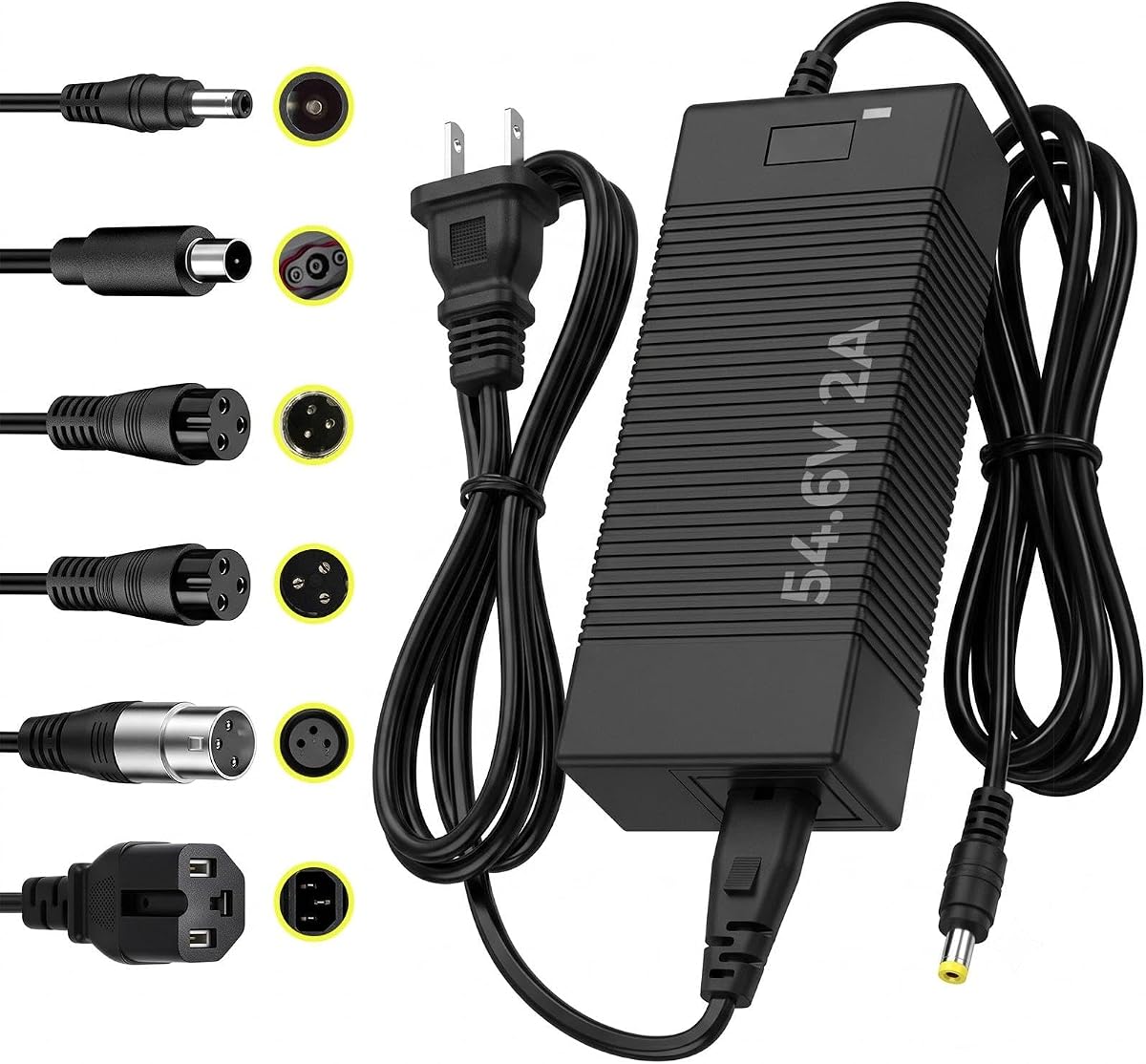

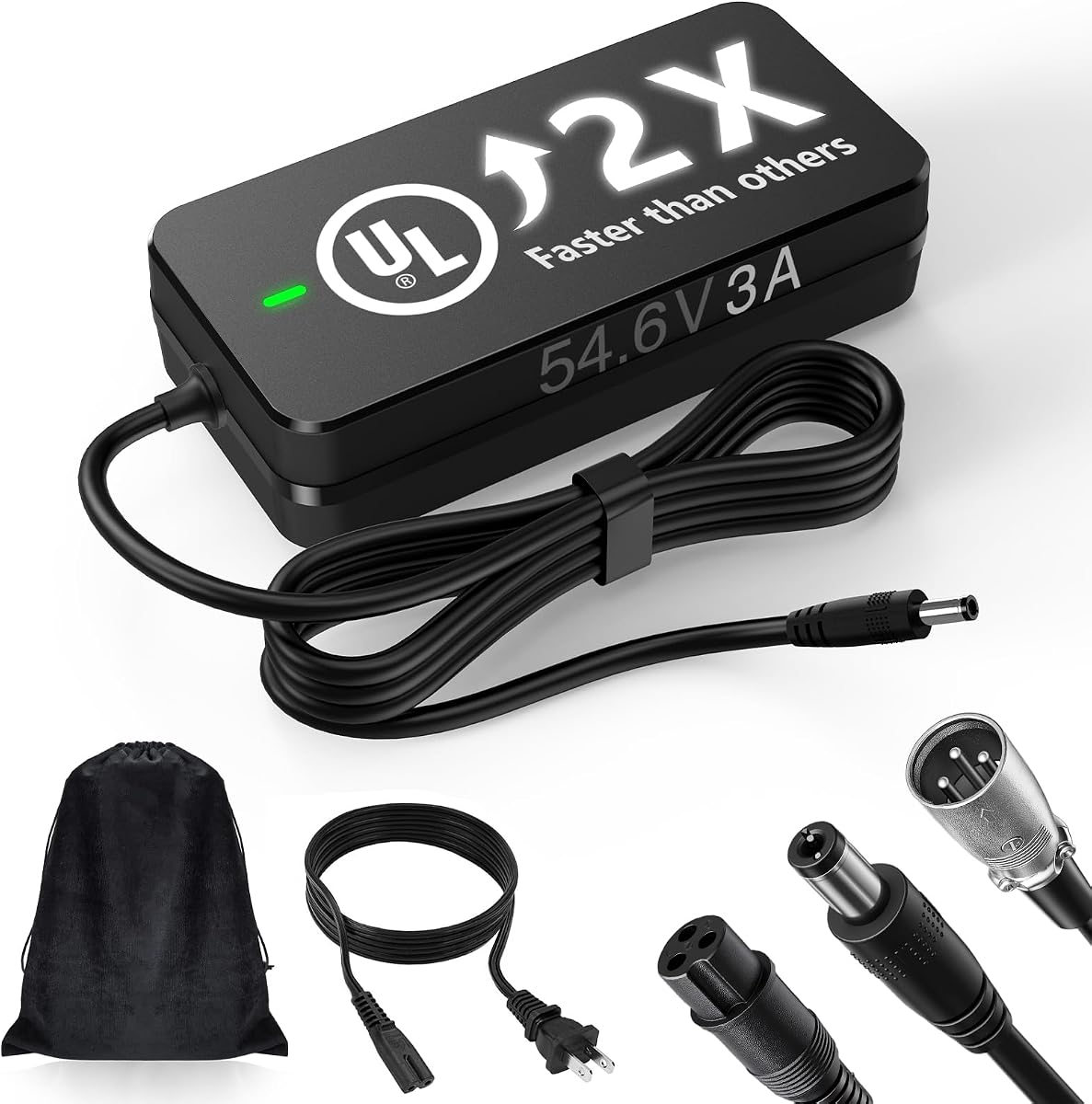

The EVAPLUS 54.6V Safe Charger is a straightforward replacement for compatible 48V lithium e-bike batteries, carrying a supplied rating of 4.4 out of 5. Its defining qualities are a 54.6V output target, UL certification, automatic shutoff at a full charge, and simple red-versus-green LED feedback. It is positioned as an economical option for riders who know their battery uses one of the listed barrel-style ports.
We may earn a commission when you buy through this link, at no additional cost to you.
The charger supports 5.5mm by 2.5mm and 5.5mm by 2.1mm connectors, but the dimensions of the socket alone do not establish full compatibility. Riders should also examine the center-pin arrangement and compare the voltage and current printed on the original charger. The stated 100–240V AC input is convenient for travel and use in regions with different household systems, while protection against overvoltage, overcurrent, and short circuits adds useful safeguards.
Its supplied information says most 48V 13S lithium batteries can charge from empty to full in about four to six hours, although the exact result depends on battery capacity, condition, and the charger's actual output current. The description does not state that current clearly. This omission matters because charging speed and heat are closely related, and riders should compare the replacement label with the specifications of the charger originally supplied with the bike.
This is a sensible pick for a basic, dedicated charging setup when the port matches and the battery is a standard 48V lithium pack. It is less suitable for owners who need multiple connector formats or whose battery uses an unusual aviation, RCA, or XLR-style plug. Confirm the battery chemistry, voltage, connector, and original charger label before purchase; once those details align, the EVAPLUS offers a compact and uncomplicated charging solution.
A red LED shows active charging and a green LED indicates a full charge, reducing uncertainty during long charging sessions. Automatic shutoff helps keep the charger from continuing to deliver power after the battery reaches its programmed endpoint.
UL certification and built-in protection against overvoltage, overcurrent, and short circuits make this charger attractive for regular home use. These features are particularly relevant when the charger will remain connected near a bicycle, wall outlet, or other heat-sensitive material.
We may earn a commission when you buy through this link, at no additional cost to you.
This universal 54.6V 2A charger combines a defined 2A output with a broad collection of charging tips, giving it an immediate advantage for riders who own more than one 48V lithium e-bike or scooter. Its supplied rating is 4.2. The listing specifically calls out compatibility with common Lectric XP 2.0 and 3.0, Ecotric City and Beach, and Evercross H5 and H7 models.
We may earn a commission when you buy through this link, at no additional cost to you.
Connector support includes 5.5mm 2.1mm and 2.5mm DC plugs, a 12mm aviation-style plug, a Cannon connector, and a further universal option described in the product details. A CC/CV operating mode controls current and voltage as the pack approaches full charge, and the charger automatically stops when charging is complete. Protection features include overvoltage, overcurrent, short circuit, over-temperature, reverse connection, and fuse safeguards.
The charger is expressly limited to 48V lithium batteries and is not intended for lead-acid packs. Its 100–240V, 50/60Hz input supports broad household compatibility, although riders traveling across regions with different outlet formats may still need an appropriate plug adapter. Because the product information duplicates its battery-life and safety description, it provides fewer unique details about cooling or charging time than some competing listings.
Choose this model when its five tips cover the ports used by your equipment and a 2A output suits your charging routine. It is a strong candidate for households with different e-bike brands or for a rider who wants one compact charger to carry. As with every replacement, check the voltage, chemistry, connector geometry, and current against the original charger before use.
The broad tip selection is more valuable when a rider regularly charges different 48V e-bikes or scooters. It reduces the inconvenience of carrying multiple dedicated chargers, although physical port shape and polarity still need confirmation.
Overvoltage, overcurrent, short-circuit, over-temperature, reverse-connection, and fuse protections create a comprehensive safety profile. Automatic stopping at full charge adds another layer of control during unattended charging.
We may earn a commission when you buy through this link, at no additional cost to you.
The Hyleton 48V Lithium Battery Charger stands out as the most comprehensively documented option in this guide, with a supplied rating of 4.4. It targets 48V 13S lithium-ion packs and provides a 54.6V 2A output. Its strongest selling points are a 3-in-1 connector system, silent cooling, intelligent temperature control, extensive safety credentials, and a spacious storage bag.
We may earn a commission when you buy through this link, at no additional cost to you.
The connector arrangement combines a 5.5mm by 2.5mm or 2.1mm DC plug with 12mm three-pin and 18mm XLR options. The listing names a wide range of compatible e-bike brands and models, including Ancheer, Jasion, Funhang, TST, Lectric, Rad Power Bikes, Heybike, Himiway, ESKUTE, and several others. That breadth still depends on the rider matching the correct tip and confirming the battery is a 48V lithium-ion pack rather than a 36V, 52V, or LiFePO4 battery.
The product claims that a 2A output charges 30% faster than a standard 54.6V 1.5A charger, while smart temperature control lowers peak temperature and fanless operation keeps charging quiet. It also states that the charger is UL certified and meets TUV, SGS, CE, FCC, and RoHS standards. A V0-rated flame-retardant enclosure, aviation-grade aluminum connectors, high-density cables, and automatic shutoff or trickle charging reinforce the maintenance-focused design.
This is the most balanced choice for a rider who values documentation, quiet operation, and a moderate 2A charging rate without needing every possible connector type. It is also a practical backup because the included bag supports storage. Before buying, send the seller a photo of the original charger label if compatibility is uncertain, and disregard the charger if the battery is 12V LiFePO4, 24V, 36V, 42V, 52V, or any other unsupported chemistry.
The fanless design avoids the noise associated with a cooling fan, while intelligent temperature control is intended to reduce heat during charging. Together, these details make the charger attractive for overnight use in a garage or living space.
The seller offers to check compatibility within 24 hours when given a photo of the original charger label. That support can be valuable, but riders should still independently verify voltage, connector, polarity, and chemistry before connecting any replacement.
We may earn a commission when you buy through this link, at no additional cost to you.
The QKIIP 54.6V 2A charger earns a supplied rating of 4.4 and differentiates itself through seven interchangeable charging tips. It is designed exclusively for 48V 13S lithium-ion batteries and produces a 54.6V 2A output. That combination of broad physical compatibility and clear electrical limitations makes it easy to understand where it belongs in the market.
We may earn a commission when you buy through this link, at no additional cost to you.
The tips cover 5.5mm by 2.1mm and 2.5mm barrel plugs, a 12mm three-prong connector, a 9mm mini three-prong connector, an 8mm RCA plug, a three-pin XLR connector, and a three-prong female universal plug. The listing associates those options with brands including Lectric, Ecotric, Rad Power Bikes, Aventon, Ancheer, Jetson Haze, Evercross, Jasion, Velotric, Ridstar, Yozma, and Ninebot.
A smart CC/CV three-stage process is described as supporting battery health, and the charger includes overvoltage, overload, overcurrent, over-temperature, and short-circuit protection along with a fire-resistant casing. Red and green LEDs provide charging status, while the 100–240V input works in many international locations. The seller also offers to review the bike model and confirm compatibility within 24 hours.
This charger is best for a rider who wants one unit to cover many 48V devices and can identify the correct tip. It is not a universal solution for every battery chemistry: the listing explicitly excludes lead-acid and other voltage systems. Check all three essentials before purchase—the battery must say 48V lithium-ion, the original charger should show 54.6V, and the physical port must match one of the supplied tips.
A seven-tip package is unusually broad for a replacement charger and can serve multiple e-bikes, scooters, and compatible devices. The physical fit must still be checked carefully because similar connector dimensions do not always guarantee matching pin configuration.
The product guidance asks riders to verify battery voltage and chemistry, inspect the original charger output, and match the port to an included tip. Following those checks reduces the chance of buying an incompatible replacement.
We may earn a commission when you buy through this link, at no additional cost to you.
The SGS-certified 54.6V 2A charger has a supplied customer rating of 3.9, the lowest in this comparison, but its specifications remain competitive. It offers a 2A output for 48V 13S lithium-ion batteries, a seven-plug assortment, and protection against common electrical faults. The listing also describes UL testing and aging tests completed before shipment.
We may earn a commission when you buy through this link, at no additional cost to you.
Its connector package includes a 5.5mm by 2.1mm DC plug plus 5.5mm by 2.5mm, 9mm mini three-prong, 12mm standard three-prong, 8mm RCA, three-pin male XLR, and universal IEC plug. This makes it suitable for a broad collection of 48V e-bikes and electric scooters, subject to confirming the battery and socket. The flame-retardant V-0 enclosure and protections for overvoltage, overcurrent, short circuits, and temperature improve its safety profile.
Automatic shutoff and red-while-charging, green-when-complete LEDs make the unit practical for routine use. Its stated 100–240V, 50/60Hz input is suitable for many regions, and the 54.6V 2A output targets efficient charging of 48V 13S packs. However, the listing does not provide a specific charging-time estimate or a detailed sound and thermal-management explanation, leaving less information than the most thoroughly documented options.
This is a reasonable choice for riders whose charging port is covered by the seven tips and who value a recognizable safety-oriented listing. The lower supplied rating should encourage buyers to examine recent customer feedback and the seller's warranty or support terms. It must not be used with 24V, 25V, 29.4V, 36V, 42V, or lead-acid batteries, and it should be reserved for packs that specifically use 48V 13S lithium-ion chemistry.
The flame-retardant enclosure, multiple fault protections, and claimed aging testing support the charger's safety positioning. These attributes are useful for a product expected to handle sustained charging sessions near a bike.
Seven plug formats allow one unit to cover a wider mix of e-bikes and scooters than a fixed-barrel model. Buyers should compare the port shape carefully and retain the original charger label for reference.
We may earn a commission when you buy through this link, at no additional cost to you.
This universal 54.6V 2A charger is a compact replacement option for 48V lithium-ion e-bikes and scooters, with a supplied rating of 4.3. Its five adapter plugs offer a meaningful degree of connector flexibility, and the listing names Rad Power Bikes, Velotric, Heybike, Juiced, and Ecotric among compatible brands. It also provides a straightforward red-and-green status display.
We may earn a commission when you buy through this link, at no additional cost to you.
The electrical output is specified as 54.6V at 2A, making it suitable for the standard 48V lithium battery format addressed by the listing. Safety protections cover overcharging, short circuits, overvoltage, and overcurrent. A solid red LED indicates that charging is in progress, while solid green indicates a full charge. These visible indicators help riders establish when the battery is ready without repeatedly interrupting the process.
Compared with the most detailed listing in the guide, this product provides fewer specifics. It does not enumerate the dimensions or pin layouts of all five adapter plugs, provide a specific charging time, or describe its cooling system in the supplied information. Those omissions do not make the charger unusable, but they make careful comparison with the original charger and inspection of the included tips more important.
This model is best for a rider who recognizes one of the listed brands and ports and prefers a straightforward 2A universal charger. It is also suitable as a travel backup when a single unit must cover several compatible 48V machines. Confirm that the battery is lithium-ion rather than lead-acid or LiFePO4, and verify the connector, polarity, and output current before use.
The two-color LED system removes uncertainty from routine charging. Riders can leave the charger connected and check whether it is actively charging or has reached its automatic endpoint.
Five included adapters can make one charger useful across several popular e-bike and scooter brands. It is especially helpful as a garage or travel backup, provided every device uses a compatible 48V lithium battery.
We may earn a commission when you buy through this link, at no additional cost to you.
The Six-in-One 54.6V 2A charger has a supplied rating of 4.4 and a title suggesting a useful universal replacement for 48V lithium e-bike and scooter batteries. However, the supplied product information contains a major inconsistency: the descriptive bullets describe a dedicated 12.8V four-cell LiFePO4 charger with 14.6V output, 20A current, Anderson connectors, M8 terminals, cooling fans, and applications involving RVs and trolling motors.
We may earn a commission when you buy through this link, at no additional cost to you.
Those description details directly conflict with the title's claimed 54.6V 2A e-bike charging specification. A genuine 48V 13S lithium-ion charger should use a suitable 54.6V charging profile, whereas the detailed bullets describe a completely different battery chemistry and application. The listing therefore cannot be recommended for purchase without direct confirmation from the seller of the exact output label, connector arrangement, and battery type contained in the package.
If the physical product is in fact the 54.6V 2A charger advertised in the title, it could offer six plug formats for several 48V devices. The title and supplied rating suggest potential value, but neither resolves the conflicting technical description. The claimed 20A charging current would be inappropriate for many smaller packs and batteries, making it especially important not to infer safe compatibility from the product headline alone.
This entry should be treated as a verify-before-order selection rather than a confident recommendation. Ask the seller for photographs of the output label, the included connector tips, and the packaging, and confirm that the unit is intended for 48V 13S lithium-ion e-bike batteries rather than 12V LiFePO4 systems. If that confirmation cannot be obtained, choose another clearly documented charger instead.
A 14.6V LiFePO4 charger and a 54.6V lithium-ion charger serve different battery systems. Using the wrong one can cause failure to charge, unstable operation, or battery damage, so the discrepancy is not a minor copy-editing issue.
Request clear photographs of the charger's output label, connector set, and model markings. Also ask the seller to confirm in writing that the item supports a 48V 13S lithium-ion e-bike battery and that its output is 54.6V 2A.
We may earn a commission when you buy through this link, at no additional cost to you.
The Five-Plug 54.6V charger holds the highest supplied rating in the group at 4.6 out of 5. It offers a 54.6V 2A output for 13S 48V lithium-ion packs, five interchangeable plugs, and a portable housing intended for home, travel, or backup use. Its low-noise design and heat-dissipation structure distinguish it from basic fixed-cord replacements.
We may earn a commission when you buy through this link, at no additional cost to you.
The product is presented as compatible with electric bicycles, scooters, one-wheel devices, and Rad Power Bike models. Multiple protections against overvoltage, overcurrent, short circuits, and overheating are included, while stable DC output is intended to support battery health. The shell is described as durable, resistant to drops and wear, and easy to store. LED charging information is not specified in the supplied details, however, so users should not assume a particular light behavior.
Unlike some alternatives, this listing does not enumerate the dimensions of its five plug formats or provide a certified charging-speed claim beyond the 2A output. It also omits a specific full-charge time and detailed temperature-control behavior. Those points reduce the depth of the technical description, but the central electrical target is easy to understand: it is intended for a 48V 13S lithium battery rather than another voltage class.
This charger is a compelling option for a rider who wants a compact multi-plug unit and values a lightweight backup. It may also appeal to owners of several device types that use the same 48V lithium format. Before ordering, verify the battery label, compare the original charger output, and examine all five tips against the required socket. The listing's strong feedback and portability features make it worth a closer review, provided electrical compatibility is confirmed.
The lightweight, compact enclosure is designed for easy storage and portability. That makes the charger practical as a secondary unit for riders who need a backup away from a fixed charging location.
Overvoltage, overcurrent, short-circuit, and overheating safeguards address common charging faults. A low-noise cooling structure and heat-dissipation design complement those protections during sustained use.
We may earn a commission when you buy through this link, at no additional cost to you.
The Hyleton 54.6V 3A charger is the premium-speed selection in this guide, with a supplied rating of 4.3. It provides a 54.6V 3A output for 48V lithium-ion e-bike batteries and is claimed to charge a 48V 15Ah pack fully in about five hours. The product is aimed at riders who want faster replenishment than a 1.5A or 2A charger can provide.
We may earn a commission when you buy through this link, at no additional cost to you.
Its three-in-1 connector system combines the common 5.5mm by 2.5mm or 2.1mm DC plug with 12mm three-pin and 18mm XLR adapters. The listing names TST, ESKUTE, Lectric, Ecotric, Ancheer, Jasion, Funhang, and many other brands as supported. It specifically lists several Lectric XP variants and Ecotric Seagull, Tornado, and Bison models, but riders should verify the battery type and connector rather than relying only on a brand name.
UL certification is accompanied by claimed compliance with TUV, CE, FCC, and RoHS. The V0 fire-resistant enclosure and protections for overvoltage, overcurrent, short circuits, and over-temperature form a substantial safety package. Intelligent temperature control is intended to reduce heat stress, and the charger automatically shuts off or changes to trickle charging when the battery reaches full capacity. Red and green LEDs make the operating state visible.
This is the top choice when a healthy 48V lithium pack is compatible with 3A charging and shorter downtime is a priority. It is not the right choice for an old, damaged, or unusually sensitive pack, and the listing warns that a battery unused for more than 12 months may not activate. It is also expressly unsuitable for LiFePO4 and other voltage systems. Confirm the original charger output and seek seller guidance if any part of the battery history is uncertain.
The 3A output distinguishes this model from the more common 2A alternatives and can reduce waiting when the battery supports that current. A 48V 15Ah battery is specifically described as reaching full charge in about five hours.
UL certification, a V0 flame-resistant case, four named protection circuits, and intelligent temperature control support safe charging. Automatic shutoff or trickle charging further reduces the risk of continued overcharging.
We may earn a commission when you buy through this link, at no additional cost to you.
The ETL-Certified 54.6V 2A charger combines a seven-plug package with a stated 2A output, giving it a supplied rating of 4.4. It is designed for 48V 13S lithium-ion batteries used in e-bikes, scooters, and hoverboards. The listing names Razor, Gotrax, Xiaomi, Jetson, and Ninebot as examples of compatible brands.
We may earn a commission when you buy through this link, at no additional cost to you.
The interchangeable plug assortment includes 5.5mm by 2.1mm and 2.5mm barrel connectors, 9mm and 12mm three-prong plugs, an 8mm RCA plug, a three-pin XLR, and an IEC connector. That range supports a varied collection of devices while the 100–240V, 50/60Hz input makes the unit usable with many household power systems. The product is not intended for 24V, 25V, 36V, 42V, or lead-acid batteries.
ETL certification provides a third-party safety credential alongside protections against overvoltage, overcurrent, short circuits, and excessive temperature. Aviation-aluminum plugs and high-density wiring are designed to resist corrosion and wear. Intelligent temperature control is intended to maintain stable charging, while red and green indicator lights show charging and full-charge states. The product also says the charger maintains the battery automatically after connection.
This is an attractive garage or travel backup for owners of several compatible 48V devices. Its seven tips and 2A rate offer useful versatility without moving to the higher current of the 3A premium model. Before using it, verify the battery chemistry, output voltage, connector geometry, and polarity, and never rely on a broad brand list as a substitute for checking the actual charging port.
ETL certification complements protection against overvoltage, overcurrent, short circuits, and temperature faults. These safeguards make the charger suitable for routine charging in a home, office, or garage when the battery is compatible.
Seven connector formats allow a single charger to cover several e-bikes, scooters, and hoverboards. The aluminum plug construction and high-density wires are also intended to withstand corrosion, oxidation, and regular handling.
We may earn a commission when you buy through this link, at no additional cost to you.
Choosing a replacement charger starts with the battery and charging port rather than the product headline. Voltage, chemistry, current, connector geometry, and protection features must all align before convenience or charging speed becomes relevant.
Most e-bike batteries described as 48V use a 13S lithium-ion arrangement charged at 54.6V, but the nominal label alone does not guarantee that a charger is appropriate. Some listings explicitly exclude LiFePO4, lead-acid, 36V, 42V, 52V, and other systems. Read the label on the battery and compare it with the charger output. If the original charger says 54.6V for a 48V lithium-ion pack, a replacement with matching output and appropriate chemistry is the usual starting point. Never assume that a charger advertised for another voltage class is merely a faster alternative.
Battery voltage and chemistry should match the charger exactly.
The most common options include 5.5mm by 2.1mm and 5.5mm by 2.5mm barrel plugs, along with 12mm aviation-style connectors, 9mm three-prong plugs, RCA-style plugs, and XLR connectors. Diameter alone may not be enough because center pins, keying, and pin arrangements can differ. Compare the replacement tip with the original charger, confirm any polarity marking, and check whether the port is recessed. A universal charger with several tips is convenient, but the included tip still has to fit mechanically and electrically.
Match both connector shape and electrical configuration.
A 2A charger is a common middle ground, while 3A models can shorten charging time for compatible batteries. Higher current is not automatically better: it creates more heat and may be unsuitable for an aged, damaged, or unusually sensitive pack. Compare the replacement rating with the original charger and follow the battery manufacturer's guidance. The supplied claims estimate about four to six hours for some batteries with one charger, five hours for a 48V 15Ah pack with the 3A model, and no fixed estimate for several others.
Choose current according to the battery and original charger.
UL, ETL, and SGS-related certifications provide evidence that a charger has been evaluated against recognized safety standards, although the precise meaning of each listing should be checked on the current product page. Built-in protection for overvoltage, overcurrent, short circuits, and overheating is also important. A V0 flame-retardant enclosure and automatic shutoff or trickle charging improve protection during extended sessions. Certification does not make an electrically mismatched charger suitable, so it should complement rather than replace compatibility checks.
Prioritize certified protection alongside correct specifications.
A constant-current and constant-voltage profile, sometimes called CC/CV, is a common method for bringing a lithium-ion pack through its charge stages. Automatic shutoff at full charge prevents continued charging, while trickle charging can top off a pack near completion. Some chargers also use tail-current cutoff or microchip-controlled transitions. These controls should be matched to the battery type, and the charging indicators should make it easy to tell whether the charger is actively working or has finished.
Look for controlled charging and a clear full-charge signal.
Charging creates heat, and a poorly managed charger can become noisy or run hot. The Hyleton 2A model emphasizes fanless silent operation with smart temperature control, while the 3A version includes intelligent temperature control as well. Other listings mention flame-resistant cases, low-noise design, or heat dissipation without providing detailed measurements. Place any charger on a stable, nonflammable surface with ventilation and never cover it while operating. Temperature management is especially important when a charger remains connected for many hours.
Expect heat to rise and leave the charger ventilated.
A lightweight, compact charger is useful for travel, rentals, apartments, and garages where outlet access is inconsistent. The Five-Plug model specifically highlights portability and a durable, drop-resistant shell, while the Hyleton 2A product includes a spacious velvet storage bag. A cable and housing that pack neatly are more valuable than extra accessories that will never be used. Consider whether you will carry one universal charger or leave a dedicated unit beside each bike.
Choose a size and tip set that suit your storage plan.
A photograph of the original charger label can reveal the required voltage, current, connector, and battery type more clearly than a brand or model name alone. Several listings offer compatibility confirmation when a rider supplies that photo or states the e-bike model. Seller assistance is useful, but it should supplement your own inspection. If the listing contains contradictory specifications, request output-label photographs and written confirmation of the exact battery chemistry supported before ordering.
Verify ambiguous listings before connecting the charger.
Before first use, compare the battery label with the charger's output label. Confirm that the battery is the specified 48V lithium-ion chemistry, locate the correct connector, check polarity and physical keying, and inspect the cord, plug, and charger body for visible damage. If the charging port, voltage, chemistry, or connector does not match, do not force the connection or improvise with an altered cable.
Connect the charger to the bike before plugging it into the wall when the supplied instructions call for that order. Keep the charger on a stable, hard, ventilated surface away from bedding, paper, fuel, and other combustible materials. Do not cover it with a blanket or leave it in direct sunlight. Observe the indicator lights, unplug the charger promptly if the plug, cable, battery, or charger becomes unusually hot, smells different, shows physical damage, or behaves abnormally.
For care, coil the cable without creating sharp bends near the plugs and store the charger in a dry location away from moisture, dirt, and heavy impact. Keep replacement tips organized so a connector is not inserted incorrectly by force. Check the charger and battery area before every charging session, follow the battery maker's guidance, and retire the charger if its output label, casing, cord, or protection behavior appears compromised.
Most standard 48V 13S lithium-ion e-bike batteries use a 54.6V charger, which is the output offered by nearly every relevant model in this guide. The battery's label and original charger should confirm that arrangement. A 48V nominal label does not make every chemistry or voltage configuration compatible, so check the battery type as well.
A 3A charger can charge a compatible healthy battery faster because it supplies more current, but it also produces more heat. Some batteries are designed for higher current while others should follow a lower rating. Compare the new charger with the original charger and follow the battery manufacturer's guidance, especially for older or damaged packs.
No. A 36V battery generally requires a charger designed for its voltage and chemistry, and using a 54.6V charger could cause serious damage or create a safety hazard. The products described in this guide repeatedly exclude unsupported voltage classes. Always confirm the battery label rather than estimating from the bike model.
No. Although 5.5mm by 2.1mm and 5.5mm by 2.5mm barrel plugs are common, center-pin size, polarity, and internal pin configuration may differ. Compare the replacement with the original connector and check any markings before use. Do not force a plug that does not fit smoothly.
On the products that specify LED behavior, green generally indicates a full charge or standby, while red indicates active charging. The Hyleton 3A model also describes automatic shutoff or a switch to trickle current. Always follow the specific charger's instructions because indicator behavior can vary between models.
No. Certification indicates that a product has been evaluated against applicable safety standards, but it does not make it electrically compatible with an unrelated battery. You must still match voltage, chemistry, connector, polarity, and appropriate current. Certification and compatibility are separate requirements.
It can if every device uses a compatible 48V lithium-ion battery and the correct connector is included. Models with seven tips cover more port styles than fixed-plug units, while the three-tip options are more compact. Check each battery label and charging socket separately; a shared 48V rating does not guarantee shared chemistry or connector design.
A long-unused lithium-ion battery may be deeply discharged, damaged, or unable to accept a charge normally. Some listings in this guide warn that a charger may not activate for such packs. Inspect the battery, follow its manufacturer's recovery guidance, and seek professional diagnosis rather than repeatedly connecting and disconnecting a charger.
The EVAPLUS 54.6V Safe Charger is the straightforward budget selection for a compatible barrel-port battery, while the Hyleton 54.6V 2A charger is the best-rounded option for riders who value detailed safety information, silent temperature-controlled charging, multiple tips, and a storage bag. The Hyleton 54.6V 3A charger is the premium choice for healthy batteries that support higher current and require faster replenishment.
Compatibility should always come before speed. Verify that the battery is 48V lithium-ion, confirm the required 54.6V output, match the connector and polarity, and consider the original charger's current. Riders with several devices should favor the QKIIP, SGS-certified, or ETL-certified models with seven tips, while those needing a compact backup may prefer the five-plug or six-in-one listing only after resolving the latter's contradictory description.
Customer ratings and certifications offer useful signals, but they cannot replace checking the physical battery and charger labels. Prices, availability, product details, and customer feedback can change, so review the current listing before purchasing. Once the electrical and physical specifications align, select the charger that provides the needed connectors, safe charging controls, and an appropriate charging rate for the battery.
