
Deeper START Fish Finder
4.1Editor score
Smartphone-compatible sonar display
Casting and depth reach 165 feet
Automatic Wi-Fi scan saving
Six-hour battery life
Explore the best castable wireless fish and depth finders, comparing sonar range, displays, portability, battery life, and standout features for anglers.
Castable wireless fish finders give shore anglers, kayakers, and small-boat fishermen a cable-free way to explore deeper water, locate structure, and identify fish holding at different depths. A useful model should combine dependable sonar, a readable screen, dependable wireless range, and enough battery life for a full outing.
The products in this guide were compared using their stated depth capability, sonar beam angle, wireless transmission range, display technology, power system, portability, and special features such as GPS mapping, fish alarms, temperature readings, and attractive lamps. The list includes standalone units, smartphone-connected sonar, and kayaking-oriented systems.
Each review explains where the finder stands out, where its specifications require compromise, and which fishing situations it suits best. Ratings and product details reflect the supplied listings at the time of research, while prices can change frequently, so readers should confirm current availability and cost before purchasing.
4.1Editor score

4.5Editor score

4.4Editor score
The comparison below highlights the major differences in sonar reach, wireless range, display format, power, and mapping features, making it easier to match a finder to your preferred fishing platform.


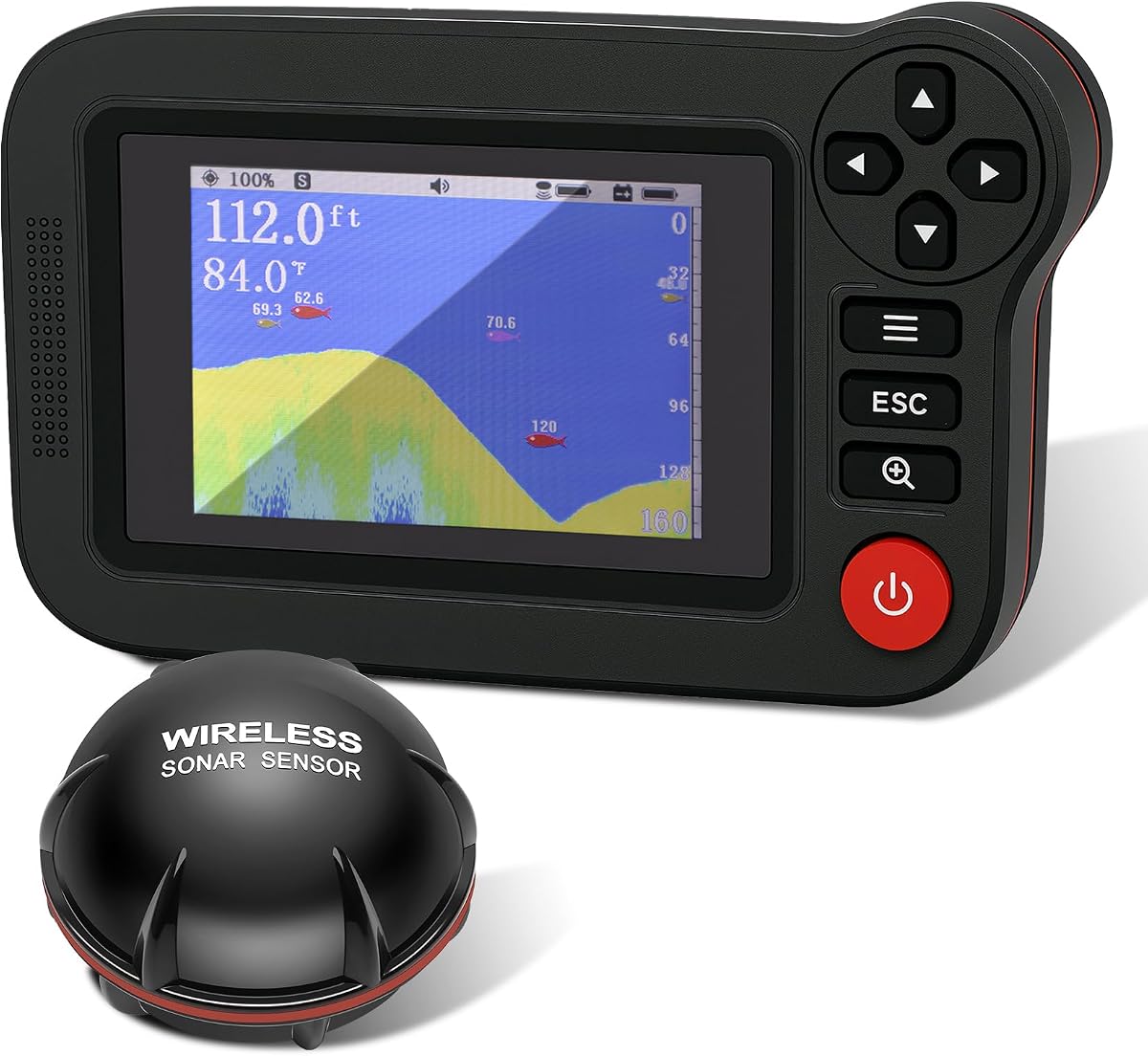


The Venterior Portable Fish Finder is a conventional handheld sonar system with a floating, castable sensor and a 4.3 rating. Its strongest quality is versatility: it supplies its own display, communicates wirelessly at distances up to 262 feet or 80 meters, and works in lakes, rivers, seas, ice, kayaks, boats, and from shore.
We may earn a commission when you buy through this link, at no additional cost to you.
The sensor detects depth, temperature, fish size, fish depth, and bottom contour, giving it a useful combination of fish-location and habitat information. A 105-degree beam covers a broad area, while its depth range extends from 2.6 to 164 feet. The display offers black and white backgrounds, a practical choice for switching between nighttime visibility and easier reading in bright sunlight.
There are some trade-offs. Its 80-meter wireless range is shorter than the advertised operating distances offered by several other products in the guide, and the sensor must enter the water before its displayed battery status becomes reliable. Those limitations may matter for anglers repeatedly casting far from shore, but they do not undermine its usefulness for normal kayak, boat, and shoreline searches.
This is a strong choice for an angler who prefers a self-contained unit and does not want to manage a phone application. It is particularly suitable for beginners because the display presents fish size, depth, and contour information without requiring advanced controls. For anglers who need extended wireless reach or downloadable maps, one of the app-based models may be a better fit.
Combining depth, temperature, fish size, fish depth, and bottom contour gives the Venterior a broad information set for its size. The display can also show a live view of the bottom, helping anglers identify changes in terrain before deciding where to fish.
The tether holes allow the sensor to be secured with fishing line and cast ahead of the angler. Because the probe floats and transmits wirelessly, it avoids the permanently mounted transducers and long cables required by many fixed boat systems.
We may earn a commission when you buy through this link, at no additional cost to you.
The Deeper PRO+ 2 Sonar is a 4.2-rated, smartphone-connected system aimed at anglers who want more than basic depth readings. Its defining feature is built-in GPS, which allows bathymetric maps to be created from shore, a dock, or a bank and saved in the Fish Deeper app for later reference.
We may earn a commission when you buy through this link, at no additional cost to you.
Wide, mid, and narrow sonar beams let anglers balance coverage against detail. The product data specifies accuracy to 330 feet, target separation of 0.4 inches with the narrow beam, and one inch with the wide and mid beams. Those figures make it particularly useful for vertical jigging, tracking a lure, and separating small targets around structure.
The main drawback is its dependence on a compatible smartphone and the associated app. That makes it less convenient for anglers who prefer a self-contained handheld screen or need a simple device with few controls. Connectivity and app behavior also become part of the overall experience, even though the sonar operates over its own dependable Wi-Fi connection.
For anglers willing to use mobile software, the PRO+ 2 is among the most capable choices here. Its combination of GPS, mapping, and selectable precision beams is especially valuable for repeatable trips to offshore structure, unfamiliar shoreline areas, and deeper water where subtle changes in bottom shape matter.
Built-in GPS makes each scan geographically useful rather than simply displaying an isolated depth number. Saved maps help anglers compare trips, revisit promising contours, and understand how a familiar lake or coastal area changes beyond the shoreline.
The narrow beam is intended for detailed target separation, while the mid and wide beams cover more water quickly. Switching among them gives anglers a practical way to balance speed, coverage, and precision during a trip.
We may earn a commission when you buy through this link, at no additional cost to you.
The LUCKY MT-202 carries the highest rating in the supplied data at 4.5, and its standout specification is an advertised 853-foot operating distance. That reach gives it exceptional flexibility for shore casting, trolling alongside structure, or deploying the sensor from a kayak or boat into water the angler cannot reach directly.
We may earn a commission when you buy through this link, at no additional cost to you.
Its 3.5-inch horizontal LCD presents fish icons with corresponding depth numbers, while the display scrolls from right to left to preserve a history of targets and structure. A 90-degree sonar beam scans a meaningful area, and the stated depth range of 3 to 147 feet covers a useful mixture of shallow and deeper fishing environments.
The MT-202 does not provide the GPS mapping and multi-beam selection of the Deeper PRO+ 2. It is a more focused standalone instrument, which simplifies operation but also means anglers cannot save geographic contours in a dedicated app. As with any advertised wireless maximum, real-world transmission can be affected by obstacles, water conditions, and interference.
For someone seeking an unusually long connection between a castable probe and a readable handheld screen, the MT-202 is a compelling option. Its portable construction, rechargeable components, and broad operating distance also make it a natural fit for anglers moving among shore, kayak, boat, canoe, pontoon, and ice-fishing locations.
The advertised operating distance allows the sensor to be sent well ahead of the boat or far out from shore. That creates opportunities to investigate deeper channels, weed edges, submerged timber, and other areas that cannot be reached with a short line.
The horizontal screen and scrolling history help an angler interpret movement rather than seeing isolated signals that disappear. Fish depth numbers are placed beside recognizable icons, reducing the mental work required to understand the display while fishing.
We may earn a commission when you buy through this link, at no additional cost to you.
This Portable Castable Fish Finder for Kayak is a 4.2-rated, all-in-one sonar package designed around portability and flexible placement. It detects depth, water temperature, fish size, fish depth, and bottom contour, while a 105-degree beam and range of 2.6 to 164 feet provide a solid balance of coverage and depth.
We may earn a commission when you buy through this link, at no additional cost to you.
Its stated transducer-to-screen distance reaches 656 feet or 200 meters, far enough for substantial casting separation. The 3.5-inch TFT LCD offers black, blue, and white backlight modes, making it adaptable to sunlight, shaded water, and low-light conditions. A mounting bracket and lanyard support use from a kayak, boat, or around the neck.
The product does not include GPS mapping, which limits its value for anglers building a repeatable map of a large area. It also specifies 5V or 12V host power and a 5V probe, so users need to ensure the correct charging arrangement. The stated eight-hour working time is useful, though actual duration depends on settings and use.
This finder suits anglers who want more screen information and wireless reach than a basic phone-only model but do not need advanced mapping. It is especially attractive for kayak anglers because the compact probe, included mounting hardware, and broad beam reduce the need for permanent installation.
Three backlight choices offer more flexibility than a single fixed display scheme. An angler can switch to white for strong daylight, black for detailed viewing, or blue for a different contrast in shaded or changing conditions.
Adjustable sensitivity, depth range, and noise filtering allow the unit to be adapted to different water and bottom conditions. These settings are valuable when working over different structures or moving between shallow and deeper zones.
We may earn a commission when you buy through this link, at no additional cost to you.
The Deeper START Fish Finder is a 4.1-rated entry into app-based sonar, intended for recreational anglers fishing from a dock, bank, shore, or kayak. It connects to the free Fish Deeper app on iOS or Android devices and presents information such as fish location, fish size, depth, bottom contour, and vegetation.
We may earn a commission when you buy through this link, at no additional cost to you.
The sonar can be cast 165 feet and detect depths to 165 feet, using a 40-degree beam for targeted coverage. It creates its own Wi-Fi network, so viewing scans does not consume mobile data. Each scan is automatically saved with its time and location, adding a useful level of continuity for later comparison.
Its main limitation is the narrow 40-degree beam, which focuses on a smaller area than the 90- and 105-degree systems in this guide. That can improve precision around a chosen target but is less convenient when rapidly scanning broad water. The absence of a built-in handheld display also makes it less attractive for users who do not want to rely on a phone.
The START is best for budget-conscious anglers who appreciate simple pairing, automatic scan history, and a compact wireless design. Its stated six-hour battery life and 2.5-hour charging time suit casual trips and family outings, while the night-fishing mode adds flexibility after dark.
The Fish Deeper app provides a clear central display without requiring a separate console installation. Pairing and viewing are designed to get an angler fishing quickly, making the product approachable for users who are new to castable sonar.
Recording the time and location of each scan helps anglers revisit productive water and recognize patterns between trips. This feature adds value even when the user is not actively fishing during the recording.
We may earn a commission when you buy through this link, at no additional cost to you.
The DANOPLUS Portable Fish Finder offers a 4.3 rating and a compact 2.4-inch color screen in a 21-language interface. It displays water depth, temperature, fish size, fish depth, bottom contour, and the water surface, making it a capable basic unit for anglers who want more than a bare depth reading.
We may earn a commission when you buy through this link, at no additional cost to you.
Its sensor detects to 147 feet or 45 meters and uses a 90-degree beam. The integrated attractive lamp activates when the sensor touches water, while the fish alarm provides both a visual notice and an audible signal when a fish enters the covered area. These features are especially noticeable during low-light fishing.
The listing does not advertise a long wireless operating distance, which limits its suitability for very long casts compared with several alternatives. It also lacks the GPS and mapping tools of the Deeper PRO+ 2 or Garmin Striker Cast, so it is better suited to immediate sonar readings than building a permanent chart.
Despite those limits, the DANOPLUS is a practical choice for travelers, kayak anglers, and shore fishermen who value a small display, rechargeable sensor, and lamp-assisted target detection. It also supports lake, river, sea, kayak, and ice fishing, giving it broad seasonal appeal.
The sensor lamp provides a visual attraction in the water and makes the sensor easier to locate at night. Combined with the audible and visual fish alarm, it adds a distinct feature set for evening anglers.
Depth, temperature, fish size, fish depth, and bottom contour cover the core information needed for real-time decisions. The absence of mapping makes the unit simpler, though it cannot serve as a full bathymetric recording tool.
We may earn a commission when you buy through this link, at no additional cost to you.
The Garmin Striker Cast is a 4.4-rated castable sonar designed to stream fish information wirelessly to a smartphone or tablet through the free STRIKER Cast app. Its polished mobile workflow, broad device compatibility, and downloadable contour mapping make it a premium choice for anglers comfortable managing their own mobile hardware.
We may earn a commission when you buy through this link, at no additional cost to you.
The sonar streams from as far as 200 feet away and supports traditional two-dimensional and ice-fishing flasher modes. Maps with one-foot contours can be downloaded from the Garmin Quickdraw Community, while the internal USB-rechargeable battery is listed at more than 10 hours, with actual duration varying by use.
Its dependence on a phone or tablet is the central trade-off. There is no dedicated handheld console, and anglers who leave their phone behind lose the primary display. The app-based approach can also be less convenient than a self-contained unit when hands are wet, storage is limited, or battery management is already a concern.
For anglers who already use their phone as a fishing dashboard, the Striker Cast is an excellent fit. Its automatic water-based power behavior, simple setup, broad shallow-to-deep performance, and map-download options deliver a well-rounded package for shore, kayak, boat, and ice fishing.
Using the STRIKER Cast app allows fish and sonar information to appear on a larger familiar screen without installing a dedicated console. Apple and Android compatibility broadens the pool of devices that can serve as a display.
One-foot contour downloads from the Garmin Quickdraw Community add meaningful context to live sonar. Knowing the shape of the bottom can help anglers relate fish signals to ledges, channels, drop-offs, and other features.
We may earn a commission when you buy through this link, at no additional cost to you.
The LUCKY Portable Fish Finder is a 4.1-rated standalone unit that combines a 2.4-inch TFT color display with a wireless sonar sensor. It reports underwater contour, depth, temperature, and fish size with depth, while wireless and simulation modes provide both real use and a way to explore the controls before fishing.
We may earn a commission when you buy through this link, at no additional cost to you.
The sensor supports an advertised 492-foot or 150-meter operating distance and detects depth to 147 feet or 45 meters. The probe includes a fish-attractive lamp under a transparent cover, making it easier to see in darkness. Settings include sensitivity, brightness, depth range, zoom, depth alarm, fish alarm, fish icons, unit conversion, and language selection.
The handheld unit runs for four hours on a full charge, while the sensor is listed at ten hours. That difference matters on long outings because the display may need recharging before the probe does. The unit also lacks GPS and downloadable maps, making it a real-time tool rather than a mapping system.
This finder is a good match for anglers who want extensive standalone controls, a long connection range, and a lamp-equipped sensor. It is equally suitable for shore, river, sea, kayak, ice, and nighttime fishing, provided the user accounts for the handheld's shorter operating duration.
Sensitivity, depth range, noise-related controls, zoom, and alarms allow the display to be tailored to the situation. This level of adjustment is valuable for anglers who understand sonar and want more control over interpretation.
A transparent replacement cover makes the illuminated sensor visible in low-light conditions. That visibility can help with retrieval while also confirming where the probe is positioned relative to the angler.
We may earn a commission when you buy through this link, at no additional cost to you.
This Portable Castable Fish Finder is a 4.2-rated standalone sonar with a strong balance of range, display size, and battery life. It detects water depth, temperature, fish size, fish depth, and bottom contour, making it useful for locating both fish and the structure around which they gather.
We may earn a commission when you buy through this link, at no additional cost to you.
The wireless probe can operate up to 500 feet or 152 meters from the screen, while its 105-degree beam spans a broad search area. The 3.5-inch TFT LCD includes black, blue, and white backlight modes. It also provides fish and depth alarms, adjustable sensitivity, depth range, and noise filtering for adaptation to different fishing conditions.
A stated eight-hour operating time follows a two-hour charge, and both the unit and probe provide low-battery alerts. The lack of GPS, contour downloads, and multi-beam selection narrows its appeal for advanced mapping users, but its core functions are broad and clearly presented.
This is a practical selection for kayak, shore, saltwater, and ice fishing. The included bracket and lanyard improve positioning on a deck or around the neck, and the 105-degree beam reduces the need to cast repeatedly when searching for fish in unfamiliar water.
The compact arrangement avoids long cables and awkward permanent installations. A bracket keeps the display visible on a kayak or boat, while the lanyard offers a hands-free carrying option near the water.
Low-battery alerts on the display and sensor help prevent an unexpected loss of information. The eight-hour stated runtime and two-hour charging process make the system reasonably suited to full-day use.
We may earn a commission when you buy through this link, at no additional cost to you.
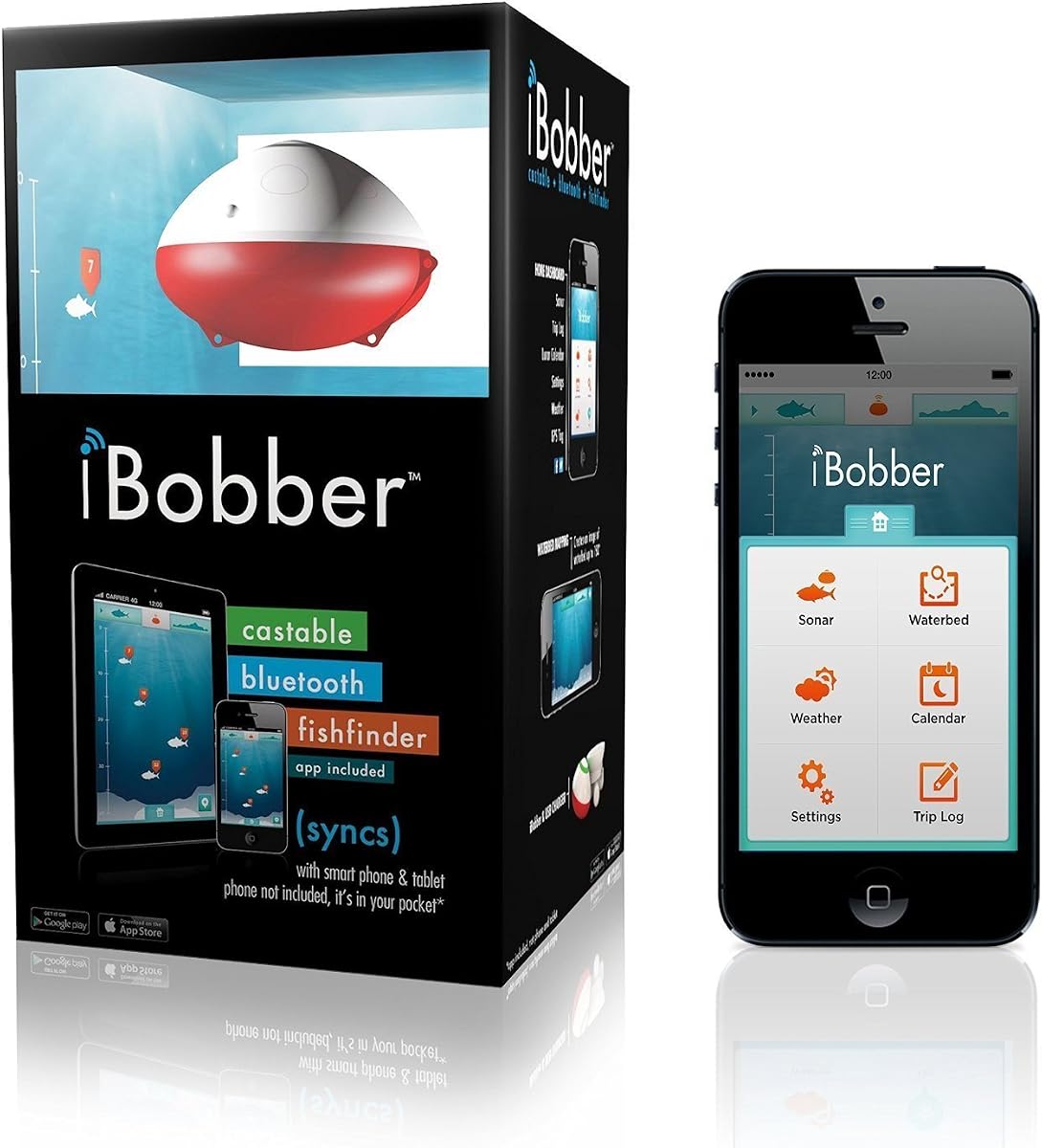
The Reelsonar iBobber is a 4-rated Bluetooth fish finder for anglers who want depth, fish location, and fish-size information on a phone or compatible watch. Its 135-foot depth range covers a useful range of freshwater and saltwater fishing environments, and its battery is listed at more than 10 hours.
We may earn a commission when you buy through this link, at no additional cost to you.
Sonar signals are translated into depth-tagged fish icons with color coding for size, making the display easier to interpret at a glance. Fish alarms can draw attention to fish under docks and piers, while a strike-alert function may notify the user when fish are biting.
The lower rating in the group suggests that some users may have found the overall experience less compelling than that of the higher-rated alternatives. The listing also does not highlight a long wireless operating distance, built-in GPS, or downloadable contour maps, so its advantages center on convenience rather than advanced sonar tools.
The iBobber is best for a mobile-focused angler who appreciates wearable notifications and Bluetooth simplicity. It can support shore fishing and ice fishing without requiring a fixed transducer, but buyers who need broad scanning coverage or detailed mapping should give closer consideration to the LUCKY, Deeper, and Garmin options.
Compatibility with both iOS and Android apps, plus watch application support, gives anglers more ways to receive information. Notifications may reduce the need to hold or repeatedly check a phone.
Fish alarms and strike alerts are useful when an angler is focused on the line rather than the display. They can also help locate activity beneath docks and piers where fish gather in concentrated groups.
We may earn a commission when you buy through this link, at no additional cost to you.
The right castable fish finder depends on how you fish, how far you cast, what water you cover, and whether you prefer a dedicated display or phone-based sonar. Compare these factors carefully before choosing.
Wireless range determines how far the sensor can travel from the display or mobile device. The products in this guide range from models suited to nearby casting to systems advertising more than 800 feet of operating distance. Longer reach is useful when searching deep channels, weed beds, or structure that cannot be reached from shore, although actual performance can vary with terrain, interference, and water conditions.
Depth capability should match the type of water you expect to fish. Several units reach 45 meters, while others provide 50-meter depth ranges. Deeper models are more valuable on reservoirs, deep lakes, and coastal water, whereas shallow units may be sufficient for ponds, marshes, and inshore fishing. A broader range also makes a device more adaptable when moving between locations.
Beam angle affects the area scanned beneath the sensor. A 105-degree beam provides broad coverage and can locate fish more quickly when exploring unfamiliar water. A 90-degree beam still offers a generous search area, while a 40-degree beam concentrates energy on a narrower target. Narrower coverage can help with precision, but it requires more deliberate casting.
Standalone units provide a dedicated screen without requiring a phone, making them straightforward and dependable at the water. Smartphone-based products often offer richer software, automatic scan storage, wearable alerts, or downloadable maps, but they depend on device compatibility and app setup. Think about whether you want immediate readings or a longer-term digital record.
A readable display is essential because the most sophisticated sonar information is of little value if it cannot be interpreted outdoors. Screen size, color, horizontal or vertical layout, backlight options, and daylight contrast all matter. Models with multiple backgrounds can adapt to bright sun, shade, and darkness, while icons and scrolling histories can make fish depth and movement easier to understand.
Consider both the sensor and display because their runtimes may differ. Some systems list more than 10 hours, while others provide approximately eight hours or a shorter handheld duration. Recharge time, USB charging, low-battery alerts, and the availability of a power adapter also influence practical use. For all-day fishing, select a system with enough runtime for the longest expected outing.
GPS and bathymetric mapping turn individual sonar scans into a persistent record of the bottom. They are particularly helpful when revisiting offshore structure, locating channels, or comparing trips. Products without mapping can still provide excellent real-time information, but they cannot build the same geographic history or support the same level of route and contour analysis.
Castable sonar is popular because it avoids permanent installation, but size still affects comfort and accessibility. A pocketable sensor and compact handheld suit travel and spontaneous trips, while a larger horizontal screen may be easier to interpret. Kayak and shore anglers should consider included brackets, lanyards, line attachment holes, and whether the display can be secured securely.
Begin by fully charging both the display and sonar sensor, then install the compatible application for an app-based model or power on the standalone unit. Pair the mobile device if required, confirm that the sensor is recognized, and familiarize yourself with depth range, sensitivity, brightness, unit, and alarm settings. Running simulation mode before the trip, when available, provides a safe way to learn the display and recognize how fish icons and bottom contours appear.
Attach the sensor securely using its tether hole, safety line, or fishing line, then cast it to a promising area while maintaining enough separation for a reliable wireless connection. Watch the screen as the sensor settles, note the depth and bottom shape, and cast around structure rather than repeatedly dropping into the same location. On app-based models, save each scan and rename or organize it while the time and location information is still available.
After fishing, bring the sensor aboard before rinsing it with fresh water, especially after use in salt water. Inspect the charging contacts and cable for moisture or debris, dry the unit completely, and store both components away from prolonged direct sun. Recharge before storing for an extended period, and check the manufacturer instructions for battery, firmware, and firmware-app compatibility. The sensor should not be left in a vehicle where heat or freezing conditions could shorten battery life.
No. Standalone products such as the Venterior, LUCKY, DANOPLUS, and several generic portable units include a dedicated handheld display. App-based options such as the Deeper START, Deeper PRO+ 2, Garmin Striker Cast, and Reelsonar iBobber require a compatible phone, tablet, or watch for viewing sonar information.
Yes. Casting the sensor from the bank lets anglers investigate water that is too deep, obstructed, or distant to reach with ordinary tackle. Wireless range, line strength, retrieval speed, and the ability to recognize the sensor in waves or darkness should all be considered before making a long cast.
Depth range describes how far below the surface the sonar can measure. Wireless operating range describes how far the sensor can communicate with the display or mobile device. A device may have excellent depth capability while still offering limited separation between the probe and screen.
No. A wide beam covers more water and can help an angler find fish faster. A narrower beam concentrates coverage on a smaller area and may be preferable when inspecting specific structure, tracking a lure, or working through a known productive zone.
Several models in this guide are explicitly suitable for ice fishing. Because the cable-free sensor is lowered through an ice hole, it can be positioned beneath the surface without permanently mounting a transducer. Low-temperature operation, charging in cold weather, and screen visibility should still be checked before an extended outing.
Kayak anglers should prioritize a light, compact system, secure mounting options, and enough wireless range for useful casting separation. The LUCKY MT-202 and kayak-focused portable units are strong candidates, while phone-based models offer more mapping but require protection for the mobile device.
Several listings identify sea or saltwater fishing as a supported application. As with any electronic device exposed to the elements, the sensor should be rinsed with fresh water afterward and allowed to dry before charging or storage.
It is important because the display and sensor may have different runtimes. Compare the stated duration of each component, recharge time, and low-battery behavior. Bringing a portable charging option can also provide useful flexibility during long or multi-session trips.
The LUCKY MT-202 stands out for its long operating distance, readable horizontal screen, and high customer rating. The Deeper START offers an approachable smartphone-based experience with automatic scan history, while the Garmin Striker Cast delivers a more polished mobile workflow, long battery life, and downloadable contour maps for anglers who want detailed context.
Prioritize wireless range when casting far, depth capability when fishing deep water, and a clear display when reading fish depth quickly. Standalone units are convenient and dependable at the water, while app-connected models are stronger for mapping, scan history, and mobile alerts. The right choice depends more on fishing method and software needs than on any single specification.
Before purchasing, check the current listing for the latest specifications, compatibility details, included accessories, warranty information, and present cost. Product features and prices can change, so confirming the current offer helps ensure the selected finder still matches your fishing platform, water conditions, and preferred display method.