
OOSSXX 845nm IR Illuminator
4.5Editor score
Up to 100-foot night range
Broad 100-degree illumination
IP66 weatherproof housing
Automatic dusk-to-dawn operation
Compare 10 IR Illuminators for Security Cameras by range, coverage, weather resistance, automatic switching, installation, and camera compatibility in this
IR illuminators for security cameras provide the invisible or near-invisible infrared light that helps night-vision cameras identify people, vehicles, animals, and other subjects in dark or poorly lit areas. A capable unit can extend useful image detail, reduce grain, and improve detection reliability without requiring bright visible lighting.
The products in this guide are compared using their stated LED output, effective range, beam angle, wavelength, housing, weather resistance, power arrangement, mounting hardware, and automatic day-night controls. The list includes compact units, mid-range models, long-range floodlights, wide-angle options, and higher-output choices for demanding outdoor installations.
Each review explains where the illuminator is most useful, what makes it different, and which trade-offs deserve consideration. The top picks highlight strong all-around value, flexible installation, and extended coverage. Product ratings and availability can change, and current prices should be checked before making a final purchase.
4.5Editor score

4.2Editor score

4.4Editor score
The table below summarizes the core differences among all ten illuminators, including their output, stated reach, optical design, weather protection, power options, and mounting characteristics.


The AI4 is a compact 850nm infrared illuminator designed to improve night visibility for suitable CCTV cameras without adding conspicuous visible light. It carries a 4.4 rating and uses four one-watt LEDs to deliver a stated effective range of up to 80 feet. Its 90-degree spread makes it more useful for close and medium coverage than for the longest possible property-wide reach.
We may earn a commission when you buy through this link, at no additional cost to you.
A major strength is the integrated IR band-pass filter, which is designed to reduce hot spots and help prevent nearby objects from becoming overexposed. The photocell provides automatic day-and-night switching, while the compact black-coated housing is rated IP65 for outdoor use. The package includes a 12VDC 0.5A adapter, screws, and a manual, making the unit relatively approachable for a first installation.
The main limitation is output. Four LEDs may not deliver consistently detailed footage across a long driveway, large yard, or distant entrance when a camera has a narrow field of view. Its stated lens compatibility is also narrower than the flexibility associated with higher-powered units. Buyers should not mistake its 80-foot claim for guaranteed identification performance at that distance in every environment.
This is a good option for a porch, side entrance, compact driveway, or small outdoor area where a low-profile light is preferred over maximum reach. It is also attractive for users who want an automatic, low-maintenance upgrade. For larger properties or distant subjects, a higher-output model is the safer choice, but the AI4 remains a focused and practical illuminator for closer coverage.
The 850nm infrared output is intended to be invisible to the unaided eye while remaining detectable by a compatible night-vision camera. The band-pass filter helps produce a more even image, especially when the light and camera are aligned carefully.
The built-in CdS photocell turns the illuminator on in darkness and off in daylight, reducing the need for manual control. Its IP65 rating also makes it suitable for exposed locations where occasional rain and weather are concerns.
We may earn a commission when you buy through this link, at no additional cost to you.
The Tendelux DI20B is a long-range 20-watt IR illuminator that stands out for combining substantial output with a housing half the size of the company's 18-watt model. It holds a 4.2 rating and is intended for users who need more reach than a small four- or eight-LED light can provide without moving to a large floodlight.
We may earn a commission when you buy through this link, at no additional cost to you.
Its tailored integrated lens is designed to spread infrared light more evenly across the camera's field of view, reducing the bright center and dark edges associated with poor auxiliary lighting. The 360-degree swivel and 90-degree tilt bracket make alignment considerably more flexible, while the aluminum housing offers better resistance to sun aging than typical plastic brackets.
The unibody enclosure also serves as an effective cooling system, helping support stable operation. One consideration is that the included power supply converts 110-240V AC to 24V DC rather than offering the 12V arrangement found on many competing products. That can be advantageous for avoiding brightness loss over long extension cables, but it may not match an existing low-voltage wiring arrangement.
The DI20B is best suited to driveways, gates, parking areas, and medium-to-large yards where long-range infrared energy matters more than the broadest possible field of view. It is a particularly strong recommendation for installers who value compact construction, even illumination, and precise mounting. It is the Editor's Choice in this guide because it combines those practical features without becoming excessively large.
The custom lens works with the LED arrangement to direct light through the intended viewing area. This design is particularly helpful when a security camera has a moderate field of view and the installer wants to avoid the harsh hotspot found with an unfocused infrared lamp.
Both horizontal swivel and vertical tilt are supported by the mounting bracket. The one-piece aluminum construction combines a modern appearance with a cooling function, while the tighter housing is easier to position close to a camera than a bulky rectangular floodlight.
We may earn a commission when you buy through this link, at no additional cost to you.
The JCHENG 20-LED illuminator is a high-output option for users who need extensive infrared coverage around a security camera. It has a 4.4 rating, a stated effective range of 150 to 240 feet, and a wide 90-degree field. Those characteristics position it as a premium choice for large yards, driveways, farms, warehouses, and other areas where darkness extends well beyond the camera body.
We may earn a commission when you buy through this link, at no additional cost to you.
Twenty high-power EPISTAR LEDs are combined with a constant-current, constant-voltage drive circuit and convection heat dissipation. A secondary optical angle is designed to improve reach and coverage. The result is a fixture designed not simply to overpower nearby objects but to provide more useful light throughout a larger surveillance area.
Its die-cast aluminum body, black rubber filling, thickened waterproof ring, and IP66 rating provide a substantial outdoor package. The included 12V 2A adapter, 180-degree bracket, and automatic photosensitive control simplify installation. The stated night-on threshold is 15 lux or less, the day-off threshold is above 30 lux, and a 15-second delay helps prevent rapid switching.
This is the best premium option for buyers who prioritize maximum useful coverage and can accommodate a larger unit. It can support better subject visibility, reduce grain, and improve the performance of AI motion detection when used with a compatible camera. Ensure that the camera recognizes 850nm infrared light, position the light to match the camera's field, and verify the included adapter can supply the required current.
The claimed 150-to-240-foot effective range exceeds that of most compact options in this guide. Actual performance varies with camera sensitivity, lens focal length, reflective surfaces, atmospheric conditions, and how closely the illuminator is aligned with the camera.
Air-convection heat dissipation and the dedicated drive circuit are intended to support efficient, continuous infrared output. Automatic light sensing reduces daily intervention, while the 15-second delay helps avoid flickering caused by brief changes in ambient light.
We may earn a commission when you buy through this link, at no additional cost to you.
The BI8 provides a middle ground between compact four-LED fixtures and higher-output 20-LED floodlights. It has a 4.3 rating, eight one-watt 850nm LEDs, and a stated night-vision range of up to 120 feet. Its 90-degree flood spread is appropriate for broad camera views and medium-sized outdoor spaces.
We may earn a commission when you buy through this link, at no additional cost to you.
The anti-UV infrared pass filter is intended to reduce hot spots and prevent foreground objects from being washed out. That is a valuable feature when the illuminator sits near a wall, gate, or parked vehicle. A built-in CdS photocell handles automatic day-night switching, and the supplied U-bracket allows rotational adjustment during setup.
Its IP66 rating supports indoor and outdoor use, while the included 12VDC 1A adapter makes it a relatively simple installation for someone with basic wiring experience. The eight-LED arrangement still lacks the output of the larger models in this list, so very distant subjects may remain less detailed even when a camera has a generous low-light specification.
The BI8 is a solid choice for a medium driveway, backyard, loading entrance, or parking area where 120 feet is a useful target. It works especially well with the stated 2.8mm, 3.6mm, and 4mm camera lenses. For users needing extreme reach or the broadest flood pattern, one of the 20-LED options is more appropriate.
The anti-UV pass filter helps limit excess infrared in the center of the beam. This can make nearby walls, doors, and vehicles less likely to appear unnaturally bright when the light is properly positioned.
The rotatable U-bracket allows the unit to be mounted on a wall, pole, or other suitable surface and then aimed toward the camera's viewing area. Automatic photocell switching further reduces the need for separate timers.
We may earn a commission when you buy through this link, at no additional cost to you.
The DI10 is designed for medium-range applications and combines a compact body with ten watts of infrared output. It has a 4.0 rating and is a sensible option for installations that need more punch than a small four-LED illuminator but do not require the reach of a 20-watt model.
We may earn a commission when you buy through this link, at no additional cost to you.
The tailored integrated lens is designed to spread illumination evenly across the camera's field of view, limiting the harsh center hotspot and dark perimeter that can occur with a basic floodlight. The housing uses premium aluminum, while the bracket provides 360-degree swivel and 90-degree tilt for accurate positioning around the camera.
A particularly useful detail is the updated 110-240V AC to 24V DC 1A adapter. The manufacturer says this arrangement was adopted to avoid pressure drop and loss of brightness after using a long extension cable. It does, however, make the DI10 less convenient for installations already designed around 12V DC accessories.
This illuminator suits entrances, mid-sized driveways, courtyards, and garden areas where a medium light spread is desired. It is a good fit for users who value a small, adjustable housing and a higher-voltage power path. The slightly lower rating compared with several alternatives should be considered alongside the benefits of the updated power design and compact construction.
The DI10 is half the size of the listed BI8 model according to the product information, yet it is designed to provide greater illumination for medium-range use. Its smaller format makes it easier to position beside a camera without creating a visually dominant fixture.
Horizontal swivel and vertical tilt allow the installer to match the infrared beam with the camera's angle. The aluminum bracket is also described as resistant to rapid aging under sunlight compared with plastic alternatives.
We may earn a commission when you buy through this link, at no additional cost to you.
The Univivi eight-LED illuminator is a rugged 850nm floodlight designed for compatible night-vision cameras. It carries a 4.1 rating and focuses on a 90-degree wide-angle pattern rather than making a maximum-distance claim. That makes it most useful when the goal is broad, uniform illumination across a camera's entire field of view.
We may earn a commission when you buy through this link, at no additional cost to you.
Its construction includes EPISTAR LED light sources, a heavy-duty aluminum housing, thick heat sink, reinforced glass window, and stainless steel screws. Together with the IP67 waterproof rating, these features create a housing well suited to exposed outdoor locations. The built-in photocell automatically activates the light at dusk and deactivates it at dawn.
The package includes a 12V 1A adapter, installation screws, and a manual. Infrared itself is invisible to the unaided eye, although the product description notes that a red glow may be visible from the LEDs. Users must confirm that their camera includes an 850nm-compatible night-vision mode before installation.
The Univivi is a good fit for yards, porches, garages, and building approaches where a wide flood pattern and durable housing matter more than a specified maximum distance. Installation should place the light beside the camera and point both toward the same subject. Its strong materials and automatic operation make it especially useful for users who want minimal maintenance.
The IP67 rating and reinforced components provide a durable option for outdoor use. Its aluminum body and thick heat sink are well suited to dissipating heat from the eight LED emitters during extended nighttime operation.
The 90-degree pattern is a sensible match for wide-angle surveillance cameras. Rather than concentrating output in a narrow beam, it aims to reduce light spots and cover more of the scene at the same time.
We may earn a commission when you buy through this link, at no additional cost to you.
The six-LED CCTV illuminator offers a straightforward way to improve a compatible night-vision camera. It has a 4.0 rating and relies on a built-in light sensor to turn the infrared illumination on at night and off during the day. Automatic operation makes it a convenient option for users who do not want to manage a timer or manual switch.
We may earn a commission when you buy through this link, at no additional cost to you.
The product uses a metal shell and tempered glass window to provide rainproof protection for indoor and outdoor installations. Its six high-power LEDs are intended to improve the camera's performance in darkness, while the compact enclosure allows the light to be mounted conveniently near a CCTV unit.
The specification is less detailed than that of many competing models. It does not provide a stated maximum effective range, beam angle, wavelength, or exact ingress-protection rating. As a result, buyers seeking precise long-distance performance may find the higher-output products easier to compare. Compatibility with the camera remains more important than any other specification.
This unit is best for relatively simple upgrades around a door, garage, hallway, porch, or small outdoor camera position. It is also a useful option for installers who prioritize automatic switching and a compact body. For large properties or long driveways, choose a product with published range and optical specifications that can be matched to the camera.
The integrated sensor removes the need for a separate timer and helps the light follow changes between daylight and darkness. This makes the unit convenient for continuously operating surveillance installations.
The small housing can be positioned close to the camera without taking up much room. A metal shell and tempered glass provide a practical level of rain protection for both sheltered interior and exposed exterior locations.
We may earn a commission when you buy through this link, at no additional cost to you.
The white Univivi 20-LED unit combines higher infrared output with a broad 90-degree flood pattern. It has a 4.4 rating and is built for compatible 850nm security cameras. Compared with the eight-LED version, it is better suited to larger outdoor areas and cameras that need more infrared energy across a wider scene.
We may earn a commission when you buy through this link, at no additional cost to you.
Its thick aluminum housing and large heat sink are designed to dissipate heat and support a longer service life. The manufacturer states that the surface temperature remains below 120 degrees Fahrenheit during continuous 24-hour operation. The IP67 waterproof enclosure, reinforced glass, and stainless steel screws further suit outdoor use in wet conditions.
The photocell automatically switches the light on at dusk and off at dawn, eliminating daily manual control. A 12V 2A adapter, mounting screws, and a user manual are included. Installation guidance recommends placing the sensor head downward to reduce exposure to direct sunlight, and the camera must be compatible with 850nm infrared light.
The unit is a strong choice for driveways, yards, warehouses, and large entrances where wide coverage and substantial output are both important. It offers a compelling alternative to the similarly capable JCHENG model, although its housing has a different appearance and construction. Buyers should compare physical dimensions and mounting requirements before choosing between high-output fixtures.
A large heat sink and thick aluminum enclosure help remove heat from the LED array. The stated temperature performance is particularly relevant for users who intend to operate the illuminator continuously throughout the night.
The 90-degree beam and twenty LEDs are designed to reduce hot spots while illuminating a wide camera view. This combination suits general-purpose CCTV cameras covering open yards, access roads, or working areas.
We may earn a commission when you buy through this link, at no additional cost to you.
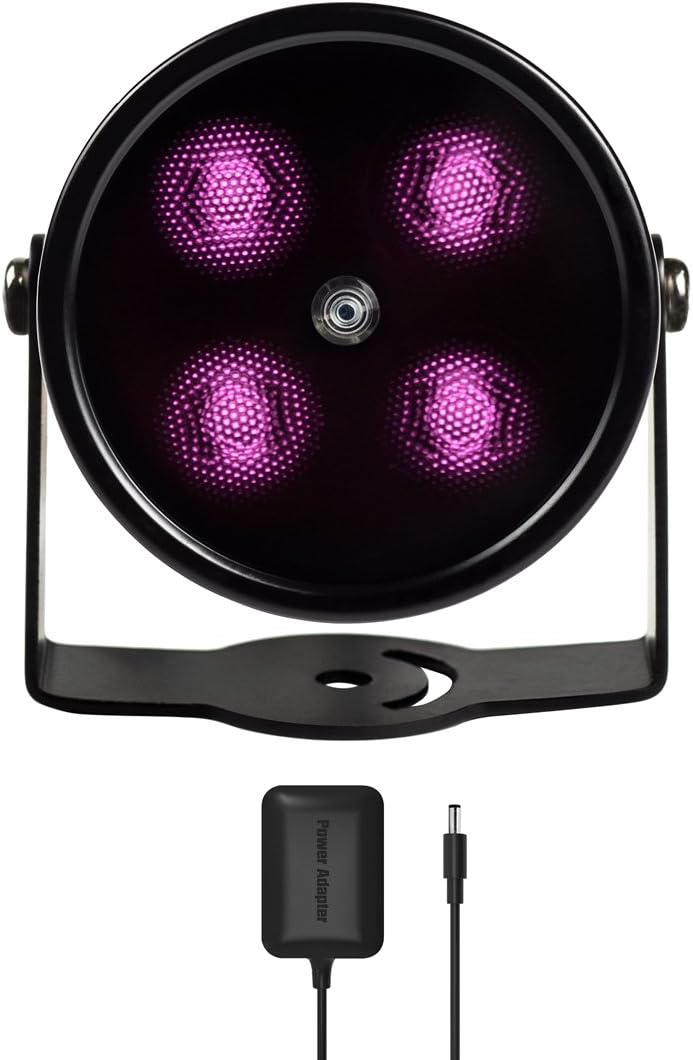
The OOSSXX 2026 Upgrade is a broad-coverage 845nm illuminator for security cameras. It has the highest listed rating in this guide at 4.5 and combines a claimed range of up to 100 feet with an unusually wide 100-degree illumination pattern. Those figures make it especially attractive for cameras that cover a broad scene but do not need extreme long-range output.
We may earn a commission when you buy through this link, at no additional cost to you.
The wide angle is intended to reach dark corners and improve full-area surveillance rather than concentrating the beam in one narrow zone. An integrated photocell turns the light on at dusk and off at dawn, while the aluminum alloy body provides heat dissipation and the IP66 housing is designed to withstand rain, snow, dust, and other outdoor conditions.
A 12V 1A power adapter is included for straightforward setup. The most important compatibility check is the camera's infrared response. Although 845nm is commonly used for surveillance illumination, a camera must be designed to detect that wavelength for the additional light to improve its image. The model is also less powerful than the 20-watt and 96-LED alternatives.
The OOSSXX is the Best Budget selection for users who want broad, automatic illumination without moving to a premium long-range unit. It works well for driveways, yards, garages, and warehouses where a 100-degree field and 100-foot potential range are useful. Its rating, low-profile feature set, and weather resistance make it a particularly well-rounded entry-level choice.
The 100-degree pattern covers more of the scene than the common 90-degree designs in this roundup. That wider spread can reduce unlit edges when the fixture is correctly aligned with a broad security-camera view.
The IP66 aluminum alloy housing is designed for exposed outdoor use, and the photocell handles day-night operation automatically. A 12V 1A adapter also keeps the power arrangement familiar for many camera installations.
We may earn a commission when you buy through this link, at no additional cost to you.
The DMetric 96-LED unit is built for long-range infrared coverage and has the most ambitious stated reach in the group. Its title identifies a range of 80 meters, or 263 feet, alongside a 60-degree wide angle. It carries a 3.9 rating, making it the lowest-rated product here, but its specifications target large properties and distant surveillance points.
We may earn a commission when you buy through this link, at no additional cost to you.
A high-quality aluminum case and reinforced glass structure create an IP65 housing for indoor and outdoor use. The built-in CDS sensor switches the light on when available light falls below 10 lux and off when it rises above 10 lux. Its 850nm output is described as invisible to the naked eye apart from a possible red glow.
The included U-shaped bracket allows direct attachment to a rod or mounting surface using its holes. Compared with 90- and 100-degree products, the 60-degree pattern concentrates more light into a narrower area. That can be advantageous for a long driveway or distant gate, but it may not cover a broad yard as effectively.
The DMetric makes sense for users with genuinely long monitoring distances and a camera capable of resolving infrared detail at that range. It is less attractive for small properties, tight spaces, or installations seeking a discreet, lightweight fixture. Carefully test camera sensitivity and align the beam before committing to this high-output configuration.
The 263-foot stated range is the strongest in this comparison, but real identification performance depends on the camera's sensor, lens, infrared filtering, and ambient conditions. A long-range fixture cannot compensate for an unsuitable camera.
The U-shaped mounting bracket can be fixed directly to a wall, pole, or other surface. Automatic switching at the 10-lux threshold reduces the need for external controls and allows the lamp to follow the day-night cycle.
We may earn a commission when you buy through this link, at no additional cost to you.
Choosing an auxiliary IR illuminator requires balancing camera sensitivity, scene size, optical angle, electrical requirements, and outdoor durability. The most important starting point is confirming that the camera can detect the illuminator's wavelength.
An illuminator only helps when the security camera can detect its infrared wavelength. Most products in this guide use 850nm light, while the OOSSXX model uses 845nm. These wavelengths are similar and are commonly used for surveillance, but compatibility should still be confirmed with the camera manufacturer or seller before purchase. A camera may switch off its own infrared LEDs when it detects external IR illumination, so the two systems need to work together rather than compete.
In short, verify wavelength support first. An incompatible illuminator may appear to operate normally while producing no improvement in the recorded image.
Range claims provide a useful starting point, but they are not guarantees of recognizable detail. A camera with a narrow lens may show a small number of pixels across a distant subject, and reflective walls, vegetation, fog, rain, or direct sunlight can reduce practical reach. Compact four-LED models are best for close coverage, while the larger JCHENG and DMetric options are intended for substantially greater distances.
In short, estimate the farthest subject you need to identify and choose a unit with sensible reach beyond that point. Verify performance with footage from the actual camera rather than relying on illumination distance alone.
Beam angle determines how broadly light is distributed. A 60-degree pattern concentrates infrared energy and can support longer distance, while 90- and 100-degree patterns cover more of a wide camera scene. The best match is the camera's own field of view. A narrow illuminator aimed at a wide-angle camera can leave dark corners, while an overly broad light can waste energy outside the image.
In short, use a similar angle for the illuminator and camera. Angle the lamp from beside the lens so infrared reaches the scene without shining directly into the camera.
LED count and wattage provide clues about available infrared energy, but lens design and thermal management determine how that energy reaches the scene. A tailored or secondary optical lens can improve uniformity and reduce hot spots. Large heat sinks and aluminum housings are especially relevant for higher-output units expected to operate all night. Even illumination is generally more useful than an intense central spot surrounded by darkness.
In short, prioritize controlled distribution rather than raw brightness alone. Choose a model with a filter, tailored lens, or secondary optical design when nearby objects could otherwise become overexposed.
Power systems differ across the list. Several products include a 12V DC adapter, while the DI20B and DI10 use 110-240V AC to 24V DC adapters. The latter approach is described as helping avoid voltage drop and brightness loss over long extension cables. Existing camera wiring, available outlets, extension length, and the required current should all be checked before installation.
In short, match the illuminator to the site's electrical arrangement. For a long run, use the appropriate voltage, conductor size, and connection method specified in the product instructions.
An outdoor illuminator should have an appropriate ingress-protection rating and a housing suited to rain, dust, sun, and temperature changes. The featured products include IP65, IP66, and IP67 claims, with the Univivi models reaching IP67. A higher rating does not make every installation completely sealed, so cable entries, mounting surfaces, and exposed connectors also need consideration.
In short, choose a weather rating that suits the exposure level. Even with a rugged enclosure, position the unit away from direct dripping water and follow local electrical guidance.
The bracket should allow the light to be placed beside the camera and aimed into the same scene. Swivel and tilt adjustments are helpful because wall poles, eaves, and camera angles rarely align perfectly. Aluminum housings and substantial heat sinks are favorable for high-output products because they help remove heat and support consistent operation.
In short, prioritize a bracket with enough range of motion. Leave space around the housing for cooling and avoid placing the unit where direct sunlight can unnecessarily heat the sensor.
Nearly every model in the roundup includes a photocell or light sensor that activates infrared after dark and turns it off in daylight. This saves energy, extends component life, and removes a manual task. Thresholds and delay settings vary, so very dark conditions or rapidly changing light may require testing. Some products also recommend shielding the sensor if unwanted switching occurs.
In short, automatic switching is a standard convenience worth having. Confirm the sensor's behavior at the installation site and protect it from direct sunlight when possible.
Begin by mounting the camera in its final position, then place the illuminator beside it rather than directly above or in front of the lens. Aim both devices toward the same subject. This placement allows the camera to see the illuminated area without receiving a strong reflection from the illuminator's face, which can create a bright center or wash out nearby objects.
Connect the correct power supply, observe the stated voltage and current requirements, and route cables away from moving parts, standing water, and sharp edges. Turn on the camera's day-and-night mode and test the scene at night. Adjust the bracket in small increments, then compare footage with and without external infrared illumination to confirm that detail improves without new glare, snow-like artifacts, or severe overexposure.
For ongoing care, keep the glass clean and ensure that the photocell is not blocked. Check mounting screws periodically, particularly after severe weather. Do not open a sealed housing unless the manufacturer provides instructions. If the light remains on during daylight, clean or shield the sensor; if the camera image changes unexpectedly, verify wavelength compatibility and make sure the camera's built-in IR filter is behaving correctly.
An IR illuminator adds infrared light to a scene so a compatible night-vision camera can capture clearer detail in darkness. The light can reduce grain, improve subject contrast, and help systems identify movement or recognize people and vehicles more reliably. It supplements the camera rather than replacing it, and results depend on sensor quality, lens choice, and correct alignment.
They are closely related and many modern surveillance cameras can detect both, but compatibility should always be confirmed. A camera's night-vision sensor and IR-cut filter must be designed to respond to the selected wavelength. The listed 850nm products are intended for typical CCTV use, while the OOSSXX uses 845nm and should be paired only with a compatible model.
Infrared light itself is not visible to the unaided eye, although some illuminators can show a faint red glow from their LEDs or reflections around the housing. Cameras and certain animal species may detect the light differently. A red glow does not necessarily mean the unit is malfunctioning, provided the camera produces the expected night image.
The illuminator may be shining directly into the camera lens, or its light may be reflecting from a nearby wall, ceiling, window, or object. Move the unit beside the camera and aim it into the scene rather than at the lens. Adjusting the angle, cleaning the glass, and reducing reflective surfaces can also improve the result.
There is no universal distance, but side-by-side placement generally reduces glare and reflection. The exact spacing depends on the camera lens, fixture beam, scene depth, and mounting surfaces. Start close enough to keep both units aimed toward the same target, then widen the separation if the infrared beam does not overlap the camera's field of view.
They can work through ordinary glass, but reflective or double-glazed surfaces may produce strong infrared reflections that make the image uneven. The camera should also avoid picking up reflections from other nearby glass. For clearer results, outdoor cameras are generally best placed under an eave or other cover with a clear view of the illuminated area.
A built-in infrared LED often handles close and moderate distances, but its output can be limited by brightness, angle, and camera design. A separate illuminator can add reach, reduce grain, and improve performance for a distant driveway, gate, or wide yard. It is most useful when the existing camera's night footage lacks detail rather than when the camera cannot see infrared at all.
Keep the front window clean, avoid foliage or debris that blocks the light, and check that the photocell is exposed to ambient light. Periodically inspect the bracket and cable connections for looseness or water intrusion. If output declines, first clean the glass and test the power supply before assuming the LED array has failed.
The OOSSXX 845nm model is the most practical budget-oriented recommendation, combining a 4.5 rating, broad 100-degree coverage, automatic switching, and IP66 protection. The DI20B stands out for compact high output, even tailored illumination, and precise bracket adjustment, while the JCHENG 20-LED unit is the strongest premium option for long-range, wide-area coverage.
Prioritize compatibility before output. Confirm that the camera detects the required wavelength, then match the illuminator's reach and beam angle to the scene. Compact units suit close coverage, 90- and 100-degree models cover broad views, and concentrated 60-degree output makes more sense for distant targets. Weather resistance, power requirements, and mounting flexibility should also be included in the decision.
Ratings, product configurations, and current prices can change, so review the latest listing details before ordering. Check the included adapter, warranty, physical dimensions, and camera-specific guidance. With the right match between infrared capability and surveillance distance, an auxiliary illuminator can materially improve night-time image quality and make outdoor security coverage more dependable.