
Stryker SRA10
4.7Editor score
Compact mirror-mount configuration
Ten-thousand-watt power capability
Waterproof IPX8 illuminated housing
A CB Beam Antenna can materially improve the reach and signal consistency of a 27 MHz radio setup, but the best choice depends on whether you need concentrated directional coverage, an omnidirectional base station signal, or a mobile installation. Important considerations include gain, radiation pattern, power handling, bandwidth, mounting requirements, and the available space around your radio equipment.
This guide compares ten antennas listed for CB or 10-meter use using the specifications and ratings supplied for each model. It covers true Yagi beam antennas, vertical base-station antennas, fiberglass designs, magnetic mobile mounts, and a mirror-mount model, helping readers distinguish directional performance from broad 360-degree coverage and portable convenience.
Each review explains the most relevant specifications, practical advantages, limitations, and likely installation scenarios. The top picks highlight a strong overall beam antenna, a capable budget directional option, and a versatile higher-end base antenna. Product ratings and availability can change, and current prices should always be checked before purchasing.
4.7Editor score

4.6Editor score

4.1Editor score
As an Amazon Associate we earn from qualifying purchases.
The comparison below places all ten antennas side by side, highlighting their antenna types, frequency coverage, gain, power handling, and installation approach so readers can quickly narrow the field.




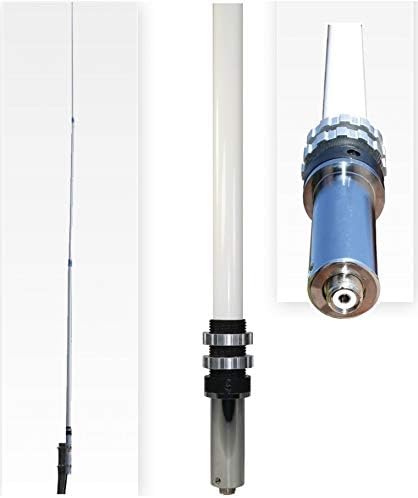


The Sirio SY 27-4 is a four-element, base-station Yagi designed for the 26.5–30 MHz CB and 10-meter range. Its supplied rating is 4.6 out of 5, and the antenna’s combination of directional gain, high power handling, and a broad tuning range makes it a compelling overall choice for a fixed location. The listed gain is 11 dBd, or 13.15 dBi, giving it a stronger directional performance figure than most of the omnidirectional antennas in this guide.
We may earn a commission when you buy through this link, at no additional cost to you.
Its four-element layout is intended to concentrate energy toward a selected direction rather than radiate equally in every direction. The antenna is factory tuned at mid-band and offers a tunable 26.5–30 MHz operating range. Power handling reaches 1000 watts continuous in CW mode and 3000 watts CW PEP, making the specifications suitable for users who want room above a basic low-power installation. The UHF-female SO-239 connector also gives installers a familiar connection point for appropriate coax.
Construction details reinforce the premium nature of this model. The elements use aluminum alloy 6063 T-832, while waterproof jointing sleeves protect the element connections. Approximate dimensions are 5846 by 4030 by 100 millimeters, and weight is listed at approximately 6100 grams. Those dimensions make the SY 27-4 a substantial fixed-site antenna rather than something intended for a small rooftop or temporary portable arrangement.
This is the strongest recommendation for a CB operator who has a clear transmission objective, adequate mounting space, and a stable mast. For example, a station aimed toward a distant group of operators or a favored direction along a ridge may gain substantially from focused radiation. Those wanting simple 360-degree coverage or a removable vehicle antenna should instead examine the vertical base or mobile products. For a high-gain directional installation, the SY 27-4 offers the most balanced set of relevant specifications.
The four-element Yagi configuration concentrates its listed 11 dBd gain into a directional pattern. That makes the antenna especially appropriate for fixed stations serving a defined area rather than listeners spread evenly in every direction.
Continuous 1000-watt CW capacity, protected element joints, and an aluminum alloy boom suit a permanent installation. Proper mounting and weather sealing remain important because the long boom creates meaningful wind load.
We may earn a commission when you buy through this link, at no additional cost to you.
The Sirio SY 27-3 is a three-element Yagi for CB and 10-meter operation from 26.5 to 30 MHz. It carries a supplied rating of 4.3 out of 5 and stands out as a practical directional option for fixed operators who want a simpler boom than the four-element SY 27-4. Its stated gain is 8.5 dBd, equivalent to 10.65 dBi, which remains useful for reaching stations in a selected direction.
We may earn a commission when you buy through this link, at no additional cost to you.
This antenna shares several qualities with Sirio’s larger beam designs: horizontal polarization, a factory-tuned mid-band configuration, and high power handling. Maximum input is specified at 1000 watts CW continuously and 3000 watts CW for short-term use. The UHF-female connection supports a conventional coax installation, while the three-element layout reduces the physical complexity compared with a four-element array.
The main tradeoff is performance and scale rather than basic functionality. The listed 8.5 dBd gain is lower than the 11 dBd rating of the SY 27-4, so users seeking the greatest concentration of energy should favor the four-element model. The SY 27-3 may nevertheless be easier to accommodate where boom length is constrained, provided its complete dimensions can be checked before purchase.
This model makes sense for a home station, club installation, or fixed operator with a clearly defined target direction. It is not a mobile antenna and does not provide omnidirectional coverage. Buyers who value straightforward directional performance, high power capacity, and a relatively modest Yagi design will find it a sensible alternative to the larger four-element beam.
Three driven elements deliver the advertised 8.5 dBd gain without the larger boom of the four-element SY 27-4. That can make installation planning easier for operators who need directionality more than maximum gain.
A listed continuous rating of 1000 watts CW gives the antenna considerable capacity. The shorter-term 3000-watt figure should be understood as a PEP allowance rather than a reason to operate continuously beyond its normal rating.
We may earn a commission when you buy through this link, at no additional cost to you.
This Sirio SY 27-3 package combines a three-element CB Yagi with 100 feet of Taurus RG8X Mini8 coaxial cable and PL 259 connectors. Its supplied rating is 4.1 out of 5. The defining advantage is convenience: a buyer selecting a fixed directional antenna does not need to determine whether a suitable 100-foot run of appropriate coax is already available.
We may earn a commission when you buy through this link, at no additional cost to you.
The antenna itself operates across 26.5–30 MHz and has a listed gain of 8.5 dBd, or 10.65 dBi. Its gamma-match feed is positioned at the center, and the UHF-female antenna connector is compatible with the supplied PL 259-terminated coax. Bandwidth at SWR of 2 or lower is listed as at least 1800 kHz, with SWR at the resonant frequency specified at 1.2 or less.
The supplied data is unusually thorough for a consumer antenna listing. It includes a wind load of 86 newtons at 150 kilometers per hour, wind resistance of 120 kilometers per hour, a wind surface of 0.07 square meters, and a 35–50 millimeter mast requirement. Approximate overall dimensions are 5740 by 2710 by 100 millimeters, with a 4700-gram weight and a turning radius of approximately 3200 millimeters.
This package is best for a fixed operator who has already decided that a directional beam is appropriate and values a long coax run. The extra cable can simplify routing from a mast to a radio location, although users should still consider connector compatibility, cable losses, grounding, and weatherproofing. The supplied 4.1 rating is lower than those of several alternatives, so the main justification is the useful package combination rather than an unqualified recommendation over every competing model.
The included 100-foot RG8X cable can save the installer from sourcing a separate run. Its length is especially useful when the radio sits farther from the mast than a short preassembled lead would reach.
Published mast sizing, boom measurements, wind figures, and turning radius help users assess mounting clearance. These details are valuable because a directional antenna’s physical footprint is as important as its gain.
We may earn a commission when you buy through this link, at no additional cost to you.
The Wilson 305-492 T2000 is a mobile CB trucker antenna rather than a fixed-site Yagi, but its strong supplied rating and strong power specifications make it one of the most appealing selections in this guide. It carries a 4.7 rating and is built around a five-inch mounting shaft, a 49-inch stainless steel whip, and a larger coil housing designed to accommodate substantial radio power.
We may earn a commission when you buy through this link, at no additional cost to you.
Its operating range of 26–30 MHz closely matches the CB and lower 10-meter bands used by many operators. The antenna is rated at 3500 watts, while the chromed brass ferrule uses a standard 3/8-inch by 24 mounting interface. These characteristics make it especially relevant to truckers, RV users, and others who need a recognizable, permanent-looking mobile installation rather than a removable magnetic base.
The AM and FM-ready description indicates that the antenna is designed to accommodate both broadcast bands within its stated capability. Its larger coil housing is an important distinction from smaller low-power whips because it is intended to provide increased power handling while preserving the familiar center-loaded whip shape.
This model is the right selection for a driver who wants a fixed antenna with a compact footprint and a high power rating. It will not reproduce the focused front-to-back pattern of a Yagi, and the 49-inch whip should be mounted so it has appropriate clearance from conductive vehicle structures. For users searching specifically for a beam, this is a strong mobile alternative rather than a substitute for the larger directional arrays.
The standard three-eighth-inch by 24 ferrule and five-inch shaft allow the antenna to use a compatible drilled mount. Proper placement away from the vehicle’s roof edge and other metal components can improve the operating environment.
The 3500-watt rating and enlarged coil housing distinguish this antenna from basic low-power mobile whips. It is more appropriate for higher-powered transceivers and users who favor a permanently installed configuration.
We may earn a commission when you buy through this link, at no additional cost to you.
The Stryker SR-A10MM is a removable magnetic-mount antenna for CB and 10-meter radios. It has a supplied rating of 4.3 out of 5 and is designed around a five-inch-diameter magnetic base, a 62-inch stainless steel whip, and a coil made from six-gauge solid copper wire with 100 percent silver plating. Its most striking specification is a listed 10,000-watt power-handling capability.
We may earn a commission when you buy through this link, at no additional cost to you.
The magnetic base is the central feature for mobile users. It allows an operator to attach the antenna to a suitable steel roof or trunk surface without a permanent drilled mount, then remove it when it is no longer needed. The broad five-inch base offers a larger contact area than many compact magnetic mounts, while the listed two-year warranty provides some reassurance for regular portable use.
Its electrical construction is aimed at efficiency. The antenna uses a high-Q coil and a solid copper, silver-plated conductor rather than a basic lightweight wire element. The 62-inch whip provides substantial vertical separation from the mounting surface, which is important because a magnetic base’s performance can be affected by nearby metal, roof curvature, and other antennas.
This antenna is best for operators who move frequently, participate in portable activities, or want one antenna to serve multiple vehicles. It does not provide the directional concentration of a Yagi. Users should clean and dry the contact surface, verify that the whip has adequate clearance, and check local mounting rules. Where portability matters more than a permanent appearance, the SR-A10MM combines a rugged design with exceptional stated power capacity.
The five-inch magnetic base creates a practical removable installation on a flat steel surface. Clean paint and debris from both mating surfaces to help establish a consistent low-resistance connection.
Six-gauge solid copper with silver plating and a high-Q coil are intended to improve electrical efficiency. These materials are especially relevant for users who move the antenna regularly and want a consistent setup.
We may earn a commission when you buy through this link, at no additional cost to you.
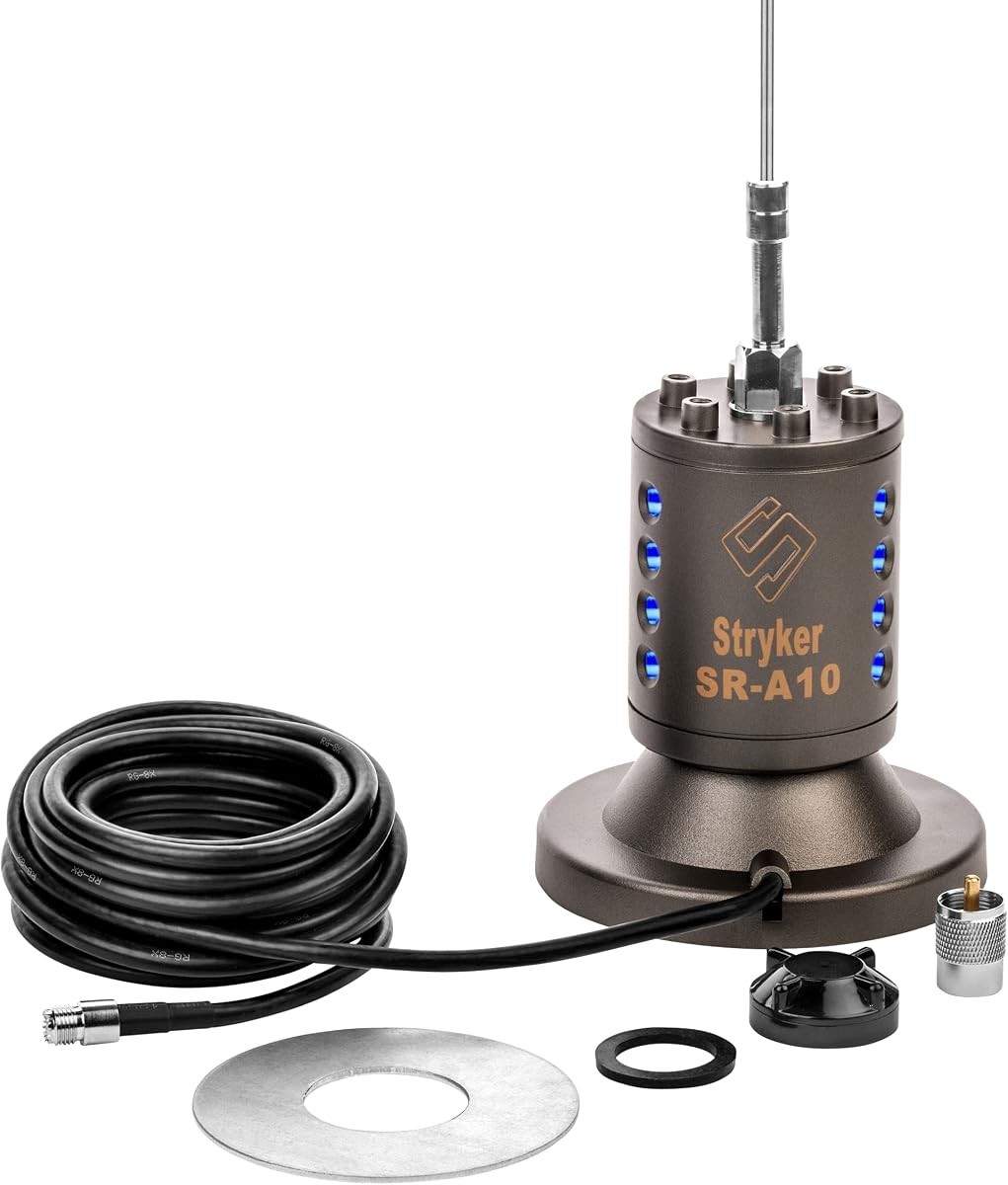
The Stryker SRA10 is a compact 10-meter antenna designed for a mirror mount, and its supplied 4.7 rating places it among the strongest-rated entries in the guide. It weighs 1.08 pounds according to the package information, making it appealing to operators who want a small, accessible antenna without the size and visual bulk of a tall base-station array.
We may earn a commission when you buy through this link, at no additional cost to you.
The housing is listed as waterproof to IPX8 and JIS8 standards. It also has a paper-white backlight for daytime visibility, a feature that adds a distinctive visual cue to the mounted unit. Higher power handling is another major strength: the listed capability reaches 10,000 watts, which is ample on paper for many high-powered mobile radio systems.
Unlike the other Yagi models in this guide, the SRA10 does not provide listed directional gain specifications. Its practical advantages instead center on compactness, high power capability, illumination, and a mounting location close to the operator. Mirror mounting may keep the antenna out of the main roofline, although the exact visual result depends on the vehicle, mirror configuration, and chosen mounting hardware.
The SRA10 is well suited to operators seeking a compact permanent mobile antenna with an illuminated, weather-resistant housing. It should not be selected for its beam pattern because no directional gain is specified. Buyers should also confirm the intended mounting arrangement and required hardware before ordering. Among compact mobile designs, it stands out for its high supplied rating and combination of waterproofing, illumination, and power handling.
A listed package weight of 1.08 pounds suits operators who prefer less visual bulk than a full-height rooftop antenna. The mirror-mount format also keeps the unit accessible for inspection and adjustment.
The paper-white daytime backlight makes the mounted housing easier to identify, while the IPX8 and JIS8 waterproof ratings support use in exposed conditions. Connector and mounting details should still be protected from standing water.
We may earn a commission when you buy through this link, at no additional cost to you.
The Sirio GPE 27 5/8 is a tunable vertical ground-plane antenna with a supplied rating of 5.0 out of 5. It operates from 26.4 to 29.0 MHz and provides 360-degree omnidirectional radiation with linear vertical polarization. For fixed operators who need signal distributed in every direction, it provides a fundamentally different and more balanced approach than the directional Yagi antennas.
We may earn a commission when you buy through this link, at no additional cost to you.
Its five-eighth-wave configuration is listed with a low radiation angle for excellent DX performance. The supplied specifications give a gain of 2.15 dBi, equivalent to 0 dBd, along with bandwidth of at least 1600 kHz at SWR of 2 or less. SWR at the resonant frequency is specified at 1.3 or lower, and tuning is performed by adjusting the whip length.
Construction details include aluminum alloy 6063 T-832 for the main body, a waterproof jointing sleeve, and a transparent protective cover over the coil. A transformer feed system at the base provides DC grounding and protection from static discharges. The antenna uses a UHF-female connector and is rated for 250 watts CW continuously, with 750 watts CW permitted for short periods.
This antenna is an excellent option for a home base where contacts are distributed around the station or the operator does not want to re-aim the antenna. The top supplied rating is encouraging, though ratings remain subjective and should not replace attention to specifications. It is less suitable than a Yagi when a strong, concentrated signal in one direction is the primary goal. For omnidirectional fixed coverage with broad tuning and static protection, the GPE 27 5/8 stands out.
The 360-degree horizontal radiation pattern removes the need to choose a transmission direction. This makes the antenna more convenient for a general-purpose home station or a group of widely dispersed contacts.
The transformer DC-ground arrangement is designed to help protect against static discharge. Whip-length adjustment allows the resonant point to be set for the operator’s local frequency within the stated range.
We may earn a commission when you buy through this link, at no additional cost to you.
The Taurus CB-18 is an 18-foot fiberglass base antenna with a supplied rating of 4.6 out of 5. It uses a half-wave-over-quarter-wave configuration to provide omnidirectional coverage, and its stated gain is 5.75 dBd. That is more gain than the compact vertical models in this guide while retaining broad coverage around the installation.
We may earn a commission when you buy through this link, at no additional cost to you.
The frequency range extends from 26 to 31 MHz, covering the CB region and a substantial portion of the 10-meter band. Its listed power rating of 2000 watts gives it considerable capacity for high-powered fixed stations. The antenna is divided into three sections, making the 18-foot structure easier to transport and assemble before it is raised into position.
A UHF connector is fitted, and the package includes a mounting bracket with stainless steel hardware. Those included components simplify basic installation, although the correct mast, ground system, coax route, and local mounting hardware still need to be planned. The fiberglass body should also be handled carefully during assembly to avoid stressing sections and fittings.
The CB-18 is most appropriate for a home station that wants more vertical gain than a short ground-plane antenna without moving to a directional Yagi. It can serve a broad local audience and remains less sensitive to target direction than the Sirio beams. Its 18-foot height is the chief limitation at many homes. If vertical space and all-around coverage matter more than directional gain, the specified 5.75 dBd rating makes this a well-balanced fixed-station choice.
A listed 5.75 dBd gain gives the antenna a meaningful improvement over simpler vertical designs. It still radiates in all horizontal directions, so the operator does not need to rotate it as contacts move around the station.
Three sections make an 18-foot antenna easier to assemble and carry than a single rigid element. Secure each joint, align the sections correctly, and observe the manufacturer’s mounting guidance during installation.
We may earn a commission when you buy through this link, at no additional cost to you.
The CB100 18ft Outdoor CB Base Antenna is a vertically mounted 27 MHz antenna with a supplied rating of 4.1 out of 5. Its listed 4.3 dB gain and 18-foot height position it between shorter ground-plane models and taller, higher-gain fiberglass antennas. The product information emphasizes broad compatibility with CB radios and reliable outdoor operation.
We may earn a commission when you buy through this link, at no additional cost to you.
A major part of the listing’s value proposition is signal transfer efficiency. The stated low VSWR is intended to reduce reflected power and provide a cleaner match between the radio and antenna. This can help protect the transmitter and support more consistent signal delivery, although actual VSWR depends on correct tuning, mounting, nearby structures, coax quality, and the operating frequency.
The construction is described as weatherproof, making it suitable for outdoor base-station use. Unlike the Sirio Yagis, it does not concentrate its signal into a directional pattern, and it does not publish a detailed maximum power rating or a broad tuning range in the supplied information. That lower specification depth deserves attention from operators with unusually high power or unusual installation requirements.
The CB100 is most appealing to someone who wants a straightforward outdoor CB base antenna with useful gain and 360-degree coverage without moving to a long directional boom. Its 18-foot size and fixed nature mean that roof or tower clearance must be evaluated. For straightforward home-station use, it offers the essentials, but buyers needing documented power limits, tuning bandwidth, or precise radiation specifications should examine the more fully specified alternatives.
The product’s low-VSWR objective supports efficient power transfer between the radio and antenna. Achieve the best results with sound coax connections, proper grounding, and an installation that avoids nearby conductive obstructions.
The stated compatibility with a wide range of CB radios makes this a practical option for common home-station setups. It is intended for 27 MHz use and should be matched to the operator’s actual radio and feed system.
We may earn a commission when you buy through this link, at no additional cost to you.
The Sirio Starduster M400 is a fixed CB and 10-meter base antenna with a supplied rating of 4.7 out of 5. Its frequency range is tunable from 26.5 to 30 MHz, and its listed gain is 2.15 dBi, equivalent to 0 dBd. This puts it in the omnidirectional or broad-coverage category rather than among the higher-gain directional models in the guide.
We may earn a commission when you buy through this link, at no additional cost to you.
Its height of 16.54 feet makes it substantially more compact than many tall base antennas while preserving useful vertical separation from a rooftop. The listed power handling is 1000 watts CW continuous and 3000 watts PEP. A UHF-female SO-239 connector provides a common connection interface for compatible coaxial cable.
The supplied data is concise, so installers should request any missing mechanical and electrical details before committing to a complex installation. Information such as exact element count, material construction, wind rating, tuning method, mounting hardware, and grounding arrangement is not provided in the product data shown. Those details can influence long-term performance and should be verified with the seller or manufacturer.
The Starduster M400 is a strong candidate for operators who prefer the Sirio brand, want a base antenna with relatively compact height, and need broad tuning across the CB and lower 10-meter range. It is not designed to replace a directional Yagi when the objective is concentrated gain toward one area. For general base-station coverage in a manageable footprint, its high power rating and strong supplied rating provide a persuasive package.
A 16.54-foot height provides useful clearance without the very tall profile of some fiberglass base antennas. The 26.5–30 MHz tuning range offers flexibility across CB and lower 10-meter frequencies.
The listed 1000-watt continuous rating supports substantial transmitter power. As with every antenna, matching should be verified after installation, and the continuous rating should be observed rather than treating the PEP figure as a sustained operating level.
We may earn a commission when you buy through this link, at no additional cost to you.
Choosing a CB Beam Antenna means balancing radiation pattern, gain, power rating, mechanical size, and installation constraints. The right antenna for a fixed home station may be entirely wrong for a truck, portable setup, or rooftop where all-around coverage is needed.
A beam antenna concentrates radio energy toward one part of the horizon, which can improve coverage toward distant or otherwise difficult contacts. A Yagi with more elements will generally offer more gain than a shorter array, but its exact performance also depends on element spacing, boom design, ground reflections, nearby structures, and how accurately it is aimed. An omnidirectional antenna is easier to use when contacts are located in several directions or their locations are not predictable.
Choose a directional model when the direction of coverage is known. Choose an omnidirectional model when reliable all-around reception matters more than front-to-back concentration.
CB radio activity is concentrated near 27 MHz, while many 10-meter operators use a broader slice of the HF band. An antenna labeled for 26–30 MHz gives more room than a narrow 27 MHz design, but the operator should verify whether tuning is performed with a movable whip, selectable taps, or another method. Wider range can add flexibility, though every adjustment introduces another installation variable that must be documented.
Match the antenna to the frequencies you actually plan to use. Confirm the tuning method and plan to check matching after installation.
The maximum transmitter power and antenna rating should be treated as a system rather than separate numbers. A high-powered radio will not automatically damage a lower-rated antenna, but repeated operation beyond the antenna’s continuous rating can generate heat, stress connections, and contribute to failure. Listings may distinguish continuous CW or carrier capacity from short-duration PEP capability, so the two figures should not be interpreted as equivalent.
Select an antenna with a comfortable continuous rating above the power level you expect to use. Avoid relying on short-time ratings for long transmissions.
The Yagi antennas reviewed here use directional, horizontally polarized radiation. Vertical base antennas use linear vertical polarization and usually provide 360-degree coverage. Polarization mismatch can reduce practical signal transfer even when both antennas are operating correctly, while the surrounding ground and structures influence real-world results.
Match the intended service to the antenna design. Use horizontal polarization for a dedicated directional beam and vertical polarization for broad base-station or mobile operation.
A beam’s full element span and turning radius can be surprisingly large. Before buying, measure the intended site, identify overhead hazards, and confirm the required mast or bracket size. Mobile antennas need different considerations: magnetic bases require a flat steel contact area, while drilled mounts and mirror mounts need compatible vehicle surfaces and hardware.
Measure first, then select. The best-performing antenna is not useful if it cannot be mounted safely or if its turning clearance conflicts with nearby structures.
The correct connector does not guarantee a good installation. Long coax runs introduce loss, especially at the higher end of the 10-meter band, and poor connectors can create impedance changes that increase reflected power. The Sirio models reviewed here use a UHF-female SO-239 connector. The SY 27-3 package includes 100 feet of RG8X cable with PL 259 connectors, while other listings do not state that a cable is included.
Verify whether coax and connectors are included, then select a cable length and loss rating appropriate to the installation. Weatherproof exposed connectors and strain relief are essential.
Base antennas remain outdoors through rain, wind, and seasonal temperature changes. Aluminum, fiberglass, stainless steel, and nylon each have different roles, while waterproof jointing sleeves and protected feed points help reduce moisture intrusion. Mobile antennas face road grime, vibration, salt, and repeated mounting, so corrosion resistance and robust connectors deserve special attention.
Look for protected joints and durable materials, but still inspect connections periodically. Weatherproofing labels do not eliminate the need for sensible installation practices.
A magnetic base gives a vehicle antenna a removable installation, while a drilled or mirror mount provides a more permanent appearance. Height also affects visibility, wind loading, and the possibility of interference with garage doors or other equipment. For temporary operations, portability may be more valuable than a permanently mounted design; for everyday driving, a compact fixed mount may be easier to live with.
Choose the installation style that fits the vehicle and operating routine. Portability, stability, and low visual profile are separate priorities.
Begin by identifying the radio’s operating frequency, output power, connector, and mounting location. Mount the antenna on a rigid support with the required clearance, secure every fastener, and follow the manufacturer’s grounding and coax recommendations. For a directional Yagi, decide the desired direction before tightening the mast clamps so the boom can be aligned accurately.
After installation, check the station’s standing-wave ratio and make the necessary tuning adjustments. On tunable models, follow the supplied whip-length or element instructions, then recheck matching in the primary operating area. Terminate exposed coax connectors appropriately, minimize sharp bends, and use weatherproof protection where a connection is exposed to rain or condensation.
Inspect the antenna periodically for loose hardware, corrosion, damaged insulation, water intrusion, and movement at the mounting point. Mobile installations should also be checked after rough travel or a significant impact. Keep the whip and base clean, and avoid using abrasive methods that could damage protective finishes. Replace damaged cable rather than relying on a temporary repair, and recheck matching if performance suddenly changes.
A beam antenna is usually better when you want more signal concentrated toward a known direction, such as a distant group of stations or a favorable path over terrain. An omnidirectional antenna is more convenient when contacts are spread in every direction. The beam can provide a stronger signal in its main lobe, but signals outside that direction may be weaker. Your operating pattern should determine which advantage matters most.
Gain describes how efficiently an antenna concentrates and radiates energy compared with an ideal isotropic reference. It is not extra power created by the antenna. A larger dBd or dBi number generally indicates greater concentration, but actual results depend on orientation, height, ground conditions, nearby structures, cable losses, and the radio system. Compare gain figures using the same units.
The listed antennas are designed for operation within their stated frequency ranges, and many provide specified low-SWR performance after proper tuning. Some installations may still need adjustment because nearby objects or an incorrect mounting position can affect matching. Check the radio’s SWR reading first. If it is unsatisfactory, verify the installation and tune the antenna before considering an external tuner.
Only if its frequency range includes the CB frequencies you plan to use. The 10-meter band extends above the classic CB range, so an antenna designed only for the upper part of 10 meters may not cover 27 MHz adequately. The Sirio Yagis, GPE 27 5/8, and Starduster M400 all list ranges that include the CB region, while other products are described specifically for 26–31 MHz or 27 MHz.
Use quality 50-ohm coaxial cable suitable for the installation length and environment. The included RG8X cable in the Sirio SY 27-3 package is designed for that purpose, with PL 259 connectors on the supplied run. Ensure connector types match both the antenna and radio, minimize unnecessary splices, and protect exposed fittings from moisture.
A magnetic antenna can provide good results when mounted on a suitable flat steel surface with proper clearance. Permanent mounts may offer more consistent placement, while magnetic models add portability. Performance can be affected by roof curvature, nearby metal, trunk placement, and the condition of the contact surfaces. Clean both mating surfaces and follow the manufacturer’s mounting instructions.
Higher placement generally helps the antenna see more of the surrounding radio environment, reducing the effect of nearby objects and ground clutter. There is no single correct height because terrain, building height, antenna design, and local conditions all matter. A practical approach is to use the tallest safe support available and compare the station’s received signal and SWR before and after changing elevation.
It is possible, but a long Yagi boom requires secure support, adequate clearance, and careful attention to wind loading. A full-size beam may be cumbersome on a passenger vehicle, while mobile whip options are usually more practical. Never allow the antenna or boom to obstruct safe vehicle operation, and make sure all mounting hardware is rated for the installation.
The Sirio SY 27-4 stands out as the strongest all-around beam selection because it combines a four-element directional design, 11 dBd listed gain, broad 26.5–30 MHz coverage, and substantial power handling. The Sirio SY 27-3 offers a simpler directional alternative, while the packaged SY 27-3 with 100 feet of RG8X cable is attractive to installers who value a ready-made feed-line solution.
For mobile users, the Stryker SR-A10MM is the most portable option, the Stryker SRA10 is the most compact and illuminated choice, and the Wilson 305-492 is the strongest permanent-mount mobile alternative. If all-around fixed coverage matters more than a concentrated beam, the Sirio GPE 27 5/8, Taurus CB-18, CB100, and Sirio Starduster M400 deserve closer consideration.
Before ordering, confirm the frequency range, continuous power rating, connector, physical clearance, and mounting requirements. Product ratings and prices change over time, so check the current listing and seller information before making a final purchase. Choosing the antenna that matches your actual operating direction and installation environment will produce a more useful system than selecting solely on gain or appearance.
