
LIT-10 Pro Battery
5.0Editor score
10,500mAh battery capacity
Five-hour full charge
Multiple safety protections
Our guide compares the best rechargeable lithium batteries for trail cameras, covering capacity, compatibility, charging, runtime, temperature tolerance, and
Rechargeable lithium batteries can give trail cameras dependable power while reducing battery changes, disposable waste, and maintenance trips. The right unit must match the camera, provide adequate capacity, tolerate seasonal temperatures, and recharge conveniently without sacrificing the long runtime expected from an outdoor scouting setup.
We compared all ten listed products by examining battery type, capacity, charging method, camera compatibility, temperature claims, safety features, and deployment convenience. The list includes model-specific battery packs, universal AA options, a complete rechargeable camera, and two conventional battery products that provide useful compatibility context.
Each review explains the product’s strongest attributes and limitations, while the comparison table makes technical differences easier to scan. The selections include standout options for extended capacity, budget-conscious buyers, and Stealth Cam users. Prices and availability can change, so confirm current listing details before purchasing.
5.0Editor score
4.8Editor score
4.6Editor score
This side-by-side comparison highlights the most important differences among the ten products, including rechargeability, capacity, charging method, camera compatibility, and intended use. Several entries are replacement batteries, while others are conventional cells or a camera with an integrated rechargeable battery.


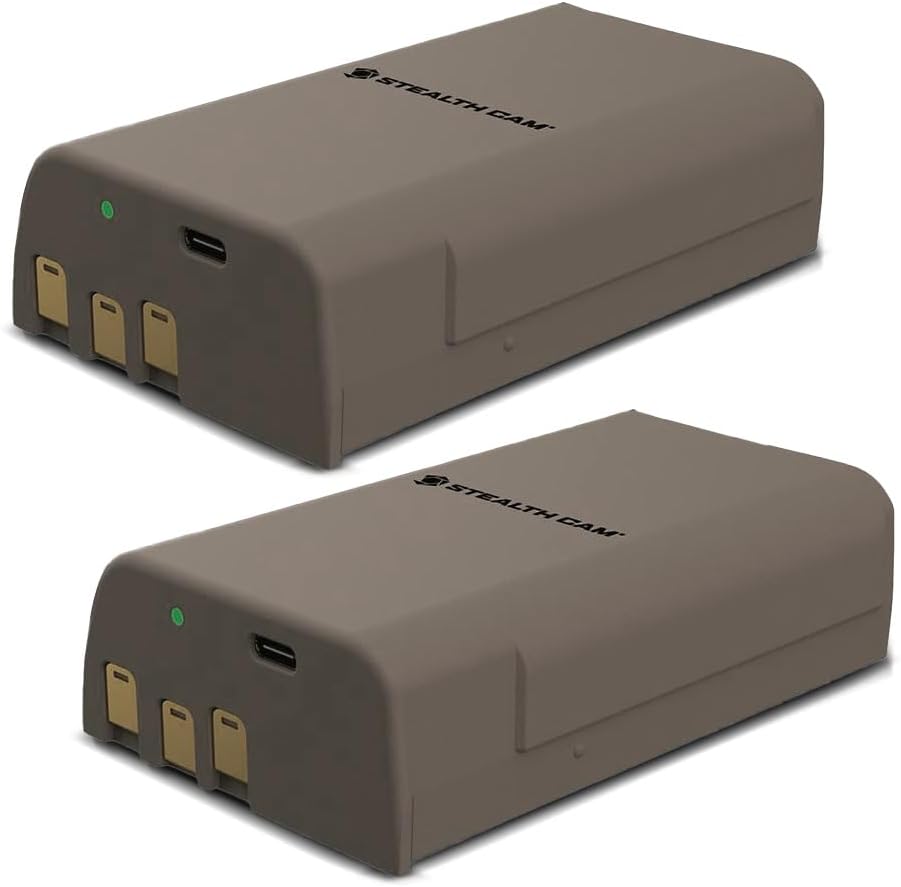
The Stealth Cam FieldMax MAX-PAK is a rechargeable 12V, 5,000mAh battery system offered as a two-pack, earning a 4.6 rating among buyers. Its defining strength is the inclusion of two complete cartridges rather than a single battery, giving users a useful rotation for long deployments or a ready spare when one pack needs charging.
We may earn a commission when you buy through this link, at no additional cost to you.
The battery uses a rechargeable lithium-ion design and includes a USB cable for recharging. It is specifically compatible with the Stealth Cam Flashback, Deceptor MAX, Fusion MAX, and Connect MAX models. That focused compatibility is an advantage for owners of these cameras because the cartridge is designed to integrate with the specified camera platforms.
Low-light use is another important consideration for trail cameras, and this product is presented as well suited to wooded areas where limited sunlight can make solar charging difficult. Its construction is also described as capable of withstanding temperature swings. The main limitation is specialization: it will not serve as a universal battery for unrelated camera brands or models.
Choose this two-pack when your setup uses a listed Stealth Cam MAX-series camera and reducing field visits is important. Keeping one cartridge deployed while the other recharges can simplify rotation, while the substantial per-cell capacity makes it better suited to extended monitoring than a small generic AA pack.
Two cartridges make it easier to maintain power without powering down the camera every time a charge is needed. After the installed pack reaches a low level, swap in the second cartridge and recharge the depleted unit indoors or in a vehicle.
Because the pack is intended to work in low-light environments, it is a sensible option for heavily wooded properties where a solar panel may receive limited direct sun. Its stated temperature resistance also supports use across changing seasonal conditions.
We may earn a commission when you buy through this link, at no additional cost to you.
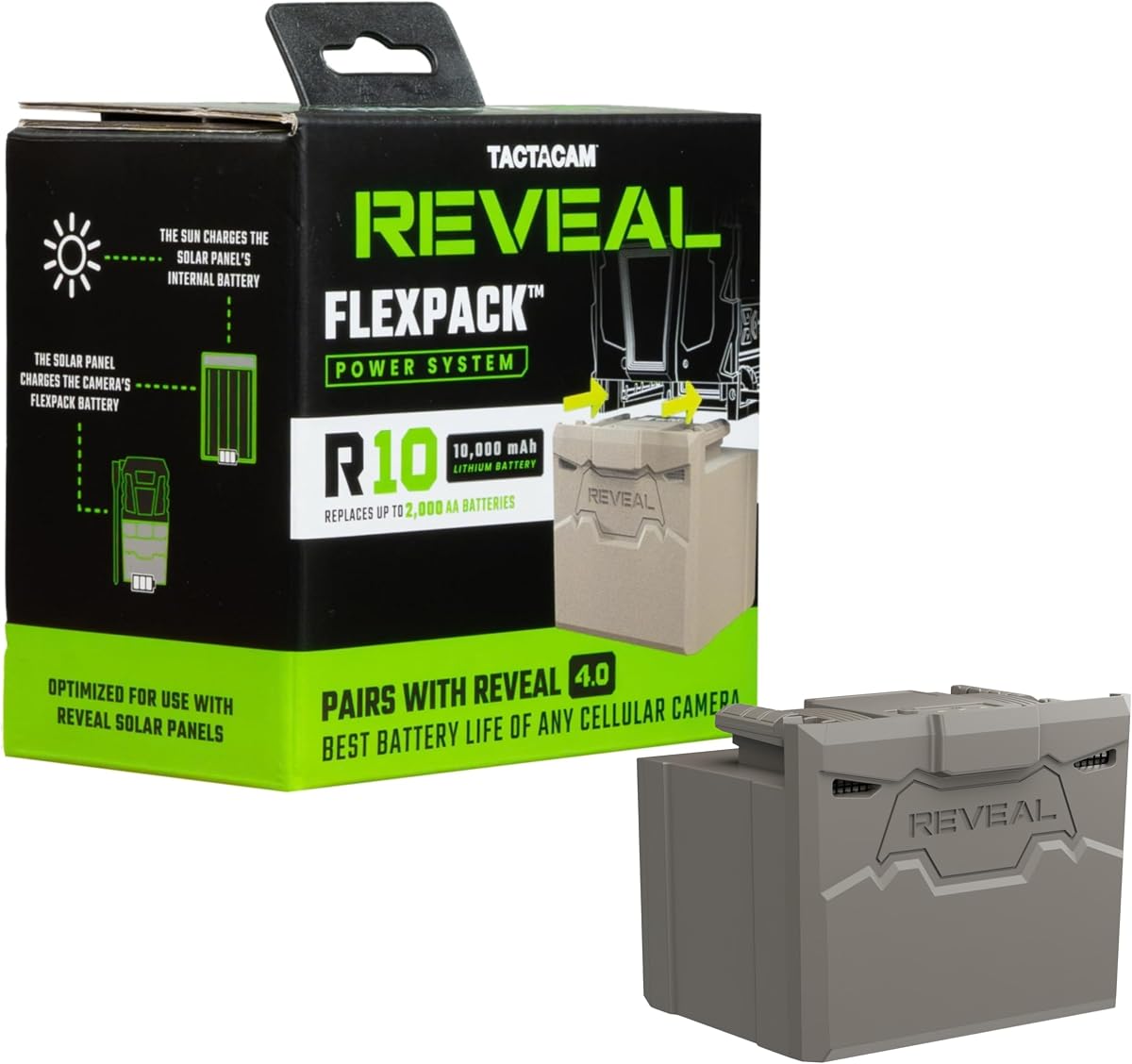
The TACTACAM Reveal FlexPack R10 is the highest-capacity rechargeable battery in this guide, with a stated 10,000mAh and a 4.8 rating. It is described as the most powerful battery offered for REVEAL cameras, making it a compelling choice for hunters and wildlife observers who want to maximize time between maintenance visits.
We may earn a commission when you buy through this link, at no additional cost to you.
Its quick-swap design is one of the most useful practical features. Rather than dealing with a complicated battery-change process, users can remove the depleted pack and install a charged one. The battery can also work with the Solar Panel R5 or other REVEAL power accessories, creating a more flexible power ecosystem than a standalone cell.
The product description says the R10 can replace up to 2,000 disposable AA batteries over its use, reducing both waste and the number of trips required to change cells. That long-term claim should still be evaluated against actual camera settings, temperature, transmission activity, and recording frequency, all of which affect energy consumption.
This is the strongest recommendation for a REVEAL user seeking long field intervals and maximum capacity. It is less suitable for owners of unrelated cameras, however, so checking the exact REVEAL model and power-system requirements is essential before ordering.
The 10,000mAh rating gives the R10 a clear capacity advantage over most model-specific packs in this roundup. It is especially attractive for locations that are difficult to reach or cameras configured for frequent uploads and recording.
Compatibility with REVEAL solar accessories allows the battery to fit into a broader setup rather than operating as an isolated replacement. Users can combine charging methods according to available sunlight and access to USB power.
We may earn a commission when you buy through this link, at no additional cost to you.
The LIT-10 Pro combines a 3.85V operating voltage with a 10,500mAh capacity, equivalent to a listed 40.42Wh, and has a perfect 5.0 rating. It is a particularly attractive option for owners of the SPYPOINT Link-Micro, Cell-Link, LM2, and Link-Micro-S-LTE cameras who want substantial capacity in a rechargeable format.
We may earn a commission when you buy through this link, at no additional cost to you.
The battery is advertised as reaching a full charge in approximately five hours. Its built-in smart circuit includes overcharge, over-discharge, overvoltage, overcurrent, and overheating protection, which adds confidence during repeated charging cycles and unattended overnight charging.
Compatibility is the defining tradeoff. The LIT-10 Pro is designed for a specific voltage and camera family, so its unusually high capacity should not be interpreted as making it universally compatible. The package also provides different assurance terms, including a stated 30-day refund period and 12 months of service, depending on the applicable seller policy.
For a compatible SPYPOINT setup, this is a strong balance of capacity, charging convenience, and protective electronics. Buyers should confirm the exact camera model and compare its fit with the original battery compartment before installation.
A 10,500mAh rating makes this one of the highest-capacity options listed. The smart protection circuit is designed to guard common electrical faults while helping extend the useful life of the battery.
The stated recharge time fits a practical preparation routine: charge the battery indoors before deployment, connect it to the camera, and return it to charge after the monitoring cycle. Actual timing can vary with the charger and operating conditions.
We may earn a commission when you buy through this link, at no additional cost to you.
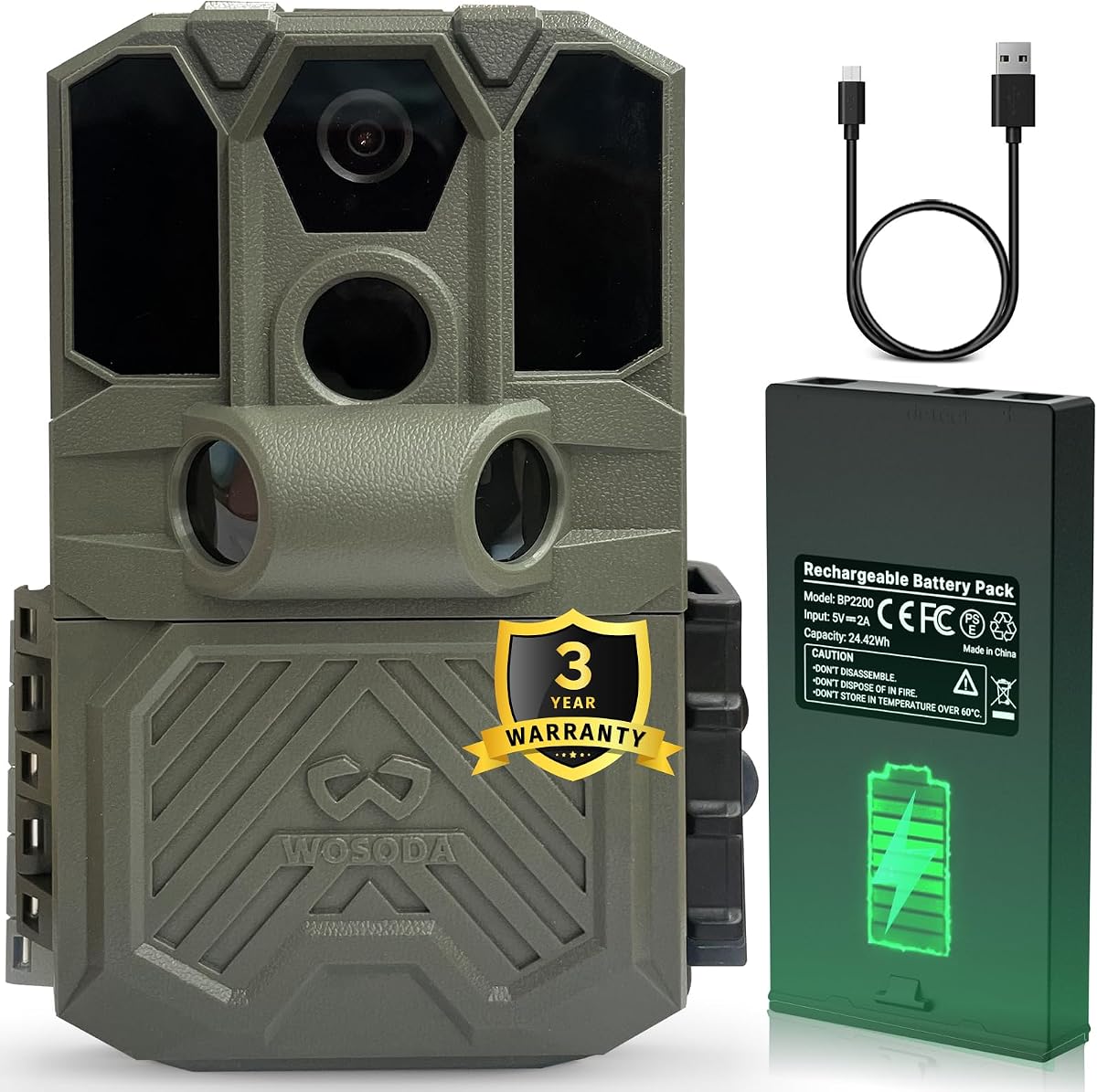
The WOSODA Rechargeable Trail Camera is a complete 40MP, 2K game camera with an integrated 2,200mAh lithium battery. It has a 4.3 rating and differs from the other entries because the package includes both the camera and its rechargeable power source rather than a replacement battery alone.
We may earn a commission when you buy through this link, at no additional cost to you.
The removable battery is charged separately using a Type-C port, and the camera provides local storage through an SD card up to 256GB. It is a non-cellular, non-WiFi device, so footage remains under the user’s control without requiring a cloud connection. The 2-inch LCD also assists with setup and immediate image review.
Its IP66 housing is designed to resist water and dust, while a 0.2-second trigger and 120-degree detection angle support wildlife monitoring. The 2,200mAh capacity is the main limitation when compared with the larger replacement packs, so users may need more frequent charging or battery rotations for demanding recording schedules.
This camera makes the most sense for someone starting a new non-connected trail camera setup or replacing a complete camera rather than just a battery. It is not the right choice for buyers who require remote cellular viewing, Wi-Fi access, or the flexibility to use separately purchased high-capacity batteries.
Recording directly to an SD card keeps footage local and avoids dependence on cloud services. The display allows quick previews without removing the card, which is helpful during initial setup and routine checks.
This option includes the camera, rechargeable battery, and a weather-resistant housing. It simplifies a new installation, although buyers seeking only a spare battery should choose a dedicated pack instead.
We may earn a commission when you buy through this link, at no additional cost to you.
This eight-pack of rechargeable lithium AA batteries has a 4.5 rating and provides a broadly reusable alternative to disposable cells. Each battery is rated at 3,800mWh and maintains a constant 1.5V output, making it suitable for many trail cameras, Blink cameras, game controllers, radios, flashlights, and other AA-powered electronics.
We may earn a commission when you buy through this link, at no additional cost to you.
The included flip-top charger holds eight batteries and uses an LCD screen to display charging progress for each position. It doubles as an organizer and storage case, while the magnetic closure helps keep cells organized and protected. A Type-C cable and two-year warranty are also included.
Compatibility deserves careful attention. The listing states that the batteries are not appropriate for smoke alarms, Nest Protect, solar lights, or camera flashes because those applications require different voltage characteristics. Some Blink models may also display a low-battery warning even while the cells continue to function normally.
This is an attractive option for users who want one charging system for multiple household and outdoor devices. For a trail camera, confirm that the camera accepts rechargeable lithium AA cells and that its low-battery indicator is reliable. The eight-cell set offers more flexibility than a single proprietary cartridge, even though its total energy is divided among the cells.
The eight-position LCD charger and integrated case simplify battery rotation. Buyers can maintain a shared pool of cells for cameras, remotes, toys, and other compatible equipment instead of managing separate charging setups.
The stated constant 1.5V output distinguishes these cells from common NiMH alternatives that maintain a lower nominal voltage. Always verify device requirements because the higher and stable voltage can also make a battery unsuitable for certain products.
We may earn a commission when you buy through this link, at no additional cost to you.
The Burflo three-pack combines 7,000mAh rechargeable batteries with support for a wide range of SPYPOINT Flex-series cellular trail cameras. It has no listed customer rating, so its appeal rests on its stated specifications, compatibility range, temperature adaptability, and three-battery rotation format.
We may earn a commission when you buy through this link, at no additional cost to you.
The upgraded replacement is described as a 7.7V design for LIT-22PRO-style use, with the listing noting that it is also positioned as a replacement for the original 7.4V rechargeable battery. Compatible models include Flex-M, Flex-S, Flex G-36, Flex-Plus, and corresponding variants, though buyers should confirm the physical and electrical requirements of the exact camera.
Charging uses USB-C and an LED indicator provides charging status. The seller recommends a 5V, 3A wall plug and cautions that a 2A plug may cause unstable charging. That recommendation matters because charger specifications can influence recharge speed and reliability.
This product is well suited to SPYPOINT Flex users who want multiple batteries to reduce downtime. The absence of a rating makes long-term customer feedback unavailable, so buyers should pay close attention to fit, voltage, charger requirements, and the seller’s warranty terms.
A three-pack lets one battery power the camera, one remain in rotation, and one charge at a time. That arrangement can be useful for cellular cameras that transmit images regularly and therefore consume power at a steadier rate.
The battery is engineered for operation across diverse weather conditions, an important consideration for trail cameras exposed to cold winters and warm summers. The included LED indicator helps users identify a charged unit before deployment.
We may earn a commission when you buy through this link, at no additional cost to you.
The Stealth Cam FieldMax 5000mAh External Battery Combo combines a 5,000mAh internal lithium rechargeable battery with compatibility for an external solar charging pack. It has a 1.0 rating, the lowest listed score, so potential buyers should investigate customer feedback and fit before relying on it for a critical deployment.
We may earn a commission when you buy through this link, at no additional cost to you.
Its primary advantage is flexibility. The battery can be charged by USB at home, in a vehicle, or at a remote location. When paired with a compatible external solar pack, it can also charge the camera directly in the field, helping preserve operation during extended deployments without regular physical access.
The product is described as compatible with a broad selection of Stealth Cam models, including MAX, Fusion, Deceptor, and Revolver series cameras. That wider model range may be useful compared with a cartridge restricted to a smaller set, although the exact battery shape and camera requirements should be confirmed.
This is not our strongest recommendation despite the useful solar-ready concept. The 1.0 rating signals that the actual user experience may fall short of the stated feature set, and the external solar accessory is sold separately. Consider it only after checking recent reviews, compatibility, and the full cost of building a complete power system.
The combo can work with a compatible external solar pack to keep a camera running in the field. This is particularly useful for long deployments, although the solar accessory is an additional purchase.
USB charging allows preparation at home and top-ups from a suitable vehicle or remote power source. That flexibility reduces dependence on disposable batteries, but users should still monitor the battery because capacity alone does not determine runtime.
We may earn a commission when you buy through this link, at no additional cost to you.
The Artman Power Mag three-pack is designed for Moultrie Edge, Edge PRO, Edge 2, and Edge 2 PRO trail cameras. Each 6,700mAh lithium-ion battery is advertised as a plug-and-play replacement for traditional AA batteries, and no customer rating is listed for this listing.
We may earn a commission when you buy through this link, at no additional cost to you.
USB-C charging and a stated four-hour full recharge time make the pack convenient to prepare. A built-in LED display indicates charging status, with green lights representing power level and all lights switching off once charging is complete. The listing also states operation from -20°C to 60°C, supporting cold-weather and hot-weather use.
Safety features include protection against overcharging, overdischarging, and short circuits, alongside a weather-resistant construction. These protections are important for a battery that will be connected to an unattended camera and repeatedly cycled, though the manufacturer’s warranty and support terms should be reviewed before purchase.
This is a practical choice for owners of multiple compatible Edge cameras or for users who want a rotation of three batteries. Confirm the exact Edge model and compare the replacement’s dimensions with the original compartment, especially if the camera sits in a tight housing.
With three batteries, users can keep one camera running, keep another charged, and recharge the third. This is particularly useful when multiple compatible cameras cover the same property.
The charging display gives users a quick way to monitor progress and identify a prepared battery. A four-hour recharge claim makes overnight or pre-deployment charging practical for many users.
We may earn a commission when you buy through this link, at no additional cost to you.
The Trail Camera AA Alkaline Batteries pack contains eight disposable AA cells and has a 4.5 rating. Although it does not meet the rechargeable focus of the guide, it remains relevant as a familiar backup for compatible trail cameras and a solution for users who need standard AA power without a model-specific charging setup.
We may earn a commission when you buy through this link, at no additional cost to you.
The primary advantage is simplicity. Alkaline AA batteries fit the common battery format used by many trail cameras, so there is no charging cable to carry, no rechargeable-cell compatibility warning to navigate, and no need to learn a proprietary cartridge system. They are particularly handy for an emergency trip or a short deployment.
The trade-offs are substantial for extended monitoring. These batteries cannot be recharged, must be replaced when depleted, add transport weight, and create recurring waste. They also lack the high capacity offered by the dedicated lithium-ion packs in this roundup, particularly in cold weather where battery performance can decline.
For long-term operation, a rechargeable lithium pack is the better choice. Consider alkaline AA cells as a short-term backup, a way to keep an older camera running, or a temporary solution while a compatible rechargeable battery is charging.
A set of alkaline AAs can rescue a deployment when a rechargeable battery is depleted, charging, or incompatible. Keeping a small backup set is useful, although it should complement rather than replace a primary rechargeable system.
Standard AA cells are easy to find and require no special charger, yet they must be discarded after use. Over a full season of frequent recording, this can create more cost, waste, and field work than a rechargeable alternative.
We may earn a commission when you buy through this link, at no additional cost to you.
The six-pack of Surefire 123A lithium batteries is a specialty primary battery option with a 4.7 rating. These cells are optimized for high-drain flashlights and include a stated ten-year shelf life, wide temperature tolerance, and built-in heat and short-circuit protection.
We may earn a commission when you buy through this link, at no additional cost to you.
Lithium primary chemistry can offer long storage life and strong performance in demanding or temperature-variable conditions. That makes the pack potentially useful for specialized equipment or emergency preparedness, provided the device accepts 123A cells and the appropriate holder or adapter.
It is not a rechargeable trail camera battery. The product is not marketed for trail cameras, its 123A format is uncommon in standard AA-based camera compartments, and the chemistry is primary rather than rechargeable lithium-ion. Adapters can introduce fit or contact issues, so physical confirmation is essential.
Keep this product on the list as a specialty backup rather than a direct recommendation for a trail camera. A dedicated rechargeable pack is more appropriate for routine camera monitoring, while Surefire cells make more sense for compatible flashlights, emergency kits, or other high-drain devices.
The ten-year shelf life makes these batteries suitable for emergency or occasional-use equipment. They can remain ready for extended periods without the frequent cycling expected from rechargeable camera packs.
The 123A cell is not interchangeable with standard AA batteries in every device. Check the camera compartment, dimensions, polarity, and required voltage before considering this pack for any outdoor monitoring setup.
We may earn a commission when you buy through this link, at no additional cost to you.
The right battery depends on camera compatibility, usable capacity, charging logistics, and the conditions the unit will face. A higher capacity number is useful, but fit, electrical design, and a realistic maintenance plan matter more than any single specification.
Start with the exact camera manufacturer and model because battery cartridges are not interchangeable across brands or even across product generations. Some packs use a proprietary 12V cartridge, others use a model-specific lithium-ion block, and still others rely on standard AA cells. Check the camera manual, the battery compartment markings, voltage, connector design, and physical dimensions before buying.
Choose only a battery explicitly listed as compatible with your camera. A high capacity does not compensate for a poor fit, incorrect voltage, or a connector that prevents the camera from closing properly.
Capacity indicates how much charge a battery can store, while watt-hours express stored energy more directly when voltage differs between products. For example, the LIT-10 Pro is listed at 3.85V and 40.42Wh, while the Stealth Cam MAX-PAK is listed at 12V and 5,000mAh. Runtime also depends on camera activity, video length, infrared illumination, temperature, signal strength, and recording frequency.
Favor a capacity that matches your expected workload, but avoid assuming a larger number guarantees a proportional runtime increase. A balanced power system and realistic maintenance schedule are more valuable than chasing the largest specification on the list.
Consider how and where you will recharge the battery. USB-C charging is convenient for many modern setups, while some products use a proprietary USB cable or a dedicated charging cradle. A fast stated charge time can support a rotation system, but use the recommended charger and voltage where the manufacturer or seller provides specific instructions.
The best arrangement keeps one battery deployed, one ready, and one charging when multiple packs are available. This rotation approach is more valuable than a quick recharge claim if it eliminates emergency trips to a remote camera.
Trail cameras operate through cold nights, warm afternoons, rain, snow, and shifting humidity. Rechargeable lithium-ion batteries can perform well across a range of temperatures, but cold can temporarily reduce available power. A battery specifically designed for outdoor temperature variation is preferable to an indoor-only pack used without protection.
Also inspect the camera’s weather sealing and make sure the battery does not prevent the compartment from closing properly. A weather-resistant battery cannot compensate for an improperly sealed camera housing.
Rechargeable batteries should include basic protection against overcharging, over-discharging, excessive voltage or current, overheating, and short circuits. These safeguards reduce the risk of damage during unattended charging and help support a longer service life. A smart charging circuit and visible charging status are also useful for spotting a complete or interrupted charge.
Avoid using a battery that is swollen, physically damaged, wet, or behaving abnormally. Follow the supplied charging instructions and use a suitable charging cable and power adapter rather than assuming every USB supply is equivalent.
The number of batteries in a pack influences both convenience and the number of units that can be deployed at once. A two-pack is enough for a simple rotation, while a three-pack works well for one camera in use, one on reserve, and one charging. Multiple cameras or difficult access make extra capacity more valuable.
Choose a quantity that you can realistically recharge and maintain. Carrying too many batteries adds weight and creates more devices to track, while carrying too few may leave a camera offline during a long deployment.
Some rechargeable trail camera batteries are designed to work with solar charging accessories. This can be valuable in open areas with reliable sunlight, but a solar panel is not automatically necessary in shaded woods or under heavy canopy. Accessory compatibility also depends on the camera platform and the specific power connection.
For extended off-grid deployments, a compatible solar system may reduce manual charging. For remote cameras in poor sunlight, prioritize battery capacity, reliable USB charging, and a sufficient rotation inventory instead.
A camera taking continuous video, using high-resolution stills, recording frequently through the night, or transmitting many cellular images consumes more energy than one set to capture occasional events. Review the camera’s motion sensitivity, night-vision mode, upload schedule, and recording duration before estimating service intervals.
Start with a conservative maintenance schedule and adjust after monitoring actual consumption. Keeping spare power available is more dependable than assuming a moderate-capacity battery will last through the entire hunting or property-monitoring season.
Begin by confirming the battery is approved for the exact camera model, then inspect the compartment, contacts, and battery body before installation. Check the voltage and connector or cell format against the camera documentation. A compatible battery should seat without force, and the camera’s weather-resistant door or housing should close completely. Charge the battery according to the supplied instructions before relying on it for a critical monitoring period.
For the first deployment, observe the camera’s first battery warning and compare the interval with later cycles. Actual runtime varies with temperature, recording activity, night illumination, and cellular transmission. If the camera reports a problem, remove the battery and inspect it, clean compatible charging contacts gently, and confirm that the camera compartment is dry and free of debris. Do not continue using a battery that is swollen, cracked, unusually hot, or visibly corroded.
Maintain a rotation when multiple batteries are available: keep one in the camera, one fully charged and ready, and one charging. Store spare lithium-ion batteries in a dry location at a moderate temperature and avoid leaving them in direct sunlight or a hot vehicle. Periodic inspection, careful charging, and timely replacement of damaged units help preserve capacity and make long deployments more predictable.
No. Rechargeable packs often use model-specific shapes, voltages, connectors, and charging requirements. Some trail cameras use standard AA cells, while others require a proprietary lithium-ion cartridge. Always confirm the exact camera model and consult its battery requirements before purchasing. A pack that physically fits is not necessarily electrically compatible.
They can be better for extended monitoring because they can be recharged, rotated, and reused instead of discarded after each deployment. Actual runtime depends on capacity, camera settings, temperature, and transmission activity. Disposable AAs remain useful as short-term or emergency backups, but they add recurring replacement work and waste.
Not by itself. Milliampere-hours measure charge capacity, while watt-hours more directly describe stored energy across different voltages. Camera workload and conditions also have a major effect. A higher-capacity battery may last longer, but the actual interval should be confirmed through field use and conservative maintenance planning.
Some listed packs are specifically designed for temperature variation, and the Rechargeable AA 8-Pack states an operating range of -20°F to 131°F. Cold can temporarily reduce lithium-ion performance even when the battery is not damaged. Keep the camera housing sealed, use batteries intended for outdoor use, and maintain a charged rotation when temperatures fall.
There is no single correct interval because recording volume, night vision, temperature, and cellular transmission all affect consumption. Recharge before deployment, monitor the camera’s first low-battery warning, and use that observation to establish a service schedule. Multiple batteries make rotating a charged unit into the camera much easier.
No. Some cameras are designed for alkaline AA cells and may not work correctly with rechargeable lithium cells, which retain a different voltage profile. The Rechargeable AA 8-Pack also warns that some Blink models may show a low-battery warning even while operating. Check the camera manual and the battery seller’s compatibility notes before use.
Choose a complete rechargeable camera when starting a new non-connected setup, as with the WOSODA model, and value an integrated display, local storage, and included battery. Choose a dedicated replacement pack when you already own a compatible camera and want higher capacity, multiple backups, or a smoother rotation system.
No. Solar integration depends on electrical compatibility, voltage, connector design, and the camera’s power architecture. The TACTACAM FlexPack R10 is explicitly described as working with REVEAL solar accessories, and the Stealth Cam FieldMax Combo supports a compatible external solar pack sold separately. Verify compatibility before assembling a solar power system.
The TACTACAM Reveal FlexPack R10 stands out for owners of compatible REVEAL systems because it combines 10,000mAh capacity, quick-swap handling, and solar accessory integration. The LIT-10 Pro is another high-capacity leader for supported SPYPOINT cameras, while the Stealth Cam FieldMax MAX-PAK two-pack offers a strong rotation solution for listed MAX-series models.
Prioritize confirmed camera compatibility before comparing capacity, and choose a battery that matches both your access schedule and the camera’s workload. Multiple packs, USB charging, temperature tolerance, and electrical protections are especially valuable for remote deployments. A larger capacity is useful only when the pack fits safely, charges reliably, and is maintained on a realistic schedule.
Listings, ratings, and prices can change, so check the current product page and seller details before ordering. Review compatibility notes, charger requirements, warranty terms, and recent customer feedback together. For a complete new setup, also evaluate the camera itself rather than assuming any battery in this guide will work with an unspecified model.