
Newentor Wireless Indoor Outdoor Thermometer
4.3Editor score
Large color LCD display
Three-channel sensor support
Atomic clock and dual alarms
Our Large Screen Weather Station guide compares display size, sensors, forecasts, wireless connectivity, alerts, and smart features across ten models for home
A large screen weather station turns complex environmental readings into information that is easy to check at a glance. The best models combine readable indoor and outdoor displays with useful forecasts, customizable alerts, accurate timekeeping, and sensors capable of tracking conditions around the home or backyard.
We compared all ten products by examining display size and readability, sensor coverage, forecast features, wireless range, connectivity, alerts, power options, and ease of setup. The list spans basic temperature stations, full-color forecast consoles, and advanced systems with wind, rain, Wi-Fi, and smart-home integration.
Each review identifies the strengths and limitations of a particular model and explains who is most likely to appreciate it. Ratings reflect the supplied customer feedback, while feature suitability varies by household and installation. Prices and availability change frequently, so readers should confirm current listings before purchasing.
4.3Editor score

4.4Editor score

4.2Editor score
This side-by-side comparison highlights display style, measurement coverage, forecasting, connectivity, and setup considerations across ten large screen weather stations for very different needs.


The Newentor Wireless Indoor Outdoor Thermometer combines a large color LCD with an unusually broad collection of household features. Its 4.3 rating reflects a generally favorable balance of functionality, appearance, and value. The screen can present indoor and outdoor temperature, humidity, daily high and low records, pressure, time, date, forecast information, moon phase, alarms, and snooze without requiring a separate clock.
We may earn a commission when you buy through this link, at no additional cost to you.
Its most useful strength is flexibility. The console supports up to three remote sensors, although only one is included, allowing a household to monitor additional rooms or outdoor locations if compatible sensors are added. Forecasts cover the next 12 to 24 hours, while a calibration period of seven to 10 days is described for improving local predictions. Custom alerts, an atomic clock, and dual alarms turn the display into a practical bedside and living-room hub.
The station can operate from an included wall adapter or on batteries, although batteries are not supplied. When running on battery power, the backlight illuminates for 15 seconds and then dims to conserve energy. This is a reasonable compromise, although users who want a continuously illuminated screen will need to keep the adapter connected. It also does not measure wind, rainfall, UV, or solar radiation, so it is better suited to basic indoor and outdoor climate monitoring.
This is the strongest choice for shoppers who want a readable, multifunction display without moving into a complete backyard weather system. It is particularly useful for comparing multiple indoor temperatures, following short-term weather trends, and combining forecasts with clock functions. Buyers who need wind and rain measurements should look farther up the list, but for core temperature, humidity, forecast, and clock features, the Newentor offers considerable capability.
Support for three channels makes this station more adaptable than many simple thermometers. One remote sensor is included, while additional compatible sensors can expand coverage to other rooms or outdoor positions.
Atomic time synchronization, dual alarms, snooze, date display, and forecast icons make the console useful beyond basic climate readings. The included power adapter supports continuous use, while battery mode automatically dims the backlight.
We may earn a commission when you buy through this link, at no additional cost to you.
The AcuRite Iris is the most complete conventional package in this guide, with a 4.4 customer rating and a broad set of environmental measurements. It is designed for readers who want a large, attractive indoor display plus meaningful outdoor coverage without moving directly into networked smart-home equipment. The console supplies more than 55 data points, including historical information, heat index, dew point, apparent temperature, pressure trends, and a directional trend arrow.
We may earn a commission when you buy through this link, at no additional cost to you.
Its wireless outdoor sensor measures temperature, humidity, wind speed and direction, barometric pressure, and rainfall. Those readings arrive at the color LCD console, which also displays the current time and date and includes an adjustable dimmer. The station offers a personalized forecast for 12 hours from current conditions by combining local elevation information with the console's pressure data. This combination of hardware, forecast information, and historical records gives it exceptional range.
Setup is straightforward: the outdoor sensor is attached to a pole or post using the included bracket, and batteries are installed. One trade-off is that the product data does not mention Wi-Fi or third-party automation, so this is not the natural choice for a homeowner seeking remote app control. It also requires batteries, and users should follow the included instructions to establish the display and sensor connection correctly.
The AcuRite Iris is ideal for a kitchen, family room, home office, or garden-facing indoor space where wind and rain readings are important. It also serves buyers who want many calculated values without the installation complexity of a professional sensor array. For balanced coverage, readable presentation, and a personalized forecast, it is the strongest all-around choice in the group.
More than 55 data points extend well beyond basic temperature. Heat index, dew point, feels-like temperature, historical data, and pressure trends help provide a more complete view of conditions inside and outside.
The included outdoor sensor adds wind speed, wind direction, barometric pressure, and rainfall. Those measurements make the Iris more appropriate for yard planning and changing-condition alerts than a conventional indoor-outdoor thermometer.
We may earn a commission when you buy through this link, at no additional cost to you.
The La Crosse Technology C85845-INT is a large-display station with a strong emphasis on comfort, alerts, and atmospheric detail. Its 4.4 rating places it among the most well-regarded products in the guide. The display combines dynamic forecast icons, trend arrows, indoor and outdoor temperature, humidity, dew point, heat index, and colorful comfort bars for relative humidity levels from 10 to 99 percent.
We may earn a commission when you buy through this link, at no additional cost to you.
Custom alerts are another important feature. Users can set high and low thresholds for both temperature and humidity, while daily records reset automatically. The console uses an atomic self-setting clock with 12- or 24-hour display, a crescendo alarm, ten-minute snooze, seven time-zone settings, a complete calendar date, and an option for automatic daylight saving time adjustment. Together, these functions make it a strong fit for a bedroom, kitchen, or living area.
Its backlight is one of the clearest advantages. A constant display is available with the included 5V power cord, and brightness can be adjusted. Three AA alkaline batteries provide optional backup, although they are not included and only preserve operation if power is lost. The wireless outdoor sensor requires two AA batteries, also not included. The absence of wind and rainfall sensing keeps it below the Iris and more advanced stations in measurement scope.
This station is a good recommendation for anyone who wants a polished indoor console with detailed comfort information and precise alarm controls. It is less suited to buyers seeking a full backyard station with wind, rain, and network connectivity. For its intended role as an informative and attractive temperature-and-humidity hub, the C85845-INT is highly capable.
Color-coded humidity bars make the display especially approachable. They can help household members quickly judge whether indoor or outdoor moisture levels are comfortable without interpreting raw numbers alone.
The atomic self-setting clock, configurable time zone, daylight saving option, crescendo alarm, and snooze make the console easy to use as a daily alarm clock as well as an environmental display.
We may earn a commission when you buy through this link, at no additional cost to you.
The Ambient Weather WS-5000 is the most technically advanced conventional station in the guide, pairing a full-color TFT display with an all-in-one outdoor sensor array. Its 4.1 rating is slightly lower than those of several simpler models, but the product's scope is substantially different. It includes an ultrasonic sensor array, rain cup, indoor-outdoor thermo-hygrometer-barometer, and a full-color indoor console.
We may earn a commission when you buy through this link, at no additional cost to you.
The outdoor array uses no moving parts and reports conditions every five seconds. That design supports fast setup, reliable operation, and less maintenance than exposed mechanical wind sensors. At the console, users can view the collected environmental data on a full-color screen. Enhanced Wi-Fi allows remote access, alerts, and programmable home behavior through IFTTT, Google Home, Alexa, and other connected services.
The station can also transmit data to the Ambient Weather Network, where users can customize dashboard tiles, share hyperlocal conditions, and create forecasts as that feature becomes available. This is more than a simple display: it is a platform for building a connected weather routine. The corresponding trade-off is complexity. A shopper must consider network compatibility, the placement of a larger outdoor assembly, power requirements, and the value of smart-home tools that may not be used by every household.
The WS-5000 is best for technology enthusiasts, smart-home users, and weather enthusiasts who want fast data and remote access. It is less attractive to someone seeking a simple bedside thermometer or a low-maintenance forecast console without account-based services. When its connectivity and sensor capabilities are fully desired, it delivers a remarkably complete and flexible weather system.
Remote access, customizable alerts, and support for IFTTT, Google Home, and Alexa allow weather data to inform automations. This makes the station more useful for responding to changing conditions around the home.
The outdoor array has no moving parts and updates conditions every five seconds. That combination supports fast feedback and reduces the mechanical maintenance associated with traditional spinning wind and rain components.
We may earn a commission when you buy through this link, at no additional cost to you.
The Ambient Weather WS-2000 delivers a capable all-in-one outdoor measurement system with a 4.4 rating. It is built around an integrated sensor array that measures wind speed and direction, temperature, humidity, rainfall, UV index, and solar radiation. A TFT color display makes those readings easy to review inside the home, while support for both imperial and metric units broadens its usefulness for different preferences.
We may earn a commission when you buy through this link, at no additional cost to you.
Its enhanced Wi-Fi option lets the station transmit data wirelessly to the Ambient Weather Network, adding remote sharing and dashboard capabilities to the local display. Calibration is also available, which is useful for buyers who want to refine readings for their installation. The console receives power through an included 5V DC adapter, while the outdoor array needs three AAA batteries that are not included.
Compared with the WS-5000, the WS-2000 may appeal to buyers who prefer a more established, broadly rated connected model and do not need the specific ultrasonic, no-moving-parts design. Its listed measurement coverage is still extensive, but it lacks several smart-home integrations explicitly named for the WS-5000. The absence of a stated zero-moving-parts feature may also make it less attractive to owners concerned about exposed mechanical wear.
The WS-2000 is a strong middle ground for a homeowner who wants local wind, rain, radiation, and climate measurements with optional online connectivity. It is well suited to patios, gardens, and weather-interest displays where a complete outdoor array adds value. Buyers should ensure that its battery-powered sensor placement suits their yard and that the optional network services fit their preferred ecosystem.
Wind, rainfall, UV, solar radiation, temperature, and humidity are all measured by the integrated array. This breadth helps create a more useful picture of local conditions than a conventional indoor-outdoor thermometer.
Support for imperial and metric measurements serves households with different preferences, while calibration adds a way to adjust the station when precise local readings are important.
We may earn a commission when you buy through this link, at no additional cost to you.
The La Crosse Technology Advanced Weather Station offers a polished balance of forecasting, climate readings, and clock functions. Its 4.4 rating reflects strong customer reception, while the full-color LCD and multiple forecast icons give the console immediate visual appeal. A tendency indicator helps communicate changing weather conditions without requiring users to interpret every number.
We may earn a commission when you buy through this link, at no additional cost to you.
The wireless outdoor sensor supplies indoor and outdoor temperatures in Fahrenheit or Celsius, humidity readings, and minimum and maximum records. Customizable alerts can notify the household when defined conditions are reached. The stated transmission distance is 330 feet without obstructions, offering ample coverage for many homes and modest yards. The station also includes an atomic self-setting clock and calendar, daylight saving time reset, and both 12- and 24-hour display modes.
Backlight settings can be set to high, low, or off. When the console runs on battery power alone, the backlight illuminates temporarily to conserve energy; the included 5V adapter enables the full display features. Optional backup operation requires three AAA alkaline batteries, which are not included. It does not measure wind or rainfall, so its outdoor coverage is more limited than the AcuRite Iris and the Ambient Weather systems.
This station is a convincing choice for a family room, kitchen, or bedroom that needs a readable forecast, useful alerts, and a dependable atomic clock. It is particularly good for users who prioritize display customization and long wireless range over advanced backyard measurements. For those needs, it delivers a mature feature set without smart-home complexity.
Color forecast icons and tendency indicators present changing conditions in a form that is easy to understand at a glance. The result is especially convenient for a display that is meant to be consulted frequently.
The 330-foot unobstructed range suits many homes, while high, low, and off backlight settings let users balance visibility and energy use. Custom alerts and min/max records add daily practical value.
We may earn a commission when you buy through this link, at no additional cost to you.
The Tempest Weather Station stands apart by using a single wireless outdoor device to measure a wide collection of conditions and sending the results to an app rather than a large physical console. Its 4.2 rating reflects a capable and well-regarded system. Temperature, humidity, barometric pressure, wind speed and direction, dew point, solar radiation, UV index, lightning strikes, and rainfall are all monitored.
We may earn a commission when you buy through this link, at no additional cost to you.
The solar-powered sensor transmits wirelessly up to more than 1,000 feet and delivers real-time updates every three seconds. Its lack of moving parts is a major design advantage because it is engineered for years of near-zero maintenance. It can also integrate with Amazon Alexa, Rachio, IFTTT, and popular smart-home platforms, allowing real-time backyard data to support lighting, thermostat, irrigation, and other automations.
The main limitation is obvious but important: this is not a traditional large screen console. Users primarily view information through the app and connected services rather than an always-visible LCD in the room. That makes Tempest more suitable for homeowners who prioritize remote access, automation, and installation flexibility. It may be less satisfying for a reader whose central requirement is a physical display that can be read from across a kitchen or bedroom.
Tempest is an excellent recommendation for smart-home enthusiasts, gardeners, pool owners, and anyone seeking a low-maintenance weather node. Its long range, rapid updates, and broad integrations offer flexibility that most basic indoor-outdoor stations cannot match. The recommendation depends on willingness to use an app-centered system rather than relying on a bedside or kitchen display.
The combined outdoor sensor tracks wind, rain, lightning, radiation, UV, pressure, temperature, humidity, and dew point. Its broad coverage is valuable for users who want one outdoor installation to inform many aspects of home management.
A wireless range exceeding 1,000 feet and three-second updates make the system responsive across a large property. Compatibility with Alexa, Rachio, IFTTT, and other platforms extends its usefulness beyond weather display.
We may earn a commission when you buy through this link, at no additional cost to you.
The La Crosse S84107 is a focused color forecast station with a 4.4 rating and a distinctive seasonal presentation. Its dynamic color display and forecast tendency indicator provide quick visual guidance, while a foliage background changes every three months. The changing background adds personality without distracting from the environmental information.
We may earn a commission when you buy through this link, at no additional cost to you.
For measurements, the console displays indoor and outdoor temperature in Fahrenheit or Celsius, humidity, minimum and maximum records, and customizable alerts. Barometric pressure is accompanied by a 24-hour historical graph, which helps show whether conditions are rising or falling. These features are presented in a format designed for frequent glances, making the station suitable for a kitchen, den, or home office.
The specified indoor temperature range is 32 to 99 degrees Fahrenheit, or 0 to 37 degrees Celsius. That limitation should be checked for homes in cooler locations, especially if the console is used in a room that may become cold. The product data also does not identify wind, rainfall, Wi-Fi, or smart-home functions. Its appeal therefore comes from a polished forecast display, comfort readings, and history rather than a comprehensive outdoor sensor suite.
The S84107 is a good recommendation for readers who want a large, attractive, always-in-view forecast station without the complexity of an outdoor sensor array. It offers strong everyday information at a moderate level of scope. Those wanting outdoor wind, rain, or network access should consider the AcuRite Iris, Ambient Weather models, Tempest, or the La Crosse V42-PRO-INT instead.
Dynamic colors, a tendency arrow, and quarterly foliage scenes make the console engaging without sacrificing the basic reading layout. It is well suited to a visible household display rather than a hidden sensor console.
The 24-hour pressure graph provides a useful visual record of trends. Combined with min/max records and customizable thresholds, it gives users more context than temperature and humidity readings alone.
We may earn a commission when you buy through this link, at no additional cost to you.
The La Crosse Technology V42-PRO-INT is a professional-style connected console that combines local measurements, Wi-Fi services, and a large amount of forecast information. Its 4.2 rating reflects a capable system with a steeper learning curve than basic station options. The console offers six distinct views as a standalone station and adds extended views when connected to Wi-Fi.
We may earn a commission when you buy through this link, at no additional cost to you.
Wind information includes current and top speeds, direction, and a compass rose. Rain data is supported through a graph and historical records with auto-scroll, while the display also shows indoor and outdoor temperature, humidity, custom alerts, timestamped high and low records, and an indoor comfort meter. The outdoor temperature range is rated from minus 40 to 140 degrees Fahrenheit, or minus 40 to 60 degrees Celsius, providing broad environmental tolerance.
With Wi-Fi enabled, the station can display a seven-day forecast, a next-12-hour forecast, seasonal background scenes, sunrise and sunset times, UV index, thunderstorm information, air quality, and additional data. The free La Crosse View mobile app supports remote monitoring, customizable alerts, and notifications. These capabilities make the station appealing to users who want both a physical console and a connected view away from home.
The trade-offs involve installation and power. The console includes a 5V adapter and a CR2032 data-retention battery, while the temperature and humidity sensor needs two AA batteries and the wind and rain sensor needs three AA batteries; these batteries are not included. The stated transmission range reaches 400 feet. Buyers should therefore plan outdoor sensor placement carefully, but the result is a rich and flexible option for serious home weather monitoring.
Current and peak wind speeds, direction, a compass rose, rainfall graphs, and historical records make the station useful for evaluating changing backyard conditions. Automatic scrolling makes older rain data easier to review.
Wi-Fi unlocks seven-day outlooks, hourly forecast toggles, sun and moon details, air quality, and additional forecast graphics. The mobile app adds remote monitoring, notifications, and customizable alerts for use away from the console.
We may earn a commission when you buy through this link, at no additional cost to you.
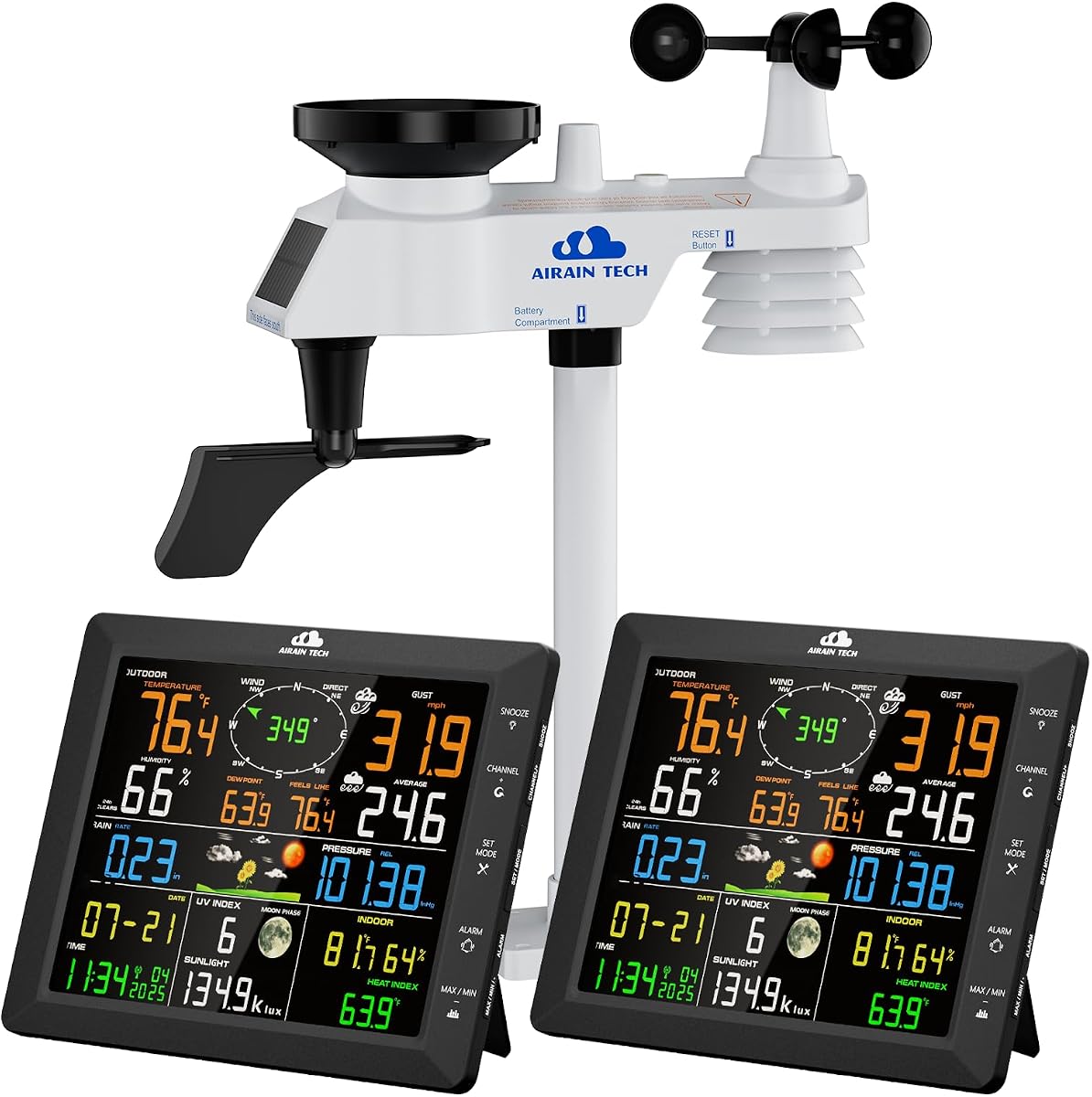
The Wireless Weather Station with Dual Displays is built around an unusually large 8.5-inch color LCD and a generous set of household features. Its 4.4 rating indicates strong customer reception. The main screen brings together wind speed and direction, future weather trends, indoor and outdoor temperature and humidity, barometric pressure changes, and other readings in a single large layout.
We may earn a commission when you buy through this link, at no additional cost to you.
The outdoor sensor transmits temperature, humidity, rainfall, wind speed and direction, moon phase, UV index, wind chill, dew point, and barometric pressure. Temperature accuracy is listed as plus or minus 2 degrees Fahrenheit or 1 degree Celsius, while humidity accuracy is listed as plus or minus 5 percent across a 10 to 99 percent range. The stated transmission radius is 328 feet, or 100 meters.
Two main display units are included, a notable advantage for placing one screen in a primary living area and another in a bedroom, office, or kitchen. Brightness is adjustable, and the included power adapter, outdoor sensor, mounting pole, bracket, hardware, and device base support a complete installation. The outdoor unit can auto-pair and sync after power-on, which simplifies initial configuration. There is no Wi-Fi, however, so remote access and automated smart-home use are outside the stated feature set.
This is a compelling pick for readers who prioritize physical screen size and want two visible locations. It also provides enough measurements for environmental education and detailed household planning. Buyers who need phone-based remote monitoring should instead favor a connected model. Otherwise, the dual 8.5-inch screens, broad sensor coverage, and straightforward synchronization make this an attractive large-display alternative.
The inclusion of two main display units is unusual in this category. It allows the same outdoor measurements to be visible in two separate areas, which is especially convenient for homes with widely separated living spaces.
Wind chill, dew point, UV index, moon phase, pressure changes, rain, and wind data are presented alongside familiar temperature and humidity readings. The range of metrics can support detailed observation and educational use.
We may earn a commission when you buy through this link, at no additional cost to you.
The right weather station depends on where the console will be viewed, which environmental measurements matter, and whether remote access or automation is important. Use the following factors to narrow the field before comparing final features and installation requirements.
A large display is most useful when it is viewed across a kitchen, bedroom, family room, or home office. It should present the most important readings clearly rather than squeezing too many small fields onto one panel. Color forecasts, trend indicators, bold temperature numbers, and adjustable brightness all contribute to quick interpretation. Product listings may describe a display as large without providing exact dimensions, so buyers should review photographs and the included specification details before ordering.
Choose a screen that remains legible from the intended viewing distance and in the room's typical lighting. Dual-display models can extend the same information to more than one location, while display-focused buyers should prioritize color screens and clearly separated data regions.
Temperature and humidity are common to nearly every station, but outdoor coverage varies dramatically. Some products add wind, rainfall, barometric pressure, UV index, solar radiation, dew point, heat index, wind chill, or lightning. More measurements are not automatically better; they matter when the household plans to use them for gardening, irrigation, outdoor comfort, pool care, or weather education.
Start with the readings you will actually use. Choose a basic temperature-and-humidity model for indoor monitoring, a wind-and-rain system for yard awareness, or a network station when remote access and automation justify added complexity.
A forecast display is most useful when it shows a readable condition icon, a tendency indicator, and a timeframe that consumers can interpret. Several stations use barometric pressure and local elevation to personalize short-range predictions. Some also require a calibration period of approximately seven to 10 days before the forecast reaches its intended accuracy.
Buyers should distinguish between a local forecast generated by the station and forecast data delivered through a connected service. Both can be useful, but they may offer different time spans, update schedules, and detail levels.
Wireless range determines whether the outdoor sensor can be mounted where it will capture representative conditions without signal obstruction. Stated ranges in this guide range from 330 feet to more than 1,000 feet, with some figures applying only without obstructions. Walls, floors, neighboring buildings, and the distance between sensor and console can all affect performance.
Estimate the real installation path rather than relying only on the maximum figure. It is also important to select a mounting location exposed to the conditions the sensor is designed to measure while still being practical and safe to maintain.
Wi-Fi and app support are decisive features for users who want remote monitoring, notifications, historical dashboards, or automated responses. Some stations connect directly to smart-home ecosystems such as Alexa, Google Home, IFTTT, or Rachio, allowing weather conditions to influence lights, thermostats, and irrigation. Other products are entirely local and deliberately omit Wi-Fi.
Decide whether a phone-based workflow is a convenience or a requirement. Local stations generally provide the most direct display experience, while connected systems are better for remote access, data sharing, and automation.
Customizable high and low alerts are valuable for protecting plants, pets, children, or sensitive equipment. Min/max records provide a quick record of recent extremes, while pressure history and trend arrows can provide context before a larger weather change. Atomic time, alarm, snooze, calendar, and daylight saving functions are especially helpful when the console also serves as a household clock.
Prioritize alerts that match your routine. A model with clear thresholds and records may be more useful than one with a longer list of advanced measurements that you rarely consult.
Power requirements differ across the guide. Some consoles run continuously from an included AC adapter, while others dim after a short illumination period when running on batteries. Backup batteries can preserve operation during outages, but batteries are not included for many of the listed products. Outdoor sensors may require AA or AAA cells, and connected systems may need a stable network and compatible account.
Review every included and required component before installation. Low-maintenance designs without moving parts can be especially attractive for rooftop, yard, or difficult-to-reach sensor locations.
Begin by deciding what the indoor console should show and where the outdoor sensor can be mounted safely. Install batteries in the sensor, mount it according to the included instructions, and position the console where the screen is easy to see. Connecting power and allowing the station to pair may be enough for automatic models, while others require settings for time, units, alerts, and wireless network access.
Give newly installed barometric stations the stated seven-to-10-day calibration period when possible. During that time, compare forecasts with local conditions and confirm that alert thresholds reflect the temperatures, humidity, or wind levels that matter to the household. For connected products, set up the compatible app, permissions, remote notifications, and any desired automations before considering the setup complete.
Clean the outdoor sensor periodically according to its manual, taking care not to scratch sensitive components or dislodge calibration elements. Replace batteries before long absences, check wireless connections after major household changes, and keep the indoor console away from direct heat, moisture, and excessive dust. Periodically verify the clock, units, alerts, recorded extremes, and sensor readings against another reliable instrument.
The Newentor Wireless Indoor Outdoor Thermometer is among the simplest choices because it includes one remote sensor, supports plug-in power, and offers a battery mode with an automatic dimming backlight. The Wireless Dual Display Station also describes automatic pairing and synchronization after power-on. In either case, reading the included manual before mounting the sensor will reduce setup problems.
Wind and rain sensors are worthwhile if you garden, monitor an outdoor property, plan around weather events, or want a broader picture of backyard conditions. They are less essential when the main goal is checking indoor temperature, household humidity, and a basic short-range forecast. The AcuRite Iris and Ambient Weather models provide a practical middle ground between thermometers and highly connected systems.
A local station displays information on its console without requiring an account or internet connection. A Wi-Fi station can add remote viewing, historical dashboards, phone notifications, network sharing, and smart-home automations. Local displays are usually more direct, while connected systems are better for users who want weather data to control devices or remain accessible away from home.
Barometric forecast stations learn the local relationship between pressure patterns and observed weather. Allowing approximately seven to 10 days of operation helps the console establish a suitable baseline for the location. During this period, keeping the console powered and allowing regular outdoor sensor readings can improve the usefulness of its personalized forecast.
Yes. The Newentor, AcuRite Iris, La Crosse C85845-INT, S84107, Advanced Weather Station, and Wireless Dual Display Station can operate as local displays without Wi-Fi. Their remote monitoring, app access, sharing, and automation options are limited or unavailable compared with the Ambient Weather, Tempest, and connected La Crosse systems.
The AcuRite Iris is a strong all-around choice because its large color LCD combines temperature, humidity, wind, rainfall, pressure, calculated comfort readings, and a personalized forecast. For a more decorative local display, the La Crosse S84107 offers seasonal foliage backgrounds and pressure history. Buyers should also consider how bright the room is at night and whether the station supports adjustable backlighting.
The outdoor sensor should be placed within the station's stated range, while accounting for obstructions that may reduce performance. Depending on the model, the listed unobstructed range is 330 feet, 328 feet, 400 feet, or more than 1,000 feet. Avoid placing the sensor where a wall, roofline, or other barrier interrupts the clearest signal path.
Customer ratings are useful for gauging overall satisfaction, but they do not independently verify measurement accuracy. Accuracy can depend on sensor placement, local exposure, calibration, power, and wireless communication. Review the stated measurement ranges and accuracy specifications, then position the outdoor sensor according to the manufacturer's instructions to achieve the best practical results.
The AcuRite Iris is the most balanced all-around option, pairing a large color screen with temperature, humidity, wind, rainfall, pressure, historical data, and personalized forecasts. The Newentor Wireless Thermometer stands out as the best budget-focused choice, while the Tempest Weather Station is ideal for smart-home users who prefer app-based remote access and automation over a physical console.
Prioritize the measurements you will use, the location of the console, and the importance of remote access. A basic temperature-and-humidity model is sufficient for many homes, but wind, rain, pressure history, and connectivity become valuable when the station supports a garden, pool, outdoor workspace, or automated irrigation. Installation range and required batteries deserve equal attention because they determine whether the system will work reliably in its intended location.
Customer ratings can help identify popular and well-regarded models, but the supplied ratings do not replace personal requirements or testing in the intended setting. Features, bundle contents, and current availability may also change over time. Check the latest product listing, included manual, installation requirements, and current price before making a final purchase decision.