
7400931 MHX XNT Transducer Bracket
4.6Editor score
Wide XNT transducer compatibility
Marine-grade mounting construction
Two-slot angle adjustment
Compare the 10 best depth finder transducer mounts for boats and kayaks, evaluating compatibility, installation, adjustability, portability, and marine
A depth finder transducer mount determines where your sonar sensor sits, how precisely it can be aimed, and whether the installation can withstand a day on the water. The right bracket should match your vessel, support your transducer, resist corrosion, and permit the angle and height adjustments needed for clear readings.
This guide compares ten options spanning portable stern pads, transom brackets, kayak arms, universal clamps, and model-specific mounting plates. We evaluated each product using its stated construction, adjustment range, installation method, hardware, vessel compatibility, portability, and suitability for different transducer styles.
Each review reveals a different practical use, from screwless adhesive mounting to tool-free rail attachment and full 360-degree positioning. Ratings and availability can change over time, and current product details should be verified before purchase, but the mounting approach and included components are central to the comparison.
4.6Editor score

4.8Editor score

4.5Editor score
This side-by-side comparison shows how the ten mounts differ in attachment style, adjustability, construction, compatibility, and intended vessel type, helping you identify the most practical option for your transducer setup.


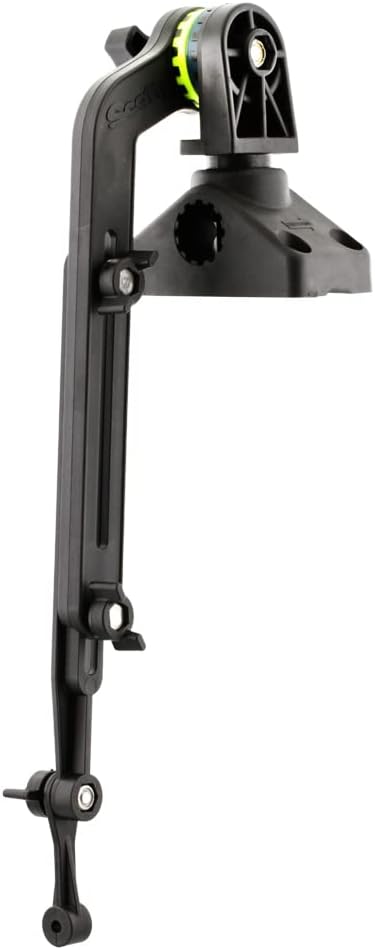
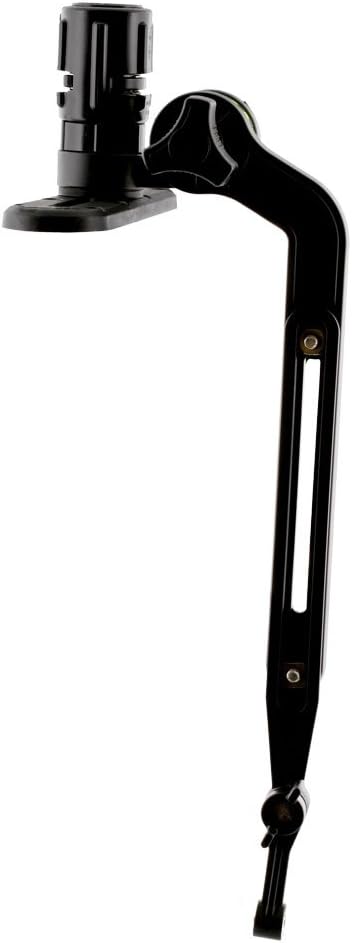


The Portable Transducer Bracket- Made in USA is a no-drill mounting solution for anglers who want a transferable transducer setup. Its 4.5 rating reflects a practical balance of aluminum construction, simple removal, and a generous 15- to 23-inch adjustment range. The bracket also provides a stable base for positioning a sonar sensor outside the hull.
We may earn a commission when you buy through this link, at no additional cost to you.
The centerpiece is a C-clamp that can attach to a compatible boat feature without forcing the user to drill permanent holes. The clamp opens to 2.375 inches, while the sliding bracket allows quick depth adjustments. A threaded opening on top accepts the MR75-45 add-on electronics mount, extending the system beyond basic transducer placement without changing the primary attachment method.
The main limitation is that this is a mount rather than a complete sonar package; no transducer is included. Its clamp must also fit the intended attachment point within the stated opening, and the overall geometry may not suit every hull, rail, or tiller configuration. These constraints are reasonable for a portable setup, particularly when avoiding permanent modifications is the priority.
This bracket is best for boat owners who relocate their electronics between vessels, fish from different watercraft, or strongly prefer a removable installation. It is also attractive for anyone who needs both transducer support and a threaded location for an additional electronic accessory. For those priorities, it is the most adaptable premium-style option in the group.
The C-clamp design keeps the installation reversible, making it easier to move the mount between compatible boats or remove it when the craft is not in use.
A 15- to 23-inch bracket range and quick depth adjustment let the user alter sensor height to suit different hull shapes, water conditions, and fishing styles.
We may earn a commission when you buy through this link, at no additional cost to you.
The Standard Black Stern Pad provides a clean, screwless way to mount a transducer on a boat stern. It earns a 4.6 rating and stands out for an installation process that takes less than five minutes of active work, plus the inclusion of three cable clips. The compact 4.5- by 3.5-inch pad is designed for standard transducers and accessories rather than large 3D scanning units.
We may earn a commission when you buy through this link, at no additional cost to you.
Unlike a conventional bracket, this product bonds to the hull using an adhesive installation. That avoids holes, exposed fasteners, and epoxy work, making it especially attractive to owners who care about the appearance and long-term condition of their boat. Its surface can be bottom painted, allowing the installation to blend more closely with the hull.
The adhesive system requires patience. Although installation takes less than five minutes, the listed cure time is 18 hours, so the transducer should not be treated as a permanent load immediately after mounting. It also lacks the obvious height adjustment of a sliding arm and may not accommodate the dimensions or profile of a large 3D scanning transducer.
Choose this pad when a clean, permanent-looking stern installation matters more than frequent repositioning. It is well suited to standard transducers, uncluttered cable routing, and anglers who do not want to drill their hull. The included clips also make it easier to secure the cable after the sensor is positioned.
The screwless design leaves no mounting holes and can be bottom painted, helping the pad integrate visually with a painted stern.
Three screwless cable clips help control the transducer lead, reducing movement and keeping the installation tidy without additional separately purchased pieces.
We may earn a commission when you buy through this link, at no additional cost to you.
The 7400931 MHX XNT Transducer Bracket combines broad XNT compatibility with an inexpensive, straightforward transom installation. Its 4.6 rating reflects a well-liked bracket that can support numerous Humminbird-style transducer configurations. The two-slot design allows the sensor angle to be refined, while the included hardware supports direct attachment to the boat.
We may earn a commission when you buy through this link, at no additional cost to you.
Compatibility is the defining strength. The listed model coverage includes XNT 9 20, XNT 9 20 T, XNT 9 28 T, XNT 9 DI T, XNT 9 HW T, XNT 9 HW MDI 75 T, XNT 9 QB 90 T, XNT 9 QB 90, XNT 9 SI 180 T, XNT 14 DI T, XNT 14 20 T, XNT 14 74 T, XNT 14 HW T, XNT 9 DB 74 T, XNT 9 HW DI T, XNT 9 HW MSI 150 T, and XNT 9 HW SI T.
The product also describes compatibility with a range of Humminbird HELIX, SOLIX, ICE HELIX, ION, ONIX, and numbered display series, although the transducer model still needs to match the bracket's supported patterns. Installation requires three holes in the transom. That permanent modification is the principal drawback, especially for fiberglass, wood, or rented boats where drilling may be undesirable.
This bracket is a compelling choice for anglers with a listed XNT-family transducer who want a secure transom mount and angle adjustment at a modest cost. It is less suitable for a universal boat with arbitrary mounting hardware, and buyers should verify the exact model number before ordering. When compatibility aligns, it offers a focused and adaptable installation.
The broad list of supported XNT models gives owners of common Humminbird-style sensors a higher-confidence path to a mechanically appropriate fit.
Two mounting slots permit incremental height and angle changes, helping the transducer align with the hull and intended sonar coverage.
We may earn a commission when you buy through this link, at no additional cost to you.
The Universal Kayak Fish Finder Mount is designed for anglers who want fast, tool-free transducer placement on a kayak gear track. Its 4.1 rating is the lowest in this group, but the specification set remains focused: a complete kit, a nine- to 14-inch adjustable arm, and compatibility with most Garmin, Lowrance, and Humminbird fish finders.
We may earn a commission when you buy through this link, at no additional cost to you.
The included base, gear track, transducer arm, and hardware simplify the purchase because a separate rail may not be necessary. Installation requires no drilling or complex tools, which is a major advantage for mobile setups, shared kayaks, and anglers who switch craft frequently. The arm can be fine-tuned to alter the transducer's angle and depth for the selected kayak and fishing conditions.
Construction combines marine-grade composite with stainless steel, providing a practical balance between weight and resistance to outdoor exposure. The trade-off is that the fixed arm range is narrower than the telescoping Scotty options, and attachment depends on having a compatible gear-track system. The product's 4.1 rating also suggests that buyers should examine current owner feedback for details not covered in the listed specifications.
This mount is best for a kayak angler who prioritizes quick setup and removal over the broadest range of extension positions. It is especially attractive when the display brand is one of the major systems named in the description. Confirm the track fit, transducer bracket pattern, and desired arm clearance before installation.
Tool-free installation makes it possible to move between compatible kayaks or begin fishing without completing a permanent modification.
The adjustable nine- to 14-inch arm provides enough movement to tune the transducer angle and depth for a typical kayak installation.
We may earn a commission when you buy through this link, at no additional cost to you.
The Scotty #140 Kayak/SUP Transducer Mounting Arm is built around precise positioning in a compact paddlecraft installation. It carries a 4.6 rating and combines a telescoping arm, 360-degree swivel, and 415 slip discs. The package includes the 241L Locking Combination Side/Deck Mount and a Scotty Post that fits Scotty Rod Holder Mount systems.
We may earn a commission when you buy through this link, at no additional cost to you.
The arm telescopes from 11.5 inches when compact to 18 inches when fully extended, giving it more reach than shorter universal kayak arms. Slip disks provide the fine adjustments needed after the larger position is established. This is especially useful when the transducer must sit clear of the hull, remain level, or avoid interference from the kayak's movement.
The mounting system is not entirely self-contained for every desired configuration. Although the side/deck mount and post are included, a compatible Scotty accessory or additional transducer support may be needed. The requirement for Scotty-compatible mounting points may also make it less attractive than a universal clamp for a boat with a different rail arrangement.
This arm is a strong fit for kayak and SUP anglers who already use Scotty accessories or value fine-tuning over completely tool-free installation. Its broad extension and swivel range also make it useful for transport-oriented setups. Buy it when your attachment points and transducer hardware align with the Scotty post platform.
The included 415 slip disks support micro adjustments after the main arm position is set, helping maintain a stable transducer angle.
The arm collapses to 11.5 inches for storage while extending to 18 inches, balancing kayak portability with useful deployment reach.
We may earn a commission when you buy through this link, at no additional cost to you.
The Scotty 0141 Kayak/SUP Transducer Mounting Arm is a modular option for paddlecraft anglers who want to reuse Scotty accessories. It has a 4.6 rating, a 360-degree swivel, and an 11.5- to 18-inch telescoping range. Unlike the #140 model, its defining feature is the included 438 gear-head track adapter.
We may earn a commission when you buy through this link, at no additional cost to you.
That adapter works with Scotty slide track and allows the universal sounder mount to be attached when desired. A fish-finder mount or another compatible Scotty post-mount accessory can also be dropped and locked on top. This interchangeability is useful for anglers who carry different tools or change their sonar arrangement between trips.
The arm is made from high-strength composite material, which suits kayak applications where minimizing weight matters. Its limitation is that the universal sounder mount, slide track, and other accessories are sold separately. As a result, buyers must determine which pieces are required for the intended setup rather than treating the package as a complete sonar installation.
Choose the #141 when modularity and compatibility with an existing Scotty setup matter more than having every component in the box. It is particularly useful for transport applications and users who may switch between a transducer mount and other post-mounted accessories. Verify the required track and sounder pieces before purchase.
The gear-head track adapter lets the arm work with Scotty slide-track equipment and post-mounted accessories instead of serving as a dedicated transducer arm alone.
The locking top connection allows a fish-finder mount or other Scotty accessory to be removed and exchanged without rebuilding the base installation.
We may earn a commission when you buy through this link, at no additional cost to you.
The Perception Kayaks Fish Finder Transducer Mounting Plate is a purpose-built solution for compatible Perception and Wilderness Systems fishing kayaks. Its 4.2 rating reflects a specialized product with a limited fit but a straightforward installation. The plate's mounting holes align with molded inserts in the specified fish-finder consoles, reducing guesswork during setup.
We may earn a commission when you buy through this link, at no additional cost to you.
Constructed from high-density polyethylene, the plate can be drilled to accommodate hole patterns from most transducer brackets. Stainless steel mounting hardware and instructions are included, while hardware for the transducer itself is not. A recessed side accommodates backing hardware, helping the plate sit securely and neatly against its intended mounting surface.
Compatibility is both the strength and the limitation. The product lists the Perception Pescador Pro 100 and 120, Pilot 120, Outlaw 11.5, and Crank 10, along with Wilderness Systems Recon and Recon HD. Owners of other kayaks should not assume the molded inserts or geometry will match, even if the overall dimensions appear similar.
This plate is best for an angler whose kayak is on the supported list and who wants a clean, dedicated mounting surface. It offers more certainty than a generic drillable plate for those specific craft. Verify the exact kayak model, inspect the console location, and confirm the transducer's hole pattern before ordering.
Holes that line up with molded inserts make this plate faster and more orderly to fit on the listed Perception and Wilderness Systems models.
Because the polyethylene plate can be drilled, it can accept many common transducer bracket patterns rather than enforcing one narrow layout.
We may earn a commission when you buy through this link, at no additional cost to you.
The RAM MOUNTS Fish Finder Mount is the most highly rated option in this roundup, with a 4.8 rating. It is designed to place Humminbird HELIX 8, 9, and 10 displays and the SOLIX 10 using a robust ball-and-socket system. The result is a highly adjustable mounting platform for anglers who want precise control over screen visibility and position.
We may earn a commission when you buy through this link, at no additional cost to you.
Power-coated, marine-grade aluminum provides a durable foundation, while the rubber ball and socket arrangement allows near-infinite adjustment within the assembled arm's geometry. The package includes a 3.68-inch round base, a short double-socket arm, and a 1.5- by 4.5-inch rectangular base with a D-size ball. This is a display mount rather than a dedicated transducer bracket, so it is valuable in broader electronics arrangements.
The primary drawback is that the included base is intended for a drill-down flat-surface installation, making it less attractive for owners committed to leaving the boat completely unmodified. It also does not itself solve every transducer-positioning requirement. Buyers need to consider the transducer's own bracket separately unless their existing setup already handles that part.
This is the top general choice for a boat with a compatible Humminbird display, particularly when screen angle, accessibility, and repeatable positioning are priorities. The included components and lifetime warranty add confidence for long-term marine use. Pair it with a suitable transducer mount when the full sonar installation requires both.
Ball-and-socket construction lets the display move through a wide range of angles and orientations, supporting better visibility from different seating positions.
Powder-coated aluminum and a rubber ball-and-socket system are suited to repeated outdoor exposure and demanding boat environments.
We may earn a commission when you buy through this link, at no additional cost to you.
The white Standard Stern Pad offers a clean, screwless stern installation using genuine 3M VHB adhesive. It shares the same 4.6 rating and core dimensions as the black version, but its light color may blend better with certain hull finishes. The package includes one standard white stern pad, three screwless cable clips, and an installation kit.
We may earn a commission when you buy through this link, at no additional cost to you.
The adhesive approach avoids drilling the hull and eliminates messy epoxy work. Installation requires less than five minutes of active effort, followed by the stated 18-hour cure time. Once prepared according to the instructions, the pad can be bottom painted and used as a stable surface for a standard transducer or compatible accessory.
Like the black stern pad, it has a compact 4.5- by 3.5- by 0.75-inch profile and is explicitly not intended for large 3D scanning transducers. The bond is permanent rather than readily adjustable, so transducer placement should be decided carefully before adhesive application. A translucent or white appearance may also be less noticeable than black on a light hull but more visible on a dark one.
Choose this model for a standard transducer and a clean permanent stern mount, particularly on a light-colored hull where black hardware would stand out. It is not the best option for frequent repositioning or large scanning sensors. The genuine VHB system and included cable management make it a refined version of the adhesive-mount approach.
The white finish can blend more naturally with a light hull while preserving the clean appearance of a screwless installation.
Genuine 3M VHB adhesive provides a mechanically substantial attachment without requiring holes, screws, or a separate epoxy fill.
We may earn a commission when you buy through this link, at no additional cost to you.
The Universal Fish Finder Mount is a broad portable bracket for anglers moving between boats, kayaks, canoes, and other small craft. It has a 5.0 rating in the supplied data and combines high-grade nylon with CNC-machined aluminum alloy. Its versatility comes from a clamp, adjustable height, and 360-degree positioning system.
We may earn a commission when you buy through this link, at no additional cost to you.
The clamp accepts openings up to 3.15 inches, allowing attachment to compatible boat rails, kayak tracks, and canoe posts. The arm rotates freely so the transducer can be oriented for different vessels and sonar conditions. A detachable design supports quick removal and transport, while the listed weight of 2.09 pounds keeps the assembly manageable.
Its pole-style form measures 4.7 by 31.5 inches, so storage space and total height should be considered. The system also depends on finding a rail, track, or post that matches the clamp's geometry and can support the load. Although the product title describes broad fish-finder compatibility, the transducer's physical bracket pattern and the installation surface still need verification.
This mount is best for a multi-vessel angler who wants one adjustable system rather than separate fixed hardware. It is also useful for temporary setups because no permanent drilling is required. For a user seeking strong compatibility across common mounting locations, easy orientation changes, and a detachable design, the product's 5.0 rating makes it a particularly compelling candidate.
The three-inch-class clamp opening and adjustable height suit many common boat rails, kayak tracks, and canoe posts without a permanent hull modification.
A 360-degree rotating bracket lets the user fine-tune the sensor direction as the vessel, water conditions, and target presentation change.
We may earn a commission when you buy through this link, at no additional cost to you.
The best depth finder transducer mount is the one that fits your transducer, attaches securely to your vessel, holds the intended position, and suits the way you fish. Compatibility and installation method deserve the most attention, followed by adjustment range, corrosion resistance, weight, and included hardware.
Start with the exact model number and mounting pattern of your transducer. A universal product may support a broad range of fish finders while still requiring a specific adapter or bracket interface. The MHX XNT option is the clearest example of model-specific compatibility in this group, explicitly listing numerous XNT and Humminbird-related models. Other mounts, such as the Scotty arms and universal clamp, are more dependent on the physical shape of the sensor, its mounting holes, and the hardware used to connect it to the arm.
Consider whether your boat can be modified and how often you expect to move the installation. A transom bracket drilled with three screws can be stable and direct, but it permanently changes the hull. Adhesive stern pads leave no holes and look clean, although they demand careful surface preparation and a full cure. Rail clamps and gear-track mounts permit quick removal and suit shared or multi-vessel setups. A model-specific plate may provide the most orderly fit when the kayak has molded inserts designed to accept it.
Transducer position affects the direction of the sonar beam and can influence bubbles, turbulence, and interference. A useful mount should provide enough freedom to change height and angle without making the sensor wobble. The two-slot bracket offers incremental tuning, the universal clamp supports 360-degree rotation, and the Scotty arms combine telescoping length with swiveling and, on the #140, slip-disc fine adjustment. Fixed adhesive pads provide less opportunity to reposition after bonding, so final placement matters especially much for them.
Salt, spray, sunlight, and repeated handling demand durable hardware. Aluminum, stainless steel, high-strength composite, high-density polyethylene, and marine-grade composite each have different advantages. Metal components provide stiffness, while composite and polyethylene can reduce weight and simplify drilling. The material specification should be considered alongside the joint design, clamp surfaces, and whether moving pieces include corrosion-resistant hardware. A strong body alone does not compensate for an attachment point that is too weak or a geometry that allows the sensor to shift.
Portability is critical for kayaks, canoes, SUPs, and anglers who fish from more than one craft. Compact telescoping arms can collapse for storage, while a detachable clamp makes transportation and seasonal storage convenient. However, a longer arm may improve positioning yet take up more space in a vehicle or kayak. Check the packed dimensions as well as the installed height, and consider whether quick-release features matter more than a low-profile permanent setup.
A complete package can make setup faster and reduce the risk of discovering a missing fastener after the boat is prepared. The RAM mount includes its bases and ball-and-socket components, the kayak universal mount includes a base, gear track, arm, and hardware, and both stern pads include cable clips and an installation kit. Other brackets may require separate screws, a transducer adapter, or a compatible rod-holder post. Read the package list closely and compare it with the hardware already present on your boat.
The best mounting surface is the one that remains rigid, accessible, and suitable for the vessel's intended movement. Kayak owners should look for gear tracks, console inserts, or established accessory posts. Power-boat owners may have a transom, rail, or other structural feature that can accept a clamp or drilled bracket. Stern pads work directly against the hull but require an uninterrupted, clean bonding area. Always identify the attachment location before ordering, and make sure the transducer will sit in clean water without touching the hull, prop, rudder, or trim hardware.
The transducer cable must follow the hull without kinks, sharp bends, abrasion, or strain on the sensor connection. The stern pads include three screwless cable clips, which helps create a controlled route from the mount to the electronics. Rail and arm systems should similarly include retention points near the base. Secure the cable to moving or fixed components appropriately, but do not create a tight radius around the cable. Good cable management supports consistent transducer performance and prevents an otherwise secure mount from being damaged during launching or transport.
Begin by identifying the transducer model, checking every included component, and comparing the mount's dimensions with the intended attachment location. Confirm that the sensor can reach clean water and that the cable will not interfere with the hull, rudder, prop, steering, or trailer. For an adhesive stern pad, follow the surface-preparation instructions carefully, keep the area dry, position the pad accurately, and allow the full stated cure time before attaching loads.
For a clamped or transom-mounted bracket, attach the base securely, install the transducer according to its instructions, and make small angle or height adjustments while the boat is in a normal operating position. Tighten all fasteners without overtightening them. On ball-and-socket or swivel systems, check the joint under hand pressure, and confirm that the sensor remains stable after the boat moves. Route the cable with gentle bends and secure it at suitable intervals.
After each outing, rinse the mount and transducer with fresh water, particularly after use in salt water, and remove sand, mud, and salt deposits with a soft brush. Inspect clamps, screws, swivels, slots, and cable clips for loosening, wear, or corrosion. Avoid abrasive cleaners and high-pressure water aimed at moving joints. Recoat a scratched protective finish when appropriate, and replace damaged hardware before the next trip. For adhesive installations, inspect the bond and avoid repeatedly loading or prying the pad.
It depends on the kayak and the transducer. Some paddlers already have a gear track, rod-holder post, console insert, or other attachment point capable of supporting a compatible arm. Kayak-specific products in this guide address gear-track, Scotty post, and Perception mounting arrangements. Confirm the transducer's bracket pattern and the available mounting surface before purchasing a separate system.
Universal usually describes the vessel-side attachment or general product format, not guaranteed compatibility with every sensor shape. The transducer must have a compatible mounting pattern or an adapter must connect it to the arm. Also check its weight, dimensions, cable connection, and required clearance. A model-specific list provides a stronger compatibility signal than the word universal alone.
A drilled transom bracket offers adjustable positioning and can be removed, although it leaves holes. An adhesive stern pad avoids drilling and can look cleaner, but placement is permanent and the adhesive needs proper preparation and a full cure time. Boats that will be refinished or sold may favor a removable mount, while owners prioritizing an untouched hull may favor the adhesive approach.
Enough movement to eliminate bubbles, align the sonar beam with the intended coverage, and keep the sensor clear of the hull. Small angle and height changes can matter considerably. Brackets with slots, telescoping arms, and swivels provide more tuning options, while a fixed pad requires careful placement before bonding. Test the finished position while the boat is sitting and moving.
Many products are explicitly designed for marine environments, using aluminum, stainless steel, marine-grade composite, or other corrosion-resistant materials. Nevertheless, freshwater rinsing after use is still important, especially for moving joints, adjustment slots, and fasteners. Inspect stainless hardware and isolate dissimilar metals when doing so is practical. The manufacturer's care instructions should take priority.
No. These products are mounting hardware, and most explicitly exclude the transducer. The stern pads include cable clips and an installation kit, while some arms include base hardware but require a universal sounder mount or other accessories separately. The RAM product is intended primarily as a display mount. Always review the package contents to identify what must still be purchased.
A transom mount attaches to the rear panel of the boat, often with screws or a clamp designed for that surface. A rail mount grips a rail, track, or post, making it easier to remove and often useful across multiple craft. A rail system may need an adapter to connect to the transducer, while a dedicated transom bracket may use a fixed, model-specific hole pattern.
The sensor should sit in clean, moving water and remain clear of the hull, bubbles, weeds, trim tabs, prop, and rudder. It also needs enough room to avoid damage during launch and transport. Begin with the manufacturer's recommended orientation, then make small adjustments while checking the electronics display. Secure the cable without sharp bends or strain at the connector.
The 7400931 MHX XNT Transducer Bracket is the best-value choice for owners of a listed XNT-style transducer, combining broad model coverage with angle adjustment and straightforward transom installation. The RAM MOUNTS Fish Finder Mount earns the editor's choice for exceptional display positioning and marine construction, while the Portable Transducer Bracket- Made in USA is the most flexible premium-style option for a removable, no-drill setup.
Prioritize compatibility before every other feature. Confirm the transducer model, attachment point, cable route, and required clearance; then choose between permanent drilling, adhesive bonding, and removable hardware according to how the boat is used. Kayak and multi-vessel anglers should also compare reach, swivel control, packed size, and whether the mount works with their existing track or post system.
Product ratings, included components, and availability can change, so check the current listing before making a final decision. Current pricing should also be compared across sellers, while considering any additional adapter, post, track, or transducer hardware that is not included. The best choice is ultimately the mount that fits correctly, stays secure, and allows the sonar sensor to operate where it can do its job.