
1/2" Hall Effect Flow Sensor
4.7Editor score
1–30 L/min range
NPT threaded connection
Dry sealed Hall sensor
Arduino flow meters make it possible to measure moving water and other compatible fluids through pulse-based sensing. The right model depends on pipe size, expected flow rate, electrical requirements, installation style, and whether the project needs a simple switch or a detailed flow calculation.
This guide compares ten Hall-effect and turbine water flow sensors using their published specifications, including flow range, connection size, operating voltage, pressure limits, output type, and stated Arduino compatibility. It also highlights practical differences that matter when wiring a controller, selecting compatible tubing, or planning a water-monitoring project.
Each review highlights the most useful strengths and limitations of the selected sensor, from compact low-flow options to higher-capacity inline models. Ratings and availability can change, as can marketplace pricing, so check the current listing and technical details before buying parts for a project.
4.7Editor score

5.0Editor score

4.8Editor score
As an Amazon Associate we earn from qualifying purchases.
The comparison below places all ten sensors side by side by connection, measurement range, electrical characteristics, and output method. It is intended to make it easier to identify a model that fits both the physical plumbing and the signal requirements of an Arduino project.


This compact 1/2-inch Hall flow sensor combines a 1–30 L/min measurement range with a sealed magnetic sensing system, earning it a 4.7 rating among buyers. Its strongest qualities are the useful low-to-moderate flow range, straightforward threaded installation, and a design that keeps the electronics away from the water stream.
We may earn a commission when you buy through this link, at no additional cost to you.
The sensor uses an integrated magnetic Hall effect component to generate an electrical pulse whenever its rotating internal assembly completes a revolution. That relationship between water movement and pulse frequency makes the device suitable for an Arduino project that counts pulses, estimates flow, or accumulates water usage. The stated NPT thread also simplifies compatibility with common 1/2-inch plumbing arrangements when appropriate fittings and compatible thread standards are used.
Correct flow direction is essential. The product information states that installing it against the indicated flow direction can prevent signal output, which is a meaningful limitation for first-time builders. The compact body is another benefit, but it leaves less room for error around fittings, and the product description does not provide a detailed electrical pin diagram. A project plan should therefore include the manufacturer's wiring guidance and the Arduino board's available supply current.
This is a sensible selection for water dispensers, purification equipment, coffee machines, and modest household monitoring projects. It is especially attractive for makers who want a capable inline sensor without moving to a larger flow range. Confirm the physical thread, expected flow, and pinout before installation, and ensure the sensor is oriented so the water follows the marked direction.
The 1–30 L/min specification covers many common household and small appliance flows without requiring the larger body and higher capacity of a G1.5-inch model. It is a useful balance for prototypes, replenishment systems, and compact water-monitoring builds.
The sealed Hall sensor is separated from the water pipe according to the product description, helping protect the sensitive electronics while the internal rotor turns. This arrangement also produces discrete pulses that an Arduino interrupt can count.
We may earn a commission when you buy through this link, at no additional cost to you.
The DEVMO 1/2-inch Hall sensor offers a 1–30 L/min range, a 4.9 rating, and clearly defined output levels. It is aimed at water testing and cooling systems, making it attractive for Arduino builders who need an unambiguous pulse signal rather than a simple visual rotor indicator.
We may earn a commission when you buy through this link, at no additional cost to you.
One of its most useful specifications is the output distinction between a high amplitude of at least 4.6 volts and a low amplitude of no more than 0.5 volts. These values help when selecting input circuitry, checking logic levels, or diagnosing a sensor that is not producing expected readings. The product is also described as suitable for water heaters, credit-card machines, water vending machines, and dedicated flow measurement equipment.
The listing provides less information about mechanical connection details and cable arrangement than some alternatives. It identifies a 1/2-inch water connection, but does not provide the same detailed thread and cable guidance offered by several DIGITEN models. Electric strength is listed as 1250 volts per minute, adding some information about intended electrical conditions, although it should not be treated as a complete safety specification for an arbitrary installation.
Buyers should favor this model when crisp high-and-low signal states are valuable and the intended use falls within 1–30 L/min. It is a strong candidate for water-testing rigs, cooling loops, and appliance experiments. Before connecting it to an Arduino, verify the actual wire functions, required supply voltage, and logic-level compatibility with the selected board.
Published high and low amplitudes make it easier to confirm that the Hall sensor is changing states as the rotor turns. These electrical details are especially helpful when troubleshooting wiring or intermittent readings.
The stated uses cover both general water testing and water cooling systems. That versatility makes it suitable for compact rigs where flow visibility and basic control are both required.
We may earn a commission when you buy through this link, at no additional cost to you.
This DIGITEN sensor combines a 5–150 L/min range with a 5.0 rating, making it the standout option for projects that need substantially more capacity than a 1/2-inch inline model. It is explicitly described as compatible with Arduino, Raspberry Pi, and reverse osmosis filter installations.
We may earn a commission when you buy through this link, at no additional cost to you.
Its Hall effect sensor produces a square-wave pulse signal, providing a clean digital event for an Arduino interrupt or other input controller. A DC operating range of 5–18 volts is compatible with common low-voltage electronics, and the stated maximum water pressure is 1.75 MPa. The materials are described as meeting RoHS testing standards and as suitable for potable-water use, although local plumbing codes and application requirements still govern final installations.
The main trade-off is size. A G1.5-inch BSPT connection needs a larger pipe arrangement and suitable fittings, making the sensor less convenient for a tightly packed Arduino project. The listing also notes that thread seal tape is needed when the unit is used with an NPT arrangement. Its broad flow range also means the sensor may not be ideal where very small flows must be resolved accurately.
This is the top recommendation for water heaters, purifier systems, beverage machines, and other moderate-to-high-flow installations. Choose it when measured capacity and a clearly defined square-wave output matter more than compact dimensions. Verify pipe thread standards carefully and ensure the expected operating flow sits comfortably within the stated 5–150 L/min range.
The 5–150 L/min range separates this model from the more compact 1/2-inch options in the list. It is better suited to systems where water may move quickly enough that a lower-capacity sensor would operate near its upper limit.
A square-wave pulse gives the controller a repeatable event to count. When the device characteristic is known, pulse frequency can be converted into a flow estimate or used to monitor consumption over time.
We may earn a commission when you buy through this link, at no additional cost to you.
This 1/2-inch food-grade Hall flow sensor is designed for water equipment such as heaters, coffee machines, purifiers, fountains, and beverage dispensers. Its 1–30 L/min range and DC 5–24 volt operation are versatile, although its 4.1 rating is lower than those of the leading models in this guide.
We may earn a commission when you buy through this link, at no additional cost to you.
Food-grade plastic is one of its defining benefits for projects handling drinking water or preparing beverages. The product information states that all raw materials conform to RoHS testing standards. It also publishes a relationship of F=(7.5×Q)±2%, with Q expressed in liters per minute, which gives developers a more concrete basis for interpreting the pulse signal than models that provide no characteristic information.
The G1/2-inch BSPT male thread is a mechanical consideration rather than a simple universal fit. Projects using NPT components may need compatible adapters and thread seal tape. The wider 5–24 volt supply range offers electrical flexibility, but the actual connection details still need to be confirmed before wiring. A 4.1 rating may reflect the range of experiences buyers have with the product, so expectations should remain practical.
This sensor is best for compact food-and-beverage equipment, water heaters, and purification projects that specifically value the stated food-grade construction. It is a practical alternative when a 1/2-inch body and known pulse relationship are priorities. Confirm the connection type, use compatible fittings, and validate the published characteristic against your own plumbing and operating conditions.
The stated food-grade plastic construction makes this model relevant to coffee machines, beverage equipment, and drinking-water systems. It should still be evaluated within the requirements of the specific appliance and installation.
The F=(7.5×Q)±2% relationship gives the pulse characteristic for software configuration. It provides a starting point for converting sensor output into an estimated flow rate in liters per minute.
We may earn a commission when you buy through this link, at no additional cost to you.
The YF-S201C package includes two transparent G1/2-inch flow sensors with a stated 1–30 L/min range. Its transparent body and visible rotor make it especially engaging for demonstrations, and the 3.7 rating is the main reason it does not rank higher despite its useful physical design.
We may earn a commission when you buy through this link, at no additional cost to you.
The clear housing allows the operator to observe water flow and rotor behavior directly, which can help with installation checks and educational builds. Internally, the impeller contains stainless steel beads intended to add wear resistance. The sensor combines a plastic valve body, rotor assembly, and Hall element, allowing the Arduino to receive a pulse signal while the water movement is also easy to see.
There is an important version-specific electrical detail: the listing states that the black model operates across DC 3.5–12 volts, while the transparent version operates across DC 3.5–24 volts. Buyers should not assume that the voltage range printed for a different housing applies to the transparent unit they receive. The listed maximum pressure is 1.75 MPa, and the stated load capacity is no more than 10 mA at DC 5 volts.
This two-sensor set works well for teaching, prototyping, or building parallel test points. It is less compelling for a critical single-channel installation where a higher customer rating and more detailed electrical guidance would provide additional confidence. Confirm the exact version, supply voltage, connector arrangement, and pulse characteristic before final wiring.
A transparent housing makes rotor motion visible while water passes through. This immediate feedback is useful when learning how a turbine flow sensor behaves or checking for a restricted installation.
The package includes two units, allowing one Arduino project to compare channels or providing a spare for bench testing. The included quantity is the main distinction from the single-sensor alternatives.
We may earn a commission when you buy through this link, at no additional cost to you.
This 1/4-inch Hall sensor targets smaller lines and lower flows, with a 4.2 rating among buyers. It uses a G1/4-inch connector suitable for a hose with an inner diameter of approximately 5–7 mm, and its stated pulse relationship is F=(98×Q)±3% with Q in liters per minute.
We may earn a commission when you buy through this link, at no additional cost to you.
The food-grade plastic body and RoHS-conforming material claim suit appliances such as coffee machines, water heaters, purifiers, fountains, and beverage machines. A DC 5–24 volt operating range provides useful flexibility, while the smaller hose connection may be more convenient than installing threaded 1/2-inch plumbing in a compact prototype.
The product information contains an important inconsistency. The title presents a 0.3–6 L/min range, whereas the detailed specifications list 0.5–3 L/min and a maximum pressure of 0.8 MPa. Buyers should treat the smaller documented range and lower pressure limit as the conservative basis for design decisions. This discrepancy also illustrates why a project should not rely solely on a marketplace title when sizing a flow meter.
This model is a good candidate for low-volume water lines, demonstration equipment, and compact beverage-related projects. It is less appropriate where the actual flow regularly exceeds several liters per minute or where higher line pressure is expected. Verify the live listing, test with the intended hose, and confirm the sensor characteristic before calibrating the Arduino software.
The documented 0.5–3 L/min range makes this sensor more appropriate for low-volume movement than the common 1–30 L/min options. Matching the sensor to the expected flow improves the usefulness of pulse-based measurements.
A 5–7 mm inner-diameter hose connection can simplify compact bench prototypes. The seal and hose clamping arrangement should still be checked to prevent leaks or air being drawn into the line.
We may earn a commission when you buy through this link, at no additional cost to you.
The selected Taidacent YF-S201 configuration combines a 1–30 L/min range with a 5.0 rating. It is particularly well suited to water-heater inlet monitoring, where the controller can use pulse feedback to determine incoming water flow and make adjustments.
We may earn a commission when you buy through this link, at no additional cost to you.
Its operating principle is easy to understand. Water moves through the valve body and turns a magnetic rotor assembly. The rotor's rotational speed changes with the flow rate, while the Hall sensor produces a corresponding pulse signal for the controller. This approach gives an Arduino a direct way to count movement and estimate water use rather than relying on an analog voltage that could be affected by electrical noise.
The listing refers to four-point and six-point interfaces and several G1/2, G3/4, or G1 options, but the selected variant is specifically the black YF-S201 with a G1/2 four-point fitting. That distinction is essential when ordering. The sensor is described as suitable for water heaters and dispensers, yet the product details do not publish a specific pulse formula or cable length, so developers should obtain the wiring and conversion information for the exact version.
This is an excellent selection for an Arduino water-heater controller, dispenser monitoring project, or other inline flow application using 1/2-inch hardware. Its 5.0 rating is encouraging, although ratings should complement rather than replace fit and technical verification. Confirm the variant, flow direction, connector pins, and operating voltage before permanent installation.
The pulse output allows a controller to react as water moves through the line. That makes the sensor useful for replenishment logic, usage monitoring, and automatic shutoff experiments.
As water speed changes, the magnetic rotor changes rotational speed and therefore changes pulse frequency. This relationship is the operating principle behind using the Hall sensor for flow estimation.
We may earn a commission when you buy through this link, at no additional cost to you.
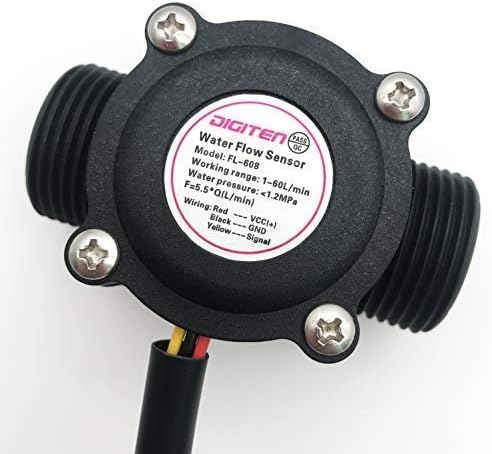
This DIGITEN G1/2-inch model is a strong all-around choice, combining a 4.8 rating with a 1–30 L/min range, an attached 1.2-meter cable, and clear square-wave output. It is explicitly listed for Arduino, Raspberry Pi, and reverse osmosis filter applications.
We may earn a commission when you buy through this link, at no additional cost to you.
The attached 3.9-foot cable is the model's most obvious convenience. Instead of building a custom cable from a short sensor lead, the user can position the flow body near the pipe and place the controller at a more comfortable distance. The SM2.54 three-pin connector also gives the electrical side a defined termination, allowing the cable and sensor to be treated as one assembly during installation.
The G1/2-inch BSPT connection requires attention to thread compatibility. The product information specifically notes that thread seal tape is required if the unit is used with NPT hardware. Its DC 5–18 volt supply range, 1.75 MPa pressure limit, and square-wave pulse output are well suited to compact embedded monitoring systems. The fixed cable length is beneficial for remote placement but can become a constraint if the controller is farther away.
This is a particularly good recommendation for makers who want straightforward physical integration and enough documentation to build a reliable Arduino flow meter. It works well in reverse osmosis equipment, beverage machines, water purifiers, and other inline water systems within the stated capacity. Match the fittings correctly, identify all three conductors before wiring, and avoid exceeding the documented electrical or pressure limits.
A 1.2-meter cable allows the flow body to remain beside a pipe while the electronics sit farther away. This separation is useful when the Arduino enclosure is near a workbench but the plumbing is mounted elsewhere.
The published voltage range, pressure limit, square waveform, connector type, and platform compatibility provide a useful foundation for project planning. They reduce ambiguity when selecting power, connectors, and signal-processing components.
We may earn a commission when you buy through this link, at no additional cost to you.
The DIGITEN G3/8-inch sensor fills the gap between very small low-flow devices and the more common 1/2-inch models. Its 0.3–10 L/min range, 4.5 rating, and 3.5–12 volt operating range make it suitable for compact water lines and Arduino projects that do not require a 1–30 L/min capacity.
We may earn a commission when you buy through this link, at no additional cost to you.
The sensor uses a Hall effect element and produces a square-wave pulse, giving an Arduino a straightforward digital signal to count. Its stated waterproof, heat-resistant, pressure-resistant, and cold-resistant construction makes it a candidate for purification and reverse osmosis equipment, where compact inline measurement is useful. The material is described as complying with RoHS testing standards.
The 12-volt upper limit is worth noting when designing the supply. A higher-voltage system would need regulation before connecting the sensor, and the user should also confirm the exact connector and pin arrangement. The listing does not provide the same detailed cable, thread adaptation, or pressure figure as the G1/2-inch DIGITEN listing, so conservative installation planning is important.
This sensor is a good fit for compact reverse osmosis equipment, small dispensers, and bench projects operating below 10 L/min. Choose it when its G3/8-inch size is more appropriate than 1/2-inch plumbing. Confirm available fittings, provide a stable regulated supply, and test the pulse output before connecting the sensor to critical control hardware.
The G3/8-inch format is useful when a 1/2-inch body would be too large but a very small hose sensor is insufficient. It can simplify compact assemblies without jumping to the much larger G1.5-inch option.
A 3.5–12 volt operating range covers many common Arduino power arrangements. The sensor should still be checked against the current output of the selected regulator or supply before connection.
We may earn a commission when you buy through this link, at no additional cost to you.
The DIGITEN G3/4-inch cable sensor offers a 1–60 L/min range, making it the second-highest-capacity option in the guide. Its 3.2 rating is the lowest among the ten products, but the combination of a medium-large threaded connection, attached 1.2-meter cable, and square-wave Hall output remains relevant for selected installations.
We may earn a commission when you buy through this link, at no additional cost to you.
Compared with a 1/2-inch sensor, the G3/4-inch body provides more headroom for water movement without reaching the 150 L/min maximum of the G1.5-inch model. The Hall sensor outputs a square-wave pulse, and the attached cable allows the flow body and Arduino controller to be separated. The listed operating range is DC 5–18 volts, while maximum water pressure is stated as 1.75 MPa.
Its lower rating is the clearest reason to consider alternatives first. Buyers should investigate whether the rating reflects fit, installation, consistency, or another issue that could also affect their application. The product description also states that the G3/4-inch BSPT connection needs thread seal tape for NPT use, so adapter selection and sealing deserve careful attention. Like the other inline sensors, correct orientation is fundamental to obtaining a useful signal.
This product is most appropriate for water heaters, coffee machines, purifiers, beverage equipment, and reverse osmosis systems that need more capacity than a 1/2-inch model but do not require the highest flow range. It is a viable choice for builders who value the specified cable and 1–60 L/min coverage, though a better-rated alternative may be preferable when the two are otherwise equivalent.
A 1–60 L/min rated range gives this model room for moderately active water lines. It sits between the common 1–30 L/min sensors and the high-capacity 5–150 L/min G1.5-inch unit.
The 1.2-meter cable provides practical placement flexibility, allowing the plumbing assembly to remain remote from the Arduino enclosure. The controller still needs a suitable connector and correctly identified conductors.
We may earn a commission when you buy through this link, at no additional cost to you.
Selecting an Arduino flow meter requires matching the sensor to the expected water volume, plumbing connection, electrical supply, and control method. The most important steps are defining the real operating range, checking physical fittings, and understanding how the output will be interpreted.
Choose a sensor whose published flow range comfortably contains the normal operating rate of the system. A sensor that is continuously near its upper limit may not provide reliable resolution, while one rated for much more water than the line carries may have difficulty detecting very small movements. The available choices cover several distinct bands: the 1/4-inch model has a conservative 0.5–3 L/min specification, the G3/8-inch sensor covers 0.3–10 L/min, most 1/2-inch units cover 1–30 L/min, the G3/4-inch unit reaches 60 L/min, and the G1.5-inch model extends to 150 L/min.
Mechanical compatibility is as important as electrical compatibility. The products use descriptions such as NPT, G1/2, G3/8, G3/4, and G1.5, but these labels refer to different thread arrangements and should not be assumed to be interchangeable. The first sensor specifically lists an NPT thread, while several DIGITEN products use BSPT male connections and note that NPT use requires thread seal tape. Check the outside diameter, thread pitch, sealing method, and available space around the pipe before ordering fittings.
The listed operating voltages vary from DC 3.5–12 volts to DC 5–24 volts, while the DEVMO model identifies a high amplitude of at least 4.6 volts and a low amplitude of no more than 0.5 volts. Arduino boards and add-on boards use different logic voltages, so the sensor's supply and output must be checked against the electronics. Do not assume that a sensor capable of operating at 24 volts will output a level safe for every controller. A regulator may be needed, and the precise pin functions should be verified from the wiring documentation for the exact model.
Most options in this guide use a Hall effect sensor to detect a rotating internal assembly, while the transparent YF-S201C also emphasizes its turbine rotor. Both approaches produce pulses, but the visible construction can be useful for demonstrations and troubleshooting. A transparent body allows direct observation of rotor movement, whereas a sealed Hall sensor keeps the electronics isolated from the wet side. Whichever construction is chosen, the output is most useful when pulse frequency is converted with the device's published characteristic and checked against a known reference.
A sensor mounted directly beside an Arduino can use a short lead, but plumbing is often less accessible than a controller enclosure. The DIGITEN G1/2-inch and G3/4-inch products include a 1.2-meter, or 3.9-foot, cable, allowing more separation between the two. The G1/2-inch version also identifies an SM2.54 three-pin connector. Longer cables improve placement flexibility, yet they should be routed away from wet locations and protected from snagging, abrasion, and electromagnetic interference.
Most products state a water-pressure limit of 1.75 MPa, while the small 1/4-inch model lists a lower 0.8 MPa limit. A water heater or pressurized purifier may impose different conditions from a low-pressure beverage line. The sensors are also described with varying levels of heat and cold resistance, but no universal operating-temperature figures are provided in the supplied data. Check the live manufacturer or seller documentation, test the assembled plumbing, and avoid exceeding the documented pressure or temperature envelope.
A pulse output is usually counted with an interrupt rather than continuously read like an analog value. The Arduino can measure the interval between pulses, calculate a frequency, and use the sensor's published relationship to estimate flow in liters per minute. Some listings provide a characteristic such as F=(7.5×Q)±2% or F=(98×Q)±3%; others require the user to consult the wiring or calibration information. Debounce, edge detection, and averaging may be needed to produce stable readings, particularly at low flow.
The stated uses overlap across water heaters, coffee machines, purifiers, drinking fountains, beverage machines, and reverse osmosis systems. Four products emphasize food-grade plastic or potable-water compatibility, which may be relevant to a dispensing project. Material claims should be considered within the context of the specific appliance, local regulations, and the actual water chemistry. For a drinking-water installation, verify certification details and avoid assuming that a broadly described food-grade body is approved for every jurisdiction or use.
Begin by confirming the sensor's flow direction, connection standard, wire functions, and electrical requirements before cutting tubing or applying thread seal tape. Connect the sensor to the intended pipe using compatible fittings, support the plumbing independently, and make sure the inline body does not carry mechanical strain from hoses or hard pipe. Tighten only as appropriate for the connection type, then perform a slow leak test before attaching the control electronics.
Power the sensor from a regulated source within its stated voltage range and connect the Hall output to a suitable Arduino input. A common implementation uses an interrupt on a digital pin to count pulses, measure elapsed time between edges, and calculate frequency. Apply the model-specific conversion formula when one is available, but calibrate against a known flow or a timed collection of water before trusting the result. Filtering and averaging are especially helpful when the rotor turns slowly and the pulse interval becomes irregular.
For maintenance, keep the connection clean and inspect for leaks, mineral deposits, and restricted flow. Do not open a sealed Hall sensor or direct a strong jet of water at the electronics. Flush the line gently when needed and keep the flow within the rated range. Periodically compare indicated consumption with a known volume, check connector seating, and look for changes in pulse rate that might indicate a partially obstructed rotor or a wiring problem.
A Hall-effect water flow sensor with a pulse output is especially convenient for Arduino projects because the Arduino can count pulses using a digital interrupt. It is important to match the sensor's voltage, logic levels, flow range, and pipe connection to the project. A simple display of pulses per second can begin the project, while a calibrated conversion provides an estimate in liters per minute.
Measure the time between sensor pulses and convert that interval into pulse frequency. Then apply the sensor's published pulse-to-flow relationship, if available, to estimate flow in liters per minute. Because real installations vary in pressure, tubing, and rotor behavior, compare the result with a known amount of water and add calibration or averaging as needed.
Only with correctly designed adapters and a flow rate that remains within the sensor's operating range. Thread labels such as G1/2, NPT, and BSPT are not automatically interchangeable, so measure the pipe and check thread pitch before ordering fittings. A restriction introduced by an adapter can also alter the flow characteristics and contribute to measurement error.
Supply depends on the exact model, with listed operating ranges including DC 3.5–12 volts, DC 5–18 volts, and DC 5–24 volts. The transparent YF-S201C has different ratings from the black version, so the product title alone is not enough. Verify the exact listing and pinout, and never connect an unknown sensor output directly to an Arduino pin until its voltage has been confirmed.
Common causes include incorrect flow direction, an improperly connected supply, wrong pin assignment, a dry or obstructed rotor, and unsuitable voltage or logic levels. Check the sensor markings and wiring documentation, confirm that the Arduino pin is configured as an input, and gently test for pulses while water moves. Also verify that the flow is high enough to turn the rotor at a detectable speed.
Several models state that their materials comply with RoHS testing standards, and some specifically describe food-grade plastic or suitability for potable water. Those claims still need to be checked against the exact model, the intended appliance, and applicable local requirements. A flow sensor's material description does not automatically certify the entire water system or every installation.
Many models are explicitly compatible with Arduino, Raspberry Pi, and reverse osmosis filter applications. Their square-wave or pulse output can generally be processed by other systems capable of counting digital edges. The controller must still meet the sensor's voltage and logic requirements, and the code must account for the sensor's pulse characteristic and any signal noise.
Use fittings that match the exact thread standard, apply the appropriate thread seal material when required, and avoid mixing NPT and BSPT based only on similar nominal sizes. Support the pipe so the sensor does not carry hose or tube strain, then test the joint under operating pressure before energizing the electronics. A slow leak test is important because even minor leakage can affect a flow measurement and damage nearby components.
The DIGITEN G1.5-inch model stands out for projects needing the greatest listed capacity, with a 5–150 L/min range and a 5.0 rating. The 1/2-inch Hall sensor from the opening selection offers a practical 1–30 L/min range, NPT connection, and a 4.7 rating, while the DIGITEN G1/2-inch cable model is especially convenient because of its 1.2-meter lead, detailed connector information, and 4.8 rating.
For most Arduino water-monitoring builds, start with physical fit and expected flow rather than rating alone. A 1/2-inch Hall sensor is the broadest middle ground in the list, the G1/2-inch cable option improves wiring placement, and the smaller or larger models are appropriate only when their flow capacities and fittings genuinely match the system. Confirm voltage, pulse output, direction, and material requirements before final assembly.
Marketplace ratings, product availability, and prices can change, so consult the current listing before making a purchase. Review the exact variant, included components, connector details, and technical specifications, and allow enough time to calibrate the sensor against a known quantity of water before relying on its readings.