
Eightwood RG58 BNC Connector
4.5Editor score
Brass construction for durability
Fits RG58, RG142, and LMR195
Includes ten heat-shrink tubes
This guide compares the best BNC male crimp connectors for RG58, RG59, RG8X, LMR195, LMR240, antenna, radio, and CCTV applications.
BNC male crimp connectors create secure, repeatable terminations for coaxial cable assemblies used in radio, antenna, RF test equipment, and surveillance systems. A worthwhile connector must match the cable diameter and impedance, provide a reliable center contact, and resist corrosion. The right details matter because even a small installation error can introduce reflected signals, intermittent faults, or compromised shielding.
This guide compares ten connector options by cable compatibility, construction, impedance, installation method, included hardware, and intended RF applications. It covers compact RG58 assemblies, high-capacity RG59 installations, RG8X and LMR240 jumper construction, and heat-shrink-assisted kits. Ratings are included as reference points, but cable fit and termination method remain the most important practical considerations.
Each review explains what the connector is best suited for, which details stand out, and where buyers should verify compatibility before ordering. The first three selections highlight particularly strong combinations of construction, application fit, and customer feedback, while the remaining entries provide practical alternatives for different cable types and project volumes. Prices and availability can change, so confirm current listings before purchasing.
4.5Editor score
4.9Editor score
4.6Editor score
The comparison below organizes all ten selections by connector family, compatible coax cable, construction, and practical installation role, making it easier to identify the right termination for a specific RF or surveillance project.


This MOOKEERF connector is a strong all-around choice for installers working with RG8X, LMR240, KMR240, 4D-FB, and related cable. Its 4.9 rating is the highest in this comparison, while the stated operating range of 0 to 1000 MHz makes it particularly relevant to demanding RF and two-way-radio work rather than simply general cable joining.
We may earn a commission when you buy through this link, at no additional cost to you.
The electrical specification set is particularly attractive. The product is described as producing less than 0.1 dB attenuation at 500 MHz and maintaining VSWR below 1.15. Its center pin uses brass with gold plating, while the dielectric is Teflon and the outer shell is copper with nickel plating. That combination addresses conductivity, dielectric stability, and corrosion resistance at once.
Its main limitation is cable compatibility. It is designed around thicker RG8-class coax rather than RG58, RG142, or LMR195 assemblies. Attempting to use a smaller-diameter cable without the appropriate ferrule or crimp profile could produce a compromised termination, so the cable designation should be checked before purchasing.
This is the strongest recommendation for builders of CB-radio, ham-radio, scanner, antenna-extension, and receiver-antenna jumpers who use RG8X or LMR240-style coax and value documented high-frequency performance. It is particularly attractive when low attenuation and controlled VSWR are more important than a very large pack quantity.
The stated attenuation and VSWR figures make this connector suitable for high-frequency jumper work where signal integrity is critical. Gold-plated brass contacts and a PTFE insulator also provide a sensible construction foundation for repeated connections in RF environments.
This option is tailored to RG8X, LMR240, KMR240, CNT240, 4D-FB, and RG8 Mini-style cable. Builders using those cables gain a purpose-designed crimp interface instead of a general-purpose connector that may not secure the jacket correctly.
We may earn a commission when you buy through this link, at no additional cost to you.
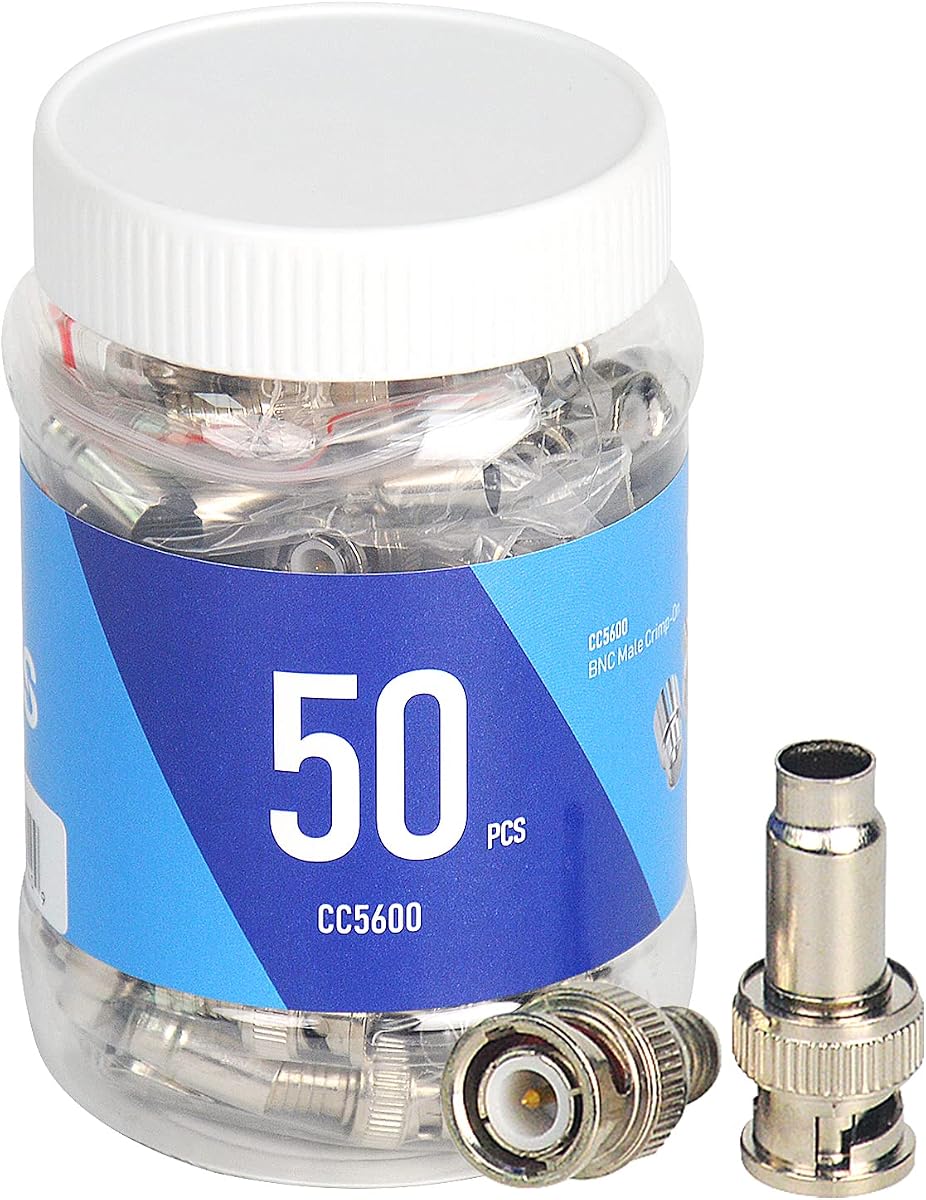
The ENS RG59 connector is designed for installers who need a substantial supply of dependable cable-mount terminations. Its 4.6 rating places it among the stronger-reviewed products here, and its 50-piece quantity is especially convenient for surveillance systems, analog video links, and other installations that may consume many identical connectors.
We may earn a commission when you buy through this link, at no additional cost to you.
The key technical distinction is its fit for RG59 coaxial cable. The two-piece crimp-on design is intended to secure the connector to the cable, while the BNC male interface provides a standard connection point for compatible female equipment. The product description emphasizes durable construction, secure and precise termination, and reliable signal transmission.
This connector family should not be confused with RG58 options. RG59 and RG58 are different coaxial cable types, and their diameters, impedance characteristics, and required crimp profiles can differ. Using the wrong connector may prevent proper compression or create a joint that is mechanically weak.
The ENS set is a strong recommendation for professional CCTV integrators, security installers, and technicians who repeatedly terminate RG59. It is less suitable for a hobbyist making one RG58 antenna lead, but the bulk format can be practical for maintenance teams, installers, and multi-camera projects.
Fifty connectors allow an installer to complete an entire run or keep a useful stock of matching terminations on hand. The quantity reduces the need for repeated orders when every camera line, jumper, or service cable requires the same connector.
The crimp-on arrangement is intended to create a stable mechanical and electrical bond with RG59 coax. For analog CCTV and compatible RF links, that makes this a focused choice for installers who regularly work with that cable type.
We may earn a commission when you buy through this link, at no additional cost to you.
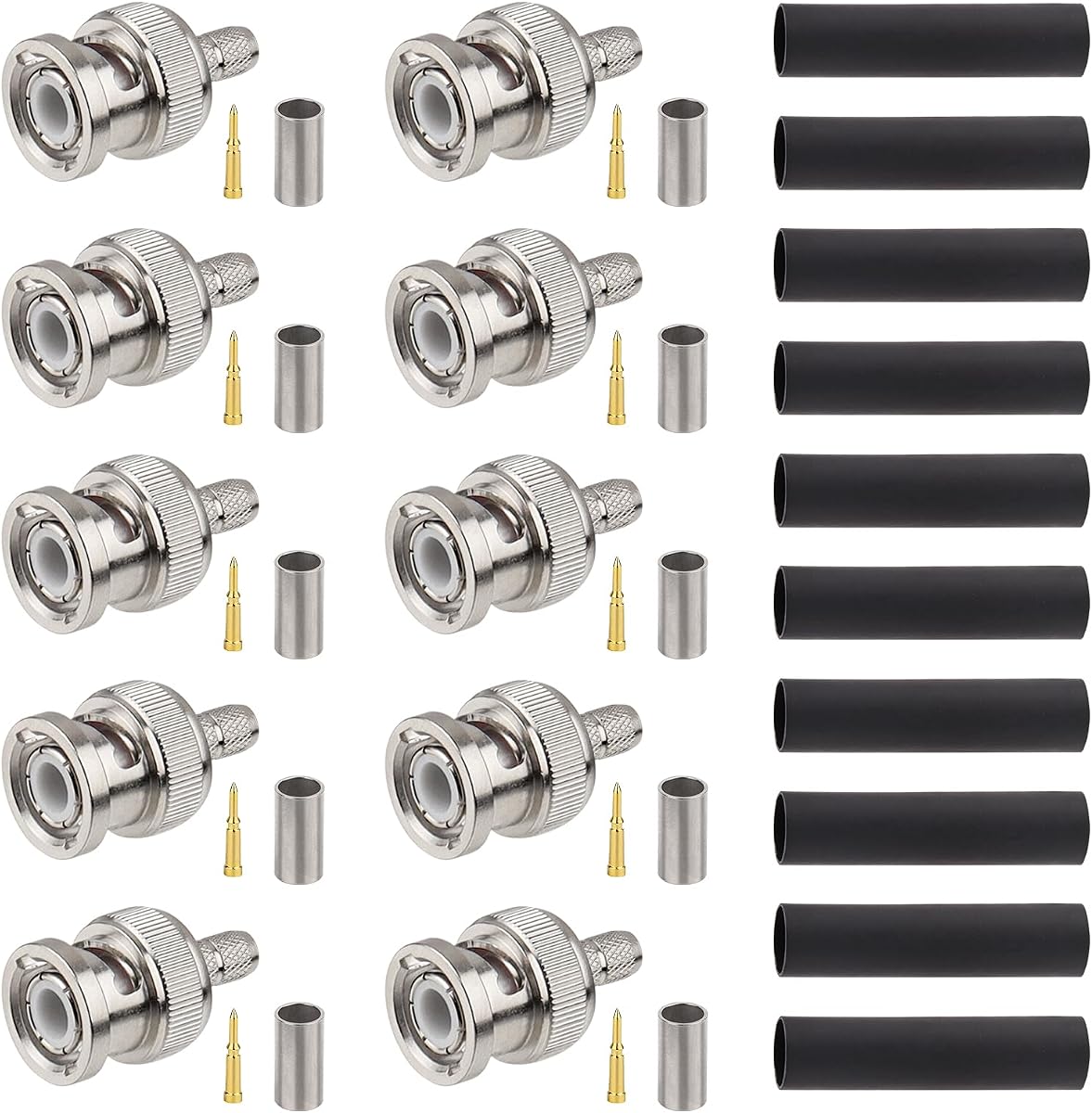
Eightwood offers a straightforward connector for the most familiar BNC cable-mount applications. It works with RG58, RG142, and LMR195 coax and carries a 4.5 rating, indicating a generally favorable customer response. Its ten-piece format and included heat-shrink tubes make it approachable for custom radio, antenna, and test-lead projects.
We may earn a commission when you buy through this link, at no additional cost to you.
Brass is the primary construction material called out in the product information. Unlike connectors that use a less rigid alloy for the body, brass provides mechanical durability and a substantial contact structure. The package includes ten BNC male connectors and ten heat-shrink tubes, allowing the installer to complete and protect multiple terminations.
The range of supported applications is broad for a compact connector set. Listed uses include antennas, VHF and UHF radio, CB, amateur radio, scanners, security cameras, oscilloscopes, spectrum analyzers, cable testers, and wireless sensors. This makes the connectors versatile, although the underlying cable and equipment must still be 50-ohm compatible.
This is our best budget recommendation for a maker or installer who primarily uses RG58-class cable and wants a straightforward, durable connector kit. It is less appropriate for RG59 or RG8X projects because those cables require connectors designed around different dimensions and crimping arrangements.
The brass body is one of the clearest reasons to consider this option for repeated handling. It offers a rugged mechanical foundation for a cable-mounted plug while maintaining the electrical characteristics expected of a 50-ohm RF connector.
Ten heat-shrink tubes add practical finishing value to the set. They can help protect the cable-to-connector transition from strain and environmental exposure after the crimp has been completed.
We may earn a commission when you buy through this link, at no additional cost to you.
XRDS offers one of the broader cable-compatibility lists in this guide. It is designed for RG58, LMR195, RG400, RG142, and 3D-FB coax, covering several commonly used 50-ohm cable families. Its 4.6 rating makes it a well-regarded alternative to the Eightwood set, particularly for users who switch between thinner coax styles.
We may earn a commission when you buy through this link, at no additional cost to you.
Construction details are clearly specified. The outer shell uses copper with nickel plating for corrosion resistance, while the inner needle uses brass with gold plating for conductivity. The BNC interface also incorporates a locking mechanism intended to keep connected equipment stable during use.
The claims around low loss, high signal integrity, and minimal VSWR are directionally appropriate for a quality RF termination, but buyers should not mistake them for a complete installation specification. Connector performance still depends on the coax, crimp profile, connector components, workmanship, and the condition of the connected equipment.
This connector is a good recommendation for RF, video, telecommunications, surveillance, and antenna work involving any of the listed cable families. It is particularly convenient for maintenance kits because one connector type can cover several cable sizes, although users should verify the dimensions and required crimp tooling for less common cables such as RG400 and 3D-FB.
Supporting RG58, LMR195, RG400, RG142, and 3D-FB gives technicians more flexibility than a product limited to one exact cable type. This makes the ten-piece set useful for mixed installations and service inventories.
Nickel-plated copper helps defend the outer shell against corrosion, while the gold-plated brass needle supports conductivity at the center contact. These finishes are especially helpful in humid or frequently handled installations.
We may earn a commission when you buy through this link, at no additional cost to you.
This MOOKEERF set provides a middle-ground option for RG58-class installations. It supports RG58, RG142, RG400, LMR195, KSR195, and 3D-FB cable, and its stated 0.15 dB attenuation and SWR below 1.2 give buyers useful performance targets. The 4.3 rating is positive, though not as strong as the highest-rated products.
We may earn a commission when you buy through this link, at no additional cost to you.
The connector uses a gold-plated brass inner pin, copper with nickel plating for the outer shell, and a PTFE insulator. These materials are appropriate choices for a 50-ohm RF interface because they combine electrical conductivity, corrosion resistance, and stable dielectric behavior.
One consideration is that this is a straight cable-mount BNC male crimp connector that connects with a BNC female interface. It is intended to let users build custom cable lengths, but that flexibility depends on using the correct cable and achieving a properly compressed termination. The connector alone does not determine final system performance.
This set is most suitable for radio, antenna, scanner, and general RF projects built with the listed coax types. Buyers who want documented attenuation and SWR may appreciate the specification, although they should also consider the similarly focused XRDS alternative, which has a stronger rating and a broader stated use range.
Published attenuation and SWR figures give shoppers more than a general compatibility claim. These values are useful when comparing termination options for sensitive RF work, although field results will also depend on installation quality.
The PTFE insulator helps maintain consistent dielectric behavior around the center conductor. Combined with plated contacts, it forms a practical construction for 50-ohm coax terminations used in radio and antenna systems.
We may earn a commission when you buy through this link, at no additional cost to you.
XRDS targets the RG8X class of coax with a connector that supports RG8X, LMR240, CNT240, KMR240, Mini8, Belden 9258, and 4D-FB cable. That breadth makes it a practical option for radio and antenna builders who may work with several similarly sized coax products.
We may earn a commission when you buy through this link, at no additional cost to you.
The connector uses nickel-plated copper for the shell, gold-plated brass for the inner needle, and PTFE for the insulator. It also includes compression sleeves and heat-shrink tubes, making it more of a termination kit than a loose collection of plugs. The inclusion of those parts can simplify preparation before a crimping operation.
Its 4.2 rating is respectable, but it sits below the stronger customer-feedback results of several alternatives. The stated emphasis on shielding, impedance matching, and low signal loss is appropriate for the category, yet those outcomes still depend on using the correct crimp die and inspecting the finished joint.
The best buyer for this option is an amateur-radio, CB-radio, or antenna technician using RG8X or LMR240-style coax and wanting the sleeves and heat shrink in one package. It is less compelling for RG58 projects, where the smaller Eightwood, XRDS, or Anina connectors are better matched.
Compression sleeves and heat-shrink tubes add the finishing components needed around the crimped body. Having them included can reduce the number of separate supplies required for a clean termination.
CB radios, ham radios, and antenna assemblies are explicit target applications. The cable list and nickel-plated, gold-plated construction align closely with the needs of frequently connected outdoor or mobile RF equipment.
We may earn a commission when you buy through this link, at no additional cost to you.
Anina takes a kit-oriented approach with its ten-pack of RG58 male crimp connectors. Individual heat-shrink tubes, pins, sleeves, and tubing are included, creating a more complete package for custom cable assemblies. Its 4.7 rating is among the strongest results in this guide.
We may earn a commission when you buy through this link, at no additional cost to you.
Its stated construction combines a brass body, copper contacts, and a reinforced alloy lock ring. The heat-shrink tubing is intended to secure the connector-to-cable transition, resist separation, and provide protection from moisture and strain. Those features are relevant to CB-radio, security-camera, and other installations where a cable may move or flex near the plug.
The product information also states that the connectors have no measurable effect on SWR or power loss. While this is a favorable claim, buyers should understand that total system performance depends on the coax, connector fit, crimp quality, and connected hardware. The claim should not replace normal continuity and installation checks.
This is a compelling choice for someone assembling protected RG58 leads for security cameras, test equipment, radio accessories, or similar applications. It is less suitable for RG59 and RG8X work. The included components make it especially convenient for builders who want more than a bare connector in the package.
Heat-shrink tubing creates a finished barrier around the transition between cable and connector. That can reduce flex at the joint and help protect the termination from moisture, making the kit useful for custom leads that may be handled or routed in demanding conditions.
Pins, sleeves, connectors, and individual tubing are included for the ten-piece set. This reduces assembly preparation and gives a builder the main finishing components needed for repeatable terminations.
We may earn a commission when you buy through this link, at no additional cost to you.
This sixteen-piece BNC male set is positioned as a basic option for people who want a larger quantity of RG58-class terminations. It supports RG58, RG142, and LMR195 coax and is intended for 50-ohm RF applications. Its 4.0 rating indicates a positive overall response, though it is lower than most products in this comparison.
We may earn a commission when you buy through this link, at no additional cost to you.
The main benefit is quantity. A pack of sixteen can cover more custom leads than the common ten-piece alternatives without requiring multiple orders. The product also has a straightforward cable-mount configuration and can be used for antennas, VHF and UHF radios, CB equipment, scanners, oscilloscopes, spectrum analyzers, cable testers, and wireless sensors.
The supplied information is less detailed about materials and electrical performance than for the higher-ranked products. It mentions mechanical durability and solid connections, but does not provide the same detailed contact plating, dielectric, attenuation, or SWR information. Buyers seeking well-documented RF specifications may find one of those alternatives easier to evaluate.
This set makes sense for a workshop, classroom, or repair bench that regularly consumes RG58, RG142, or LMR195 plugs. It is a straightforward bulk option, provided the buyer confirms that the crimp tooling and connector components meet the requirements of the finished cable assembly.
The larger pack is convenient for technicians who make several jumpers in one session. It can also serve as a small maintenance stock for replacing worn connectors on radio, antenna, and test leads.
The stated application list includes oscilloscopes, spectrum analyzers, and cable testers. These are common reasons to build custom coax leads, and the connector's supported cable types give users a few options for those projects.
We may earn a commission when you buy through this link, at no additional cost to you.
This ten-piece connector offers a compact 50-ohm option for RG58, RG142, and LMR195 cable. It has a 3.7 rating, the lowest in the guide, so it is best considered a straightforward choice for simple assemblies rather than the leading recommendation for performance-focused work.
We may earn a commission when you buy through this link, at no additional cost to you.
The listed overall length is 23.6 millimeters, or 0.92 inches. The housing is aluminum alloy with a nickel plating, while the center contact is pure copper. These are useful physical details, although the aluminum housing is less mechanically substantial than the brass bodies offered by several other products.
One unusual claim is that installation requires no tools and that the connector is ready to use by plugging it in. Because this is a crimp connector, buyers should still follow the manufacturer instructions, use the correct crimp profile, and confirm how the connector seals around the cable. Tool-free installation language should not be interpreted as permission to skip a proper crimp.
The option may suit a buyer who wants a compact connector for antennas, radio equipment, scanners, security cameras, or test devices and does not require a heavily documented high-frequency specification. For critical RF links, especially outdoors or in frequently handled equipment, one of the better-reviewed brass or RG8-class options may be a safer choice.
At 23.6 millimeters overall, the connector offers a relatively small termination point. That can be useful where space around an equipment panel or cable routing point is limited.
Despite the no-tools wording, a crimp-style connector should be installed according to its instructions with the appropriate die. Confirming the sequence and crimp dimensions helps avoid a loose center contact or improperly compressed ferrule.
We may earn a commission when you buy through this link, at no additional cost to you.
This DIYSecuritycameraworld set is built around a straightforward requirement: making professional-style RG59 terminations in quantity. It contains 50 BNC male crimp-on connectors, each formed as a two-piece set, and carries a 4.5 rating. Its focus makes it especially relevant to camera installers and surveillance technicians.
We may earn a commission when you buy through this link, at no additional cost to you.
The product information is concise. It identifies the cable type as RG59, the interface as a BNC male crimp-on connector, and the quantity as fifty. It also explicitly states that an RG59 or RG59/6 crimping tool is required, which is useful purchasing guidance for anyone who does not already own the correct tooling.
Detailed electrical claims are not provided for this product, so comparisons involving attenuation, VSWR, contact plating, and dielectric material should be made cautiously. The connector still needs to match the cable and be crimped correctly for a surveillance installation to perform as intended.
This is a practical recommendation for professional camera installers or serious hobbyists building many RG59 leads. The fifty-piece count supports multi-camera work and provides matching stock for maintenance. For a single RG59 jumper, a smaller pack may be more practical, while installers using RG58 or RG8X should choose a connector designed for those cable types.
The RG59 focus reflects the widespread use of that coax in analog surveillance systems. A matching fifty-piece supply reduces interruptions during larger camera, monitor, and recording-system installations.
The required RG59 or RG59/6 crimping tool should be obtained before installation. Matching the tool to the connector and cable is essential for creating a stable mechanical and electrical termination.
We may earn a commission when you buy through this link, at no additional cost to you.
The best connector is the one that matches your coax, installation method, impedance, and operating environment. Use the following factors to narrow the field before comparing individual products.
Short summary: match the exact coax type before considering quantity or electrical claims.
Short summary: use a 50-ohm connector only when the cable and equipment support the same system.
Short summary: prioritize conductive plated contacts and a stable dielectric for dependable RF performance.
Short summary: confirm the required tool, die size, and crimp sequence before ordering connectors.
Short summary: brass or nickel-plated copper bodies suit demanding handling better than lighter alternatives.
Short summary: use plating and strain relief to protect frequently exposed or outdoor terminations.
Short summary: choose a quantity that covers the project and realistic replacement needs.
Short summary: compare documented RF specifications for critical links, but assess the finished assembly too.
Begin by identifying the exact coax cable and selecting a connector listed for that cable family. Strip only the amount of jacket and braid specified by the connector instructions, because removing too much can leave no surface for the ferrule to grip. Keep the braid tidy and ensure the center conductor is straight before fitting the contact.
Assemble the center contact or pin with the manufacturer's recommended tool, then place the connector body and ferrule over the prepared cable. Use the correct crimp die and complete the specified crimps. Inspect the finished joint for movement, uneven compression, exposed conductor, and a secure center-contact connection before adding heat shrink or installing the connector into equipment.
After installation, route the cable so that bending and pulling occur away from the termination. Add the supplied heat-shrink tubing where applicable and allow it to contract fully. Periodically inspect outdoor or frequently handled connections for corrosion, moisture, damaged tubing, looseness, or changes in signal performance, and replace a compromised connector rather than relying on a loose joint.
No. BNC describes the connector interface, while the cable-mount body must match the coax diameter, jacket, and required crimp profile. RG58-class connectors are not automatically suitable for RG59, and RG8X or LMR240 generally require a different connector and die. Always check the exact cable type before ordering.
The main difference is the cable family and the connector's crimp geometry. RG58 is commonly used in radio, antenna, and data applications, while RG59 is widely used in surveillance and video installations. The cable diameter and center-contact arrangement differ, so using an RG59 connector on RG58 or vice versa can produce an improper termination.
They are often grouped because they belong to a similar thicker coax class, and several products here support both. Still, buyers should verify the exact outside diameter, dielectric, and conductor size of their cable. Similar product family names do not guarantee that every manufacturing variation uses the same crimp dimensions.
Yes, a crimp connector normally requires the matching crimp tool and die to compress its ferrule and contact correctly. Some product listings explicitly specify an RG59 or RG59/6 crimping tool. Improper tooling can leave the connector loose, create an intermittent center connection, or prevent the body from sealing around the cable.
No. Heat shrink adds strain relief and environmental protection, but it cannot correct a loose crimp, damaged contact, or incompatible cable fit. The mechanical and electrical termination must be completed correctly first, after which the tubing can protect the finished joint from flex and moisture.
The choice depends on the coax being used. For RG58, RG142, or LMR195 leads, the Eightwood, XRDS, or Anina sets are relevant. For RG8X, LMR240, 4D-FB, or Mini8-style coax, the MOOKEERF and XRDS RG8X options are more appropriate. Match the cable first, then consider construction and pack quantity.
The ENS and DIYSecuritycameraworld sets both focus on RG59 and include fifty connectors, making them more relevant to large surveillance projects than smaller ten-piece kits. Ensure that the cable is truly RG59 and obtain the required RG59 crimping tool before assembly.
Inspect the crimp for even compression and make sure the connector cannot rotate or pull away from the jacket. Confirm that the center conductor is properly seated and that no braid or stray conductor touches the shell. For critical equipment, a cable tester or suitable RF measurement can provide additional confirmation of continuity and signal quality.
The MOOKEERF RG8X set stands out for its detailed low-loss specifications, 1000 MHz operating range, and strong customer rating. The ENS RG59 set is the most practical premium choice for bulk surveillance work, while the Eightwood RG58 set offers a balanced, budget-friendly package with brass construction and heat-shrink tubing.
Cable compatibility should remain the deciding factor. Use RG58 or RG142 connectors for those smaller coax types, RG59 connectors for surveillance cable, and RG8X or LMR240 connectors for thicker RF jumper cable. Then consider contact construction, body material, supplied crimp components, environmental protection, and how many terminations the project actually requires.
Current listings, specifications, ratings, and prices can change, so verify the cable compatibility and included components before ordering. Also confirm that you have the correct crimp tool and die. Taking those extra steps helps produce a secure connector, a stable shield, and a more reliable finished cable assembly.