
LiNKFOR 192kHz DAC Converter
4.8Editor score
192kHz PCM conversion
Built-in amplifier chip
Extended 6-foot cable
Our Optical to RCA Adapter guide compares ten digital-to-analog converters for compatibility, audio formats, sampling rates, outputs, setup, and value.
An optical to RCA adapter connects the digital audio output of a television, game console, Blu-ray player, or streaming box to an older amplifier or pair of analog speakers. The best models support the required PCM format, provide a stable signal, and include practical connections for a straightforward home audio setup.
We compared all ten products by examining their supported input and output formats, maximum sampling rate, built-in amplifier features, cable design, power requirements, and compatibility with legacy stereo equipment. The list covers compact converters, extended-cable designs, volume controls, and models capable of decoding surround formats.
Each entry highlights the features that distinguish one converter from another and explains the compromises involved. Ratings reflect the supplied customer feedback, while practical suitability also depends on your source device, speaker system, and audio-format settings. Product availability and pricing can change over time.
4.8Editor score

4.4Editor score
4.4Editor score
The following comparison makes the major differences easy to see, including supported audio formats, sampling rates, output flexibility, cable length, and power requirements.



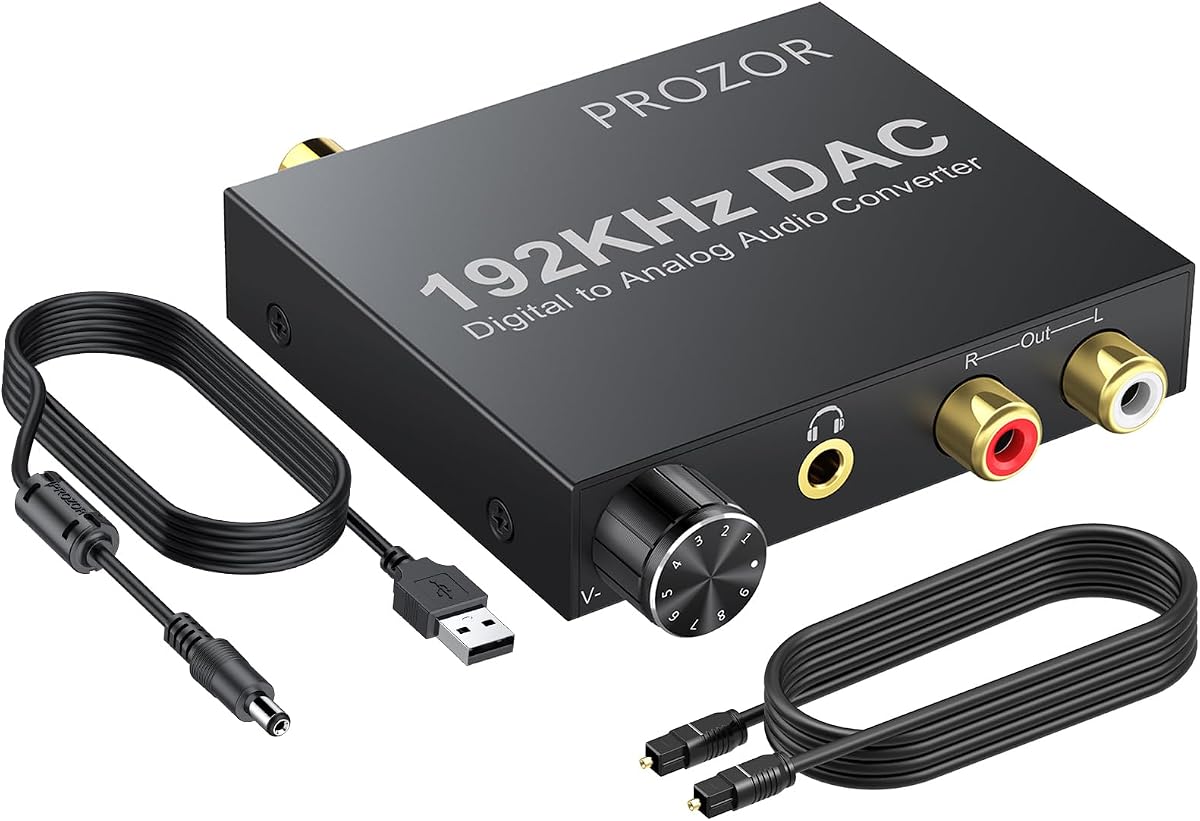
The PROZOR 192KHz DAC Converter combines broad compatibility with a well-considered physical design, making it the strongest all-around option in this guide. Its 4.4 rating reflects generally positive customer feedback, while its distinguishing features are the simultaneous RCA and 3.5mm outputs, optical and coaxial inputs, and detachable converter box.
We may earn a commission when you buy through this link, at no additional cost to you.
The converter accepts uncompressed two-channel LPCM or PCM signals and supports sampling rates from 32KHz through 192KHz with a 24-bit incoming SPDIF stream on both channels. Its dual-channel amplifier chipset is designed to improve clarity and reduce distortion, while the aluminum housing provides better heat dissipation and electromagnetic shielding than a basic plastic enclosure. Gold-plated RCA connectors and detachable cabling add flexibility when the included leads are unsuitable for your setup.
There are a few limitations to understand. It does not decode 5.1-channel Dolby AC-3 or DTS signals, and it requires a suitable 5V 1A power source that is not included. TV remote volume may not affect the optical output directly, so source-level adjustment through television menus may be necessary. The 3.5mm output is also useful but cannot add true surround channels to a pair of stereo speakers.
This is the most suitable choice for someone who wants one dependable box to connect several modern source devices to an amplifier, stereo speakers, and headphones. The included three-foot optical cable and USB power lead simplify setup, while the detachable outputs make it easier to use custom RCA leads. It is our Editor's Choice because it offers the most versatile feature set without requiring surround decoding.
Optical and coaxial inputs allow the converter to work with more source components than a one-purpose model. Simultaneous left and right RCA plus 3.5mm outputs make it useful for an amplifier, powered speakers, and headphones without repeatedly reconnecting different cables.
Support for 192KHz sampling and 24-bit SPDIF streams suits listeners who want a higher-resolution path than a basic optical converter. The amplifier chipset and metal housing are intended to produce a stable, clear output through analog stereo equipment.
We may earn a commission when you buy through this link, at no additional cost to you.
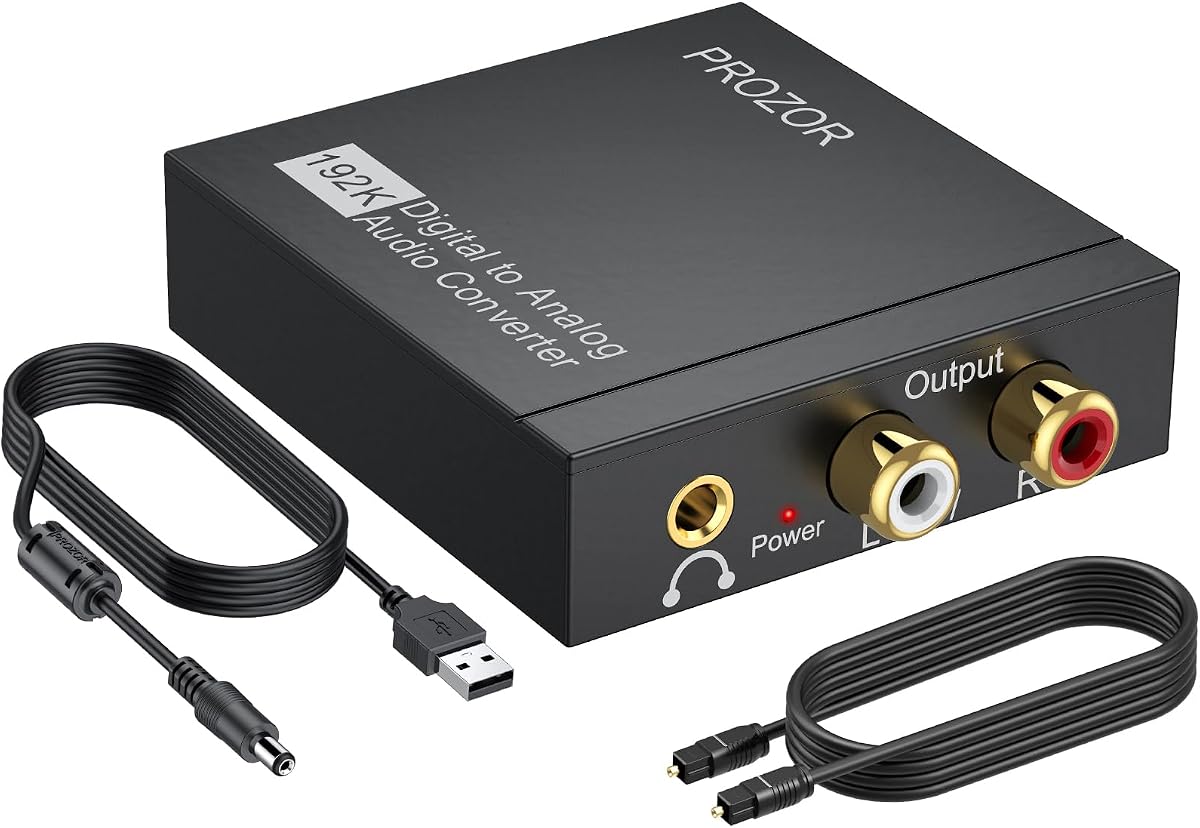
The PROZOR 7ft Cable DAC is built for installations where the television or source device sits farther from an analog amplifier. Its 4.4 rating and seven-foot integrated RCA lead make it a practical option for reducing the number of separate connections around a media cabinet.
We may earn a commission when you buy through this link, at no additional cost to you.
It converts optical SPDIF signals into left and right RCA audio and includes a built-in amplifier chip intended to address low output volume. The converter supports 32, 44.1, 48, 96, and 192KHz sampling rates with a 24-bit SPDIF incoming bitstream on both channels. Its compact housing and non-pluggable one-meter RCA cable make it particularly easy to position behind a television or beside a receiver.
The product supports uncompressed two-channel LPCM and PCM rather than Dolby AC-3 or DTS 5.1 signals. That means the source device may need to be changed from automatic or surround output to PCM. It also lacks a 3.5mm jack and physical volume control, and a certified 5V 1A wall adapter is needed for the best stability.
Choose this model when cable reach and simple placement matter more than having several analog outputs. It is especially convenient for connecting a television to an amplifier or powered speakers across a room's media shelf. The integrated seven-foot cable, compact converter body, and noise-conscious power lead make it a strong alternative for straightforward PCM audio setups.
The fixed RCA cable provides enough reach for many entertainment centers while eliminating the need to buy a separate analog lead. Its non-pluggable construction also keeps the installation visually compact, although cable length cannot be adjusted independently.
The supplied USB power cable incorporates a ferrite core intended to reduce electromagnetic and radio-frequency interference. Using a certified 5V 1A adapter helps the converter maintain a consistent signal and avoid unwanted noise or delay.
We may earn a commission when you buy through this link, at no additional cost to you.
The PROZOR RCA and 3.5mm DAC offers an appealing combination of connection options and high-resolution support. It carries a 4.4 rating and is especially attractive to buyers who want to feed headphones and stereo equipment from one digital source without buying separate converters.
We may earn a commission when you buy through this link, at no additional cost to you.
Both optical and coaxial digital inputs are accepted, and the converter produces left and right RCA output alongside a 3.5mm jack. It supports 32, 44.1, 48, 96, and 192KHz sampling rates, 24-bit SPDIF streams, and uncompressed two-channel LPCM or PCM. A built-in amplifier chip is included to improve output level, while gold-plated RCA connectors support reliable signal transfer.
The principal trade-off is format limitation. Dolby AC-3, DTS, and other 5.1-channel signals are not decoded, so the television, console, or disc player must output PCM or LPCM. A separate 5V 1A USB power adapter is also required, and the remote's volume control may not directly alter the optical output.
This converter fits modern televisions, set-top boxes, Blu-ray players, and gaming systems that need a reliable analog path. It is a strong choice for listeners using both a traditional amplifier and headphones, particularly when the source can be configured for PCM. Its broad output selection gives it greater everyday versatility than the simpler cable-based converters.
The simultaneous RCA and 3.5mm outputs let one source feed a home theater amplifier while headphones remain available for private listening. This reduces the need to unplug and reconnect analog leads whenever the listening arrangement changes.
The broad sampling-rate range allows the converter to accept signals from a variety of modern source components. Because it works in the digital-to-analog direction, source devices must be configured to send compatible PCM audio.
We may earn a commission when you buy through this link, at no additional cost to you.
The Neoteck 192kHz DAC Converter stands out for a lightweight, compact design that is easy to place around a home entertainment system. Its 4.4 rating reflects solid customer approval, and the seven-foot built-in RCA cable is useful when the television and amplifier are not positioned side by side.
We may earn a commission when you buy through this link, at no additional cost to you.
Its digital-to-analog conversion supports 32, 44.1, 48, 96, and 192KHz sampling rates, along with 24-bit SPDIF streams on the left and right channels. A built-in amplifier chipset is intended to raise the RCA output level and improve interference resistance. The converter is designed for HD televisions, set-top boxes, DVD and Blu-ray players, and game consoles with compatible optical output.
Users must configure the source to send uncompressed 2.0-channel PCM because the adapter cannot process 5.1-channel Dolby AC-3 or DTS. The package does not include a wall plug, and troubleshooting guidance emphasizes a correctly connected 5V 1A supply. Volume may need to be changed through television settings rather than the original remote.
This is a good match for a simple stereo setup where tidy placement and minimal separate wiring matter. It can be especially helpful for older users because the direct connection process is uncomplicated. Choose it when PCM-only operation is acceptable and the long built-in cable will comfortably reach the amplifier or powered speakers.
The small housing can be tucked beside or behind a television with minimal visual clutter. Its integrated cable removes the need for extra analog leads, while the lightweight construction makes repositioning straightforward.
Selecting PCM in the source's digital audio menu is essential for reliable playback. The supplied guidance also recommends checking the power connection, output mode, and shielded cable condition if noise or no-sound problems occur.
We may earn a commission when you buy through this link, at no additional cost to you.
The LiNKFOR 192kHz DAC Converter combines a 4.8 customer rating with a practical extended-cable design, making it the leading budget-oriented recommendation. It offers a straightforward way to connect a modern optical source to an older stereo amplifier without requiring a complex surround processor.
We may earn a commission when you buy through this link, at no additional cost to you.
The converter accepts optical Toslink signals and outputs left and right RCA audio. It supports sampling rates of 32, 44.1, 48, 96, and 192KHz, with a 24-bit SPDIF incoming bitstream on both channels. A built-in amplifier chip is designed to increase output level and produce a clearer signal, while the one-meter RCA cable offers more placement flexibility than a very short lead.
Its main limitation is that it only supports digital PCM or LPCM audio and cannot decode 5.1-channel Dolby AC-3 or DTS. The source must therefore be set to a compatible format. The integrated RCA cable is fixed rather than detachable, which may be inconvenient when a custom length or right-angle connection is needed.
For viewers using HD televisions, set-top boxes, DVD and Blu-ray players, or game consoles with older analog speakers, this is an efficient and approachable solution. It suits buyers who want essential high-resolution support, clean RCA output, and useful cable reach without paying for volume controls or surround decoding.
Its 4.8 rating is the highest among the products examined, indicating particularly favorable customer feedback. The design keeps the feature set focused on the essential tasks of digital-to-analog conversion and reliable stereo output.
The six-foot integrated cable can bridge the gap between a wall-mounted television and a lower amplifier shelf. It reduces cable clutter while providing enough length for many common living-room arrangements.
We may earn a commission when you buy through this link, at no additional cost to you.
The LiNKFOR Compact DAC Converter is a space-conscious option for linking optical sources with legacy speakers. Its 4.3 rating indicates generally favorable feedback, and the short integrated RCA cable makes it particularly convenient when the source and amplifier are close together.
We may earn a commission when you buy through this link, at no additional cost to you.
It converts digital optical Toslink audio into analog left and right RCA output. Supported sampling rates include 32, 44.1, 48, 96, and 192KHz, with support for 24-bit SPDIF streams. The built-in amplifier chip is intended to improve output level and clarity, while the lightweight 1.1-meter cable design keeps the installation simple.
The converter supports digital PCM and LPCM only, meaning Dolby AC-3, DTS, and 5.1-channel content are not compatible without changing the source output. The shorter integrated lead may not reach across a wide entertainment center, and the fixed cable cannot easily be replaced if its length is unsuitable.
This model is a sensible choice for a compact desk setup, small television stand, or tightly grouped amplifier and source components. It is most useful when the listener wants a simple two-channel connection without paying for physical volume adjustment or surround decoding. Its compact construction also makes it easier to conceal near the equipment.
The lightweight housing and short built-in lead are suited to small media areas where loose cables are inconvenient. It can sit directly beside an amplifier without requiring a separate converter box and multiple long cables.
The amplifier chipset and high-resolution PCM support provide useful headroom for ordinary music, television, and gaming applications. Correct source-format settings remain the most important requirement for dependable playback.
We may earn a commission when you buy through this link, at no additional cost to you.
The PROZOR Volume Adjustable DAC is the premium pick because it adds direct output-level control to an otherwise comprehensive converter. Its 4.4 rating is supported by a feature set aimed at installations where matching the converter's output to an older amplifier is important.
We may earn a commission when you buy through this link, at no additional cost to you.
Optical and coaxial digital inputs feed left and right RCA outputs and a 3.5mm headphone jack. The converter supports 32, 44.1, 48, 96, and 192KHz sampling rates with 24-bit SPDIF streams. A built-in knob provides manual volume adjustment, while gold-plated input and output interfaces are intended to reduce signal loss and improve long-term connection quality.
The serviceable aluminum metal casing is designed for heat resistance and can be operated without drivers. A 5V 1A power adapter is not included, and the converter cannot reverse the signal or decode surround formats. Users still need a compatible two-channel PCM source, and volume control on the television may not affect the optical signal.
This is the strongest choice for someone who wants more control than a basic fixed-output adapter provides. It is particularly useful with older amplifiers, active speakers, or headphones that need output-level matching. The added control, metal construction, and multiple outputs justify selecting it as a premium option for a permanent home audio installation.
The built-in volume knob makes it easier to match the converter to an amplifier or active speakers without relying entirely on television menus. This is valuable when the source's optical output level cannot be adjusted conveniently.
The aluminum housing improves heat dissipation, while gold-plated interfaces support dependable signal transfer. Optical and coaxial inputs plus RCA and 3.5mm outputs give this model more flexibility than a basic single-output converter.
We may earn a commission when you buy through this link, at no additional cost to you.
The PROZOR 5.1-Channel DAC fills an important gap by accepting Dolby AC-3, DTS, LPCM, and PCM source formats before producing analog stereo output. Its 4.4 rating makes it a practical choice for users who cannot easily change their television or console from surround output to PCM.
We may earn a commission when you buy through this link, at no additional cost to you.
Optical and coaxial signals can be connected from devices such as Blu-ray players, game consoles, HD televisions, and home cinema equipment. The converter supports 192KHz sampling and 24-bit SPDIF streams, while an adjusted amplifier chipset and magnetic-ring power cord are intended to promote stable, low-noise transmission. RCA left and right outputs and a 3.5mm jack provide convenient analog destinations.
Although the converter accepts 5.1-channel audio, its final analog output is 2.0-channel stereo. It therefore down-mixes surround information rather than preserving six independent channels. This distinction is important for anyone expecting discrete center, surround, and subwoofer channels from the RCA connections.
This model is best for older stereo speakers used with a modern game console, disc player, or television that sends surround formats by default. It removes much of the frustration associated with repeatedly changing source menus. For listeners needing true multichannel output, however, a receiver with native surround decoding would be the more appropriate solution.
Accepting Dolby AC-3 and DTS alongside PCM makes this converter easier to pair with consumer source devices that default to surround output. The surround mix is then converted to a stereo signal suitable for analog speakers.
The magnetic-ring power cord is designed to help reduce interference and maintain consistent operation. This makes the converter useful in media cabinets containing numerous power supplies and electronic components.
We may earn a commission when you buy through this link, at no additional cost to you.
The eSynic 7ft PCM DAC combines a long fiber-optic run with a metal-bodied converter for connecting modern electronics to vintage stereo equipment. Its 4.2 rating is slightly lower than the leaders, but the aluminum housing and extended reach provide a distinct set of practical benefits.
We may earn a commission when you buy through this link, at no additional cost to you.
The adapter supports 192KHz and 24-bit resolution, with conversion limited to two-channel PCM. It includes a seven-foot fiber-optic cable for routing behind wall-mounted televisions and tight furniture gaps. Gold-plated RCA ports and an aluminum housing offer shielding and heat dissipation, while an integrated DAC chip performs the digital-to-analog conversion.
There is an inconsistency within the supplied listing regarding power: one section describes drawing power directly from an optical port, while the compatibility guide specifies a 5V 1A USB adapter that is not included. The explicit compatibility note is the safer basis for setup. Dolby and DTS signals are also unsupported, and the source must be set to PCM 2.0.
This converter is best for a clean two-channel setup with a modern television, PS5, or other compatible source and an older amplifier. It is particularly useful when the television is mounted and space behind it is tight. Buyers should confirm the actual package contents and follow the listed USB-power requirement before installation.
The extended fiber-optic cable can travel through a narrow gap between a wall-mounted television and its support. This keeps the source connection out of sight while providing more freedom in amplifier placement.
The aluminum enclosure and gold-plated RCA connectors are designed to limit interference and maintain stable analog connections. PCM-only operation keeps the conversion path focused on standard stereo audio.
We may earn a commission when you buy through this link, at no additional cost to you.
The eSynic 5.1 Decoding DAC focuses on avoiding repeated television-menu changes by accepting common surround formats and converting them to stereo. Its 4.3 rating reflects positive customer feedback, while native Dolby AC-3 and DTS handling distinguishes it from most PCM-only converters.
We may earn a commission when you buy through this link, at no additional cost to you.
The converter accepts PCM, LPCM, Dolby AC-3, DTS, and other listed digital formats from a source device. It then down-mixes 5.1 audio to 2.0 for RCA speakers or an amplifier while retaining dialogue, ambience, and bass effects in the stereo presentation. Sampling rates range from 32KHz to 192KHz at 16- or 24-bit resolution, and an integrated amplifier chip boosts output level.
The built-in one-meter RCA cable provides a total listed reach of about 2.1 meters, allowing placement behind televisions or shelves. USB power is used, though the product description suggests plugging into any 5V port while also referring to a 5V 1A requirement. It remains fundamentally an analog stereo converter, so a 5.1 input does not yield six separate RCA channels.
Choose this model for streaming, gaming, or movie systems that commonly send surround audio but are connected to older stereo speakers. It is particularly useful when changing television settings for each application is inconvenient. Confirm that the source device outputs a compatible digital stream and use a dependable 5V 1A supply for stable results.
Dolby AC-3 and DTS compatibility allows applications such as streaming services, consoles, and disc players to remain on their preferred surround output. The converter handles the conversion to stereo without requiring repeated menu adjustments.
The DAC and amplifier are combined within the compact housing, reducing the number of separate boxes on the signal path. The extended RCA cable and included power lead make it convenient to position the converter within a typical entertainment center.
We may earn a commission when you buy through this link, at no additional cost to you.
The right converter depends mainly on source format, output flexibility, cable reach, and how much control you want over the analog signal. Reviewing these factors before buying helps avoid an installation that produces silence, noise, or incompatible surround audio.
Choose PCM-only models for simple, predictable operation. If your equipment regularly sends surround audio and changing settings is inconvenient, consider a converter with Dolby AC-3 or DTS decoding.
Match the converter's analog outputs directly to your playback equipment. RCA-only designs are sufficient for most stereo systems, while combined RCA and 3.5mm outputs are more versatile.
Measure the installation before buying. Choose an integrated cable that reaches comfortably, or select a detachable model when routing flexibility matters more.
Prioritize broad sample-rate compatibility and reliable PCM decoding over headline specifications. A stable converter that works correctly matters more than an unused maximum rate.
A physical volume control adds convenience and setup flexibility. Basic converters remain suitable when source-level adjustment is already reliable.
Confirm whether a power adapter is included and use a stable 5V 1A source if required. Proper power helps prevent noise, delay, and intermittent shutdowns.
Favor solid construction, shielded cables, and a reliable amplifier chipset when the converter will remain permanently installed. Cosmetic extras matter less than correct compatibility.
Choose surround decoding for convenient stereo downmixing. Use a native surround receiver when independent multichannel output is the goal.
Begin by identifying the digital output on your television, game console, Blu-ray player, set-top box, or streaming device. Connect the optical cable to the converter's Toslink input, then connect the left and right RCA outputs to the matching inputs on your amplifier or powered speakers. If using the 3.5mm jack, confirm that the destination accepts stereo audio before connecting it.
Power the converter using the required 5V 1A USB supply. Turn the source and receiving equipment on, select the correct analog input, and adjust the converter volume if a physical knob is present. If the source offers automatic, Dolby, DTS, PCM, or LPCM output choices, select PCM or LPCM for models that only support two-channel PCM.
For best results, keep the optical connection seated, avoid sharply bent fiber leads, and use shielded RCA cables when replacing the supplied ones. Keep the converter ventilated, especially in a crowded cabinet. If noise or delay appears, check the source format, power connection, and cable seating before changing equipment or settings.
The most common cause is an incompatible digital audio format. Set the source device to PCM or LPCM for two-channel models, and confirm that the optical cable is fully seated. Also check that the amplifier is on the correct RCA input and that the converter's power light is active. A stable 5V 1A power source can resolve problems caused by an inadequate USB port.
It depends on the model. Most converters accept only two-channel PCM and do not accept Dolby AC-3 or DTS directly. Models with explicit 5.1 decoding can down-mix surround audio into two stereo RCA channels. This does not create separate front, center, rear, and subwoofer outputs; a surround-capable receiver is required for discrete multichannel audio.
Usually not, because many televisions send a fixed digital output level through their optical ports. Some newer models support adjusting digital audio output from the television's sound settings, while converters with a built-in volume knob provide direct control. Check the source's digital audio output volume menu if the remote does not change the analog output.
That depends on the package. Several listed models include a USB power cable but not a wall adapter, so a suitable 5V 1A supply may need to be purchased separately. Some devices can draw adequate power from a television or another reliable USB source. A dedicated certified adapter is generally the most consistent option for avoiding noise and intermittent operation.
Converters with both RCA and 3.5mm outputs can feed stereo speakers and headphones. You may be able to use both outputs simultaneously, depending on the converter. The headphone connection is mono-compatible only if the source and converter support mono, and any volume control on the converter affects its analog outputs.
Both carry digital audio, but they use different connectors and cables. Optical uses light through a Toslink cable and is common on televisions and game consoles. Coaxial uses an RCA-style physical connector and is found on some amplifiers, CD players, and other components. Models with both inputs can connect to a wider range of source equipment.
No. The converter must support the sample rate emitted by the source, and the final sound also depends on the source recording, amplifier, speakers, and analog cables. Broad sample-rate support improves compatibility, while stable decoding, a clean power supply, and a good connection path are more relevant to reliable everyday performance.
A detachable model is better when you need custom cable lengths, right-angle plugs, or easier replacement of damaged wiring. A fixed-cable converter usually creates a tidier installation and may be sufficient when the included lead reaches the amplifier comfortably. Measure the available distance and consider how the devices will be positioned before deciding.
The LiNKFOR 192kHz DAC Converter is the best budget option for its 4.8 rating, extended cable, and straightforward PCM conversion. The PROZOR 192KHz DAC Converter earns the Editor's Choice recommendation for its optical and coaxial inputs, simultaneous RCA and 3.5mm outputs, detachable design, and broad high-resolution support.
For a permanent installation where output matching is important, the PROZOR Volume Adjustable DAC is the premium selection. Its aluminum housing, gold-plated interfaces, and manual level control add practical value. Users who need surround-format convenience should instead consider a converter with explicit Dolby AC-3 or DTS decoding.
Before purchasing, confirm the source's audio format, the required analog connection, the needed cable reach, and the converter's power requirements. This ensures the selected adapter integrates cleanly with your television, amplifier, or speakers. Product specifications and prices can change, so review the current listing before making a final purchase.