
NBVOICE Portable All-in-One PA System
4.2Editor score
Complete 300-watt PA package
Eight-channel detachable mixer
Bluetooth 5.3 wireless streaming
PA speakers for bands must deliver enough volume, preserve vocal clarity, and make rehearsal rooms, clubs, and outdoor stages manageable. A useful system balances low-end impact with controlled feedback, offers practical connections, and remains portable enough to move between performances without making setup unnecessarily complicated.
We compared these ten options by examining their stated power, driver size, mixer capabilities, input selection, wireless functions, DSP, feedback control, mounting options, and included accessories. The list covers complete all-in-one systems, individual powered loudspeakers, and a passive pair that requires separate amplification.
Each review explains where a product fits best, while the comparison table makes the major differences easier to scan. Ratings reflect the supplied customer feedback, and product configurations can change over time, so readers should confirm current specifications, availability, and prices before purchasing.
4.2Editor score

5.0Editor score

4.6Editor score
As an Amazon Associate we earn from qualifying purchases.
The comparison highlights the differences that matter most to bands: speaker size, amplification, mixer integration, wireless connectivity, feedback control, and whether a complete system or a separate powered speaker is included.




The NBVOICE Portable All-in-One PA System is a complete, accessible package for rehearsals, acoustic performances, presentations, worship gatherings, and karaoke. Its supplied rating is 4.2, placing it among the more broadly reviewed options here, but its defining strength is the combination of two 8-inch speakers, a detachable eight-channel mixer, stands, a wired microphone, cables, and a remote in one coordinated setup.
We may earn a commission when you buy through this link, at no additional cost to you.
The system produces 300 watts of stated output and uses a pair of 8-inch two-way speakers. The detachable mixer provides a useful degree of control for a portable package, while four XLR/quarter-inch combo inputs, four balanced quarter-inch TRS inputs, RCA connections, and a 3.5 mm input provide several ways to connect microphones, instruments, and playback devices. Bluetooth 5.3 is convenient for streaming between sets, although the mixer remains the central hub for live sources.
A major limitation is that the mixer outputs are line-level only and cannot power additional passive speakers. The same warning applies to the speakers themselves: this is a fixed two-speaker setup rather than an expandable passive system. Its 300-watt specification is also less forceful than the higher-output Mackie and JBL powered speakers, so it is better suited to intimate rooms than large, high-energy stages.
The buying case is strongest for a singer-songwriter, teacher, DJ, or small band that wants one box to open at a rehearsal rather than a rack of separate components. The hidden accessory compartment, foldable stands, included microphone, and suitcase-style construction make transport and setup comparatively uncomplicated. For those needs, this is an effective way to begin without assembling a full PA from individual pieces.
The included mixer, stands, microphone, cables, and remote remove the need to source a basic system separately. That convenience is especially valuable for new performers who want a workable setup quickly and may not yet know which additional accessories or connections their future rigs will require.
Eight mixer channels and a varied input selection offer room for several microphones, instruments, and a playback source. Although the line-level outputs do not support passive speaker expansion, the supplied two-speaker configuration remains enough for many rehearsal rooms, classrooms, and compact events.
We may earn a commission when you buy through this link, at no additional cost to you.
The Mackie Thrash15v2 pairs a large 15-inch woofer with 1300 watts of stated peak amplification, making it a strong budget choice for bands that need more punch than a compact practice PA can provide. It carries a supplied rating of 5.0 and is designed to fill bands, dance floors, and outdoor events. Unlike the bundled systems, it is a single powered loudspeaker intended for flexible deployment.
We may earn a commission when you buy through this link, at no additional cost to you.
Its four voicing modes let performers tailor the output for music, speech, or floor-monitor duty. A built-in feedback eliminator is particularly valuable when placing the speaker close to a vocal microphone, while the mic/line combo input allows direct connection of microphones and line-level sources. Bluetooth adds another option for playback, and the speaker can link wirelessly to a second Thrash unit for a wider or more balanced coverage pattern.
The main trade-off is that the Thrash15v2 does not include a mixer, stands, microphones, or cables. Bands must decide how many speakers they need, acquire an appropriate mixer, and build the rest of the signal chain themselves. That reduces all-in-one convenience, but it also gives more experienced performers control over matching the PA to their instruments, room, and monitor needs.
This is a compelling recommendation for a band that wants a powerful, recognizable powered loudspeaker without moving to a premium price bracket. It suits rehearsal spaces, small clubs, and outdoor events where a 15-inch driver can provide useful low-end support. Buyers should plan for a suitable mixer and matching accessories, but the core speaker combines generous output with helpful DSP and feedback protection.
The integrated feedback eliminator can help suppress unwanted squeal before it becomes disruptive. It is not a substitute for correct microphone placement, but it provides a useful safety layer when a band performs with the loudspeaker angled toward its vocalists.
The 15-inch woofer gives the Thrash15v2 more physical low-end capability than an 8-inch or 12-inch portable model. Combined with its high stated peak output, that makes it more suitable for energetic sets and audiences that need the speaker to carry both bass and vocal intelligibility.
We may earn a commission when you buy through this link, at no additional cost to you.
The Mackie Thump12v4 combines 1400 watts of stated peak power with a 12-inch powered woofer in a cabinet designed to be light enough for one person to carry. Its supplied 4.9 rating is among the strongest in this group. It is aimed at users who want more output and intelligent tuning than a basic portable speaker without moving to a large installed system.
We may earn a commission when you buy through this link, at no additional cost to you.
SoundCheck DSP is the defining feature. A performer can select an application voicing mode instead of starting with a completely neutral, unfamiliar sound, which reduces setup time during rehearsals and quick changes between gigs. The DSP handles tuning, while Bluetooth supports streaming, linking to a second speaker, and app-based control from a compatible device.
Although the output figure is high, a single powered cabinet still needs an appropriate source and likely a mixer for a full band. The product listing does not include a mixer, stands, microphones, or cabling, so its lower equipment burden depends on the user's existing signal chain. The 12-inch driver is also physically smaller than the Thrash15v2 and may not provide the same amount of deep low end.
For a touring musician, acoustic duo, mobile DJ, or drummer who already owns a mixer, the Thump12v4 can be a practical centerpiece. It works particularly well for a performer who values quick DSP setup, app control, and manageable weight. Those shopping for a complete beginner package should instead examine a bundled mixer system.
SoundCheck DSP removes some of the guesswork from initial setup by offering voicing choices for common applications. This is particularly helpful for a solo act or a band that changes rooms frequently and cannot devote much time to detailed EQ adjustments before every performance.
The combination of Bluetooth, second-speaker linking, and app control means several system adjustments can be made away from the speaker. That convenience helps when the cabinet is positioned on a stand or placed where walking back to physical controls is inconvenient during a rehearsal or performance.
We may earn a commission when you buy through this link, at no additional cost to you.
The Mackie Thrash12v2 is a 1300-watt powered 12-inch loudspeaker built for solo acts, DJs, and small venues. Its supplied rating is 4.8, and its core appeal is straightforward: substantial stated output, a compact format, Bluetooth streaming, and controls designed to make the speaker useful without an external amplifier rack.
We may earn a commission when you buy through this link, at no additional cost to you.
Four voicing modes let users select settings for music, speech, or floor-monitor duty. The built-in feedback eliminator is useful for a singer or presenter who needs the loudspeaker pointed toward the audience rather than directly away from the microphone. A mic/line combo input, Bluetooth, rugged frame, and metal carry handles cover the common needs of mobile performers.
Like the Thrash15v2, this model is sold as an individual powered speaker. It does not provide a mixer or the other components needed for a complete band system. The smaller 12-inch woofer is easier to transport and generally easier to position, but it offers less physical bass depth than the 15-inch version. Users must balance space-saving size against low-end impact.
The Thrash12v2 is a sensible choice for a musician who already has mixing equipment and wants a rugged, high-output speaker with practical DSP. It is especially attractive for rehearsals, small performances, DJ use, and monitor applications. Bands buying their first PA may prefer a bundled system, while experienced players may value the freedom this focused loudspeaker provides.
The four presets make it easier to alternate between music playback, spoken content, and monitor duties. That flexibility broadens the speaker's use beyond rehearsal and allows a performer to adapt it to changing set requirements with less manual adjustment.
The metal carry handles and 12-inch format support repeated loading and unloading. This portability matters for musicians who move between small venues, although a wheeled case or cart may still be useful when the speaker also has to share a vehicle with instruments and stands.
We may earn a commission when you buy through this link, at no additional cost to you.
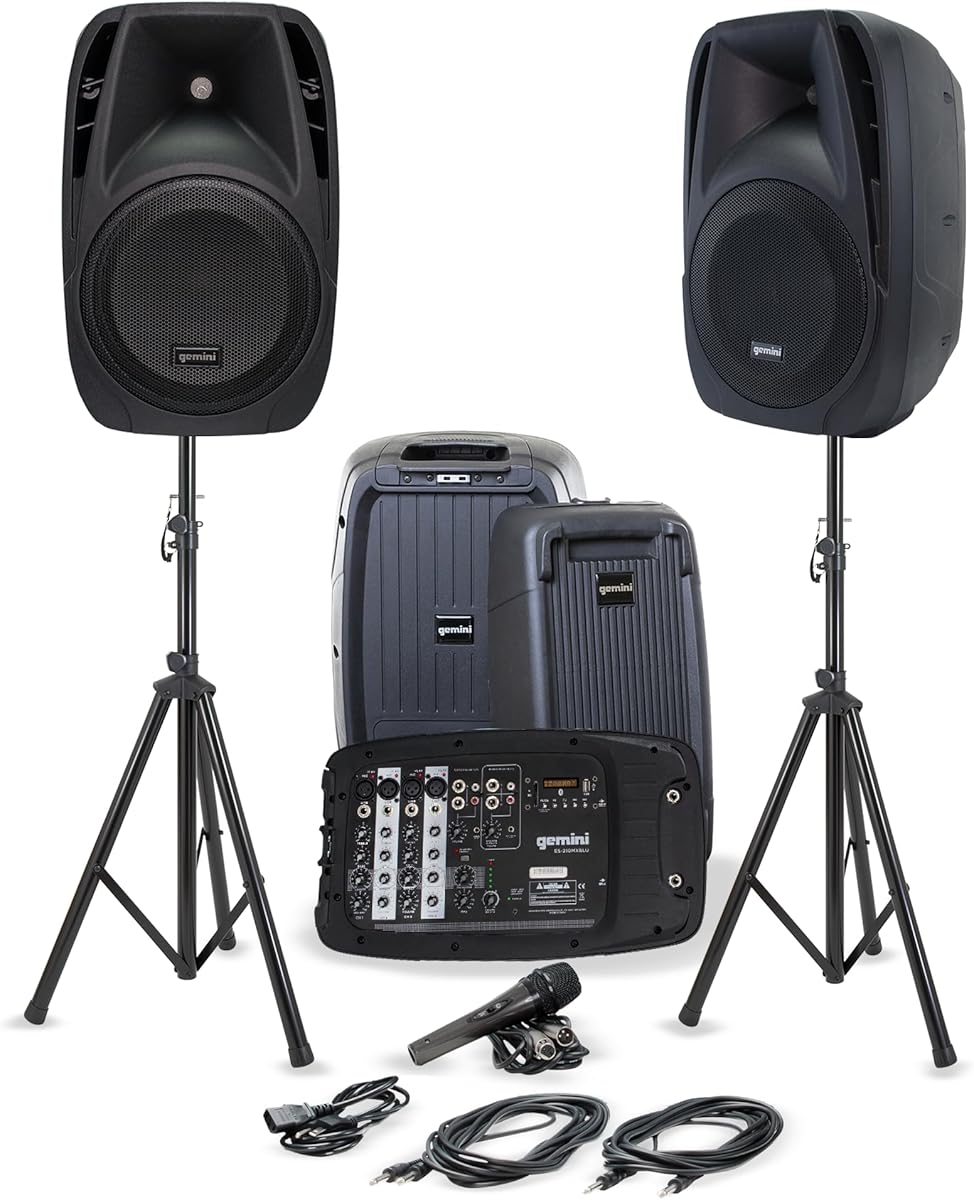
The Gemini ES-210MXBLU-ST is a complete 600-watt portable PA system with two 10-inch passive speakers, a powered six-channel mixer, two adjustable tripod stands, a wired dynamic microphone, and cables. Its supplied rating is 4.2. It targets mobile performers, churches, DJs, schools, karaoke hosts, and bands that want a traditional wired show package already assembled.
We may earn a commission when you buy through this link, at no additional cost to you.
The mixer is particularly noteworthy. Four XLR mic/line channels each offer bass, treble, echo effects, and volume controls, while 48V phantom power supports condenser microphones. A separate stereo auxiliary channel handles RCA and 1/8-inch playback sources, keeping all four performance channels available. Peak-indicator LEDs and a master limiter help maintain a clean, distortion-free mix.
Media playback is unusually flexible. Bluetooth streaming is joined by USB and SD card support for MP3, WAV, and FLAC files, along with built-in FM radio. Monitor outputs and a headphone connection make it possible to check the mix. The complete system weighs 48.5 pounds, so it is less convenient than a compact single-speaker rig even though the cabinets include storage compartments.
For a band seeking a ready-to-use traditional PA, the Gemini bundle removes many early setup decisions. Its four dedicated microphone channels and 10-inch speaker pair are practical for a rehearsal room or moderate event. Performers who need maximum portability or advanced wireless control may prefer a more specialized powered speaker, but this system is comprehensive and transparent about what it includes.
Each of the four XLR channels has individual bass, treble, echo, and volume controls. That level of onboard adjustment makes it easier to shape vocals and instruments directly, while the separate media channel prevents background playback from consuming a performance input.
Bluetooth, USB, SD card, and FM radio support give the system several ways to provide interludes or prerecorded material. A dedicated media-volume control further improves workflow, allowing playback to be adjusted without disturbing the gain structure of the live channels.
We may earn a commission when you buy through this link, at no additional cost to you.
The Fender Passport Venue S2 is a portable, 600-watt PA bundle designed for bands, DJs, presentations, education, meetings, and community events. With a supplied rating of 4.6, it offers one of the most versatile control surfaces in this roundup. Its compact suitcase-style enclosure houses a powered mixer and speakers intended for fast deployment.
We may earn a commission when you buy through this link, at no additional cost to you.
Every mixer channel includes individual volume, bass, treble, and reverb controls, which makes the system practical for balancing vocals, instruments, and playback. Thirteen total inputs include XLR and quarter-inch combo connections, mic/line pad, phantom power, a high-impedance instrument input, and Bluetooth. The instrument input is especially relevant to electric guitarists and other players using pickups, while Bluetooth provides a convenient way to add music between sets.
A dedicated subwoofer output with an automatic high-pass filter allows the system to expand into deeper bass, but users should match any subwoofer carefully to the main system. The package includes two compact speaker stands, a cardioid-pattern microphone, a stand clip, a microphone cable, and an instrument cable. These accessories reduce the need for immediate add-on purchases, though the description's reference to bundling an instrument should be checked carefully against the current package contents.
The Fender package is a compelling choice for a rehearsal-stage band that needs a ready-to-run system with flexible inputs. Its suitcase format, included accessories, and broad mixer control simplify transport and setup. The main reason to consider an alternative would be a need for battery operation, advanced wireless control, or a much lighter individual loudspeaker.
The combination of combo jacks, XLR connections, phantom power, and a dedicated high-impedance instrument input supports a broader range of sources than a basic PA. Bands can connect microphones, acoustic instruments, electric guitars, and playback devices while retaining meaningful control over each channel.
The automatic high-pass filter helps protect the main speakers from low frequencies when a subwoofer is added. This is a valuable feature for bands expanding into dance music, EDM, or other bass-heavy styles, though correct gain and crossover settings remain necessary.
We may earn a commission when you buy through this link, at no additional cost to you.
The JBL EON715 is a 15-inch, two-way multipurpose powered PA speaker with 1300 watts of stated output. Its supplied rating is 4.5. It falls into the same broad category as the Mackie Thrash15v2, but the EON715's defining attribute is its JBL waveguide technology, which is designed to improve directivity and vocal clarity across the coverage area.
We may earn a commission when you buy through this link, at no additional cost to you.
For a band, that controlled dispersion can be useful in venues where uncontrolled highs create problems for performers or nearby audience members. The large 15-inch driver gives the speaker more physical bass capability than compact 8-inch and 12-inch designs, while the powered enclosure eliminates the need for a separate amplifier. Bluetooth integration adds a convenient playback option for breaks, backing tracks, or prerecorded material.
The supplied information is concise and does not detail the full input panel, voicing presets, wireless linking, or included accessories. Buyers should therefore verify the current product page for exact connections and configuration rather than assuming features from a different EON model. The listing also presents a single loudspeaker, not a complete PA bundle with mixer, poles, and microphones.
The EON715 is best suited to performers who prioritize a large driver, high output, and controlled coverage. It may be especially appropriate for rehearsal rooms, small-to-medium venues, and mobile events where a pair of 15-inch cabinets provides substantial physical impact. A complete beginner should budget for the additional components needed to turn this speaker into a working band system.
A waveguide directs sound more deliberately than a basic horn arrangement, helping maintain clarity across the audience area. That behavior can reduce the need for extreme high-frequency cuts, although correct placement and room-specific EQ are still required for consistent results.
Because amplification is built in, the EON715 requires only a line or microphone signal to operate. Its 15-inch format and 1300-watt specification make it a straightforward way for a band to add substantial output without assembling a separate power rack.
We may earn a commission when you buy through this link, at no additional cost to you.
The Bose S1 Pro+ stands apart as a premium, battery-powered all-in-one PA for performers who prioritize mobility. It weighs 14.4 pounds, includes an ergonomic carry handle, and has a supplied rating of 4.6. It is designed for singer-songwriters, mobile musicians, presenters, and bands that need a fast, cable-light setup in places where reliable power may be limited.
We may earn a commission when you buy through this link, at no additional cost to you.
Its integrated three-channel mixer provides two channels for microphones and instruments and one dedicated to music playback. The Bose app gives control over volume, EQ, reverb, and the ToneMatch preset library. The speaker can also work with optional wireless RF transmitters for mic/line and instrument sources, allowing performers to move without cable restrictions, although those transmitters are sold separately.
Positioning is a major strength. The S1 Pro+ can be placed vertically, tilted back, horizontally, or on a standard 35 mm stand. Automatic EQ adjusts to those orientations, reducing the need to reinvent the sound every time the cabinet is moved. Its rechargeable battery can provide up to 11 hours of playtime under the conditions described in the supplied information, with actual performance varying according to content, volume, and temperature.
The Bose S1 Pro+ is ideal for mobile acoustic acts, street performances, pop-up shows, and rehearsal situations where a full mixer and power supply would be burdensome. It is less suitable as a direct substitute for a large, high-output two-speaker stage rig. Even so, it offers one of the most thoughtfully integrated ways to carry, position, configure, and perform with a portable PA.
Built-in battery power removes the need to find a mains connection or run a long extension cable. For a singer-songwriter at an outdoor event or a band playing an unconventional location, that independence can matter more than the maximum output of a larger powered stack.
Automatic EQ adjusts the system when the S1 Pro+ is placed in one of its supported orientations. This makes it easier for a solo performer to move the speaker for audience coverage, floor monitoring, or instrument use without abandoning a repeatable sound.
We may earn a commission when you buy through this link, at no additional cost to you.
The Thump15v4 is best recommended for a band that already understands signal flow and wants strong output with flexible digital setup. It suits singers needing a vocal system, guitarists using pickups, and DJs who want a main speaker with app control. A smaller practice-room setup may be easier to manage, but for energetic performances the larger driver offers the greater headroom.
We may earn a commission when you buy through this link, at no additional cost to you.
Compared with the Thrash15v2, the Thump15v4 emphasizes app-driven control, an expanded DSP workflow, and professional mounting provisions. Its outdoor voicing mode is especially relevant to bands that regularly perform outside. Overall, it is a strong high-output choice for users who value both substantial physical impact and remote system management.
Dedicated modes for outdoor use and floor-monitor duty reflect the practical needs of mobile performers. These presets offer a faster starting point than building each balance from scratch, while still allowing further adjustment where the room and system require it.
Pole mounting and fly points make the cabinet easier to incorporate into a compact stage or elevated deployment. A band using these features should verify safe rigging practices and compatibility with stands, brackets, and venue requirements before suspending or elevating the speaker.
We may earn a commission when you buy through this link, at no additional cost to you.
This 8-inch passive speaker pair offers a compact two-way alternative for performers who already own compatible amplification. It carries a supplied rating of 5.0 and is rated for up to 800 watts of peak power at 8 ohms. Each enclosure combines an 8-inch woofer with a 3-inch tweeter, a format intended to balance clear vocals, bass, and balanced reproduction in small-to-medium gatherings.
We may earn a commission when you buy through this link, at no additional cost to you.
The passive design gives experienced users considerable freedom. Because the speakers require an amplifier or receiver, the same pair can be connected to different amplification systems over time. A home audio setup, stage monitor application, karaoke configuration, or small performance rig can each use the cabinets as the signal chain changes, provided the amplifier's capability is appropriate.
The heavy MDF enclosure is intended to minimize unwanted resonance, while full-copper voice coils and sturdy driver assemblies support consistent performance. Installation options include desk placement, stand mounting, and overhead suspension. However, required cables and mounting accessories must be purchased separately, and users should confirm that their chosen hardware is appropriate for the speaker's weight and setup.
This pair is best for a band or musician who values flexibility and already has an amplifier, or who wants passive cabinets that can remain useful across different audio applications. It is less convenient for a first-time buyer because there is no mixer, amplification, microphone, stand, or connection cable in the package. Its 8-inch drivers are also less forceful than the 15-inch powered models, making room size and genre important considerations.
A passive cabinet can move between rehearsal, rehearsal-room, live, and installed uses as long as the amplifier provides suitable power and the connection method matches. That makes the pair attractive to players who want speaker longevity rather than a sealed all-in-one system.
Separating bass and high-frequency reproduction into an 8-inch woofer and 3-inch tweeter supports clear vocal output while keeping the cabinet manageable. The two-way arrangement also makes these speakers more versatile than a single full-range driver when vocals and instruments both need to be reproduced.
We may earn a commission when you buy through this link, at no additional cost to you.
The right PA depends on room size, musical style, number of performers, transport requirements, and the equipment a band already owns. Paying attention to output, driver size, connections, feedback control, and included components prevents an expensive mismatch between the system and the gig.
A powered speaker includes its own amplification and therefore needs only a line-level or microphone signal to operate. A passive speaker requires a compatible amplifier or receiver, offering greater long-term flexibility but adding another major purchase. A complete bundle includes speakers, a mixer, and often stands, microphones, and cables, making it the simplest choice for a new performer. Bands with an existing mixer may prefer individual powered speakers, while experienced users may choose passive cabinets for maximum routing options.
In short, beginners usually benefit from a bundle, established mobile acts often prefer powered cabinets, and adaptable passive systems suit players who want to control every part of the signal chain.
An 8-inch driver is portable, easy to position, and sufficient for rehearsals, small rooms, and spoken events. A 12-inch model offers a better balance of midrange projection and physical bass for small venues. A 15-inch driver generally produces more impactful low end and can better support energetic music in larger spaces, but it is heavier and requires more effort to transport. Stated peak wattage can also create misleading comparisons because amplifier design, efficiency, and maximum sustained output differ.
Match the physical cabinet to the room rather than choosing solely by the largest power number. For most club-level bands, 12- or 15-inch powered speakers offer a useful balance, while compact 8-inch systems are strongest for rehearsals and smaller audiences.
A four-channel mixer can support several vocalists, an acoustic instrument, and playback, while six or eight channels provide more room for a full ensemble. XLR inputs suit microphones, quarter-inch connections accommodate instruments and line-level sources, and a high-impedance input helps electric guitars and bass instruments. Balanced TRS and RCA connections can simplify playback routing, while dedicated auxiliary media controls keep background music separate from live channels.
Count the actual sources a band will use rather than buying based on the highest possible channel count. Confirm that the mixer offers phantom power, per-channel tone controls, and useful output options for connecting speakers or additional processing.
Bluetooth is valuable for playing recorded music from a phone or computer between sets, but it does not automatically replace a wired microphone connection for live performance. Wireless linking can let two powered speakers play different channels or create a wider stereo image. RF microphone and instrument systems offer greater freedom of movement, while app control can make EQ and system settings easier to adjust from a distance. A band playing an active stage should also consider wireless latency, signal reliability, and battery requirements.
Use Bluetooth for convenient playback and wireless linking when supported, but retain dependable wired connections for the main vocal and instrument paths whenever possible. Treat advanced wireless accessories as part of the signal-chain budget rather than an automatic saving.
Digital signal processing can provide useful starting points for music, speech, monitor use, and outdoor operation. Feedback elimination helps suppress problematic tonal feedback, though it cannot replace correct microphone placement, speaker positioning, or disciplined gain staging. Automatic EQ is particularly useful for battery-powered speakers that can be placed in several orientations. For conventional band systems, a neutral starting point and room-specific adjustments may provide more control than a fixed set of presets.
Look for DSP that simplifies common decisions without removing necessary control. Feedback protection is particularly valuable for vocalists, while application modes can save time during quick setup and teardown.
A PA that sounds appropriate but cannot be moved reliably may fail the practical needs of an active band. Compare cabinet weight, handle design, stand compatibility, storage space, and whether mixer and accessories can be packed into the speaker case. Battery operation can reduce cable clutter, while a compact 8-inch system is easier to load into a small vehicle. Large 15-inch speakers and complete double-speaker bundles frequently require a cart or two-person handling.
Choose the lightest system that still covers the intended room and genre. A slightly heavier speaker with built-in DSP may be less tiring to operate than a smaller one that demands excessive gain or introduces feedback.
Bands playing bass-heavy rock, pop, electronic music, or dance music may need more low-end energy than a full-range PA can provide alone. Look for a dedicated subwoofer output, high-pass filtering, and enough amplifier headroom to operate the sub without overloading the main speakers. Passive systems may be easier to expand with a matching amplifier, while powered systems require a compatible powered sub or an output that can feed one. Expansion is only useful when crossover settings and gain are handled correctly.
Plan the full system before adding a subwoofer. A filtered output and properly matched amplifier produce a more balanced result than an underpowered sub placed too close to the main cabinets.
A complete PA may include a mixer, speaker stands, microphones, instrument cables, speaker cables, and a remote. These accessories save time and prevent compatibility problems, but buyers should verify exactly what is present because bundles can be revised. A microphone kit is useful for vocals, an instrument cable is needed for direct guitar input, and stands are essential for raising speakers above the audience. Separate components offer more choice but require compatible sockets, adequate cable length, and a clear understanding of the routing.
Inventory the setup before ordering. Comparing the complete list of included items is more useful than judging a system by speaker wattage alone, and it can prevent duplicate accessory purchases immediately before a gig.
Begin by placing the speakers where they can cover the audience without pointing directly into a vocal microphone. Raise them on stable stands, connect power and signal cables with the system powered down, and keep microphone and instrument cables separated from mains power where practical. Turn individual gain controls down before switching on the mixer or amplifier, then raise levels in stages while keeping the loudspeaker at a moderate level during initial sound checks.
Use an appropriate voicing preset or set the EQ gradually from neutral or near-neutral starting points. Place microphones behind the speaker's main output axis where possible, maintain reasonable distance from the cabinets, and give vocalists headphones or a separate monitor feed when available. With a complete mixer, assign microphones and instruments to separate channels, apply only the amount of echo or reverb needed, and keep the media channel independent from the live performance mix.
After each show, lower the volume and disconnect power before moving any equipment. Inspect connectors, cable insulation, stands, pole cups, and cabinet surfaces for damage. Store passive speakers and powered cabinets in a dry environment, keep ventilation openings clear, and do not leave rechargeable batteries in a hot or deeply discharged state. Before the next rehearsal, reconnect every source, check levels gradually, and confirm that feedback control, Bluetooth, wireless linking, and subwoofer output still operate as expected.
Two speakers are usually preferable for even audience coverage, consistent level, and a more balanced stereo image. One speaker can work for a small rehearsal, solo performance, or monitor duty, but it may strain to cover a larger room evenly. A complete dual-speaker package can simplify matching, while separate powered speakers provide greater placement and routing flexibility.
A 12-inch powered speaker is often the most practical starting point for a small band because it balances portability, vocal projection, and physical bass. Eight-inch systems are easier to transport and work well in compact rehearsal rooms, while 15-inch models provide more low-end impact for louder venues. Room size, musical style, and transport needs should determine the final choice.
Only when the powered PA provides a suitable line-level or speaker-level output and the impedance and power ratings are compatible. The line output on the NBVOICE system cannot power passive speakers, so its two included cabinets should not be expanded with additional passive units that way. Check both the output type and the manufacturer's guidance before connecting any speaker.
Bluetooth is best suited to convenient playback from a phone, tablet, or computer, often for material between sets. Live vocals and instruments generally benefit from reliable wired XLR or quarter-inch connections, or from a dedicated wireless microphone system designed for the performance environment. Bluetooth can also stream or link some powered speakers when the manufacturer supports those functions.
A subwoofer is not mandatory for every rock band, but it can make bass more impactful in a larger room or on a dance-oriented stage. If one is added, use a proper subwoofer output with a high-pass filter where available, and match its amplifier to the main system. Excessive low end without correct filtering can make the full-range speakers sound thin or unstable.
Start by moving the microphone behind the main output axis of the loudspeaker, keeping it away from the cabinet's front, and using moderate vocal volume. Enable a feedback eliminator if the speaker provides one, then lower gain, reposition the mic, and adjust EQ rather than relying on the processor alone. Feedback control is a safety tool, not a substitute for correct placement and disciplined levels.
Peak power describes a maximum short-term output level, while continuous or sustained output is more relevant to how a speaker performs throughout a set. Comparing only peak wattage can make two products appear more similar than they are, especially when amplifier designs differ. Cabinet size, driver efficiency, thermal limits, and the manufacturer's test methods also influence real-world performance.
A bundle is usually easier for a first-time buyer because it supplies the mixer, stands, microphones, and commonly required cables in a coordinated package. Individual powered speakers offer more control and suit musicians who already own a mixer and accessories. Passive cabinets provide maximum flexibility but also require separate amplification and careful impedance matching.
The strongest overall choice here is the NBVOICE Portable All-in-One PA System for bands that want one coordinated package with a detachable eight-channel mixer, two speakers, stands, a microphone, and wireless playback. The Mackie Thrash15v2 stands out as a budget-focused individual powered speaker, while the Bose S1 Pro+ earns the premium position through battery operation, flexible positioning, app control, and integrated wireless-ready mixing.
Prioritize the factors that affect your actual performances. Match driver size and output to the room, count every microphone and instrument input, confirm feedback controls, and make sure transport weight is realistic for the people who will carry the system. Existing equipment matters too: a mixer can change the ideal choice from a complete bundle to a pair of powered speakers, while a passive pair is most valuable when a compatible amplifier already exists.
Ratings, bundle contents, and technical configurations can change over time, so check the current product listing before ordering. Read the input specifications carefully, verify what accessories are included, and compare the complete system rather than focusing on a single wattage figure. A modest amount of planning helps prevent a speaker purchase that looks suitable in isolation but creates inconvenient setup problems on the night of the gig.